
This reporting is made possible through a collaborative partnership between Grist and WABE, Atlanta’s NPR station.
Executive Overview
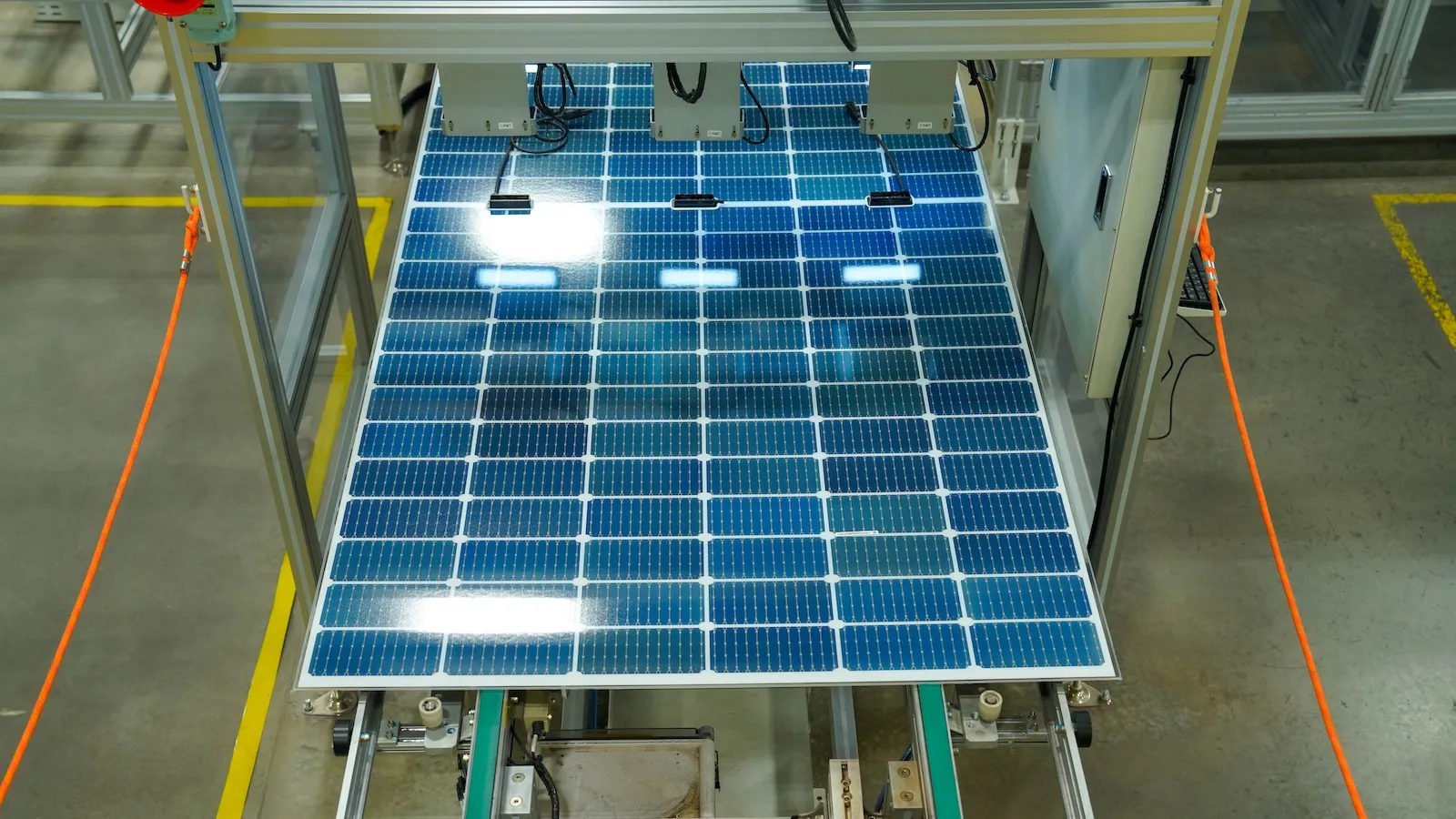
Inside a sprawling, heavily automated manufacturing complex in Cartersville, Georgia, the machinery of a multi-billion-dollar industrial revolution hums relentlessly. Here, at the massive Qcells facility located roughly an hour northwest of Atlanta, delicate, ultra-thin slices of polysilicon are subjected to complex chemical baths, precision laser cutting, and robotic assembly. The ultimate goal of this intricate choreography is the production of solar cells—the fundamental building blocks of modern photovoltaic panels.
Yet, the immense capital expenditure visible on the factory floor—spanning a $2.5-billion investment, millions of gallons of water recycling systems, massive power draws, and football fields’ worth of specialized infrastructure—represents far more than corporate expansion. It is the frontline of a high-stakes national effort to reclaim a domestic solar supply chain that has been dominated by China for well over a decade.
For years, Chinese manufacturing prowess flooded the global market with cheap solar panels, undercutting international competitors and effectively stifling domestic U.S. manufacturing. Today, driven by mounting national security imperatives, concerns over global labor practices, and the race for clean-energy job creation, Washington is aggressively steering the ship back toward home turf.
However, this transition has been plagued by policy whiplash. As the U.S. shifts from the carrot-and-stick incentives of past administrations to new, aggressive trade barriers, tariffs, and tax credit rollbacks under the current administration, the domestic renewable energy sector finds itself caught between long-term manufacturing aspirations and short-term market turbulence. While mega-corporations like Qcells navigate these tectonic shifts with massive capital reserves, developers, smaller firms, and the broader American energy landscape face an uncertain, expensive, and volatile path forward.
Detailed Chronology: The Evolution of U.S. Solar Policy
To understand how the U.S. solar industry arrived at its current crossroads, one must trace a decade-long trajectory of shifting political strategies, international trade disputes, and legislative maneuvers.
The Era of Chinese Dominance (2010s)
Throughout the 2010s, China cemented its grip on the global photovoltaic supply chain. Through aggressive state subsidies, cheap industrial financing, and streamlined manufacturing clusters, Chinese firms captured dominance over every tier of solar production—from polysilicon refining and ingot slicing to wafer production and final panel assembly. Western nations, eager to meet climate goals by adopting cheap solar energy, heavily relied on these low-cost imports, inadvertently hallowing out their own domestic renewable manufacturing ecosystems.
The Carrot Approach: The Inflation Reduction Act (2022)
Recognizing the geopolitical and economic risks of foreign supply chain dependency, the federal government attempted a massive course correction. The passage of the landmark Inflation Reduction Act (IRA) in 2022 deployed a "carrot" approach. It introduced robust manufacturing tax credits (known as 45X credits) and bonus incentives for clean energy projects that utilized domestic materials.
This legislative framework served as an irresistible magnet for foreign green-tech manufacturers. South Korean-owned Qcells seized upon these incentives, announcing massive multi-billion-dollar expansions in Georgia to bring the entire production pipeline—from raw polysilicon to finished panels—under one American roof. By June, the Cartersville plant officially achieved this milestone, marking a historic leap for U.S. manufacturing independence.
The Stick Approach: The One Big Beautiful Bill Act and New Tariffs
The political winds shifted swiftly with subsequent administrations. Eschewing the broad-based subsidies of the IRA, the current administration pivoted toward a "stick" methodology. Under the legislative vehicle colloquially dubbed the "One Big Beautiful Bill Act," lawmakers revoked the majority of the clean energy tax credits established under the previous administration.
Crucially, the legislation also disqualified solar equipment tied to specific foreign adversaries—chiefly China—from accessing the remaining tax credits. To further insulate domestic producers, the administration enacted strict new trade barriers, including looming tariffs and minimum import price floors on polysilicon, the vital raw ingredient for solar cells, scheduled to take full effect in December.
While these punitive trade measures are designed to shield domestic manufacturers like Qcells from foreign undercutting, they have injected profound uncertainty into the broader market. According to energy analysts, the sudden policy reversals have created an environment of whiplash, forcing companies to constantly recalibrate their business models to survive an unpredictable regulatory landscape.
Supporting Context & Metrics: The Balancing Act of Scale and Supply
The friction between macro-level trade policy and micro-level project development is vividly illustrated by hard economic data and industrial metrics.
Capital Flight vs. Scrambled Investments
The dual-track approach of punishing foreign imports while slashing domestic subsidies has triggered seismic shifts in market capital. According to tracking data from the clean energy advocacy group E2, the first quarter of the year saw nearly $13 billion in clean energy investments abandoned across the United States. Projects spanning wind, solar, and battery storage were shelved as developers grappled with soaring costs and regulatory ambiguity.
Conversely, the same quarter witnessed a frantic $18 billion surge in new project announcements. Developers rushed to break ground and lock in financing before the final expiration windows of legacy tax credits slammed shut.
The Polysilicon Bottleneck
At the center of the current industrial debate is polysilicon. As Scott Bell of Qcells demonstrated on the Cartersville factory floor, transforming raw polysilicon into a paper-thin blue solar cell requires an extraordinary concentration of energy, water, and specialized chemical engineering.
[Raw Polysilicon]
       ↓ (Chemical Baths & Laser Slicing)
[Photovoltaic Cells]
       ↓ (Robotic Assembly)
[Assembled Solar Panels]
       ↓ (Deployment to U.S. Grid)
With the new December tariffs and minimum import price controls taking effect, foreign polysilicon will become significantly more expensive. While this protects American producers, industry experts warn that domestic output cannot yet meet the aggregate demand of the entire U.S. solar market. Consequently, developers will likely remain dependent on foreign imports for the foreseeable future, absorbing higher costs that will inevitably trickle down to utility consumers.
Grid Dominance Despite Headwinds
Despite regulatory turbulence and supply chain roadblocks, the fundamental economics of solar energy remain overwhelmingly strong. According to data from the Solar Energy Industries Association (SEIA), solar power and battery storage combined accounted for a staggering 90 percent of all new power generation added to the U.S. electrical grid in the first quarter of the year.
Furthermore, solar energy holds a distinct logistical advantage over competing power sources. While traditional fossil-fuel infrastructure faces severe bottlenecks—such as gas turbines carrying backorders stretching multiple years—solar panels remain comparatively abundant, highly modular, and vastly faster to deploy.
Official Statements and Industry Perspectives
Navigating the transition toward a self-sustaining American solar industry has elicited diverse reactions from clean energy executives, financial analysts, and manufacturing experts.
-
On the Necessity of Full Integration:
"Having the full supply chain is critical," noted Ben Damiani, chief technology officer at Atlanta-based solar developer Cherry Street Energy. However, Damiani did not mince words regarding the challenges of domestic execution, adding, "Probably the biggest hindrance has been the constant change of our own policies."
-
On the Policy Whiplash:
Coco Zhang, a prominent energy researcher at banking and investment firm ING, observed that while the Biden and Trump administrations shared the overarching goal of boosting domestic manufacturing, their conflicting methods caused systemic whiplash. "For other companies with less capital and poorer timing, the supply-side incentives for domestic production may not be enough—especially when the policies could completely change again," Zhang explained. She noted that while closing the IRA loophole for Chinese-owned firms operating inside the U.S. successfully roots out foreign evasion, it simultaneously complicates short-term operations across the entire supply chain.
-
On the Unstoppable Momentum of Photovoltaics:
Despite the immediate hurdles of tariffs, court battles over federal land access, and canceled clean energy funding, industry veterans remain bullish on the technology’s long-term viability. "We absolutely should make solar, right? Like, it is the fastest deployed, lowest cost foreseeable," Damiani emphasized. "Solar will be, for the next hundred years, a good portion of our energy."
Future Outlook: The Road Ahead for American Solar
As the U.S. solar industry looks toward the horizon, the core debate has shifted from whether solar power will dominate the future energy mix to how quickly it will grow, how much it will cost consumers, and where the panels will ultimately be manufactured.
In the long run, optimists like ING’s Coco Zhang believe the domestic manufacturing ecosystem can achieve maturity. The structural elimination of foreign loopholes, combined with massive capital investments already embedded in facilities like the Qcells Cartersville plant, creates a formidable foundation for American energy independence. Companies with deep capital reserves are well-positioned to weather the regulatory storms and emerge as titans of a localized green economy.
However, the short-term outlook remains fraught with friction. Smaller developers face squeezed profit margins, delayed project timelines, and unpredictable compliance costs. The delicate balancing act between erecting protective trade barriers and maintaining an affordable supply of green technology will define the success or failure of U.S. energy policy over the next decade.
Ultimately, the roaring machinery in Cartersville serves as a testament to industrial ambition. Whether the broader American market can successfully keep pace with that ambition—without pricing itself out of a clean energy future—remains the defining question of the modern renewable era.