In contemporary landscape architecture and domestic garden design, the traditional reliance on high-maintenance lawns and bare, chemical-treated soil beds is undergoing a profound paradigm shift. Driven by a combination of climate variability, water conservation mandates, and a growing societal desire for low-maintenance, ecologically rich outdoor spaces, horticulturalists are increasingly turning to strategic ground-cover planting. Far from serving merely as passive "green mulch," modern ground covers are recognized as dynamic, multi-functional botanical systems. They suppress invasive weeds, regulate soil temperature, retain vital soil moisture, prevent erosion on vulnerable slopes, and provide essential habitats and foraging corridors for pollinators.

This comprehensive architectural and horticultural assessment examines 20 elite ground-cover plants. Curated for diverse environmental niches—ranging from baking, arid rockeries to deep, moisture-deprived woodland shades—these selections offer a masterclass in combining aesthetic resilience with functional utility. By understanding the specific biological traits, ideal planting distances, and microclimatic requirements of each species, landscape professionals and domestic gardeners alike can transform problematic, high-upkeep garden zones into self-sustaining ecosystems of enduring beauty.

Detailed Chronology & Typological Evolution of Ground Covers
The evolution of ground-cover usage within Western garden design has progressed through distinct eras, transitioning from formal, labor-intensive carpet bedding to modern, ecologically integrated naturalistic planting schemes.

Phase I: The Structural Foundation (Late Spring to Early Summer Bloomers)
Historically, early-season ground covers were selected primarily for their ability to rapidly establish dominance over bare earth following winter dormancy. Species such as Alchemilla mollis (Lady’s mantle), Brunnera macrophylla (Siberian bugloss), and Convallaria majalis (Lily of the valley) formed the backbone of Victorian and Edwardian woodland gardens. These plants evolved under forest canopies, developing specialized root systems—such as the creeping rhizomes of lilies and the sturdy crowns of bugloss—that allowed them to capture filtered sunlight and spring moisture before overhead deciduous trees fully leafed out.

Phase II: The Arid and Alpine Adaptation (Mid-Summer Resilience)
As suburban plots shrank and urban heat islands expanded through the late 20th century, the demand shifted toward drought-tolerant, sun-loving varieties capable of surviving extreme weather events. Horticultural breeders focused heavily on Mediterranean and alpine natives. Ground-hugging champions like Thymus serpyllum (Creeping thyme), Erigeron karvinskianus (Mexican fleabane), and Iberis sempervirens (Candytuft) emerged as structural solutions for modern urban landscapes, thriving in shallow soils, poor rockeries, and between scorching paving stones.

Phase III: The Contemporary Ecological Matrix (Year-Round Interest)
Today, the standard for ground cover demands multi-seasonal appeal. Modern cultivars are specifically bred not only for ground-hugging density but for transformative seasonal color shifts—such as the copper-tinted autumn foliage of hardy geraniums, the deep burgundy winter tones of Bergenia (Elephant’s ear), and the prolonged, pollinator-friendly blooming cycles of modern shrub roses.

Supporting Context & Botanical Profiles: The Elite 20 Ground Covers
To assist landscape designers in precise spatial planning and environmental matching, the following detailed profiles categorize each of the 20 selected ground-cover species, detailing their botanical classification, optimal spacing, and functional landscape application.

1. Hardy Geraniums (Geranium cultivars, e.g., ‘Rozanne’)
- Botanical Type: Herbaceous perennial
- Planting Distance: 50–90cm apart
- Microclimatic Preference: Sun or dappled shade; adaptable to various soil types.
- Analysis: Indispensable for continuous seasonal color, hardy geraniums form low mounds (typically under knee-high) that bloom continuously from late spring through early autumn. Multi-award-winning cultivars like ‘Rozanne’ (‘Gerwat’) produce dazzling purple-blue flowers from June all the way to November. Beyond their prolific floral display, their foliage often transitions to rich copper tones in autumn, providing exceptional seasonal transition.
2. Japanese Spurge (Pachysandra terminalis)
- Botanical Type: Evergreen perennial
- Planting Distance: 15–30cm apart
- Microclimatic Preference: Shady spots under deciduous trees and shrubs.
- Analysis: A foundational stalwart for difficult, low-light shade gardens. Pachysandra terminalis forms a dense, glossy green carpet of foliage, punctuated by delicate white, whiskery flowers in early summer. While requiring consistent moisture during its initial establishment year, it exhibits remarkable drought tolerance thereafter, making it the premier choice for greening dark, bare earth beneath mature tree canopies.
3. Creeping Thyme (Thymus serpyllum)
- Botanical Type: Evergreen perennial
- Planting Distance: 20–30cm apart
- Microclimatic Preference: Hot, dry, exposed locations with excellent drainage.
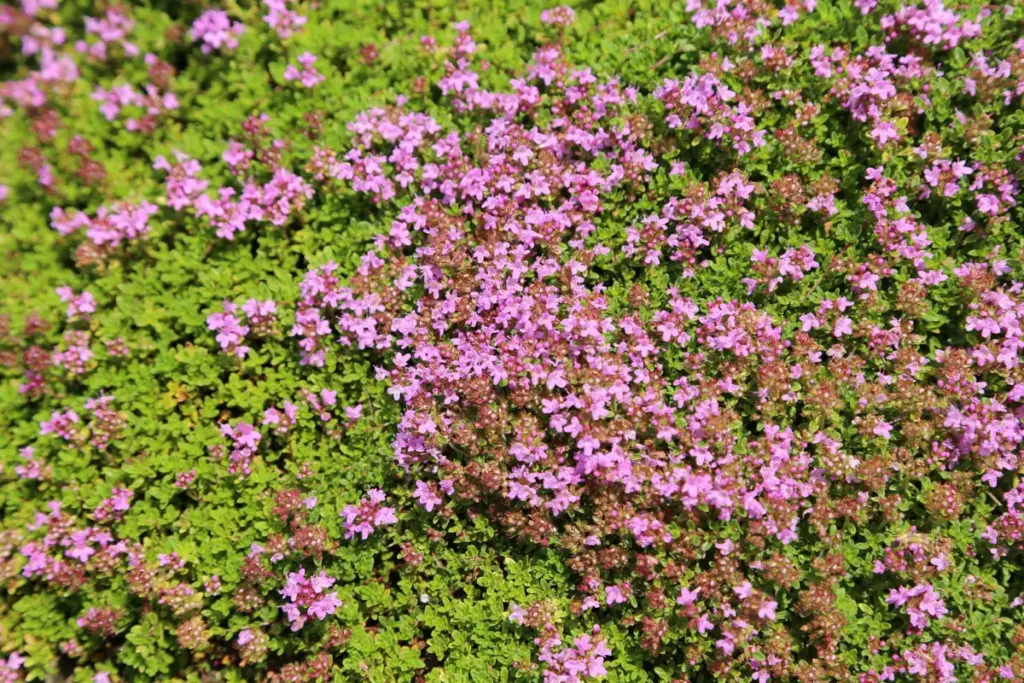
- Analysis: Encompassing various low-growing cultivars, creeping thyme forms aromatic cushions of foliage ranging from silver-grey to variegated green. During summer, they erupt into blankets of white and pink flowers that act as powerful magnets for bees and beneficial insects. Cultivars like ‘Snowdrift’ offer pure white blooms, while ‘Silver Posie’ displays lavender-pink flowers against white-edged, grey-green leaves. They are uniquely suited for rockeries, gravel gardens, and foot-traffic-tolerant crevices between paving stones.
4. Elephant’s Ear (Bergenia)
- Botanical Type: Evergreen perennial
- Planting Distance: 40–50cm apart
- Microclimatic Preference: Full sun to partial shade; highly adaptable.
- Analysis: Famed for their bold, leathery, and glossy evergreen leaves, Bergenia varieties provide striking architectural structure. Cultivars such as ‘Overture’ elevate this appeal by shifting their foliage to a dramatic burgundy hue during winter. In spring, stout architectural spikes of pink or white flowers emerge atop contrasting claret-red stems, making them exceptional choices for framing pathways and establishing bold evergreen edging.
5. Periwinkle (Vinca species)
- Botanical Type: Evergreen sub-shrub
- Planting Distance: 30–60cm apart
- Microclimatic Preference: Full sun to dense shade; highly versatile.
- Analysis: Periwinkles are aggressive, rapid colonizers capable of eradicating bare earth across difficult terrain, including steep, erosion-prone banks. For compact gardens, Vinca minor ‘Ralph Shugert’ offers refined violet flowers set against cream-margined foliage. However, landscape planners must exercise caution with larger species like Vinca major, whose vigorous growth habits require substantial spatial allocation to prevent crowding neighboring flora.
6. Lady’s Mantle (Alchemilla mollis)
- Botanical Type: Herbaceous perennial
- Planting Distance: 40–50cm apart
- Microclimatic Preference: Moist, fertile soils in partial shade or sun.
- Analysis: Beneath its delicate, frothy exterior lies a remarkably tough perennial. Alchemilla mollis features scallop-shaped leaves covered in microscopic hairs that capture morning dew, transforming water droplets into shimmering beads of liquid silver. Throughout summer, it produces sprays of zesty lime-green flowers that retain their visual impact for weeks, requiring virtually no active maintenance once established.
7. Flower Carpet Roses (Rosa FLOWER CARPET series)
- Botanical Type: Shrub
- Planting Distance: 1.0–1.2m apart
- Microclimatic Preference: Open, sunny exposures with well-drained soil.
- Analysis: Challenging the convention that roses require formal, high-maintenance beds, the Flower Carpet series was specifically engineered for low-profile, arching ground cover. Growing to a manageable height of roughly 80cm, these cultivars produce abundant single blooms followed by colorful autumn hips. Options like the white semi-double ‘White’ (‘Noaschnee’) and the fiery red-orange ‘Sunset’ (‘Deseo’) provide vibrant, shrub-based coverage for sunny banks and retaining wall perimeters.
8. Bishop’s Hat (Epimedium)
- Botanical Type: Evergreen/semi-evergreen/herbaceous perennial
- Planting Distance: 40–50cm apart
- Microclimatic Preference: Dappled woodland shade; tolerant of dry shade.
- Analysis: One of the most durable plants for challenging dry-shade environments, Epimedium creates airy, delicate ground cover standing 30–40cm tall. Their heart-shaped, intricately veined leaves frequently display brilliant autumn colors, complemented in spring by dainty, nodding flowers suspended on wiry stems in shades of white, yellow, pink, and orange. The lemon-yellow Epimedium x versicolor ‘Sulphureum’ is particularly noted for conquering difficult dry-shade microclimates.
9. Knotweed (Persicaria affinis ‘Darjeeling Red’)
- Botanical Type: Semi-evergreen perennial
- Planting Distance: 50–60cm apart
- Microclimatic Preference: Full sun to partial shade.
- Analysis: Forming dense, weed-suppressing mats of slim green foliage, this cultivar delivers exceptional seasonal color. From midsummer through autumn, it produces upright brick-red stems crowned with dense bottle-brush plumes of soft pink flowers that gradually mature to a rich, rusty red, offering a naturalistic, highly resilient ground-cover aesthetic.
10. Siberian Waldsteinia (Waldsteinia ternata)
- Botanical Type: Semi-evergreen perennial
- Planting Distance: 50–60cm apart
- Microclimatic Preference: Adaptable to sand or clay; wet or dry soils; shade-tolerant.
- Analysis: A true botanical workhorse, Waldsteinia ternata thrives across vastly different soil conditions without exhibiting invasive tendencies. Its glossy, lobed leaves form a dense carpeting understory, which is illuminated in late spring by cheerful clusters of bright yellow, strawberry-like blossoms. It is the premier choice for underplanting the spreading root zones of mature deciduous trees.
11. Wood Spurge (Euphorbia amygdaloides variants)
- Botanical Type: Evergreen perennial
- Planting Distance: 50–60cm apart
- Microclimatic Preference: Woodland shade, including dry-shade conditions.
- Analysis: Wood spurges impart a distinctly architectural, woodland feel to shaded garden beds. Cultivars like ‘Purpurea’ offer rich beetroot-colored foliage paired with lime-green spring bracts, while Euphorbia amygdaloides var. robbiae stands out for its extreme toughness in dry shade. Safety Advisory: All spurges produce a milky sap that is toxic if ingested and can cause severe skin and eye irritation; protective gloves and eye protection must be worn during handling and pruning.
12. Alpine Strawberry (Fragaria vesca ‘Semperflorens’)
- Botanical Type: Semi-evergreen perennial
- Planting Distance: 40–50cm apart
- Microclimatic Preference: Dappled shade with consistent moisture.
- Analysis: Combining ecological utility with culinary delight, the alpine strawberry produces delicate white flowers and attractive green foliage alongside intensely sweet, aromatic berries that ripen continuously from June to November. While rarely found in commercial agriculture due to their delicate shelf life, they serve as a delectable, low-growing ground cover for woodland edges and shaded garden pathways.
13. Mexican Fleabane (Erigeron karvinskianus)
- Botanical Type: Herbaceous perennial
- Planting Distance: 30–40cm apart
- Microclimatic Preference: Hot, exposed locations with poor, rocky, or sandy soil.
- Analysis: Characterized by masses of dainty daisy-like flowers that open white and age to soft pink, this prolific self-seeder creates a charming, multi-month floral display. Highly drought-tolerant and virtually maintenance-free, it naturally colonizes stone walls, gravel paths, and patio cracks, softening hard architectural lines with effortless grace.
14. Wall Bellflower (Campanula portenschlagiana)
- Botanical Type: Semi-evergreen perennial
- Planting Distance: 40–50cm apart
- Microclimatic Preference: Full sun to light shade in well-drained soil.
- Analysis: Forming vigorous, mounding carpets of foliage, the wall bellflower erupts in summer with an abundance of deep purple, bell-shaped blossoms. Because of its aggressive lateral spread, it should be isolated from delicate, slow-growing alpine plants, making it ideally suited for cascading over retaining walls, populating rockeries, or filling raised garden beds.
15. Candytuft (Iberis sempervirens)
- Botanical Type: Evergreen perennial
- Planting Distance: 50–60cm apart
- Microclimatic Preference: Mediterranean-style conditions featuring light, well-drained soil and full sun.
- Analysis: A classic rockery staple, candytuft features narrow, deep-green evergreen foliage that becomes completely obscured in late spring by dense blankets of scented, pure-white flower clusters. As a Mediterranean native, it demands optimal soil drainage and solar exposure, rewarding the gardener with a magnificent floral show while heavily supporting local pollinator populations.
16. Lungwort (Pulmonaria species, e.g., ‘Ocupol’)
- Botanical Type: Herbaceous/semi-evergreen perennial
- Planting Distance: 40–50cm apart
- Microclimatic Preference: Reliably moist soils in partial shade.
- Analysis: Lungworts are invaluable shade-tolerant perennials distinguished by long, lance-shaped leaves speckled with silver and pale green. In early spring, they produce open trumpet-shaped flowers transitioning through pink and purple hues—such as the serene pale violet of Pulmonaria ‘Ocupol’—providing critical early-season nectar for emerging bumblebees.
17. Lily of the Valley (Convallaria majalis)
- Botanical Type: Herbaceous perennial
- Planting Distance: 20–30cm apart
- Microclimatic Preference: Damp, rich soils under shaded woodland canopies.
- Analysis: Renowned for its spear-shaped leaves, nodding white bell flowers, and legendary sweet fragrance, lily of the valley colonizes damp shaded soils via underground rhizomes known as "pips." Safety Advisory: All parts of the plant are highly toxic to humans and domestic pets if ingested; protective gloves must be worn during division and handling.
18. Ivy-Leaved Cyclamen (Cyclamen hederifolium)
- Botanical Type: Tuberous perennial
- Planting Distance: 10–20cm apart
- Microclimatic Preference: Shaded woodland beds under deciduous trees.
- Analysis: Offering exceptional seasonal longevity, Cyclamen hederifolium displays exquisitely marbled, heart-shaped leaves followed by swept-back, pale pink flowers throughout the autumn months. As tubers mature beneath deciduous tree canopies, they establish dense, self-sustaining carpets that inject vital color into the garden when most other perennials are entering dormancy.
19. Siberian Bugloss (Brunnera macrophylla)
- Botanical Type: Herbaceous perennial
- Planting Distance: 50–60cm apart
- Microclimatic Preference: Full to partial shade in moisture-retentive soils.
- Analysis: In mid-spring, delicate sprays of sky-blue, forget-me-not flowers rise above large, heart-shaped basal leaves. Brunnera macrophylla is a vigorous grower that self-seeds reliably, allowing gardeners to slowly colonize dark, shaded corners with minimal intervention.
20. Common Chamomile (Chamaemelum nobile)
- Botanical Type: Herbaceous perennial
- Planting Distance: 25cm apart
- Microclimatic Preference: Well-drained soil in full sun.
- Analysis: Featuring feathery foliage and white, daisy-like summer flowers, common chamomile is a versatile drought-tolerant ground cover. The compact, non-flowering cultivar ‘Treneague’ can be cultivated as a fragrant, low-maintenance alternative to traditional grass lawns, releasing an intense, uplifting apple fragrance whenever stepped upon or brushed against.
Official Industry Metrics & Spatial Planning Data
To ensure successful landscape implementation, professional designers must calculate plant density based on mature spread rates rather than immediate visual coverage. The following matrix outlines standardized planting densities per square meter based on species-specific spacing recommendations:

| Planting Distance | Approximate Density (Plants per $m^2$) | Representative Species |
|---|---|---|
| 10 – 20 cm | 25 – 100 plants | Cyclamen hederifolium |
| 15 – 30 cm | 11 – 44 plants | Pachysandra terminalis |
| 20 – 30 cm | 11 – 25 plants | Thymus serpyllum, Convallaria majalis |
| 25 cm | 16 plants | Chamaemelum nobile (‘Treneague’) |
| 30 – 40 cm | 6 – 11 plants | Erigeron karvinskianus |
| 40 – 50 cm | 4 – 6 plants | Bergenia, Alchemilla mollis, Epimedium, Pulmonaria, Fragaria vesca, Campanula portenschlagiana |
| 50 – 60 cm | 3 – 4 plants | Geranium (Rozanne), Persicaria affinis, Waldsteinia ternata, Euphorbia amygdaloides, Brunnera macrophylla, Iberis sempervirens |
| 1.0 – 1.2 m | 0.7 – 1 plant | Rosa FLOWER CARPET series |
Future Outlook: The Macro-Environmental Trajectory of Ground Cover Integration
As global climate patterns trend toward warmer summers, intensified precipitation events, and increasingly stringent municipal water restrictions, the future of landscape design will increasingly reject resource-intensive monoculture lawns. Ground-cover plants represent a vital botanical defense mechanism for urban and suburban green spaces.

Future horticultural research will likely focus on breeding sterile, hyper-dense cultivars that maximize weed suppression while minimizing the risk of invasive escape into native ecosystems. Furthermore, the integration of multi-tier ground-cover matrices—interplanting deep-rooted sub-shrubs like Euphorbia with delicate spring ephemerals like Convallaria—will allow landscape architects to construct micro-climates that mimic natural woodland and alpine ecologies. By adopting these resilient, multi-functional species, property owners can secure sustainable, ecologically vibrant, and visually breathtaking landscapes that endure well into the 21st century.