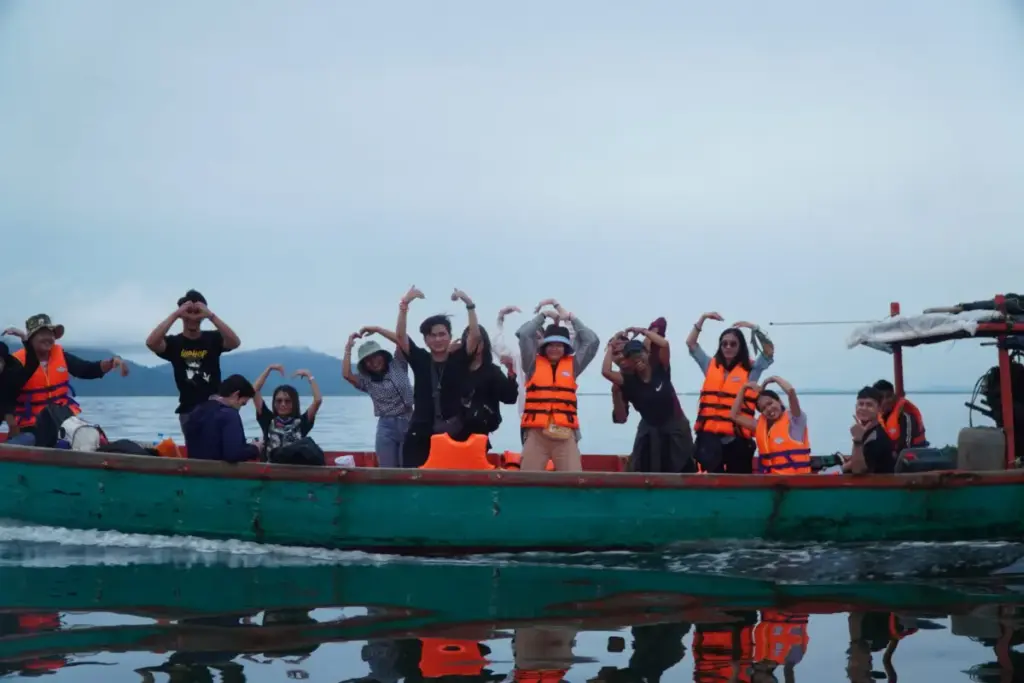
In the sprawling, heavily guarded courtrooms of Phnom Penh, the apparatus of the state has once again signaled its intolerance for ecological advocacy. The Cambodian government has officially rebuffed an urgent appeal from the United Nations, maintaining that the continued incarceration of five prominent environmental defenders is entirely legal and justified.
The activists—members of the internationally acclaimed grassroots organization Mother Nature Cambodia—are currently serving prison sentences ranging from six to eight years. Their crime? Challenging environmental degradation, exposing state-linked corruption, and demanding accountability for the rampant plundering of Cambodia’s natural resources.
The conflict reached a critical diplomatic crossroads following the release of a definitive 16-page legal opinion by the U.N. Working Group on Arbitrary Detention. Published in February, the international body concluded that the imprisonment of Long Kuntha, Ly Chandaravuth, Phuon Keoraksmey, Thun Ratha, and Yim Leanghy violates international human rights laws, lacks any legitimate legal basis, and constitutes a direct, discriminatory assault on fundamental freedoms.
Despite a six-month window provided by the U.N. to rectify these systemic abuses and furnish proof of compliance, Cambodian authorities have dug in their heels. In August, following the expiration of the U.N.’s deadline, Ministry of Foreign Affairs officials made it clear that the activists will remain behind bars. This standoff underscores a broader, deeply entrenched crisis in Southeast Asia: a regime that relies on the systemic silencing of environmental defenders to safeguard a patronage network built on resource extraction.
Detailed Chronology of a Judicial Crackdown
To understand the severity of the current crisis, one must trace the rapid, calculated escalation of legal and extrajudicial maneuvers directed against Mother Nature Cambodia (MNC). Founded as a decentralized collective of young, fiercely dedicated campaigners, the group has spent over a decade documenting and protesting high-profile ecological crimes, ranging from illegal sand mining and massive deforestation to the contamination of vital waterways.
From Grassroots Activism to Criminal Conspiracies
The legal crusade against the group escalated dramatically prior to and during 2024. Long Kuntha (28), Ly Chandaravuth (26), Phuon Keoraksmey (25), Thun Ratha (34), and Yim Leanghy (37)—collectively dubbed the "Mother Nature Five"—were swept up in a sweeping state prosecution that utilized draconian statutes within the Cambodian Criminal Code. Authorities accused the defendants of plotting against the government and committing lese-majesty, utilizing legal clauses critics describe as intentionally vague, overbroad, and weaponized to stifle dissent.
The trial itself was a flashpoint for international criticism. Characterized by human rights monitors as a sham proceeding, the trial spanned a meager five hearings totaling roughly 22 hours. In an egregious breach of fair-trial standards, only half of the defendants were permitted to attend parts of the proceedings. Furthermore, the courtroom doors were slammed shut to the press, the general public, and even the families of the accused.
In mid-2024, the courts handed down severe custodial sentences. As the activists were led away, placards reading "Justice is dead" were held aloft by supporters outside the courthouse—a poignant summary of public sentiment regarding the independence of Cambodia’s judiciary.
The U.N. Intervention and the Broken Deadline
Following their sentencing, international legal teams and human rights organizations petitioned the United Nations for intervention. The U.N. Working Group on Arbitrary Detention took up the mantle, conducting a thorough review of the case.
In its February opinion, the Working Group dismantled the prosecution’s narrative piece by piece. It ruled that:
The arrests possessed no valid legal basis, as the criminal provisions applied by Phnom Penh were so ill-defined as to invite systemic abuse.
The activists were specifically targeted for exercising their rights to freedom of expression and peaceful assembly, making their detention discriminatory.
The trial itself violated fundamental standards of due process, rendering the proceedings null and void from an international human rights perspective.
The U.N. mandated that the Cambodian government take immediate remedial action in accordance with the Universal Declaration of Human Rights and the International Covenant on Civil and Political Rights (ICCPR)—a treaty Cambodia formally ratified in 1992. The state was given six months to provide concrete evidence of compliance.
That deadline passed in August. When contacted by investigative journalists, the Cambodian government did not release the activists. Instead, they offered defiance.
Supporting Context & Metrics: The Price of Environmentalism in Cambodia
The persecution of Mother Nature Cambodia cannot be viewed in a vacuum. It is the operational byproduct of a political economy deeply reliant on the exploitation of land, timber, and minerals.
For nearly four decades, Cambodia was ruled with an iron fist by Prime Minister Hun Sen. His regime maintained power through the strategic distribution of economic concessions to a tight-knit nexus of business tycoons, political elites, and military leaders. Natural resources—forests, fisheries, and real estate—served as the primary currency of this patronage system. Consequently, anyone attempting to protect these ecosystems posed an existential threat to the ruling elite’s financial architecture.
A Legacy of Repression
Mother Nature Cambodia has long been a thorn in the side of this oligarchy. Despite facing relentless harassment, the group’s tenacity earned it global recognition, including the prestigious Right Livelihood Award in 2023 (often referred to as the "Alternative Nobel Prize"). Their investigations have repeatedly exposed:
Widespread Land Grabs: State-sanctioned displacement of rural communities for private mega-developments.
Systemic Corruption: Complicity of high-ranking military and prison officials in industrial-scale illegal logging operations.
Ecological Destruction: The devastating impacts of unregulated sand dredging on marine life and coastal communities, such as their educational initiatives surrounding Koh Kong Krao, Cambodia’s largest island.
The state’s response has historically been ruthless. Founders have been deported and barred from re-entering the country; offices have been raided; and members have faced repeated cycles of arbitrary arrest.
Dynastic Succession and Continuity
In August 2023, Hun Sen orchestrated a dynastic handover of power, passing the premiership to his eldest son, Hun Manet. A U.S.-educated former military chief, Hun Manet was initially framed by some foreign diplomats as a potential reformer who might modernize Cambodia’s governance.
However, the continued imprisonment of the "Mother Nature Five" under his watch has thoroughly shattered those illusions. Under Hun Manet’s administration, the state-sponsored suppression of environmentalism has continued unabated, proving that the machinery of repression remains firmly intact regardless of who sits in the prime minister’s chair.
Official Statements and Institutional Defiance
The official response from Phnom Penh to the U.N.’s damning findings highlights a regime increasingly indifferent to international pressure and diplomatic norms.
Chan Rothona, spokesperson for Cambodia’s Ministry of Foreign Affairs and International Cooperation, dismissed the U.N. Working Group’s conclusions in a written message to researchers.
"I have no comment on [the working group’s] rulings against us as all detentions have been made under legal and judicial proceeding," Rothona wrote.
While Rothona confirmed that the Cambodian government submitted a formal response to the U.N. on August 4—even providing a photograph of the document’s cover page as proof—he flatly refused to share the contents of the document in full. In a display of administrative intransigence, he deflected further inquiries by challenging the legitimacy of international oversight:
"If you were Cambodia, how [would] you proceed [in] this case and how [would] the rule of law […] be[?]"
In a surreal twist, Rothona directed journalists to Article 7 of the 1993 Cambodian Constitution—which stipulates that the King reigns but does not govern and is inviolable—a legal non-sequitur that appeared designed to obfuscate rather than clarify the government’s stance on the arbitrary detention of human rights defenders.
Human Rights Advocates Fight Back
International watchdogs have expressed profound outrage at the government’s dismissive posture. Phil Robertson, director of Asia Human Rights and Labor Advocates, did not mince words regarding the implications of the U.N. ruling.
"This UN decision proves everything the [Mother Nature Cambodia Five] and their lawyers have been saying all along about the political witch-hunt cooked up against them by Hun Sen, Hun Manet and the Cambodian government," Robertson stated.
"Put simply, every aspect of the criminal case and court proceedings against Mother Nature Cambodia was rotten to the core. But the court didn’t care because they had obviously received political orders to ensure a conviction no matter what."
Meanwhile, representatives from the Office of the United Nations High Commissioner for Human Rights (OHCHR) in Cambodia have emphasized that while the international human rights system lacks direct police enforcement powers, accountability mechanisms are grinding forward. Matilda Bogner, OHCHR country representative in Cambodia, affirmed that her office will continue to monitor the situation closely.
"As the Office of the High Commissioner for Human Rights in Cambodia, we continue to seek the release of all individuals who have been found by UN human rights mechanisms to have been arbitrarily detained," Bogner noted.
Future Outlook: A Testing Ground for International Diplomacy
As the dust settles on the expired U.N. deadline, the fate of Long Kuntha, Ly Chandaravuth, Phuon Keoraksmey, Thun Ratha, and Yim Leanghy hangs in the balance. Their bodies remain confined within the walls of Cambodia’s prison system, but their spirit—and the movement they helped build—remains unbowed.
The battleground has now shifted to the realm of high-stakes international diplomacy. Analysts note that the U.N. Working Group’s findings will be formally integrated into the upcoming annual report to the U.N. Human Rights Council, slated for publication.
More immediately, pressure is mounting on the Hun Manet administration from foreign governments, international trade partners, and multilateral organizations. With Phnom Penh scheduled to host the prestigious Francophonie Summit in November 2026, human rights coalitions are renewing calls for targeted diplomatic pressure. Activists hope to leverage the international spotlight of the summit to force the Cambodian government into releasing the environmental defenders before global leaders descend on the capital.
However, whether Phnom Penh will bow to foreign pressure remains an open question. Historically, the ruling Cambodian People’s Party (CPP) has proven adept at weathering international condemnation, often pivoting toward alternative regional allies to insulate itself from Western economic and diplomatic sanctions.
For now, the "Mother Nature Five" serve as powerful symbols of both the escalating perils of ecological defense in the Global South and the indomitable courage of a generation of young Cambodians refusing to let their country’s natural heritage be plundered in silence. As Phil Robertson observed, the ball is now squarely in the court of Hun Manet and the international diplomatic community: will they choose to appease an authoritarian regime, or will they stand firm for the rule of law and the defenders of our planet?