Executive Overview
Along the rugged, mist-shrouded coastline of British Columbia, a quiet ecological revolution is underway. In the pristine waters of Clayoquot Sound, a pioneering collaboration uniting the Tla-o-qui-aht First Nation, the Redd Fish Restoration Society, and West Coast Kelp is challenging the narrative of marine degradation. Launched in early 2026, this ambitious initiative represents a fusion of modern marine science and time-tested Indigenous wisdom, working in tandem to rebuild vital, disappearing kelp forests.
Kelp ecosystems are the marine equivalent of terrestrial old-growth forests. They provide intricate habitats, nurseries, and feeding grounds for a vast array of marine life, sequester massive amounts of carbon, and buffer coastlines against the increasingly violent storms driven by climate change. However, decades of overgrazing by voracious marine populations, compounded by historical disruption and environmental stressors, have hollowed out these underwater canopies.
The new project aims to reverse this tide. By cultivating young bull kelp (Nereocystis luetkeana) and giant kelp (Macrocystis pyrifera) in protected nurseries—safely out of reach of ravenous grazers like sea urchins—the coalition is taking proactive steps to repopulate the seabed. Though the current scope of the restoration is modest, covering roughly 4,200 square meters (about the size of 10 basketball courts), the initiative serves as a crucial proof-of-concept. It demonstrates how contemporary ecological restoration can be guided by Indigenous oral histories and traditional management systems, offering a beacon of hope for coastal ecosystems across the Pacific Northwest.
Detailed Chronology: The Genesis of the Clayoquot Sound Project
The path to restoring Clayoquot Sound’s kelp forests did not begin in a modern marine laboratory; it stretches back millennia through the continuous stewardship of the Tla-o-qui-aht First Nation. Understanding the trajectory of this 2026 initiative requires looking at both the deep historical context and the rapid sequence of events that brought contemporary researchers and Indigenous guardians together.
Pre-Contact Abundance and the Interrupted Balance
For generations prior to European contact, the coastal waters of British Columbia teemed with dense, vibrant kelp forests. These underwater ecosystems were maintained through a complex web of ecological interactions and human stewardship. Indigenous communities practiced a strict ethic of reciprocity—taking only what was needed and actively managing marine resources to ensure long-term sustainability.
In this pre-contact era, apex predators such as sea otters kept herbivorous invertebrates, particularly sea urchins, in check. When sea otters were hunted to near-extinction during the maritime fur trade, the delicate ecological balance shattered. Unchecked by predators, sea urchin populations exploded, chewing through vast underwater forests and creating marine "urchin barrens"—vast underwater deserts where once-thriving kelp canopies had stood.
The Modern Catalyst: Forging the Partnership
Fast-forward to the early 2020s, as mounting evidence of climate change and biodiversity loss brought renewed urgency to marine conservation in British Columbia. Scientists and conservationists realized that passive protection was no longer enough; active, interventionist restoration was required to rescue degraded marine habitats.
In early 2026, this realization crystallized in Clayoquot Sound through the formalization of a three-way partnership. The collaboration brought together:
- The Tla-o-qui-aht First Nation, whose ancestral territory encompasses the project area and whose oral histories provide critical baseline ecological data.
- The Redd Fish Restoration Society, a non-profit organization specializing in watershed and marine habitat restoration on the west coast of Vancouver Island.
- West Coast Kelp, an enterprise contributing specialized aquaculture techniques and operational expertise in kelp cultivation.
Establishing the Nursery and First Outplantings
The initial phase of the project focused on overcoming the primary bottleneck in kelp restoration: juvenile mortality. Young kelp spores and microscopic gametophytes are exceptionally vulnerable to grazing by sea urchins and other herbivores when directly seeded onto the open seabed.
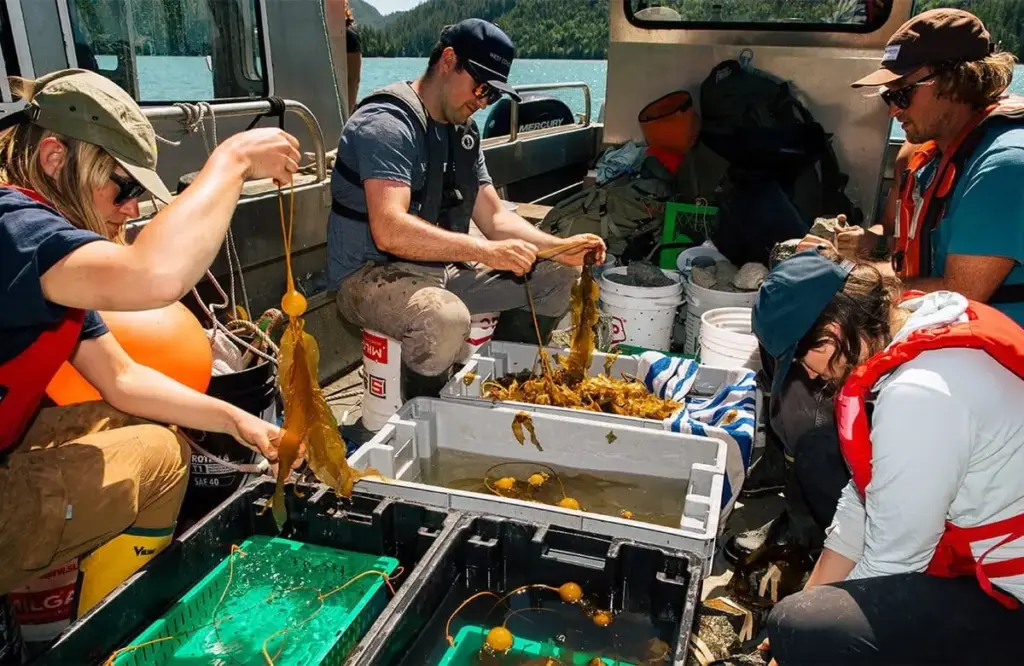
To bypass this hurdle, the team established a specialized onshore and nearshore nursery system. Here, technicians cultivated juvenile bull kelp and giant kelp under controlled conditions, allowing them to grow past their most vulnerable life stages. Once the kelp specimens reached a robust size, project teams—comprising field scientists, technicians, and Tla-o-qui-aht tribal guardians—harvested sections from the nursery lines and systematically transplanted them to carefully selected sites around Clayoquot Sound.
To date, the initiative has successfully rehabilitated approximately 4,200 square meters of marine habitat. While modest in global terms, this footprint represents an intensive, highly monitored pilot phase designed to refine restoration methodologies before scaling up operations.
Supporting Context & Metrics: The Science and Scope of Kelp Restoration
To fully appreciate the significance of the Clayoquot Sound project, one must examine the ecological mechanics of kelp forests, the metrics driving the current restoration effort, and the broader environmental implications for Canada’s Pacific coast.
The Ecological Engine of the Pacific
Kelp forests are among the most productive and dynamic ecosystems on Planet Earth. Fast-growing species like giant kelp can grow up to half a meter a day under optimal conditions, forming towering underwater pillars that reach from the seabed to the ocean surface.
These structural habitats perform multiple critical functions:

- Biodiversity Hotspots: They offer shelter and spawning grounds for hundreds of species of fish, invertebrates, and marine mammals, including commercially and culturally vital species like salmon and herring.
- Carbon Sequestration: Kelp absorbs carbon dioxide at rates that rival terrestrial forests. When kelp fronds break off and sink to the deep ocean floor, they lock away carbon for centuries, making them a potent natural weapon against climate change.
- Coastal Protection: By dampening wave energy, kelp forests mitigate coastal erosion and protect shorelines from the increasing intensity of storm surges driven by global heating.
Quantifying the Clayoquot Sound Intervention
While the ecological value of kelp is well-established, measuring the direct, localized benefits of restoration remains a challenge for modern marine biology. This is precisely what the Clayoquot Sound project sets out to quantify.
| Project Metric / Parameter | Details & Data Points |
|---|---|
| Total Replanted Area | ~4,200 square meters (~45,208 square feet / equivalent to ~10 basketball courts) |
| Target Kelp Species | Bull Kelp (Nereocystis luetkeana) and Giant Kelp (Macrocystis pyrifera) |
| Primary Bottleneck Addressed | Herbivore grazing pressure (mitigated via controlled nursery cultivation) |
| Key Collaborators | Tla-o-qui-aht First Nation, Redd Fish Restoration Society, West Coast Kelp |
| Baseline Integration | Tla-o-qui-aht oral history and traditional ecological knowledge (TEK) |
By tracking biodiversity recovery rates, water quality improvements, and localized carbon capture within the 4,200-square-meter test site, the project team aims to transition kelp restoration from a speculative art into an exact, scalable science.
Official Statements and Perspectives
The success of the Clayoquot Sound initiative hinges not just on technological innovation, but on the bridging of two distinct worldviews: empirical marine science and Indigenous traditional knowledge. Leaders from the project have articulated this philosophy through their public statements.
Emily Fulton, the marine program manager for the Redd Fish Restoration Society, emphasized the need for empirical rigor in a field where anecdotal success is often mistaken for systemic recovery.
"We know that kelp creates habitat, but we don’t have numbers to associate with that, and we want to be able to determine the actual benefit," Fulton explained in an interview with Mongabay. By gathering quantitative data on species returns and structural reef health, Fulton’s team hopes to build a replicable model that can be deployed across other degraded marine zones in British Columbia.
At the heart of the project’s site-selection process is the integration of ancestral wisdom. Tatt Charlie, a tribal guardian of the Tla-o-qui-aht First Nation, highlighted how traditional oral histories have guided modern restoration efforts to historical hotspots that western charts might otherwise overlook.
"My ancestors had a system of reciprocity where they knew not to take too much, and we were always giving back," Charlie noted, reflecting on the philosophy that governed the coastline for millennia. "So, to have that balance is what we’re trying to achieve with our territories. It’s really interesting to see that these are the baby steps we need to take to set it back to pre-contact 300 years ago."
This perspective reframes restoration not merely as an environmental cleanup effort, but as a cultural homecoming—a conscious effort to restore broken relationships between human communities and the marine ecosystems that sustain them.
Future Outlook: Scaling Up and Sustaining the Coastline
As the Clayoquot Sound kelp restoration project moves past its initial outplanting phase, stakeholders are casting their gaze toward the horizon. The challenges ahead are formidable, but the potential rewards for marine conservation are immense.
Overcoming Scaling Challenges
Transitioning from a 4,200-square-meter pilot project to landscape-scale restoration will require overcoming significant financial, logistical, and biological hurdles. Nurseries must be expanded, diving and monitoring teams must be sustained over multi-year cycles, and broader ecosystem pressures—including warming ocean temperatures and marine heatwaves linked to climate change—must be factored into future planting strategies.
Furthermore, managing grazing populations remains an ongoing necessity. Without concurrent management of sea urchin populations—whether through the natural return of sea otters or targeted human intervention—newly planted kelp beds remain vulnerable to devastation.
A Blueprint for Indigenous-Led Conservation
Despite these hurdles, the Clayoquot Sound initiative offers a powerful blueprint for the future of marine conservation in Canada and beyond. By centering Indigenous leadership and braiding traditional ecological knowledge with Western scientific methodologies, projects like this demonstrate that effective environmental stewardship requires more than just technology—it requires cultural alignment and respect for historical relationships with the land and sea.
For now, the offshore nurseries and the newly greening patches of seabed in Clayoquot Sound represent cautious optimism. They are the small, deliberate steps of a community working to heal its waters, offering a vital glimpse into what a restored, resilient coastline might look like for the next three hundred years.