As the global energy landscape accelerates its transition toward deep decarbonization and resilient alternative fuel systems, an enormous volume of renewable energy remains literally burned away into the atmosphere every day. Across thousands of active and closed municipal solid waste landfills worldwide, methane-rich gas is routinely flared—burned off as waste simply because remote locations, prohibitive pipeline interconnection costs, or small gas volumes make traditional renewable natural gas (RNG) recovery projects economically unviable.
Enter Emvolon, an innovative clean-technology firm whose pioneering modular conversion systems are poised to disrupt the waste-to-energy paradigm. By leveraging uniquely repurposed internal combustion engine architectures, Emvolon transforms refined landfill gas and anaerobic digestate biogas from smaller, traditionally overlooked sites directly into high-value, carbon-negative methanol.
Following a successful high-profile pilot project at the Waste Management-operated Atascocita Landfill near Houston, Texas—conducted in collaboration with Montauk Renewables—Emvolon is commercializing its technology. Bolstered by an offtake and logistics partnership with Freepoint, scaling modular hardware deployments, and a shifting geopolitical energy landscape that has drastically amplified global demand for localized liquid fuels, Emvolon is turning previously stranded landfill gas into a lucrative, highly secure asset class.
Detailed Chronology: From Concept to Commercialization
The journey toward transforming stranded landfill gas into high-value maritime and industrial fuel has been marked by strategic technological development, key partnerships, and rapid commercial scaling.
The Genesis of Modular Methane Conversion
Long before the launch of its Texas pilot, Emvolon recognized a structural inefficiency in the renewable energy market. While massive, hyper-productive municipal landfills have seen aggressive capital investment from RNG developers seeking to inject biomethane directly into interstate natural gas grids, thousands of smaller landfills are left behind. These sites produce significant methane volumes—enough to pose environmental compliance and greenhouse gas reduction challenges—yet fall short of the thresholds required to justify the multi-million-dollar capital expenditures associated with traditional pipeline grid tie-ins or large-scale liquefaction plants.
To solve this, Emvolon engineered a proprietary chemical processing system built around repurposed car engines. By using internal combustion technology as a robust, scalable chemical reactor, the company found a way to bridge the economic gap. The system takes purified methane gas and converts it efficiently into methanol (CH₃OH), a versatile liquid chemical and premium fuel that is significantly easier to transport, store, and monetize than gaseous methane.
The Atascocita Landfill Pilot (2024)
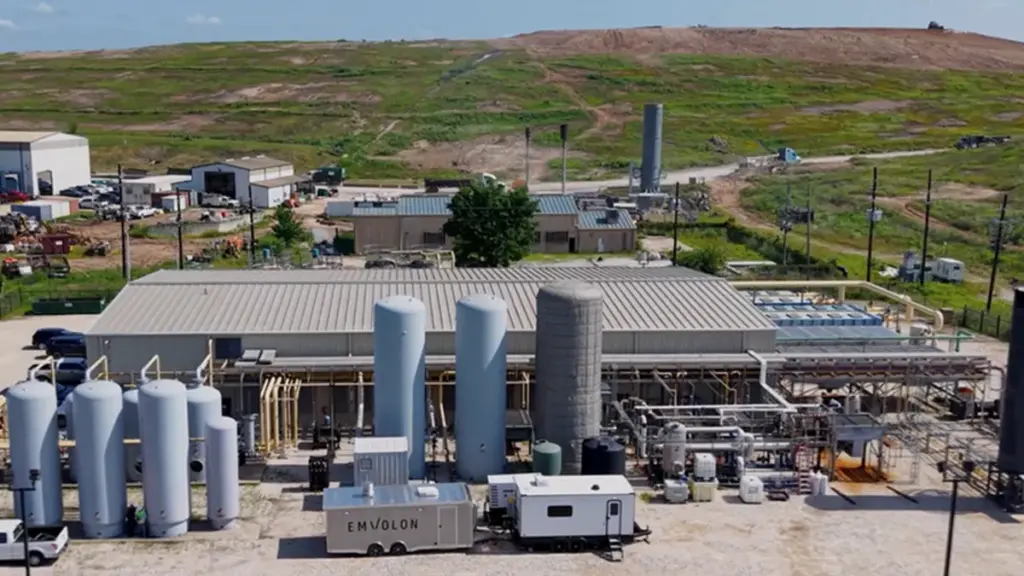
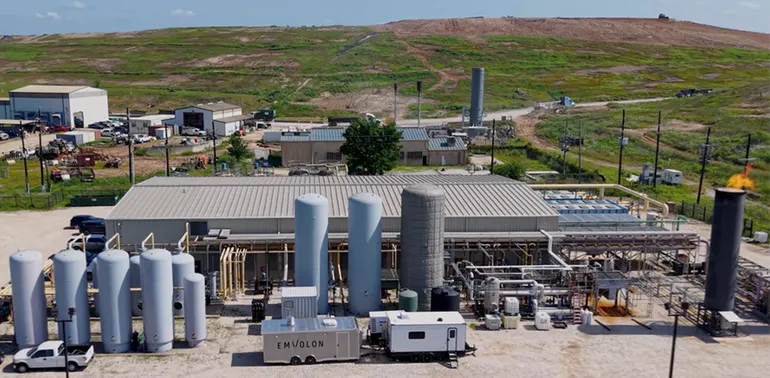
A critical milestone in the company’s trajectory arrived in late 2024, when Emvolon announced a strategic collaboration with Montauk Renewables, Inc. The initiative culminated in a pilot deployment at the massive Atascocita Landfill near Houston, Texas, a facility managed by Waste Management (WM).
During the pilot, Montauk Renewables managed the gas collection and initial purification infrastructure, while Emvolon’s modular unit integrated seamlessly at the site to refine the output into clean methanol. Unlike traditional energy infrastructure projects that require months of complex civil engineering and on-site assembly, Emvolon’s system arrived on-site pre-assembled on transportable skids. According to company leadership, the unit was fully installed and operational within mere days of delivery, proving the viability of its plug-and-play, generator-like design philosophy.
Securing the Commercial Pipeline and Logistics (2025–2026)
With the technical efficacy of the Atascocita pilot validated, Emvolon turned its focus to commercialization, supply chain logistics, and revenue predictability. The company struck a vital partnership with Freepoint, a prominent global commodities merchant. Under the agreement, Freepoint committed to managing the complex logistics of transporting the methanol produced at Emvolon-enabled sites to end-use markets, while also establishing a guaranteed minimum price floor. This financial backstop ensures predictable, robust returns for Emvolon and its project partners irrespective of short-term commodity price swings.
Building upon this framework, Emvolon announced plans to vastly expand its footprint at the Atascocita Landfill, transitioning the successful pilot into a full-scale commercial production facility. Industry estimates project that this expanded commercial site will churn out approximately 4,000 tons of high-grade methanol annually, establishing a blueprint for multi-site rollouts across North America.
Supporting Context & Metrics: The Economics of Stranded Methane
To fully grasp the disruptive market potential of Emvolon’s technology, one must examine the vast scale of untapped methane emissions and the underlying macroeconomics of the alternative fuel sectors.
The Problem with Flaring
Landfill gas is roughly 50% methane and 50% carbon dioxide, with trace amounts of non-methane organic compounds. Methane is a potent greenhouse gas with a global warming potential roughly 28 to 36 times greater than carbon dioxide over a 100-year timescale (and significantly higher over a 20-year horizon). Environmental regulations strictly limit fugitive emissions, forcing landfill operators to either capture the gas or burn it via flares.
In the United States alone, hundreds of billions of cubic feet of landfill gas are flared annually. While flaring destroys the methane by converting it into carbon dioxide, it represents a complete waste of chemical energy.
Methanol is one of the most widely traded chemical commodities in the world, serving as a fundamental building block for plastics, paints, adhesives, and silicones. However, its modern appeal stems from its explosive growth as a clean-burning marine fuel.
With the International Maritime Organization (IMO) tightening carbon intensity regulations, major global container shipping lines—including Maersk and others—have invested heavily in dual-fuel methanol vessels. Traditional fossil-derived methanol does little to help these corporations meet their net-zero targets. Consequently, demand for green, bio-derived, and carbon-negative methanol has skyrocketed.
Because Emvolon’s methanol is synthesized from methane that would otherwise be flared or released into the atmosphere as a waste byproduct, the resulting fuel carries a deeply negative carbon intensity score. This makes it intensely sought after in regulated compliance markets, particularly in Europe, where strict mandates encourage blending advanced biofuels and green chemicals into conventional gasoline and industrial supply chains.
Modular CapEx Efficiency
Traditional energy projects suffer from long development timelines, massive capital outlays, and severe exposure to labor shortages and supply chain bottlenecks. Emvolon circumvents these hurdles through radical modularity.
By building its conversion units on skids—resembling standard industrial generators rather than sprawling chemical refineries—the company achieves:
Lower Capital Expenditures: Significantly reduced civil works, piping, and on-site construction costs.
Rapid Deployment Cycles: Installation times measured in days rather than months or years.
Scalable Co-existence: The ability to profitably service smaller landfills (yielding lower daily gas volumes) that major RNG developers bypass entirely due to uneconomical pipeline tie-in distances.
Official Statements and Industry Insights
The convergence of waste management, modular engineering, and commodity trading has attracted significant attention from industry leaders.
Emmanuel Kasseris, co-founder and chief executive officer of Emvolon, has been vocal about the strategic imperative driving the company’s growth. Reflecting on the vast untapped potential of smaller municipal waste sites, Kasseris emphasizes that the industry has historically suffered from an "all-or-nothing" mentality regarding landfill gas valorization.
"Landfills are a great opportunity," Kasseris notes. "There’s a lot of gas that’s being flared because you cannot do much with it. We’re trying to really build these [systems] as more like a generator, more like an industrial piece of hardware."
Kasseris points out that Emvolon’s technology is explicitly designed not to compete with massive RNG pipeline injection networks, but to unlock value in the underserved long-tail of the market—landfills that are physically isolated from high-pressure pipelines or electric grids.
Furthermore, Kasseris highlights how geopolitical instability and shifting international trade dynamics have fundamentally altered the value proposition of clean energy assets. Emvolon locked in its foundational logistics agreement with Freepoint prior to the escalation of Middle Eastern conflicts that subsequently sent global fuel prices surging. While Emvolon’s chemical conversion process remains economically viable even under low baseline fossil fuel pricing regimes, recent market volatility has underscored a deeper, systemic truth about industrial manufacturing and energy independence.
"I think there’s also a lot of interest in terms of energy security in some of these liquid fuels because of supply chain limitations," Kasseris explains. "It’s not just sustainability. All the pieces of the puzzle are there."
Industry analysts note that by converting a domestic waste liability into a storable, transportable liquid fuel, Emvolon insulates its supply chain from the volatile pipeline capacity constraints and regional price shocks that frequently disrupt conventional natural gas and petrochemical markets.
Future Outlook: Scaling the Waste-to-Fuel Revolution
As Emvolon prepares to scale its operations beyond the Atascocita Landfill expansion, the broader waste and energy sectors are taking close note. The convergence of tightening environmental regulations, corporate net-zero mandates in the maritime sector, and continuous technological refinements in modular gas-to-liquid (GTL) systems positions the company at the vanguard of a multi-billion-dollar market transformation.
Overcoming Infrastructure Hurdles
The path forward is not without challenges. Scaling modular hardware requires robust manufacturing supply chains, rigorous quality control, and ongoing regulatory approval across diverse state and international jurisdictions. Navigating local air quality permits for chemical conversion units sited at municipal landfills demands close cooperation with environmental protection agencies.
However, Emvolon’s strategic alignment with industry heavyweights mitigates these hurdles. By partnering with established waste giants like Waste Management (through the Atascocita site), seasoned renewable energy operators like Montauk Renewables, and global commodity logisticians like Freepoint, Emvolon has constructed a de-risked commercial ecosystem.
The Road Ahead
Over the next decade, the pressure on municipalities and corporate landfill operators to eliminate methane flaring will only intensify. Regulatory bodies in North America and Europe are systematically closing loopholes that permit routine flaring, viewing uncaptured or burned landfill gas as an unacceptable environmental loss.
At the same time, the maritime shipping industry’s demand for green methanol will scale exponentially as shipyards continue delivering methanol-powered container vessels through the late 2020s and into the 2030s. Emvolon’s ability to quickly deploy skid-mounted conversion units to remote, medium-sized, and small landfills positions the company to capture this swelling demand efficiently.
Ultimately, Emvolon is demonstrating that the future of clean energy does not solely reside in massive, multi-billion-dollar gigafactories or sprawling cross-country pipelines. Often, it lies hidden in plain sight—captured from the decomposition of municipal waste, refined through ingenious mechanical engineering, and converted into the high-value liquid fuels that power a modern, resilient global economy.