Executive Overview
The American renewable natural gas (RNG) and biogas sectors are undergoing a structural transformation, balancing legacy infrastructure growth with advanced commercial diversification. As the waste management and energy sectors mature, wastewater treatment facilities (WWTPs) continue to solidify their position as the foundational bedrock of the anaerobic digestion industry. According to a landmark report released in autumn 2026 by the American Biogas Council (ABC), wastewater plants operate an overwhelming 47% of all anaerobic digesters installed across the United States.
Simultaneously, the strategic priorities of the biogas market are shifting. While major waste operators near the completion of their initial, large-scale landfill-gas-to-RNG (LFGTRNG) capital commitments, project developers are increasingly exploring alternative feedstocks, agricultural waste applications, and high-value end uses for biogas. This evolution is underpinned by shifting regulatory credits, fluctuating environmental commodity markets, and dynamic multi-party partnerships among waste haulers, private equity-backed energy developers, and local municipalities.
This report provides an exhaustive, multi-faceted analysis of the state of the North American biogas industry, integrating wastewater infrastructure findings, a detailed chronology of key corporate developments from September 2026, prevailing carbon credit metrics, and a forward-looking perspective on the future of renewable fuels.
Supporting Context & Metrics: Market Drivers and Credit Pricing
The commercial viability of biogas and RNG projects remains deeply intertwined with regulatory compliance markets, federal credit schemes, and state-level clean fuel policies. Developers and project financiers closely monitor price fluctuations across Renewable Identification Numbers (RINs) and carbon credit indices to project long-term internal rates of return (IRRs).
Market metrics compiled by EcoEngineers provide a critical snapshot of the regulatory economic landscape as of early October 2026:
- D3 RIN Prices (Cellulosic Biofuel): Trading at $2.294, down slightly from $2.380 in 2025. Despite the marginal decline, D3 RINs continue to provide robust price support for projects producing pipeline-quality RNG utilized as transportation fuel.
- D5 RIN Prices (Advanced Biofuel): Trading at $2.085, exhibiting a modest increase from $2.060 in 2025.
- Oregon Clean Fuels Program (CFP): Valued at $81 per metric ton of carbon dioxide equivalent ($textMTCO_2texte$), reflecting steady demand for low-carbon intensity fuels within the Pacific Northwest.
- California Low Carbon Fuel Standard (LCFS): Valued at $88 per metric ton of carbon dioxide equivalent ($textMTCO_2texte$). As the gold standard for state-level carbon policies, the California LCFS market remains a vital revenue stack for RNG developers operating within or supplying the Golden State’s heavy-duty transportation corridors.
These commodity valuations directly influence capital expenditure decisions. For instance, companies deploying hundreds of millions of dollars into agricultural waste and landfill recovery systems rely on these predictable, policy-backed revenue streams to service debt and fund aggressive growth pipelines.
Detailed Chronology: Key Industry Developments (September 2026)
The month of September 2026 marked a period of intensive commercial activity, featuring major facility inaugurations, long-term operational expansions, and pivotal strategic partnerships across the United States.
Montauk Renewables Expands Footprint with Swine Waste Facility
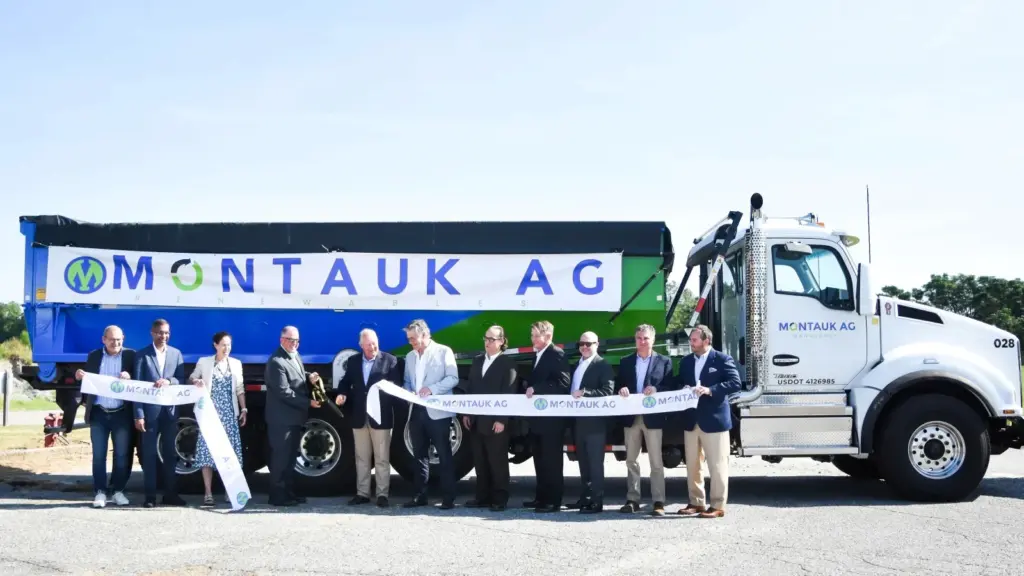
On September 15, 2026, executives from Montauk Renewables, alongside local dignitaries and agricultural leaders, formally celebrated the ribbon-cutting and grand opening of a state-of-the-art anaerobic digestion facility in Turkey, North Carolina. This massive undertaking represents a $200 million capital investment by Montauk aimed at capturing high-methane biogas from agricultural operations—specifically swine waste—to generate utility-scale electricity and high-grade organic fertilizers.
According to statements released by Montauk Renewables CEO Sean McClain, the facility is backed by long-term supply agreements spanning more than 80 independent farming locations in the region. To de-risk the capital investment, Montauk secured a 10-year power purchase agreement (PPA) to sell the electricity generated on-site, alongside a separate contract to commercialize roughly one-third of the renewable energy certificates (RECs) produced to Duke Energy.
Technical disclosures in Montauk’s regulatory filings indicate that the Turkey, North Carolina installation is engineered to produce up to 41 megawatt-hours (MWh) of electric power annually at full operational capacity. Additionally, the facility addresses regional environmental concerns by processing agricultural sludge into roughly 870 tons of organic fertilizer alternatives per year, establishing a circular nutrient economy for local growers.
This agricultural push complements Montauk’s broader financial health. The company closed out the second quarter with revenues surging 19.7% year-over-year to hit $54 million, propelled by stable RNG production metrics that reached 1.5 million million British thermal units (mmBtus), marking a 3% annual volume increase.
Waga Energy Secures LRS Partnership and Advances Casella Joint Ventures
French RNG pioneer Waga Energy, bolstered by majority-stake backing from private equity, dominated September headlines with major milestone announcements concerning landfill gas (LFG) extraction and upgrading infrastructure.
On September 15, Waga announced that Lakeshore Recycling Systems (LRS) had officially selected the developer to design, build, own, and operate a cutting-edge RNG production facility at the Eco-Hill Landfill. Located in Atkinson, Illinois, the Eco-Hill site is uniquely positioned as LRS’s sole owned landfill property, serving critical municipal and commercial waste collection networks throughout the greater Chicago metropolitan area.
The Atkinson project is slated for an initial design capacity of 3,000 standard cubic feet per minute (scfm), with projections indicating an annual output of up to 610,000 mmBtus of pipeline-quality RNG. Under the commercial structure, LRS will retain a direct equity share of the revenues generated from the on-site sale of the upgraded gas. Construction is currently scheduled to culminate with commercial operation by 2028.
Earlier in the month, on September 3, Waga Energy and Casella Waste Systems jointly announced the operational launch of their third collaborative landfill gas project. Situated at Casella’s McKean Landfill in Mount Jewett, Pennsylvania, the facility is designed to process 2,000 scfm of raw landfill gas. Once fully ramped up, the facility will yield up to 407,000 mmBtus of RNG annually.
The overarching strategic partnership between Casella and Waga encompasses a multi-site framework wherein Waga funds 100% of the project capital expenditures while retaining ownership and operational oversight for a 20-year term. Revenue streams from environmental attributes and commodity gas sales are subsequently split between the two firms, offering Casella a low-risk, high-return avenue to monetize fugitive methane emissions.
Opal Fuels Bolsters California Biogas and CNG Infrastructure
Opal Fuels announced a series of crucial operational updates throughout September 2026, reinforcing its dominant footprint in the California renewable fuel and power generation markets.
On September 16, Opal confirmed the official five-year renewal of its operating agreement with the City of San Diego. Under the renewed contract, Opal will continue to manage and operate the landfill-gas-to-energy project located at the city’s Miramar Landfill. Operating continuously since 1998, the Miramar installation generates approximately 400,000 MWh of reliable electricity annually, serving local grid demands while actively mitigating potent greenhouse gas emissions.
This municipal renewal followed on the heels of an August-into-September expansion of Opal’s downstream transportation infrastructure. Opal announced the completion of a major capacity upgrade at its compressed natural gas (CNG) fueling station in Goshen, California. Following extensive engineering modifications, the station added 1.7 million gasoline gallon equivalent (GGE) units of expanded dispensing capacity, fully integrated with locally sourced RNG.
Opal acquired the Goshen facility in 2025 as part of an aggressive vertical integration strategy. During the first half of 2026, the company deployed $52.7 million across its broader capital project portfolio. Financial disclosures from Opal’s Q2 reporting cycle indicated a 4% year-over-year increase in quarterly revenue, even as first-half revenues experienced a marginal 5% dip due to market recalibrations. Meanwhile, total RNG production for the first six months of the year hit 2.4 million mmBtus, representing a robust 6% volume expansion over the corresponding period in 2025.
Official Statements: Industry Perspectives on Wastewater and Growth
The release of the American Biogas Council’s 2026 wastewater report has sparked renewed dialogue regarding the unrealized potential resting within municipal utility networks across the United States.
Wastewater treatment plants were the absolute pioneers of anaerobic digestion technology, utilizing closed-vessel biological decomposition to stabilize municipal sewage sludge long before commercial energy markets recognized the value of methane capture. Today, they remain the undisputed market leaders, operating nearly half of the nation’s total active digester fleet.
According to the ABC report, 29 new wastewater digestion facilities have successfully commenced operations across the United States since 2020, pushing the total count of operational municipal plants with digesters to 1,213. Industry analysts consider any wastewater facility with an average daily flow rate of 1 million gallons per day (MGD) to be an ideal operational candidate for anaerobic digestion. However, current market penetration remains low relative to the addressable market: the ABC report reveals that only about 24% of qualifying U.S. wastewater plants currently operate anaerobic digesters.
The remaining 76% of eligible facilities represent a massive, largely untapped reservoir for future biogas deployment. Patrick Serfass, Executive Director of the American Biogas Council, emphasized these strategic expansion avenues in an official statement accompanying the report release:
"Our survey shows there are opportunities to do more — by expanding anaerobic digestion where it makes sense and getting more value from the digesters already in place."
Serfass’s assessment highlights a dual-pronged industry strategy: constructing greenfield digesters at unserved municipal facilities while simultaneously retrofitting legacy infrastructure to capture higher economic value.
Future Outlook: The Next Frontier for Biogas and RNG
As the North American biogas sector looks toward the remainder of the decade, the nature of project engineering is undergoing a definitive evolution. Historically, wastewater digesters were designed primarily for internal plant heat and power generation, or simply for volume reduction and pathogen destruction of sewage sludge.
However, market forces are shifting these operational paradigms. Since 2018, a rapidly escalating percentage of wastewater and agricultural digesters have integrated advanced gas-upgrading modules to convert raw biogas directly into pipeline-compatible RNG. Others are adopting combined heat and power (CHP) configurations or engaging in "codigestion"—the practice of introducing high-strength organic waste (such as commercial food waste, fats, oils, and grease) into municipal wastewater digesters to exponentially increase methane yields and tipping-fee revenues.
Unlocking Stranded Potential
The quantitative upside of this structural shift is substantial. Currently, wastewater digesters across the U.S. capture in excess of 100 billion cubic feet of biogas annually. Yet, empirical modeling by the American Biogas Council demonstrates that if the remaining eligible wastewater plants were to adopt anaerobic digestion, the sector could capture an additional 70 billion cubic feet of biogas per year.
This potential expansion arrives at a pivotal juncture for the broader waste and energy industries. Some of the nation’s largest publicly traded waste management firms are rapidly approaching the terminal completion dates of their initial, highly publicized landfill-gas-to-RNG capital commitments. As these primary landfill assets are fully optimized, project developers, private equity firms, and utility companies are actively pivoting toward decentralized feedstocks—including agricultural manure lagoons, smaller municipal wastewater plants, and complex industrial organic waste streams.
Conclusion
The convergence of supportive state-level clean fuel standards, resilient federal RIN valuations, and maturing engineering partnerships is propelling the biogas industry into an era of professionalization and technical sophistication. Whether through Montauk Renewables’ $200 million agricultural investment in North Carolina, Waga Energy’s sophisticated landfill gas extraction joint ventures with LRS and Casella, or Opal Fuels’ ongoing municipal infrastructure stewardship in California, the sector is proving its capacity to deliver essential decarbonization services.
Ultimately, bridging the gap between the 24% adoption rate currently observed in qualifying municipal wastewater plants and the total addressable market will define the trajectory of the North American renewable energy landscape for the next decade. By capturing wasted methane, producing organic agricultural inputs, and supplying low-carbon transportation fuels, the biogas industry is cementing its status as an indispensable pillar of the modern circular economy.