This is the first article in Mongabay’s three-part investigation of spekboom-led ecosystem restoration in South Africa. It is part of an award-winning collaboration between independent science writer Leonie Joubert, the Stellenbosch University School for Climate Studies, and the Henry Nxumalo Foundation, which supports investigative journalism in Africa.
Executive Overview
In the semi-arid expanses of South Africa’s Eastern Cape province, a quiet ecological revolution is underway, fueled by a humble succulent known locally as the spekboom (Portulacaria afra). Translated literally from Afrikaans as the "bacon tree"—a moniker earned because its plump, juicy leaves are to livestock what ice cream is to a toddler—this unassuming plant has become the focal point of a massive, high-stakes environmental gamble. Generations of intensive livestock farming, predominantly driven by mohair-producing Angora goats, have stripped roughly 90% of the Albany thicket biome. What was once a dense, impenetrable subtropical thicket has been degraded into desert-like barrens, where baked soils regularly surpass 60°C (140°F) in summer and torrential rains wash away precious topsoil rather than nourishing it.
Today, however, the landscape is attracting a different kind of harvester. No longer just a forage plant for hungry goats, the spekboom is being hailed as a miracle carbon-scrubber. As the global economy assigns a tangible financial value to atmospheric carbon—ranging from $20 to $45 per metric ton of CO₂ removed—corporate giants, international developers, and financial institutions like the World Bank are pouring tens of millions of dollars into large-scale restoration projects.
This article investigates the transition of spekboom restoration from a small, artisanal agricultural fix into an industrial-scale financial asset class. While the injection of millions of dollars offers unprecedented hope for repairing a moribund farming economy and healing millions of acres of degraded land, it also introduces profound risks. Ecologists warn that overly optimistic carbon-capture projections could jeopardize the entire sector if reality falls short of corporate models, threatening investor confidence and leaving local communities holding empty promises.

Detailed Chronology: From Farm Utility to Global Carbon Asset
The story of modern spekboom cultivation does not begin in a corporate boardroom or a high-tech laboratory; it starts out of localized necessity in the mid-1970s.
1976: The Humble Beginnings
On what is now the Krompoort farm, located about an hour’s drive inland from the port city of Gqeberha, a commercial mohair farmer faced a persistent nuisance: mud kept flooding his barn due to severe soil erosion on an uphill slope. To anchor the earth, he planted a line of spekboom cuttings.
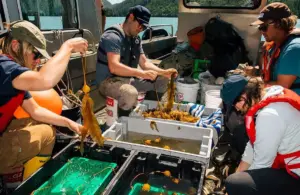
Over the next half-century, those initial plantings evolved into a dense, pointillist hedge standing taller than a person. Where the lower branches dipped and touched the earth, they spontaneously rooted, carpeting the soil beneath them. This site, now owned by the restoration initiative Return to Thicket, has quietly become the holy grail of thicket restoration research. General Manager and environmental policy graduate Nick Hamp-Adams notes that researchers have used this historical plot for decades to experiment with different planting densities and methods, creating a living laboratory of ecosystem recovery.
The Two-Decade Scientific Evolution
For years, the restoration of the Albany thicket remained an artisanal pursuit—small-scale, underfunded, and driven largely by passionate botanists and local landowners. A turning point occurred in 2006, when a landmark scientific study conducted at sites like Krompoort published a striking figure: recovering thickets led by spekboom had the potential to sequester an average of 15.4 metric tons of CO₂ equivalent (tCO₂e) per hectare per year.

While this figure was intended as an initial baseline derived from optimal conditions with good soil and high rainfall, it served as the foundational bedrock for building a commercial business case. Over the ensuing two decades, as global carbon markets matured, this number was adjusted and debated. Yet, it successfully caught the attention of carbon market developers looking for viable, nature-based solutions to offset corporate emissions.
2022–Present: The Industrial Leap
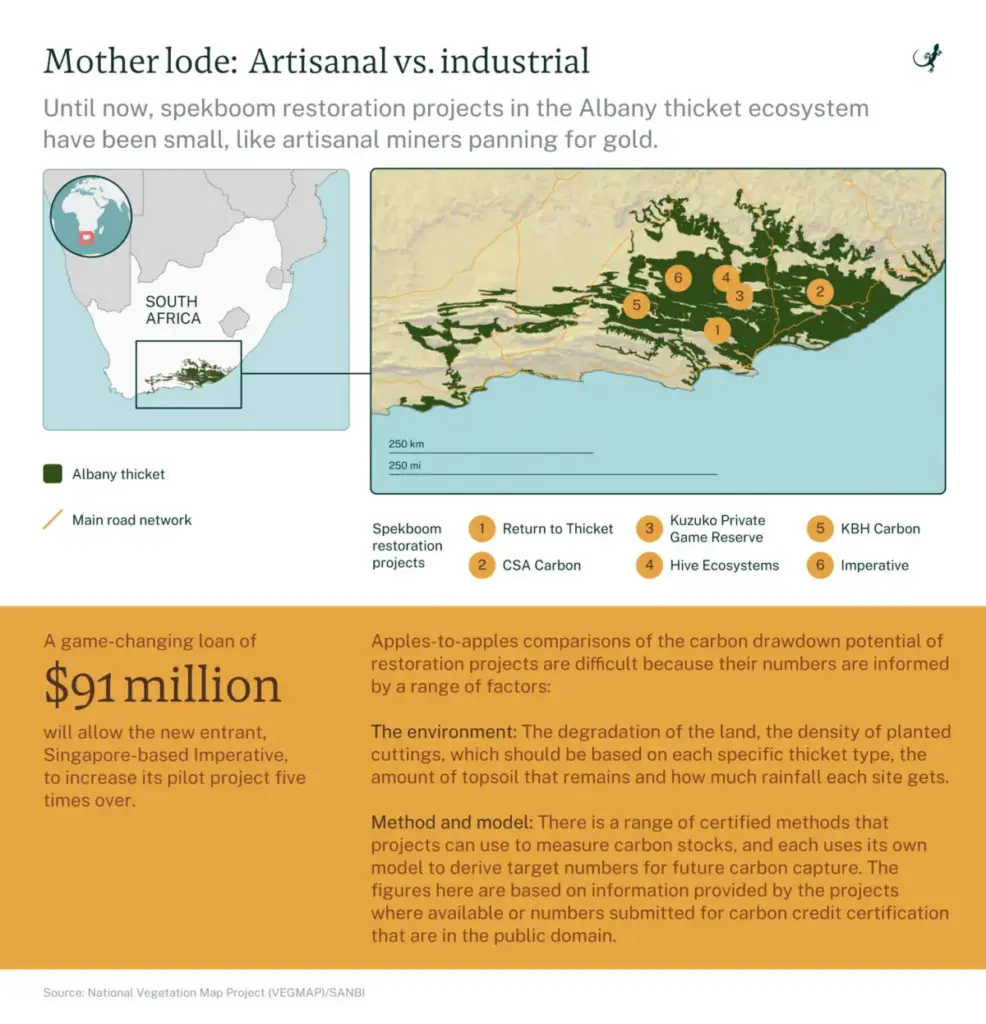
The scale of spekboom restoration shifted dramatically with the entry of international corporate players equipped with deep pockets from the Global North. Singapore-based Imperative Global Solutions Pte. Ltd.—an infrastructure developer focused on building ecosystems rather than concrete dams—entered the scene.
In a landmark financial maneuver, Imperative secured $91 million in blended financing. This package included a $25 million outcome-based bond issued by the World Bank (appropriately named in spekboom’s honor) and $66 million from elite private investors. Furthermore, tech giant Amazon stepped in to derisk the project by agreeing to purchase nearly 10% of the projected 20.8 million carbon credits expected from the upcoming plantings. Imperative is now scaling up its operations to restore 100,000 hectares (247,000 acres) of spekboom over the next four to five years, marking a definitive shift from small-scale conservation to industrial-grade carbon farming.
Supporting Context & Metrics: The Ecology and Economics of Spekboom
To understand why international financiers are willing to gamble tens of millions of dollars on a succulent plant, one must examine the unique ecological mechanisms of Portulacaria afra and the stark economic realities of the Eastern Cape.

The Ecological "Magic" of the Plant
Spekboom is a master of survival in arid environments. Botanist Alastair Potts of Nelson Mandela University explains that degraded, bare ground bakes under the African sun, turning soil into a concrete-like crust that repels seeds and water.
Spekboom counteracts this through its unique growth habit. As the bushes mature, they develop a dense "skirt" of low-hanging branches and fleshy leaves. This canopy creates a micro-climate beneath the plant:
- Temperature Regulation: It shields the soil from the blistering 60°C summer heat.
- Raindrop Mitigation: It breaks the jackhammer-like impact of heavy raindrops, preventing further soil compaction and erosion.
- Nurse Environment: The organic matter accumulating beneath the skirt creates fertile, moist conditions where seeds of other indigenous thicket species can finally take root.
Without spekboom acting as an ecological "skin graft," much of the 1.5 million hectares (3.7 million acres) of damaged Albany thicket cannot recover on its own.
+-------------------------------------------------------------------------+
                    THE SPEKBOOM RESTORATION CYCLE
+-------------------------------------------------------------------------+
 1. Degradation  --> 90% of Albany thicket stripped by mohair goat farming.
 2. Intervention --> Manual, one-cutting-at-a-time planting of Spekboom.
 3. Canopy Effect--> Low-hanging skirts shield soil from heat & heavy rain.
 4. Soil Healing --> Micro-climate restores moisture and organic soil structure.
 5. Biodiversity --> Native seeds germinate, reviving the wider ecosystem.
 6. Carbon Yield --> CO2 drawn into plant biomass and soil, funding the cycle.
+-------------------------------------------------------------------------+
Diverging Business Models: Artisanal vs. Industrial
The contrast between historical restoration efforts and current corporate projects highlights a profound tension within the sector:

| Metric / Parameter | Artisanal / Small-Scale Projects | Industrial-Scale Projects (e.g., Imperative Global) |
|---|---|---|
| Footprint Target | Typically under 5,500 hectares (14,000 acres) | Up to 100,000 hectares (247,000 acres) over 4–5 years |
| Financing Structure | Grants, local partnerships, small private investments | Blended finance ($91M), World Bank bonds, corporate offtake (Amazon) |
| Projected Carbon Yield | 4.6 to 8.5 tCO₂e / hectare / year | An ambitious average of 10.4 tCO₂e / hectare / year over 40 years |
| Primary Motivation | Local biodiversity revival and watershed protection | Large-scale corporate carbon offsetting and ecosystem infrastructure |
Official Statements and Expert Perspectives
The rapid commercialization of ecological restoration has elicited a complex mix of optimism and anxiety among scientists, policy experts, and project developers.
Nick Hamp-Adams of Return to Thicket views the influx of heavy financiers as a validation of decades of grassroots work, noting:
"Wooing such hefty financiers shows growing faith in a business model for ecosystem repair that’s been in the works for roughly two decades."
However, this enthusiasm is tempered by caution. Many veteran thicket ecologists worry that the carbon-capture numbers cited in corporate business models may be overly optimistic. While the original 2006 study suggested a sequestration rate of 15.4 tCO₂e per hectare per year, prominent scientists have repeatedly cautioned that this figure was recorded under optimal conditions with high rainfall and superior soil quality—parameters that cannot be generalized across the entire, drought-prone biome.

Tiaan Burger, project director at Imperative Global, defends their operational modeling, noting that their targets reflect scaled efficiencies and rigorous long-term projections averaging 10.4 tCO₂e per hectare annually over a 40-year horizon.
Despite these assurances, independent ecologists remain wary. They point out that if carbon yields fail to match today’s aggressive model projections, it could trigger a crisis of confidence. Should investors experience capital flight due to lower-than-expected returns, the financial apparatus supporting the restoration could collapse—delivering a devastating blow to a regional farming economy that relies on these projects as a lifeline.
Future Outlook: High Stakes for South Africa’s Thicket Economy
The future of the Albany thicket hangs in a delicate balance. On one hand, the mass planting of spekboom represents a vital, perhaps indispensable, emergency treatment for a landscape on life support. If successful, these projects will not only pull millions of tons of carbon dioxide from the atmosphere but also restore regional watersheds, revive native wildlife populations, and pave the way for sustainable, low-density livestock grazing.
On the other hand, the stakes could not be higher. If the industrialization of carbon farming outpaces the underlying science, the consequences will ripple far beyond corporate balance sheets. Local farmers, whose lands have been rendered sterile by generations of overgrazing, cannot afford a speculative bubble burst. If carbon markets abandon spekboom restoration due to unmet yield promises, these rural communities will lose their only remaining agricultural yield: the invisible, yet immensely valuable, tons of atmospheric carbon locked safely within the soil and stems of the resilient bacon tree.
Cite this Article
- APA Style: Joubert, L. (2026). South Africa’s new gold rush: Big money, high stakes in emerging spekboom restoration sector. Mongabay Conservation News. DOI: 10.66709/news-327564