Executive Overview
The artificial intelligence revolution is running headfirst into a physical bottleneck: the power grid. As generative AI models grow exponentially in scale, parameter counts, and complexity, the data centers housing them demand unprecedented amounts of electricity. This surging consumption threatens corporate greenhouse gas (GHG) reduction targets, drives utilities to consider building new fossil-fuel infrastructure, and places immense pressure on technology manufacturers to innovate beyond traditional silicon scaling.
Amid this high-stakes backdrop, Advanced Micro Devices (AMD) has outlined an aggressive roadmap to transform the energy landscape of AI computing infrastructure. According to a corporate blog post and its newly released 2025–2026 corporate responsibility report, AMD projects that by 2030, just two of its next-generation server racks will perform computational tasks that would have required 570 standard server racks in 2024.
This ambitious trajectory translates to a 20-fold reduction in electricity consumption and a 28-fold decrease in carbon intensity for rack-scale AI workloads over a six-year period. By focusing on holistic, rack-scale optimization—encompassing compute silicon, memory, interconnects, software, and advanced cooling—AMD is attempting to redefine what is possible in data center efficiency.
Yet, as the company races to outpace historical industry averages and rival market leaders like NVIDIA, questions remain. Environmental advocates, investors, and energy analysts point out that hardware efficiency gains alone do not automatically curb absolute emissions if the sheer volume of deployed computing hardware continues to skyrocket. This comprehensive report investigates AMD’s technological strategy, its race against NVIDIA, the broader implications for corporate climate goals, and the lingering transparency challenges facing the semiconductor industry.
Detailed Chronology: The Evolution of AMD’s Efficiency Roadmap
To understand how AMD arrived at its current 2030 targets, it is necessary to examine the chronological evolution of the company’s product development, strategic pivots, and corporate disclosures over recent years.
The Foundation and Market Ascent (2022–2024)
Over the past two years, AMD transitioned from a challenger in the AI hardware space to a primary market leader for high-performance computing infrastructure. The company’s financial growth has been explosive: second-quarter sales surged by more than 50 percent to reach $11.5 billion, with data center products alone accounting for an impressive 58 percent of that total.
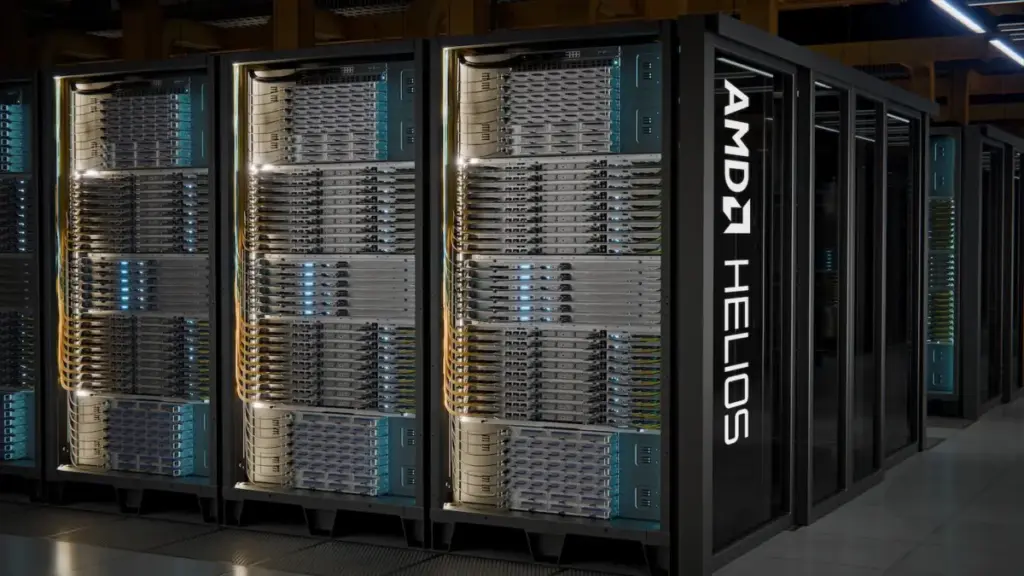
A cornerstone of this market penetration has been AMD’s strategic bet on integrated systems, notably its Helios rack architecture. Adopted by hyperscale technology giants and AI pioneers including Meta, Microsoft, OpenAI, and Oracle, Helios is deployed for training massive large-scale foundational models and delivering rapid, low-latency prompt responses.
However, as the deployment of Helios and similar clusters accelerated, so did the scrutiny surrounding their operational footprints. Recognizing that data center operators were facing severe power constraints, AMD leadership began institutionalizing energy-per-watt metrics across every engineering team, tying progress directly to company-wide performance bonuses.
The 2025 Milestones: Climate Transition Plans and Transparency
In 2025, prompted in part by sustained shareholder advocacy from groups like Green Century, AMD published its inaugural climate transition plan. This document established formal milestones for addressing the company’s indirect and direct environmental impacts.
Crucially, AMD’s internal audits revealed that approximately 85 percent of its total greenhouse gas emissions stemmed from the downstream use of its sold data center products. Consequently, the company determined that its most significant environmental leverage point was not merely optimizing office energy use or reducing direct manufacturing waste, but fundamentally engineering greater energy efficiency into every generation of its microprocessors and server racks.
The August 2025 Disclosures: A Leap Ahead of Schedule
On August 18, AMD released its 2025–2026 corporate responsibility report alongside a dedicated technical blog post outlining major progress in rack-scale AI energy efficiency. The company revealed that through a prioritization of co-optimization, it had already delivered a fourfold increase in energy efficiency between the 2024 baseline and 2026.
Building on this momentum, senior executives formally codified the 2030 target: a 20-fold increase in rack-scale efficiency for AI training and inference compared to 2024—a pace three times faster than historical industry averages. Furthermore, AMD updated its supply chain and operational targets, demonstrating measurable reductions across multiple emissions scopes and cementing its positioning as a transparent steward of sustainable high-performance computing.
Supporting Context & Metrics: Decoding the Numbers
Evaluating the environmental claims of semiconductor giants requires a rigorous look at the underlying metrics, calculation boundaries, and supply chain realities.
The Mechanics of Rack-Scale Efficiency
Achieving a 20-fold efficiency gain cannot be accomplished through silicon manufacturing improvements alone. According to Sam Naffziger, senior vice president and corporate fellow at AMD, the next wave of AI efficiency depends on tighter co-optimization across five distinct vectors:
- Compute Silicon: Designing denser, more power-aware graphics processing units (GPUs) and central processing units (CPUs).
- Memory: Integrating high-bandwidth memory (HBM) architectures that minimize the energy required to move data between logic and storage.
- Interconnects: Reducing latency and power dissipation across high-speed node-to-node communication fabrics.
- Software: Enhancing compiler efficiency and workload scheduling to maximize hardware utilization and minimize idle power draw.
- Rack-Scale System Design: Incorporating advanced thermal management, including rack-level liquid cooling technologies.
AMD’s efficiency calculations explicitly account for the impact of these rack-level cooling technologies. However, independent analysts note important boundaries in these calculations. Jonathan Koomey, an expert researcher on data center energy and water consumption, points out that AMD’s metrics do not include the wider electricity or water required to remove heat from the broader facility housing the data center. Despite these exclusions, Koomey praises the rigor of the disclosures. "AMD is being very transparent about what it will take, and it is known for being rigorous," Koomey remarked. "The systems-level view is very appropriate."
Scope 1, 2, and 3 Emissions Breakdown
To contextualize AMD’s product-use emissions, one must examine the corporate carbon accounting framework divided into three distinct scopes:
- Scope 1 (Direct Emissions): Generated by direct operations, such as facility heating and fleet vehicles.
- Scope 2 (Indirect Emissions from Purchased Energy): Associated with the electricity, steam, heating, and cooling purchased by the company.
- Scope 3 (Value Chain Emissions): Encompasses all other indirect emissions up and down the corporate value chain, including upstream manufacturing by third-party partners and downstream emissions from customer use of sold products.
Both AMD and its chief rival, NVIDIA, operate on a "fabless" business model—meaning they design the advanced semiconductors but outsource physical fabrication to specialized manufacturing partners like Taiwan Semiconductor Manufacturing Company (TSMC). This structure places manufacturing squarely within the Scope 3 category.
- AMD’s Progress: AMD has achieved a 30 percent reduction in combined Scope 1 and Scope 2 emissions relative to its baseline. In its supply chain, the company aims to cut the carbon intensity of its manufacturing partners by 25 percent between 2024 and 2030, having already realized an 8 percent reduction. Crucially, as of 2025, AMD successfully persuaded 100 percent of its manufacturing suppliers to establish formal greenhouse gas emissions reduction targets. Total estimated Scope 3 emissions for AMD dipped slightly by 2 percent between financial cycles, resting at 24.1 million metric tons of carbon dioxide equivalent (mt of CO2e), with the vast majority—85 percent—driven by downstream product usage.
- NVIDIA’s Metrics: NVIDIA presents a contrasting trajectory in its sustainability reporting. While the company reported a cumulative reduction of roughly 80 percent in market-based Scope 1 and Scope 2 emissions since 2024 (despite a brief 13 percent single-year uptick between 2025 and 2026), its Scope 3 emissions tell a different story. NVIDIA’s Scope 3 footprint surged by approximately 54 percent between fiscal years 2025 and 2026, reaching 10.7 million mt of CO2e. Notably, this figure omits emissions related to the downstream use of NVIDIA products—a notable gap that has drawn intense criticism from institutional investors.
The Competitive Landscape: AMD vs. NVIDIA
The battle for AI infrastructure supremacy is inextricably linked to marketing energy efficiency to enterprise clients. Corporations under pressure to meet strict net-zero commitments are increasingly scrutinizing the power demands of their AI vendors.
- AMD’s Pitch: AMD leans heavily on its systems-level trajectory, promising a 20-fold rack efficiency boost by 2030 and emphasizing that every engineering team has binding efficiency-per-watt targets tied to corporate compensation.
- NVIDIA’s Pitch: NVIDIA anchors its sustainability narrative around per-PetaFLOP metrics. Its most explicit pledge is to reduce emissions intensity from product use by 75 percent per PetaFLOP (one quadrillion floating-point operations per second) by fiscal year 2030. In its mid-June sustainability report, NVIDIA highlighted that its latest "Vera Rubin" product generation delivers a remarkable 10-fold improvement in energy efficiency compared to the preceding "Blackwell" architecture. However, NVIDIA declined to comment on the record for this article regarding broader supply chain transparency demands.
Official Statements and Industry Perspectives
The tension between technological innovation and environmental stewardship has drawn sharp commentary from corporate leaders, independent analysts, and shareholder advocates.
Inside AMD: Executive Leadership Speaks
Emphasizing the cultural integration of sustainability within AMD, Chief Sustainability Officer Justin Murrill underscored that hardware optimization remains the company’s primary environmental lever.
"Our biggest impact and opportunity is the energy efficiency of our products," Justin Murrill, AMD Chief Sustainability Officer, told industry analysts.
Murrill explained that sustainability is not treated as a peripheral corporate social responsibility checkbox at AMD. Instead, operationalizing efficiency is enforced from the top down: every engineering team is assigned strict efficiency-per-watt performance thresholds for upcoming product generations, and meeting these targets is directly tied to the company-wide employee bonus structure.
Amplifying this technical vision, Sam Naffziger detailed the multi-layered engineering philosophy driving the hardware roadmap:
"The next wave of AI efficiency will depend on tighter co-optimization across compute silicon, memory, interconnects, software and rack-scale system design," noted Sam Naffziger, Senior Vice President and Corporate Fellow at AMD.
External Analysis: Rigor vs. Realism
Independent validation of AMD’s methodology underscores the complexity of measuring data center impacts. Jonathan Koomey praised AMD for establishing clear, verifiable system boundaries:
"AMD is being very transparent about what it will take, and it is known for being rigorous," said Jonathan Koomey, data center energy and water research analyst. "The systems-level view is very appropriate."
However, financial and environmental watchdogs urge caution, reminding markets that efficiency gains do not automatically equal absolute carbon reductions in an expanding market. Giovanna Eichner, a shareholder advocate at Green Century—an investment firm utilizing environmental, social, and governance (ESG) criteria—stressed the necessity of absolute transparency:
"Energy efficiency doesn’t always translate to emissions reduction if you’re continuing to crank out products at a higher rate, and so that’s why transparency is really important," stated Giovanna Eichner, Shareholder Advocate at Green Century. "They have an energy efficiency commitment, which is great. But that’s not telling us the full story."
Eichner’s concerns highlight why Green Century, alongside Mercy Investment Services, filed shareholder resolutions requesting comprehensive downstream emissions disclosures from competitors like NVIDIA. While NVIDIA’s resolution secured 18 percent support, the ongoing advocacy reflects a broader investor push for standardized, economy-wide carbon accounting across the semiconductor sector.
Future Outlook: The Road to 2030 and Beyond
As the technology sector looks toward the end of the decade, the race to build sustainable AI infrastructure will define market winners and losers. The convergence of grid constraints, regulatory pressures, and skyrocketing computational demands means that energy efficiency is no longer merely a marketing differentiator—it is an existential requirement for data center scalability.
Technological Frontiers
Looking forward, AMD’s roadmap assumes continuous breakthroughs in chiplet architectures, advanced packaging, and photonics. By shifting from traditional air cooling to advanced rack-scale liquid cooling and optimizing software stacks to eliminate computational redundancy, the industry hopes to bend the energy curve downward. If AMD successfully hits its 2030 milestone—reducing the required server footprint from 570 racks down to just two for equivalent workloads—it will alleviate immense pressure on regional power grids and natural gas utilities currently scrambling to feed data center expansions.
Corporate Accountability and Governance
Nevertheless, technological prowess must be matched by unyielding corporate transparency. The divergence between AMD—which published a formal climate transition plan, engages with activist shareholders, and tracks downstream product emissions—and peers who omit key usage metrics highlights a growing fault line in corporate governance.
For enterprise buyers, cloud service providers, and institutional investors, the future of artificial intelligence cannot be built on efficiency metrics alone. It requires a holistic commitment to absolute emissions reduction, transparent supply chain management, and verifiable renewable energy integration. As AMD presses forward with its aggressive 2030 roadmap, the entire technology ecosystem will be watching to see whether engineering innovation can successfully outpace the insatiable energy appetite of the artificial intelligence age.