Executive Overview
In the semi-arid expanse of northern Tanzania, where the Great Rift Valley cuts a dramatic scar across the East African landscape, an ecological and cultural renaissance is quietly taking root. For generations, the Indigenous Datooga and Hadza communities have roamed these ancient acacia woodlands and sweeping savannahs. The Hadza, one of the last remaining hunter-gatherer societies on the African continent, and the Datooga, traditionally pastoralists and skilled pastoral-metallurgists, have maintained a harmonious, symbiotic relationship with their environment for millennia.
However, entering the 21st century, this delicate balance faced unprecedented threats. Rapid agricultural encroachment, illegal logging, and climate-induced pressures brought the ecosystem—and the traditional ways of life it sustains—to the brink of collapse.
Enter the Yaeda-Eyasi carbon offset project, a pioneering conservation initiative spearheaded by Carbon Tanzania in partnership with local communities and supported by international conservation bodies like the Sustainable Travel International Climate Impact Portfolio. By monetizing the ecosystem services of the standing forests through the global voluntary carbon market, the project has flipped the traditional conservation paradigm on its head. Instead of top-down, exclusionary "fortress conservation" models that historically displaced Indigenous populations, the Yaeda-Eyasi project empowers the Datooga and Hadza as the ultimate arbiters and beneficiaries of their ancestral lands.
Through verifiable carbon credits generated by avoided deforestation, the project injects crucial capital directly into community-led forest management. Locally appointed rangers patrol the boundaries, deterring land grabbers and poachers. Meanwhile, steady revenues fund vital socioeconomic infrastructure—ranging from schools and healthcare clinics to veterinary services for livestock.
As global debates intensify over the efficacy and ethics of carbon offsetting, the Yaeda-Eyasi landscape stands as a powerful empirical case study. It demonstrates that when Indigenous land rights are legally secured and integrated with market-based climate finance, carbon offsets can deliver profound, measurable benefits for both biodiversity preservation and human development. This report provides an in-depth examination of the project’s mechanics, chronological evolution, economic metrics, leadership perspectives, and future outlook.
Detailed Chronology: From Vulnerability to Community-Led Resilience
To fully understand the current success of the Yaeda-Eyasi project, one must examine the historical trajectory of land tenure rights and environmental degradation in northern Tanzania, as well as the deliberate steps taken to reverse these trends.
The Pre-Project Era (Prior to 2010): Encroachment and Marginalization
For decades, the Hadza and Datooga faced systemic marginalization. Despite holding ancestral claims to the Yaeda Valley and the surrounds of Lake Eyasi, their customary land rights lacked formal legal recognition. Consequently:
- Agricultural Expansion: Outsiders frequently encroached upon the valley, clearing ancient acacia forests to establish maize farms. This not only fragmented wildlife corridors but also stripped the Hadza of their foraging grounds and the Datooga of dry-season grazing pastures.
- Charcoal Production: Commercial syndicates targeted the slow-growing, highly resilient indigenous hardwoods for charcoal production, rapidly depleting forest cover.
- Cultural Erosion: As natural resources dwindled, the Hadza were increasingly restricted in their ability to hunt and gather, threatening the transmission of generational knowledge and cultural identity.
Phase One: Securing Land Tenure and Establishing the Baseline (2010–2013)
Conservationists realized that no carbon project could succeed without first solving the underlying tenure insecurity.
- Customary Rights of Occupancy: Working alongside organizations like the Ujamaa Community Resource Team (UCRT) and Carbon Tanzania, local communities successfully navigated the complex legal pathways of Tanzanian land law to secure Certificates of Customary Rights of Occupancy (CCROs). This gave the Hadza and Datooga formal, legally binding ownership over their ancestral lands.
- Baseline Mapping: Scientists and project developers established comprehensive carbon baselines, quantifying the carbon stored within the acacia-commiphora woodlands and calculating the projected emissions that would occur under "business-as-usual" deforestation scenarios.
Phase Two: Operationalizing the Carbon Offset Mechanism (2013–2018)
With land secure, the institutional framework for the carbon project was formally established.
- Verified Carbon Standard (VCS) Certification: The project sought and achieved rigorous international validation, ensuring that every ton of carbon dioxide prevented from entering the atmosphere translated into a verified carbon credit.
- Community Governance Structures: Local community trusts were established to manage incoming funds transparently. These bodies ensured that financial disbursements reflected democratic consensus rather than elite capture.
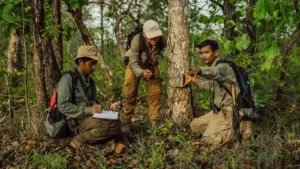
- Deployment of Local Rangers: Community members were recruited, trained, and employed as forest monitors and rangers, utilizing traditional tracking skills combined with modern GPS technology to patrol boundaries.
Phase Three: Scaling, Diversification, and Maturation (2018–Present)
In recent years, the project has expanded its geographical scope and deepened its socioeconomic impact.
- Integration into Global Portfolios: Partnerships with organizations such as Sustainable Travel International channeled consistent funding from conscious travelers, corporations, and individuals seeking high-integrity carbon offsets.
- Diversification of Livelihoods: Beyond forestry, the project has stimulated ancillary economies, most notably sustainable wild honey harvesting, which provides a lucrative, forest-friendly income stream.
- Infrastructure Expansion: Carbon revenues transitioned from basic operational budgets to funding permanent brick-and-mortar investments, including primary schools, dispensaries, and water points.
Supporting Context & Metrics: The Mechanics of Ecological and Economic Impact
The success of the Yaeda-Eyasi project cannot be measured by narrative alone; it is underpinned by rigorous ecological metrics, financial transparency, and tangible socioeconomic indicators.
Ecological Recovery and Carbon Metrics
The primary objective of the project is the mitigation of climate change through avoided deforestation and forest degradation (REDD+).
- Hectares Under Protection: The project encompasses tens of thousands of hectares of threatened acacia-commiphora woodland, serving as an essential carbon sink in East Africa’s dryland ecosystems.
- Emissions Reductions: By halting illegal land clearance, commercial logging, and uncontrolled wildfires, the project successfully prevents hundreds of thousands of tons of $textCO_2$ equivalent from entering the atmosphere annually.
- Biodiversity Co-Benefits: The stabilization of the forest canopy has led to a noticeable resurgence in wildlife populations. Species such as the leopard, striped hyena, African wild dog, and numerous migratory bird species have stabilized their ranges within the valley. Furthermore, native flora—including wild fruits essential for Hadza nutrition—are regenerating naturally.
The Economic Model: From Trees to Community Development
Carbon finance operates as a direct payment-for-ecosystem-services (PES) mechanism. Corporations and individuals purchase credits to offset their unavoidable emissions. The capital generated is distributed according to a strict benefit-sharing agreement:
- Operational Costs: A portion covers monitoring, reporting, verification (MRV), and project management.
- Community Payments: The vast majority of net revenues go directly to the community trusts.
- Transparent Allocation: General assemblies vote on how funds are utilized. Investments are categorized into three main pillars:
- Direct Household Benefits: Direct cash dividends or employment stipends for community rangers and committee members.
- Public Infrastructure: Construction and maintenance of schools, teacher housing, and medical dispensaries.
- Natural Resource Management: Funding for boundary marking, anti-poaching patrols, and wildfire management equipment.
Livelihoods and Nutritional Security
For the Hadza, the forest is a complete supermarket and pharmacy. The preservation of the ecosystem ensures uninterrupted access to tubers, berries, medicinal plants, and wild game (within sustainable traditional frameworks). For the Datooga, protected woodlands mean reliable dry-season grazing for cattle, goats, and sheep, insulating pastoralists from the catastrophic livestock losses typically associated with overgrazing and land degradation.
Additionally, the project has catalyzed sustainable enterprise development. Community-harvested wild honey from the Yaeda Valley is now marketed under ethical trade standards, commanding premium prices in regional and international markets. This provides households with liquid capital that does not depend on destroying the environment.
Voices from the Ground: Official Statements and Perspectives
To understand the human heart of the project, one must listen to those whose lives are directly shaped by its existence. The intersection of Indigenous sovereignty, modern economics, and grassroots conservation is best articulated by the project managers and community members on the front lines.
The Indigenous Perspective: Guardianship as Identity
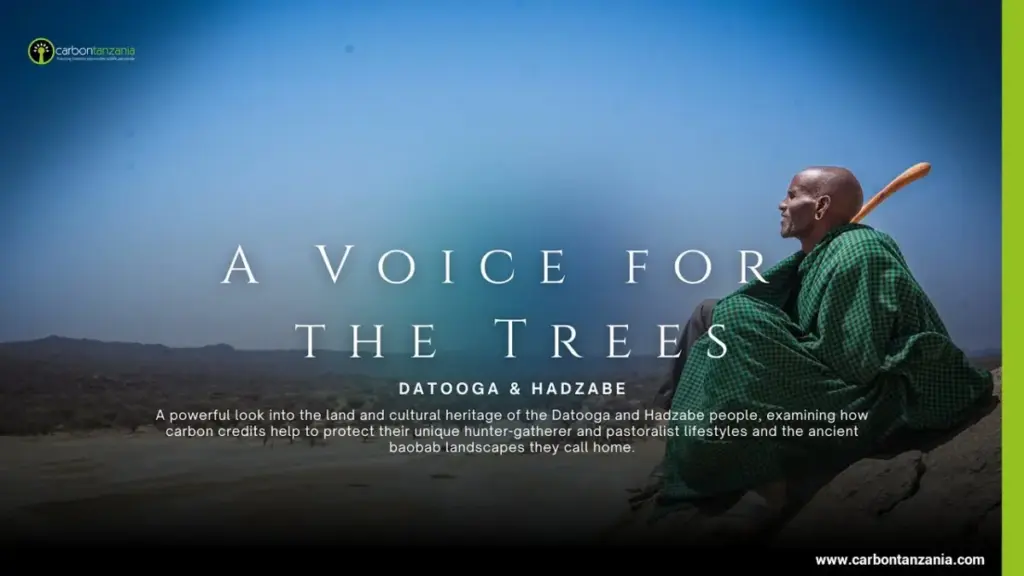
In the video documentation produced by Carbon Tanzania, members of the Datooga and Hadza communities articulate a profound, ontological connection to their environment. As one community elder poignantly noted:
"This land has been our home forever. It is part of who we are."
For the Hadza, separation from the land is not merely a loss of economic livelihood; it represents the dissolution of cultural heritage, spiritual continuity, and social cohesion. The carbon project provides the financial armor necessary to maintain this connection in an increasingly pressured modern world.
Administrative Insights: The Cost of Inaction
German Sedoyeka, the Yaeda-Eyasi Project Manager, offers a clear-eyed assessment of what is at stake. Reflecting on conversations with local stakeholders, Sedoyeka highlights the indispensable nature of the carbon finance model:
"I once asked a community member what would happen if the carbon project were to leave. He said, ‘If the carbon project were to leave today, the situation would be very bad. Life would be very difficult.’"
Sedoyeka’s observation underscores a critical reality of contemporary conservation in developing nations: without viable, self-sustaining economic alternatives that compete with predatory land-use models, impoverished rural communities are inevitably forced into environmentally destructive practices merely to survive. Carbon finance bridges this gap, aligning economic self-interest with ecological stewardship.
Future Outlook: Challenges, Scaling, and the Global Carbon Market
As the Yaeda-Eyasi Landscape Project looks toward the future, it navigates a complex global landscape characterized by both unprecedented opportunity and heightened scrutiny of the voluntary carbon market (VCM).
Navigating the Integrity Debate in Carbon Markets
In recent years, the global voluntary carbon market has faced intense media scrutiny regarding the integrity, additionality, and actual climate impact of certain REDD+ projects. Critics have raised valid concerns about over-crediting and the baseline methodologies employed by some developers.
However, jurisdictional and community-based projects like Yaeda-Eyasi serve as the gold standard for high-integrity offsets. Because land rights are legally secured, benefits are transparently distributed, and deforestation baselines are rigorously monitored using ground-truthed data alongside satellite imagery, the project withstands rigorous independent audits. Maintaining this transparency will be vital as international standards—such as the Core Carbon Principles (CCPs)—demand ever-higher levels of accountability and permanence.
Scaling Up and Replicating the Model
The success of Yaeda-Eyasi has proven that Indigenous-led conservation is not only viable but superior to state-led or corporate enclosure models. The challenge ahead lies in scaling and replication:
- Policy Advocacy: Securing similar legal land tenure frameworks for other Indigenous groups across Tanzania and East Africa remains a pressing priority. Without legal title, carbon projects cannot be established on a secure foundation.
- Portfolio Diversification: Platforms like Sustainable Travel International continue to integrate Yaeda-Eyasi into broader Climate Impact Portfolios, connecting remote African communities directly with global travelers and businesses seeking verified, ethical climate action.
- Climate Resilience: As East Africa faces increasingly erratic weather patterns—characterized by prolonged droughts punctuated by intense downpours—project funds are increasingly earmarked for climate adaptation strategies, such as water catchment management and drought-resistant agriculture training for agro-pastoralist Datooga fractions.
Conclusion: A Blueprint for Harmonized Conservation
The Yaeda-Eyasi carbon offset project transcends the mechanics of metric tons of carbon dioxide and financial spreadsheets. It represents a profound moral and practical alignment between global climate action and local Indigenous sovereignty. By recognizing that the original inhabitants of the land are its best protectors, the project offers an inspiring blueprint for the future of conservation worldwide.
As long as the forests of the Yaeda Valley stand, protected by the watchful eyes of local rangers and sustained by the economic lifeline of carbon finance, they bear witness to an enduring truth: when Indigenous communities are empowered to protect their homes, the entire planet breathes a little easier.