Executive Overview
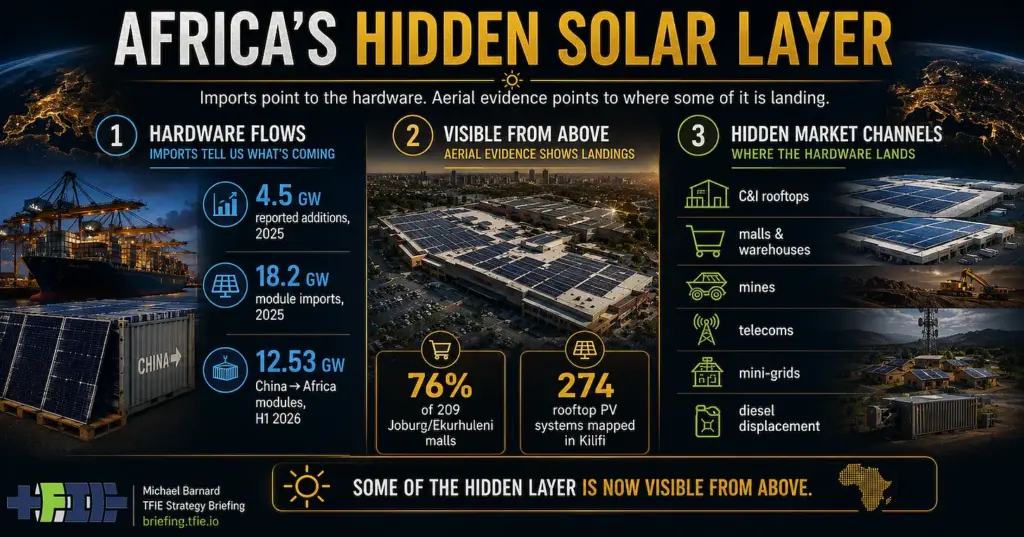
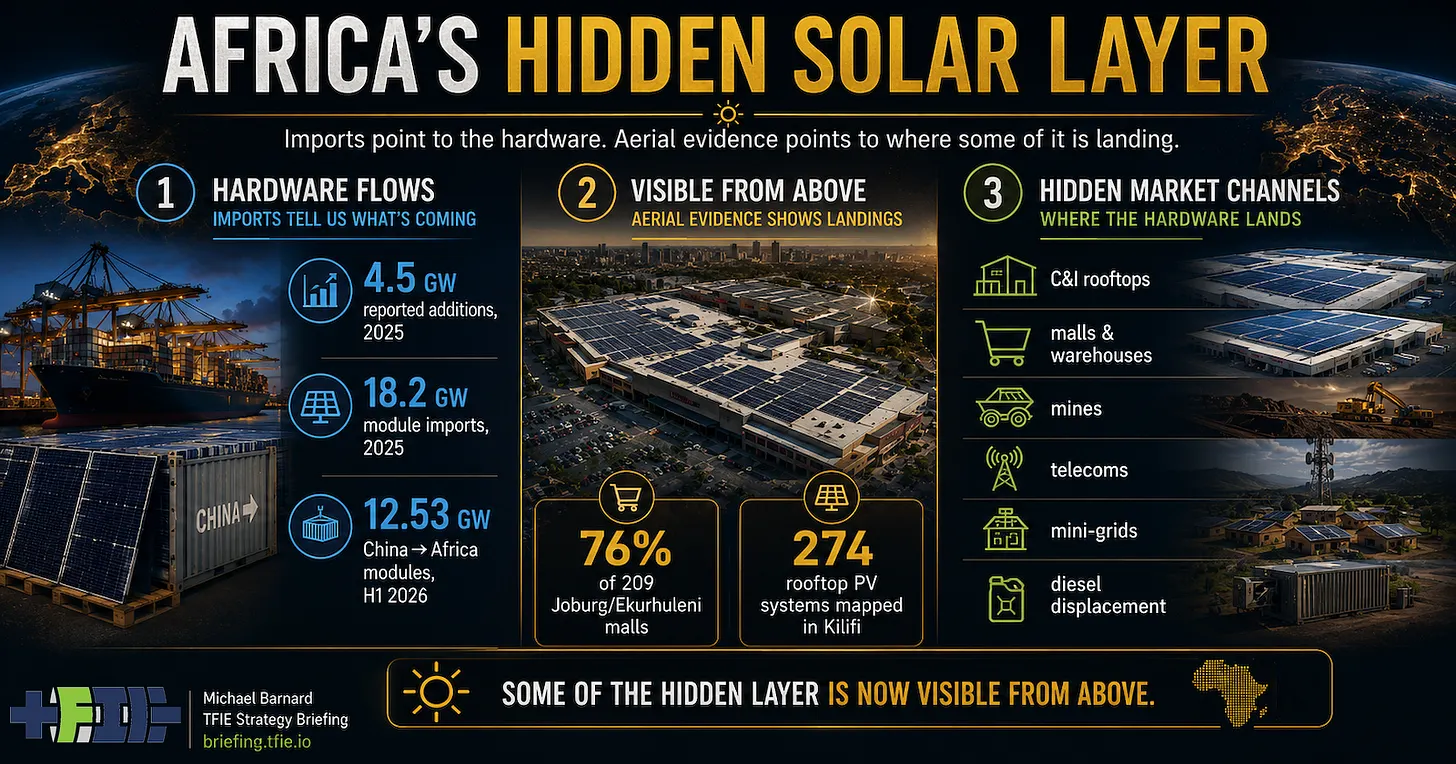
Official energy capacity statistics have long served as the gospel truth for tracking the global energy transition. For policymakers, international financial institutions, and grid operators, these figures dictate planning, financing, and forecasting. However, an unprecedented blind spot is emerging across the African continent. Official tallies report that Africa added approximately 4.5 gigawatts (GW) of solar capacity in 2025. Yet, customs data and manufacturing records tell a wildly divergent story: the continent imported roughly 18.2 GW of solar modules during that same period, followed by another 12.53 GW of finished Chinese modules in the first half of 2026 alone.
This staggering chasm between official installations and hardware inflows cannot be dismissed as mere accounting noise or panels sitting indefinitely in shipping containers. Instead, it points to a massive, underreported, behind-the-meter solar revolution. Driven by plunging photovoltaic (PV) module prices, increasingly affordable battery storage, soaring diesel costs, and notoriously unreliable public grids, commercial and industrial (C&I) entities are taking matters into their own hands.
Mines, factories, shopping malls, telecommunication towers, and agricultural operations are quietly funding and deploying localized energy infrastructure. Because these projects bypass traditional utility-scale announcements and government-backed procurement pipelines, conventional tracking metrics fail to capture them.
Now, a convergence of independent data points—ranging from customs logs and battery supply chains to high-resolution satellite imagery—is dragging Africa’s hidden solar layer into the light. This investigative report explores how aerial evidence and trade flows are rewriting our understanding of the continent’s renewable energy trajectory, revealing a decentralized transformation happening faster than official statisticians can track.
Detailed Chronology: The Divergence of Imports and Installations
To understand the magnitude of Africa’s unrecorded solar expansion, one must trace the timeline of hardware inflows and market dynamics over recent years.
The 2025 Inflection Point
In 2025, traditional capacity trackers logged roughly 4.5 GW of newly operational solar across the African continent. At first glance, this appeared to be a modest, steady increase consistent with historical trends in regional clean energy development. However, trade data captured a completely different reality. African ports processed an estimated 18.2 GW of solar modules throughout the year.
Skeptics initially argued that these panels were simply languishing in warehouses, delayed at customs, or earmarked for speculative utility projects. While hardware transit inevitably accounts for a fraction of imported goods, the sheer scale of the 13.7 GW gap between imports and official additions raised immediate red flags among energy analysts. It became increasingly clear that a massive volume of equipment was being cleared and installed entirely off the books of traditional grid regulators.
The 2026 Acceleration
The trend accelerated dramatically entering the new year. During the first half of 2026 alone, an additional 12.53 GW of finished Chinese solar modules arrived on African shores. This persistent influx validated earlier market-structure predictions—such as an aggressive forecast made by energy analysts at the beginning of 2026 projecting that the continent would absorb upwards of 20 GW of solar capacity over the course of the year.
Crucially, this forecast was never built on the fragile foundation of announced utility-scale projects or state-sponsored tenders. Rather, it was rooted in a hard-nosed assessment of market realities: global oversupply had driven Chinese module prices to historic lows; lithium-ion battery storage was following a similar cost-reduction curve; and municipal electricity grids were buckling under the weight of maintenance deficits, load shedding, and rising operational strains.
For African enterprises, the financial calculus shifted decisively. Relying exclusively on unstable grid power or expensive diesel generators was no longer a viable business model. Purchasing and installing private solar-plus-storage infrastructure transformed from an environmental aspiration into a basic prerequisite for economic survival.
Supporting Context & Metrics: Unmasking the Behind-the-Meter Revolution
Because official capacity statistics are heavily biased toward utility-scale installations and centralized grid connections, they remain fundamentally blind to decentralized, customer-side deployments. To bridge this data deficit, analysts have turned to alternative measurement layers, most notably high-resolution satellite imagery and commercial real estate mapping.
Aerial Evidence from South Africa
The most robust public aerial data verifying this hidden boom currently comes from South Africa. In a landmark investigative effort, data organizations DataDesk and The Outlier analyzed high-resolution satellite imagery covering 209 major shopping malls across Johannesburg and Ekurhuleni.
The results were striking: rooftop solar installations were identified on 76% of the surveyed retail centers. Malls represent the textbook definition of the customer profile driving this hidden market. They feature expansive, unshaded roof surfaces that are ideal for photovoltaic arrays; they experience heavy daytime electricity demand precisely when solar generation peaks; their corporate ownership structures possess the capital or access to financing necessary to purchase equipment outright; and they bear direct, painful financial exposure to grid unreliability and surging electricity tariffs.
A solar-paneled shopping center does not require a government renewable energy target or a public procurement announcement. A corporate board simply writes a check, contractors install the hardware, and the system begins generating clean electricity behind the meter.
Contrasting Regional Dynamics: Africa vs. Pakistan
It is important to contextualize Africa’s solar deployment pattern against other import-heavy emerging markets. For instance, countries like Pakistan experienced a highly visible, viral rooftop solar surge characterized by residential neighborhoods and small businesses rapidly covering entire cityscapes with panels following massive module imports.
In contrast, the African solar boom—while similarly driven by massive hardware inflows—exhibits a more concentrated, institutional footprint. The evidence gathered so far heavily leans toward commercial, industrial, agricultural, and infrastructural applications. Factories installing captive power plants, agricultural estates replacing diesel irrigation pumps, telecom towers migrating away from grid-tied diesel generators, and mining operations securing uninterrupted power supplies form the backbone of this movement. This distribution directly mirrors the underlying economic pressures: businesses and critical service providers protecting their bottom lines from outages and volatile fuel pricing rather than households single-handedly driving a domestic transformation.
The Methodological Limits of Satellite Mapping
While aerial imagery provides a vital window into the hidden solar market, analysts caution against treating it as an infallible metric. Satellite data comes with inherent limitations:
- Visibility Constraints: Large, clean commercial and industrial roofs are exceptionally easy to detect from above. Conversely, small residential systems, rural off-grid arrays, micro-clinics, remote agricultural pumps, and rooftop installations obscured by tree cover are easily missed.
- Resolution and Timing Gaps: The accuracy of satellite surveys depends heavily on the age of the imagery and camera resolution.
- The "Inverter Gap": Crucially, seeing a solar panel from space does not automatically prove that the complete electrical system—including inverters, charge controllers, and battery banks—is fully operational.
Consequently, satellite mapping must be viewed not as a replacement for official statistics, but as an indispensable validation layer that confirms the physical reality of the import data.
Official Statements and Perspectives: Shifting the Burden of Proof
The growing divergence between official metrics and ground-level reality has triggered a quiet reckoning among energy economists, utility executives, and policy planners across the continent.
For decades, the narrative of African electrification was dominated by top-down paradigms: massive hydro dams, centralized fossil-fuel plants, and state-managed grid expansions funded by international development banks. Decentralized, customer-side solar was frequently marginalized as a supplementary solution for remote rural communities rather than a primary driver of industrial transformation.

Industry stakeholders are now forced to reckon with a decentralized reality. Traditional utilities, which historically enjoyed monopolies over power distribution and sales, are finding their high-tariff commercial and industrial customer bases slipping away as companies generate their own power. This loss of lucrative industrial revenue—often referred to as the utility "death spiral"—threatens the financial viability of state power companies, even as it dramatically improves the operational resilience of the private sector.
Independent analysts emphasize that the burden of proof has officially shifted. It is no longer sufficient for official state bodies to claim that solar adoption is lagging simply because utility-scale pipeline additions are low. When tens of gigawatts of hardware clear customs and subsequently vanish into commercial rooftops, agricultural fields, and industrial parks, the institutional data collection methods are the things that must change.
As energy market experts point out, imported watts should not be prematurely relabeled as installed watts; however, ignoring the mountain of customs logs and aerial verification is no longer defensible. The data streams are finally beginning to converge, pointing to an organic, market-driven energy transition that operates entirely outside the traditional bureaucratic gaze.
Future Outlook: The Economic and Structural Consequences
The implications of Africa’s hidden solar layer extend far beyond academic debates over whether a 20 GW annual absorption prediction was accurate. The rapid, unrecorded deployment of behind-the-meter solar and battery storage systems is fundamentally reshaping the continent’s energy landscape in several profound ways:
1. Transformation of Grid Demand and Revenue Models
As major power consumers—such as mines, manufacturing plants, and commercial complexes—transition to self-generation, baseline demand on public grids will shift dramatically. While this alleviates crippling pressure on strained generation fleets during peak daylight hours, it also starves distribution companies of vital revenues needed to maintain and upgrade transmission lines. Regulators will be forced to adapt by modernizing tariff structures and integrating distributed energy resources (DERs) into national grid codes.
2. Drastic Reductions in Diesel Consumption
For decades, diesel generators have served as the de facto primary or backup power source for businesses across Sub-Saharan Africa, burning billions of dollars in imported fuel and contributing heavily to carbon emissions. The rapid integration of solar-plus-storage solutions is systematically displacing diesel consumption. This shift not only slashes operational expenditures for businesses—enhancing their regional and global competitiveness—but also eases foreign exchange pressures for nations that previously relied heavily on imported petroleum products to keep the lights on.
3. Redefining Industrial Competitiveness
Access to reliable, affordable electricity is a primary determinant of industrial productivity. By bypassing bureaucratic delays and financing their own resilient power infrastructure, African enterprises are insulating themselves from macroeconomic shocks, power outages, and volatile fossil-fuel markets. This bottom-up electrification is quietly unlocking new layers of economic productivity that official gross domestic product (GDP) and energy metrics fail to capture.
Conclusion
Africa’s energy transition is no longer a distant promise waiting for official sanction or multi-billion-dollar state financing. It is happening in real time, funded by private capital, driven by market economics, and materialized in silicon and lithium across thousands of commercial roofs.
While official statistics remain stubbornly anchored to legacy metrics, the convergence of customs data, hardware trade flows, and satellite verification proves that a massive, resilient solar layer is already taking root. As institutional tracking mechanisms slowly catch up to ground-level realities, one thing remains certain: the true scale of Africa’s renewable energy revolution has only just begun to surface.