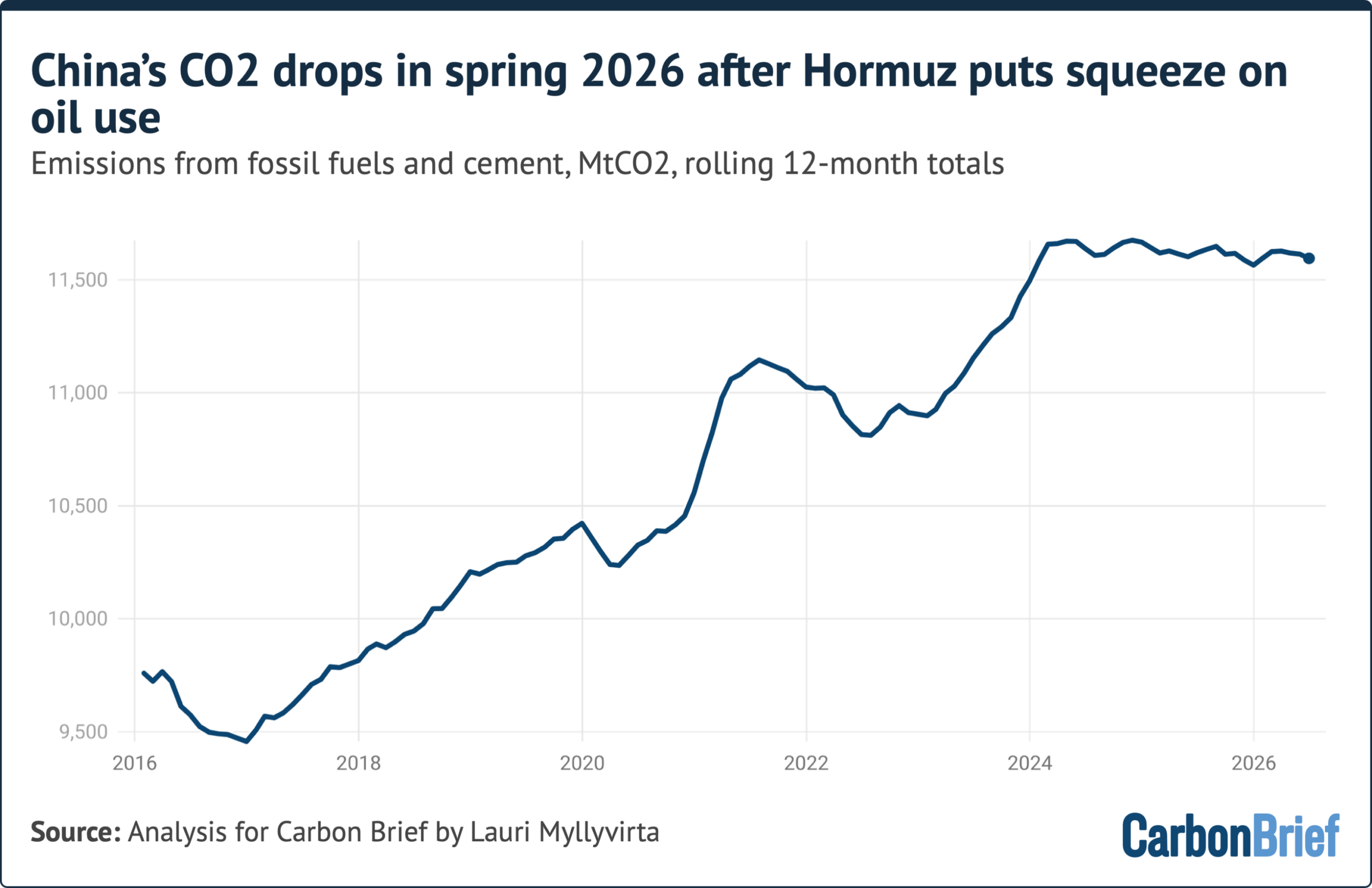
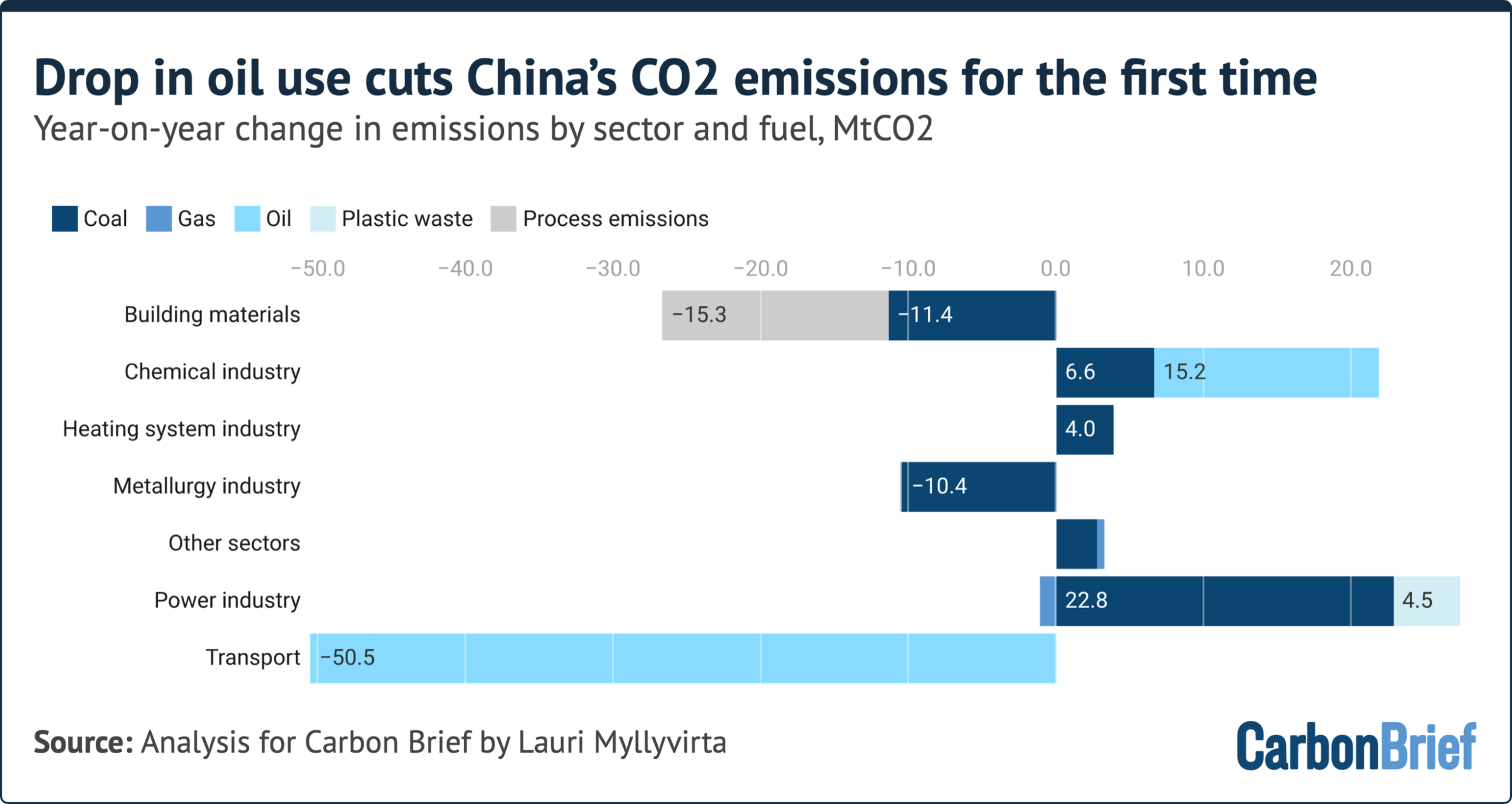
In a historic first for the world’s second-largest economy, China’s carbon dioxide ($CO_2$) emissions fell by 1% in the second quarter of 2026, entirely driven by a massive, structural contraction in national oil consumption. While previous emissions dips in modern Chinese history have invariably been tied to slowdowns or cutbacks in coal combustion, the Q2 2026 contraction marks a definitive paradigm shift.
Triggered by supply disruptions stemming from the geopolitical crisis in the Strait of Hormuz, China’s overall oil usage plummeted by 9% year-on-year, with transport-specific oil consumption dropping an unprecedented 16%. This dramatic shock laid bare the profound resilience built into China’s transport sector through years of aggressive electrification.
Even as coal-fired power generation ticked upward due to intermittent grid-integration bottlenecks, the sheer scale of oil displacement by electric vehicles (EVs), alternative rail networks, and public transport optimization was large enough to force an absolute drop in national fossil emissions. This plateauing and eventual downward pressure confirm that China’s total $CO_2$ output remains firmly capped below its 2023–2024 peak, heralding an accelerating race between slowing energy demand growth and relentless clean-energy expansion.
Detailed Chronology of the Q2 2026 Energy Shift
The trajectory of China’s carbon emissions throughout the first half of 2026 has been a study in complex, cross-current energy dynamics.
Q1 2026: The year began with a 2% year-on-year increase in $CO_2$ emissions. This early bump was primarily fueled by an increase in "wasted" or curtailed wind and solar generation, as regional power markets and transmission networks struggled to ingest surging variable renewable supply.
April–May 2026: As the Strait of Hormuz crisis escalated, international crude supply chains froze. China executed an immediate 32% slash in crude oil imports during the second quarter. Crude oil processing volumes fell by 11%, forcing refiners like Sinopec to draw down vast domestic inventories. Total oil product sales dropped by 9%.
June 2026: National Bureau of Statistics (NBS) data confirmed that transport fuel demand—specifically for petrol, diesel, and jet fuel—had plummeted. Simultaneously, structural electrification milestones reached a tipping point. Electric heavy-truck sales doubled year-on-year, pushing market penetration past 45% for new commercial truck sales.
July–August 2026: Beijing capitalized on the geopolitical volatility by rolling out a sweeping suite of 15th Five-Year Plan documents. These sectoral guidelines formally codified higher bars for new coal plant approvals, increased allowance for grid curtailment to manage massive renewable installations, and set aggressive electrification targets aiming for electricity to account for 35% of total final energy use by 2030.
Supporting Context & Metrics: Unpacking the Oil and Coal Divergence
To fully grasp how a 1% quarterly drop occurred despite rising coal use in the power sector, energy analysts must unpack the stark divergence across fuel types and industrial sectors.
The Anatomy of the Oil Shock and EV Displacement
While external observers marveled at how China absorbed the Hormuz oil shock without severe domestic economic paralysis, the internal mechanics point directly to deep structural transformation rather than pure rationing. Passenger travel levels and commercial freight tonnages actually remained stable or grew slightly (with commercial freight up 2.4% in Q2). This proves that mobility did not collapse; rather, the fuel source powering that mobility fundamentally changed.
According to data compiled from the China Association of Automobile Manufacturers and the National Energy Administration (NEA):
EV Charging Surges: EV charging volumes spiked by 60% in the second quarter, demonstrating that vehicles already on the road were utilized aggressively at the expense of internal combustion engine (ICE) vehicles.
Heavy-Duty Electrification: Electric heavy-truck sales soared 77% year-on-year in Q2.
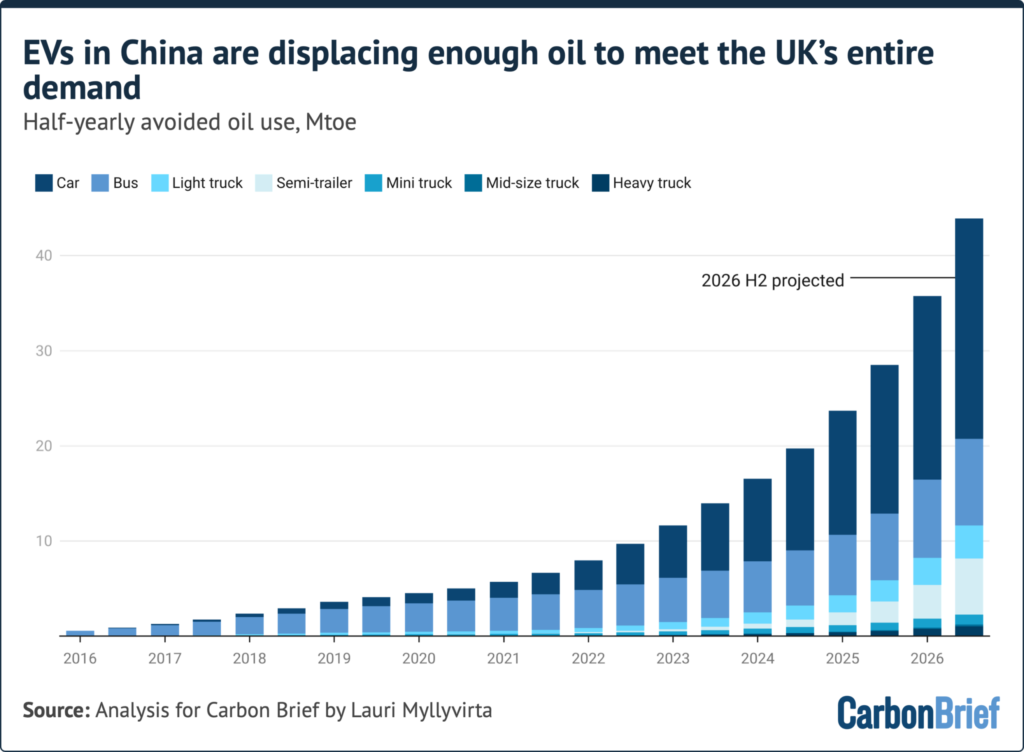
Total Displaced Volume: EVs helped avoid an estimated 19 million tonnes of oil equivalent (Mtoe) of consumption in Q2 alone—a 50% year-on-year increase. For the first half of 2026, cumulative avoided oil consumption reached 36 Mtoe, outstripping the total six-month oil consumption of the United Kingdom.
Beyond transportation, the remainder of the drop in oil imports was absorbed by drawing down national strategic stockpiles, flattening growth in the chemical industry, and behavioral adaptations by commercial enterprises.
The Paradox of Rising Coal Power
Ironically, the power sector moved in the opposite direction. Power-sector emissions climbed approximately 3% in the first half of 2026. This occurred despite record wind and solar capacity additions, a 9% surge in hydropower generation, a 2% increase in nuclear output, and a deceleration in electricity demand growth (slowing from 5.9% in Q2 2025 to 5.2% in Q2 2026).
The culprit was widespread renewable energy curtailment. Because China’s grid-operating and electricity-market models rely on rigid, pre-contracted capacity payments for coal plants rather than flexible dispatch incentives, variable solar and wind power were frequently wasted. Furthermore, 30 GW of new coal-power capacity came online in the first half of 2026—the highest rate since 2016—creating a structural oversupply of inflexible backup generation that crowded out clean power.
Official Statements and Policy Responses
The release of China’s sequential Five-Year Plan blueprints for energy, power systems, renewables, carbon peaking, and the environment (Beautiful China initiative) has signaled a notable evolution in Beijing’s long-term climate governance.
"Electrification both reduces emissions immediately and sets different sectors up for deep decarbonisation… Faster transport sector electrification lowers the outlook for oil demand, increases the role of the sector in peaking and reducing emissions, and means that more of China’s clean energy growth ends up displacing oil." — Energy Market Analysts
Key Policy Shifts in the New Framework:
Redefining System Reliability: For the past five years, coal expansion was defended as an absolute necessity for grid reliability. The new renewable energy and power system five-year plans pivot toward a diversified reliability model, incorporating advanced energy storage, virtual power plants, demand response, and smart microgrids.
Stricter Coal Control Language: For the first time, Beijing has vowed to control absolute "coal-power generation" rather than merely capping "generation growth." The plans establish a higher approval bar for new coal projects, though analysts note that the 204 GW of coal capacity currently under construction still presents a formidable implementation hurdle.
Curtailment Adjustments: The updated plans introduce nuanced regional curtailment limits—allowing thresholds to rise to 15% in specific resource-rich provinces to accommodate massive influxes of renewable generation, while tightening oversight on official reporting metrics to eliminate historical data understatements.
Future Outlook: A Race Between Energy Demand and Clean Capacity
As China looks toward the second half of 2026 and beyond, the trajectory of its national $CO_2$ emissions hangs in a delicate balance. The structural pressures squeezing oil demand—cemented by surging EV adoption, a protracted real-estate slump, and slower growth in coal-chemicals—are proving durable.
If current trends hold, China is on track to add sufficient non-fossil generation capacity (wind, solar, hydro, and nuclear) this year to completely cover electricity demand growth. The underlying energy demand growth has slowed down much more sharply than electricity demand growth, widening the margin for clean energy to actively cannibalize fossil fuel demand.
Ultimately, China’s carbon emissions profile is locked in a high-stakes race. If grid operators successfully resolve the transmission and market-design bottlenecks that currently force solar and wind curtailment—and if the newly enacted five-year targets successfully rein in excessive coal utilization—the plateau that began in early 2024 could give way to a permanent, structural decline in Chinese greenhouse gas emissions well ahead of schedule.