Executive Overview
For years, transit agencies navigating the transition to zero-emission fleets have treated battery-electric and hydrogen fuel-cell buses as two parallel, competing technologies waiting for the market to declare a definitive winner. Municipalities and public transport authorities have spent millions building out test deployments, retraining maintenance technicians, rebuilding depots, and experimenting with both architectures under varying daily operational realities. Both options successfully eliminate tailpipe emissions, offering a cleaner vision for urban centers choked by diesel exhaust.
However, the era of treating these two propulsion types as a toss-up is coming to a close. A comprehensive global analysis of public procurement data across hundreds of transit markets reveals a definitive turning point: battery-electric buses have decisively become the universal reference technology for zero-emission mass transit.
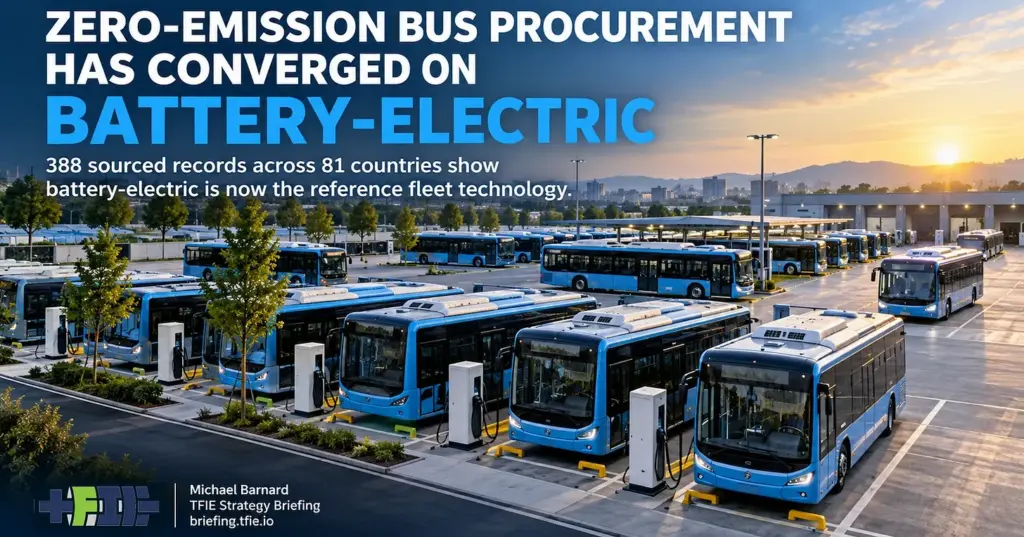
Rather than relying on theoretical projections or marketing hype, the most reliable indicator of market maturity is what municipal authorities are actually willing to buy repeatedly, and at true fleet scale. An examination of 388 sourced global procurement records spanning 81 countries shows an extraordinary divergence in purchasing behavior. Out of thousands of tracked acquisitions, battery-electric technology captures roughly 99.5% of the market share for firm commitments. Hydrogen fuel-cell buses, despite decades of heavy subsidization, pilot trials, and industry promotion, remain niche experiments confined to isolated pockets of municipal support.
This deep dive examines the empirical realities of modern transit procurement, analyzes why battery-electric architecture has pulled so far ahead, and outlines how cities, policy-makers, and transit planners must shift their focus from endless technology comparisons to solving the real-world deployment challenges of grid capacity, depot integration, and operational scaling.
Detailed Chronology: From Pilot Parity to Market Divergence
To understand how the zero-emission bus market reached its current state, it is necessary to retrace the evolutionary timeline of municipal transit modernization over the past two decades.
Phase One: The Era of Parity and Experimentation (2010–2018)
In the early days of zero-emission transit targets, both battery-electric vehicles (BEVs) and hydrogen fuel-cell electric vehicles (FCEVs) entered the public consciousness as experimental alternatives to internal combustion engines. National governments and regional transit authorities launched heavily subsidized pilot programs. Early battery-electric buses suffered from limited driving ranges, heavy and expensive battery packs, and immature charging standards. Concurrently, hydrogen advocates promised rapid refueling times, longer ranges, and operational parity with traditional diesel buses.
During this foundational phase, industry analysts and policy-makers championed "technology neutrality." The prevailing wisdom dictated that governments should fund both pathways equally, allowing the market, technological innovation, and declining component costs to dictate the eventual victor. Transit agencies dutifully purchased small trial batches—often five to ten buses of each type—to test the waters.
Phase Two: The Operational Reality Check (2019–2023)
As pilots transitioned into multi-year operational deployment, the day-to-day realities of running a transit fleet exposed deep economic and logistical chasms between the two technologies.
For battery-electric fleets, early challenges centered on range anxiety and depot power constraints. However, rapid advancements in battery chemistry, energy density, and high-power overnight charging transformed BEVs into reliable workhorses capable of handling standard urban and suburban routes. Municipalities quickly discovered that while depot electrical upgrades required capital and coordination with local utilities, the per-mile operating cost of electricity was drastically lower and more stable than the price of refined, compressed hydrogen.
Conversely, hydrogen fuel-cell programs encountered stubborn structural hurdles. Operating a hydrogen fleet required specialized, high-pressure fueling infrastructure that proved notoriously expensive to install, maintain, and insure. Furthermore, the thermodynamic inefficiencies of producing, compressing, transporting, and storing green hydrogen drove total operational costs significantly higher than anticipated. While hydrogen buses could complete long routes without recharging, the supporting supply chain remained fragile, leaving operators vulnerable to fueling station downtime and volatile gas pricing.

Phase Three: The Great Divergence and Fleet-Scale Adoption (2024–Present)
Today, the market has moved decisively past the theoretical debate. Transit operators have accumulated enough empirical data to make definitive, long-term capital allocation choices. As public agencies scale up from small pilot batches to full-fleet electrification mandates, procurement records reflect a massive consolidation around battery-electric architecture.
Rather than keeping doors open to both technologies out of an abstract desire for diversity, procurement officers are voting with their budgets. The modern landscape is characterized not by balanced portfolios of green transit options, but by a sprawling, globally distributed ecosystem of battery-electric deployment sitting alongside a virtually stagnant hydrogen procurement pipeline.
Supporting Context & Metrics: The Numbers Behind the Shift
Public procurement data must be handled with analytical rigor. Public announcements routinely double-count or triple-count the same vehicle purchases across different stages of the bureaucratic pipeline. A single bus order may appear first as an ambitious municipal tender, reappear as a formal contract award, and show up once more in a supplier’s delivery press release. Furthermore, non-binding framework options and tentative funding approvals often fail to materialize into signed contracts.
To bypass this noise and evaluate true market intent, researchers compiled a conservative global procurement register consisting of 388 verified records across 81 countries, separating firm orders from speculative tenders and framework options.
The Stark Global Breakdown
Within this rigorous dataset, the numbers tell an unequivocal story:
- Firm Battery-Electric Bus Orders: 13,165 units
- Firm Hydrogen Fuel-Cell Bus Orders: 65 units
- Ratio of Acquisition: Approximately 202 battery-electric buses for every single hydrogen bus.
- Market Share Dominance: Battery-electric technology accounts for roughly 99.5% of all firm zero-emission bus acquisitions captured in the register.
- Purchaser Breadth: Battery-electric orders originate from 55 distinct, geographically diverse purchasing bodies across multiple continents. In stark contrast, all 65 hydrogen buses originate from just two municipal buyers.
Examining the Two Hydrogen Outliers
A fair and rigorous analysis must account for those two sole hydrogen buyers to understand under what specific conditions the technology still finds adherents:
- Qingyang, China: This municipal administration is intentionally constructing a localized, closed-loop hydrogen ecosystem. The city is concurrently coordinating bus fleets, local hydrogen production, and specialized refueling infrastructure as a core pillar of a broader regional industrial development strategy.
- Krefeld, Germany: A stronger commercial counterexample, this European transit operator already possessed operational experience with hydrogen buses in service. Following years of real-world testing, the agency made the deliberate choice to procure additional hydrogen units.
While these two cases demonstrate that hydrogen fuel-cell buses can function effectively under highly specific, heavily supported local conditions, they fail to demonstrate broader industrial replication. After decades of global subsidies, engineering development, and climate advocacy, the entire global market for hydrogen bus expansion reduces to a single municipal industrial project in China and a single repeat purchase in Germany.
Battery-electric procurement, meanwhile, has transcended regional anomalies. It is successfully deployed by hundreds of distinct buyers operating under wildly differing climatic conditions, electrical grid topologies, route structures, and municipal policy regimes—from the freezing winters of Scandinavia to the blistering heat of Latin American mega-cities.
Official Statements and Industry Insights
As the transit sector reaches this consensus, transit executives, procurement leads, and strategy analysts are adjusting their messaging to reflect the new economic reality.
Industry analysts emphasize that maintaining the fiction of an ongoing head-to-head race between batteries and hydrogen is no longer constructive. In recent strategic briefings, transport economists have noted that public authorities must abandon the practice of treating radically different commercial reference classes as equivalent risks:

"Zero-emission bus procurement has moved beyond the stage where battery-electric and hydrogen fuel-cell buses should be treated as two parallel technologies waiting for the market to decide between them. Transit agencies have now spent years operating both… The more useful evidence now comes from what agencies are prepared to buy repeatedly and at fleet scale."
Municipal transit directors wrestling with capital budgets increasingly echo these sentiments. The debate has shifted from what technology to buy to how to successfully execute the deployment of the chosen technology without breaking public budgets. According to urban planning authorities, the vast supplier ecosystem surrounding battery-electric buses—featuring dozens of competitive manufacturers, standardized charging interfaces, and rapidly scaling component supply chains—provides a level of risk mitigation that hydrogen simply cannot match.
Future Outlook: The Road Ahead for Zero-Emission Transit
With the technological debate effectively settled by market realities, the path forward requires a fundamental realignment of policy priorities, municipal planning, and financial deployment.
1. Battery-Electric as the Default Reference Standard
For normal urban and suburban bus procurement, battery-electric systems should now serve as the default baseline technology. Transit agencies should begin their planning frameworks with the architectural standard that possesses the deepest procurement base, the broadest supplier network, and the most extensive operational history.
An agency should only depart from this baseline if a rigorous local constraint justifies doing so. "Technology neutrality" must be redefined: it means applying rigorous, uniform standards for service reliability, emissions reductions, and cost efficiency, rather than pretending that technologies with vastly disparate commercial maturities present equal risks.
2. Raising the Bar for Hydrogen
Hydrogen fuel-cell technology should henceforth be treated as the specialized exception that bears the burden of proof. Moving forward, any municipal proposal advocating for hydrogen buses should be required to pass a strict series of hurdles:
- Identify a genuine, material duty-cycle, depot-power, or topological constraint that battery-electric buses and practical high-power charging cannot resolve economically.
- Demonstrate conclusively that hydrogen solves that specific constraint at an acceptable whole-system cost.
- Establish a credible, long-term, low-carbon fuel supply chain.
- Prove that the resulting operational advantage is large enough to justify the immense capital expenditure required for dedicated production, transport, on-site generation, compression, storage, and dispensing infrastructure.
If a hydrogen proposal clears these stringent tests, a transit agency has a legitimate rationale to proceed. However, public agencies must stop resetting every procurement cycle to zero, acting as though both technologies are neck-and-neck competitors awaiting yet another publicly funded pilot trial.
3. Refocusing Policy and Funding Priorities
Public subsidies, grants, and strategic initiatives must pivot away from endless comparative pilot demonstrations and toward solving the tangible engineering and logistical bottlenecks holding back mass battery-electric adoption. The critical problems facing modern zero-emission transit fleets are well-documented:
- Grid Capacity and Interconnection: Securing multi-megawatt depot connections and working with local electric utilities to accelerate substation construction.
- Charging Reliability: Ensuring overnight and on-route charging hardware performs consistently under extreme weather conditions.
- Workforce Transformation: Retraining mechanics, electricians, and operations staff to manage high-voltage electric fleets safely and efficiently.
- Software and Fleet Management: Integrating sophisticated telematics, smart-charging algorithms, and route-scheduling software to optimize energy consumption.
- Innovative Financing: Structuring long-term capital investments that bridge the gap between higher upfront vehicle costs and lower lifetime operating expenditures.
By shifting policy focus toward solving these operational bottlenecks rather than second-guessing the core propulsion technology, cities and national governments can drastically accelerate the transition to fully decarbonized public mass transit. The market has spoken: the future of clean urban mobility is electric.