

Executive Overview
Washington, D.C., is significantly expanding its innovative smart-bin composting infrastructure, a crucial step in the district’s overarching campaign to achieve a zero-waste future. As part of an updated sustainability roadmap released in 2024, the nation’s capital has committed to diverting 80% of its municipal solid waste away from landfills and incineration by 2040.
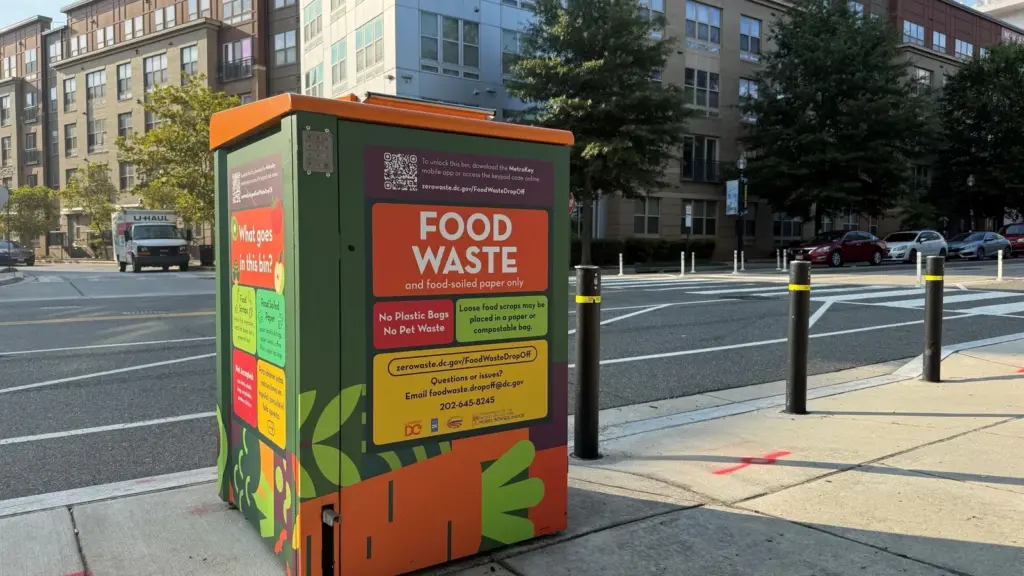
Because multifamily housing units—such as apartment complexes and high-rise condominiums—make up the vast majority of residential living spaces in the District, traditional backyard composting is largely unfeasible for most residents. To bridge this accessibility gap, the D.C. Department of Public Works (DPW) and the Office of Waste Diversion have scaled up an intuitive, 24-hour keypad-access composting bin program.
The initiative relies on strategically placed, secure organic waste collection bins distributed equitably across neighborhoods. Residents can locate the nearest receptacle using an interactive digital map, unlock it with a simple key code, and deposit their food scraps at any time of day or night.
In just 18 months, the program has garnered remarkable public engagement, signing up roughly 10,000 active users. Behind this grassroots momentum is a broader infrastructural transformation. City leadership is reimagining waste management through public-private partnerships, expanding drop-off pilots for household hazardous materials like batteries, and planning long-term capital investments—including the modernization of the fire-damaged Benning Road transfer station into a state-of-the-art, multi-stream green facility.
This comprehensive report examines the mechanics of D.C.’s expanding composting program, its integration into the 2040 Zero Waste Plan, the technological and logistical frameworks driving its success, and the future outlook for municipal waste diversion in the District.
Detailed Chronology of the D.C. Zero-Waste Evolution
To understand the current expansion of Washington, D.C.’s smart-bin composting network, it is essential to trace the policy and operational milestones that have shaped the city’s waste diversion trajectory over the past decade.
2014–2019: Laying the Groundwork for Organic Diversion
D.C.’s journey toward large-scale organic waste management began in earnest during the mid-2010s. The DPW established foundational collection programs aimed at capturing residential food scraps, primarily through seasonal farmers market drop-off sites and pilot curbside services in select low-density neighborhoods. Between 2014 and the onset of the decade, the city accumulated millions of pounds of organic waste. However, these early efforts suffered from a structural limitation: they catered overwhelmingly to single-family homeowners with yards or those willing to travel significant distances during restricted operational hours.
2020–2022: The Multifamily Dilemma and the Birth of Smart Bins
As urban densification continued, city planners confronted a stark reality: standard municipal services were failing the city’s renter population and apartment dwellers. While D.C. code mandated that large apartment building managers provide adequate baseline waste and recycling services, organic composting was entirely optional. Residents wishing to divert food waste were forced to purchase expensive countertop composters, rely on private subscription services like Compost Cab, or haul their scraps manually to distant farmers markets.
Recognizing this equity gap, the Office of Waste Diversion introduced the concept of keypad-access "smart bins." These secure, weather-resistant containers allowed the city to test decentralized drop-off points in dense urban neighborhoods. By granting residents unique or shared access codes, the city could prevent illegal dumping while maintaining around-the-clock availability.
2023–2024: Rapid Scaling and the Updated Zero-Waste Plan
The smart-bin initiative transitioned from a localized pilot to a citywide phenomenon over the subsequent 18 months. Word-of-mouth promotion, digital mapping tools, and heightened public awareness campaigns drove sign-ups past the 10,000-user mark.
In tandem with this operational growth, Mayor Muriel Bowser’s administration released an updated D.C. Zero Waste Plan. This strategic document codified the district’s aggressive target: diverting 80% of all solid waste from landfills and the incinerator by 2040. Crucially, the plan outlined a reduction in the citywide solid waste stream by 18% and projected a staggering reduction of greenhouse gas emissions equivalent to 1.38 million metric tons of carbon dioxide.
Late 2024–Present: Multipronged Diversion and Facility Redesign
Most recently, the city has begun leveraging its successful food-waste infrastructure to tackle other hard-to-dispose-of household materials. In a pilot launched at eight farmers market food-waste drop-off locations, the city began accepting used household batteries alongside organic waste. Furthermore, D.C. leadership has advanced architectural and community-planning phases for the reconstruction of the Benning Road transfer station, laying the physical groundwork for a multi-decade expansion of municipal recycling and composting capacity.
Supporting Context & Metrics: Analyzing the Data
A closer examination of the metrics reveals both the efficacy of D.C.’s current programs and the immense scale of the challenge ahead.
The Weight of Waste: Quantifying Impact
Since 2014, the DPW estimates it has collectively diverted more than 11 million pounds of food waste through its various municipal composting programs. While this figure underscores a decade of steady progress, a deeper dive into the numbers highlights the disproportionate impact of the newly deployed smart bins. Despite representing a fraction of the city’s overall collection infrastructure, the smart bins alone are responsible for generating roughly 10% of all historical organic waste collections.
This outsized contribution demonstrates that when structural barriers—such as restricted hours, long travel distances, and lack of secure storage—are removed, urban residents will enthusiastically adopt sustainable disposal habits.
Where Does the Waste Go?
Logistics play a critical role in maintaining the integrity of municipal composting. The District partners with Compost Cab, an established regional organics collection service provider, to service the smart bins and transport the collected material. Rather than ending up in regional landfills, the organic matter is hauled to various specialized composting and anaerobic digestion facilities across the Mid-Atlantic region.
Anaerobic digestion, in particular, allows facilities to break down food scraps in oxygen-depleted environments, capturing methane to generate renewable energy while simultaneously producing nutrient-rich digestate used as a soil amendment.
The Incineration Reality
Despite these gains, D.C. still faces a heavy reliance on waste-to-energy conversion. As D.C. Department of Public Works Director Anthony Crispino noted, the vast majority of the city’s solid waste stream currently travels to the Reworld waste-to-energy facility located near Lorton, Virginia.
While waste-to-energy is environmentally preferable to unimproved open landfills in terms of methane mitigation, it still results in air emissions, ash disposal challenges, and the destruction of materials that could otherwise be recovered, recycled, or composted. Reducing this dependency is the primary mathematical driver behind the 2040 Zero Waste Plan’s 18% overall volume reduction goal.
Official Statements and Administrative Insights
Key municipal leaders have been vocal about the strategic necessity of scaling these programs, emphasizing equity, community collaboration, and infrastructural modernization.
John Johnson on Accessibility and the Equity Imperative
John Johnson, program manager for D.C.’s Office of Waste Diversion, emphasizes that geographic equity is the linchpin of behavioral change.
"Residents are much more likely to use the bin if it’s close to their home, so the goal is to make sure that we have equitable distribution throughout the city," Johnson explains.
Reflecting on the unexpected popularity of the keypad units over the past year and a half, Johnson describes the initiative as a vital lifeline for urban renters.
"It’s been a phenomenal program that’s really making up that gap in accessibility for residents who otherwise have no viable way to compost their daily food scraps."
Johnson also points out that the city is not solely relying on shared public bins. For residents eager to manage their own organic waste at home, the city has rolled out a series of educational how-to workshops alongside a financial rebate program for approved composting equipment, such as indoor worm bins and electric countertop units.
Anthony Crispino on Modernizing Municipal Infrastructure
Department of Public Works Director Anthony Crispino looks beyond immediate collection bins toward long-term physical infrastructure. Central to his vision is the revitalization of the city’s Benning Road transfer station, a crucial municipal asset that was unfortunately decommissioned following a destructive fire.
Rather than simply rebuilding the station to its previous specifications, DPW is collaborating closely with the Office of Waste Diversion and neighborhood advisory boards to reimagine the property from the ground up.
"The vision is for a new green facility that is going to expand our capacity to accept composting materials, recycling, and other residential drop-off," Crispino stated. "There’s a whole plethora of ideas on the table to ensure the space meets our community’s needs over the next twenty years of population growth."
Future Outlook: The Road to 2040
As Washington, D.C., looks toward its mid-century sustainability benchmarks, the intersection of technology, policy, and public participation will dictate whether the city can successfully divert 80% of its waste.
Expanding Beyond Food Waste: The Multi-Stream Approach
The success of the smart-bin food waste initiative has emboldened municipal planners to test similar decentralized drop-off frameworks for other problematic waste streams. The recent rollout of battery collection bins at eight farmers market food-waste sites serves as a test case. Household batteries contain heavy metals and toxic chemicals that pose severe fire hazards when mistakenly thrown into standard recycling trucks or commercial incinerators. By pairing battery drop-offs with existing organic waste collection points, D.C. is effectively training residents to view these neighborhood nodes as comprehensive household hazardous waste routing stations.
Navigating Challenges Ahead
Despite undeniable momentum, significant hurdles remain. Managing contamination—such as plastic bags, cutlery, and non-compostable packaging finding their way into smart bins—requires continuous public education and robust monitoring by collection partners like Compost Cab. Furthermore, scaling the smart-bin network to cover hundreds of densely populated multifamily blocks requires sustained capital investment, political will, and ongoing cooperation from private real estate developers and property managers.
Conclusion
Washington, D.C.’s smart-bin expansion proves that urban sustainability initiatives can succeed when designed with the unique realities of city living in mind. By combining secure, 24/7 digital access points with aggressive long-term planning—ranging from neighborhood battery pilots to the reinvention of the Benning Road transfer facility—the District is steadily dismantling the structural barriers that have historically kept urbanites from participating in the circular economy.
If current adoption rates and community enthusiasm are any indicator, D.C. is well-positioned to turn its ambitious 2040 zero-waste vision from an idealistic policy paper into an operational reality.



