

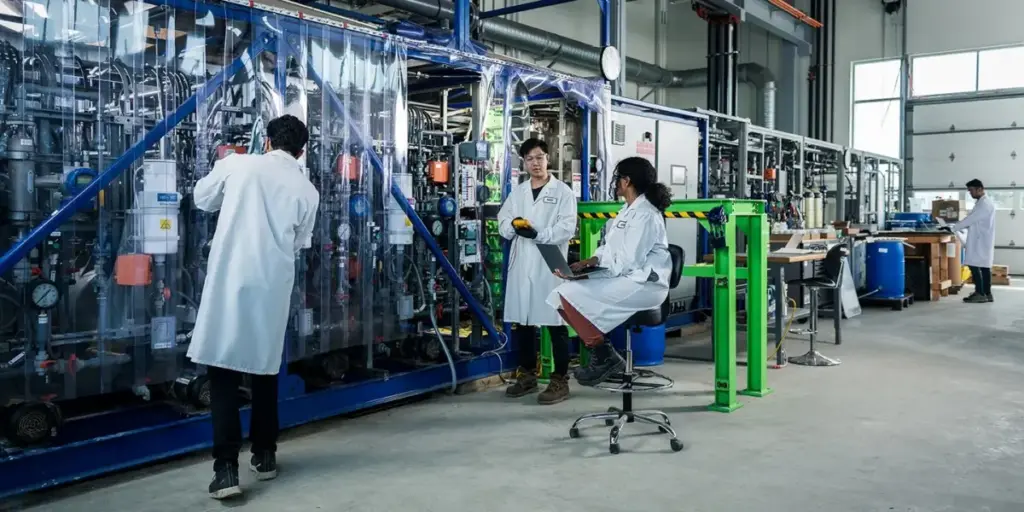
Executive Overview
The global transition to electric vehicles (EVs) has reached a critical bottleneck. While automakers continue to scale up assembly lines to meet surging consumer demand, the underlying supply chain for critical battery minerals—most notably lithium—remains dangerously vulnerable to geopolitical friction, supply constraints, and heavy foreign dominance.
In a decisive move to counter this structural vulnerability, Vancouver-based clean-tech innovator Mangrove Lithium has announced plans to construct a massive new commercial refinery. Capable of producing a staggering 20,000 tonnes of battery-grade lithium annually, this single facility will yield enough material to power over 500,000 electric vehicles every year—a volume that equals the entirety of North America’s current domestic lithium refining capacity.
To lock in the success of this monumental undertaking, Mangrove has already secured binding or semi-binding commitments. The company has signed multiple memoranda of understanding (MoUs) with major US battery gigafactories to secure 100% offtake agreements for the plant’s anticipated output. Although the exact physical location of the new facility remains under wraps, the strategic implications of the announcement are clear: North America is aggressively moving to reshore its critical mineral refining capabilities, reducing its historical reliance on processing hubs in China.
This new refinery represents a significant evolutionary step for Mangrove. Going beyond the company’s proprietary electrochemical refining technology, the plant will integrate spodumene concentrate processing, thrusting Mangrove deeper upstream into the foundational layers of the lithium supply chain.
Coming on the heels of their pioneering commercial plant in Delta, British Columbia—slated to come online by the end of the year—this new project marks a turning point for North American energy independence. As global supply chain vulnerabilities intensify, Mangrove’s localized, scalable, and environmentally sustainable approach may well serve as the blueprint for the Western EV revolution.
Detailed Chronology: From Pilot Plant to Continental Scale
The trajectory of Mangrove Lithium highlights how rapidly the clean energy sector is being forced to adapt to geopolitical realities. To understand the gravity of the company’s latest announcement, it is necessary to examine the chronological progression of its operational milestones.

1. The R&D and Pilot Phase (2021–2023)
Long before capturing headlines with multi-thousand-tonne projections, Mangrove spent years perfecting its core technology. Traditional lithium refining is notoriously water-intensive, chemically wasteful, and carbon-heavy. Mangrove developed a proprietary electrochemical process designed to bypass these traditional constraints. By cleanly converting raw lithium feedstocks into high-purity, battery-grade materials with minimal waste and a reduced carbon footprint, the company proved its concept at a pilot scale, culminating in testing facilities that validated the commercial viability of its technology.
2. Securing Capital and Breaking Ground in Delta, BC (Late 2023–2024)
The validation of Mangrove’s technology unlocked crucial venture capital and strategic backing. Bolstered by a successful USD $35 million funding round, the company broke ground on its first commercial-scale plant located in Delta, British Columbia.
- Capacity: 25,000 EVs powered annually.
- Significance: Set to come online by the end of the year, this facility holds the distinction of being North America’s first commercial electrochemical lithium refining plant. It serves as the operational proof-of-concept for Mangrove’s broader regional ambitions.
3. Upstream Integration and the 20,000-Tonnes Announcement (2025)
Building upon the momentum of the Delta facility, Mangrove announced its most ambitious project to date: a massive secondary refinery designed to churn out 20,000 tonnes of battery-grade lithium annually.
Unlike the Delta facility, which primarily focuses on downstream electrochemical conversion, this new plant incorporates spodumene concentrate processing. Spodumene is a hard-rock lithium mineral that requires complex thermal and chemical cracking before it can be refined into battery-grade lithium carbonate or lithium hydroxide. By integrating this step, Mangrove is expanding vertically, taking control of a crucial upstream bottleneck that has traditionally been outsourced overseas.
Simultaneously, Mangrove successfully negotiated and executed MoUs with major United States battery gigafactories. These agreements guarantee that 100% of the new plant’s future output is pre-sold, providing the financial and operational stability required to greenlight construction.
Supporting Context & Metrics: The Geopolitical Imperative
To fully appreciate the magnitude of Mangrove’s expansion, one must examine the precarious macroeconomic and geopolitical landscape governing the critical minerals sector.
The Looming 2030 Supply Crunch
Industry analysts have repeatedly warned that the demand for electric vehicle batteries will vastly outstrip the supply of refined raw materials by the end of the decade. According to recent market forecasts, critical EV battery materials—specifically lithium, nickel, and cobalt—face an acute supply crunch by 2030. Without rapid investments in domestic extraction and refining infrastructure, North American automakers risk severe production halts, inflated vehicle costs, and missed climate targets.

Breaking the Chinese Monopoly on Refining
While South America (the "Lithium Triangle" of Chile, Argentina, and Bolivia) and Australia hold massive raw reserves of lithium, the global processing and refining market has long been heavily concentrated in China. China currently controls a commanding majority of the world’s lithium refining capacity, turning raw brine and spodumene into the high-purity materials required by modern lithium-ion cells.
This centralization of processing power has created a profound vulnerability for Western economies. The fragility of this supply chain moved from a theoretical concern to an active crisis earlier this year when Beijing floated potential export bans on key lithium extraction and processing technologies. The implicit threat—that access to the lifeblood of the EV transition could be abruptly throttled—sent shockwaves through Washington, Ottawa, and corporate boardrooms alike.
North America needs local capacity, and it needs it fast. Mangrove’s new facility is a direct response to this strategic vulnerability.
The Technological Edge: Electrochemical Flexibility
Mangrove’s competitive advantage lies in its technological approach. Traditional roasting and acid-leaching methods used in conventional lithium processing generate vast quantities of toxic byproducts and consume enormous amounts of energy and water.
In contrast, Mangrove’s electrochemical platform offers unprecedented feedstock flexibility. It can process a wider variety of raw inputs while significantly reducing operating costs, lowering carbon emissions, and virtually eliminating industrial waste. By decoupling lithium refining from the environmentally destructive practices of the past, Mangrove is proving that domestic production does not have to come at the expense of local environmental standards.
Official Statements and Leadership Perspectives
The strategic vision driving Mangrove Lithium is championed by an executive team featuring deep industry veterans who have spent decades navigating the volatile global supply chain for major automakers.

Saad Dara, CEO and Founder of Mangrove Lithium, emphasized the strategic urgency of the company’s expansion:
"Global customers are recognizing that Mangrove is a strategic partner in securing lithium supply. The global lithium supply chain is getting more fragile by the day. Mangrove is building the foundation for a self-reliant, scalable, and sustainable North American lithium future."
Dara’s comments underscore the paradigm shift occurring within the automotive sector. Automakers are no longer viewing critical minerals as mere commodities to be purchased on the spot market; they are treating refining capacity as national security infrastructure, demanding long-term partnerships with trusted domestic suppliers.
Annie Liu, Chief Strategy and Commercial Officer at Mangrove Lithium, brought her extensive industry pedigree to bear on the announcement:
"Having negotiated deals for automakers like Tesla and Ford, I’ve seen just how crucial a reliable Western lithium supply chain is—and that’s exactly what we’re building here."
Liu’s background—having spearheaded high-stakes supply chain negotiations for some of the world’s leading electric vehicle manufacturers—gives her unique insight into the anxieties plaguing the auto industry. Her presence at Mangrove signals to the market that the company’s commercial strategy is directly aligned with the real-world manufacturing requirements of major gigafactories.

Future Outlook: Building a Self-Reliant North American Battery Ecosystem
As Mangrove Lithium prepares to bring its Delta, British Columbia facility online later this year and finalizes plans for its 20,000-tonne mega-refinery, the company stands at the vanguard of a new industrial era.
The path forward, however, is not without challenges. Selecting the site for the new facility will require careful navigation of local zoning laws, environmental regulations, and access to clean energy sources. Furthermore, securing continuous streams of upstream feedstock—whether from domestic hard-rock mines in Canada and the US or through allied international trade partners—will be essential to keeping the massive refinery operating at full capacity.
Yet, the macro tailwinds strongly favor domestic processing initiatives. With government incentives such as the Inflation Reduction Act (IRA) in the United States and matching industrial policies in Canada aggressively rewarding localized supply chains, the economic case for domestic refining has never been stronger.
By bridging the gap between raw mineral extraction and high-purity battery manufacturing, Mangrove Lithium is doing more than just building a business; it is helping to secure the industrial sovereignty of North America. If the company successfully executes its vision over the coming years, it will have laid the bedrock for a self-sustaining, resilient, and green energy economy capable of powering millions of electric vehicles independently of foreign supply shocks.



