Australia’s commercial transport landscape is standing at a historic crossroads. For more than seventy years, diesel has served as the unquestioned lifeblood of the nation’s heavy vehicle logistics sector, powering the freight, supply chains, and distribution networks that keep the continent moving. Today, however, that foundational reliance is fracturing under the weight of an unprecedented "perfect storm."
Ongoing geopolitical volatility, compounding oil price fluctuations, ambitious 2035 emissions targets, and government-backed transition incentives have fundamentally altered the financial calculus of commercial fleets. According to industry leaders, the question facing Australian fleet operators is no longer if they should electrify their transport assets, but whether their charging infrastructure will be ready when the vehicles arrive.
At the vanguard of this seismic shift is JET Charge, an Australian electric vehicle (EV) charging infrastructure specialist actively facilitating the country’s heavy vehicle fleet transition. Tim Washington, Co-Founder and CEO of JET Charge, pulls no punches regarding the economic reality currently facing logistics companies.
“At current diesel prices, the fuel cost savings of switching a commercial fleet to electric are not marginal. They are transformational,” Washington stated in a recent corporate release.
With retail diesel prices climbing well past AU$2.60 per liter—far outstripping historical baselines—logistics operators managing thin operational margins are finding that diesel-led fleets are no longer financially viable. Crucially, industry experts note that the transition is moving from a long-term corporate sustainability goal to an immediate, active procurement decision. For a medium-to-large fleet operator running 100 heavy vehicles, delaying the shift could mean missing out on millions of dollars in net savings, while simultaneously risking being locked out of essential grid access as power competition heats up across the commercial sector.
Detailed Chronology: From Niche Experiments to Mainstream Infrastructure
To understand how rapidly Australia’s commercial transport sector is pivoting, one must examine the timeline of electric heavy vehicle adoption. Historically, battery-electric trucks were viewed as distant, speculative technology suited primarily for controlled, closed-loop trials or light-duty urban duty cycles.
The Early Days of Heavy Electric Transport
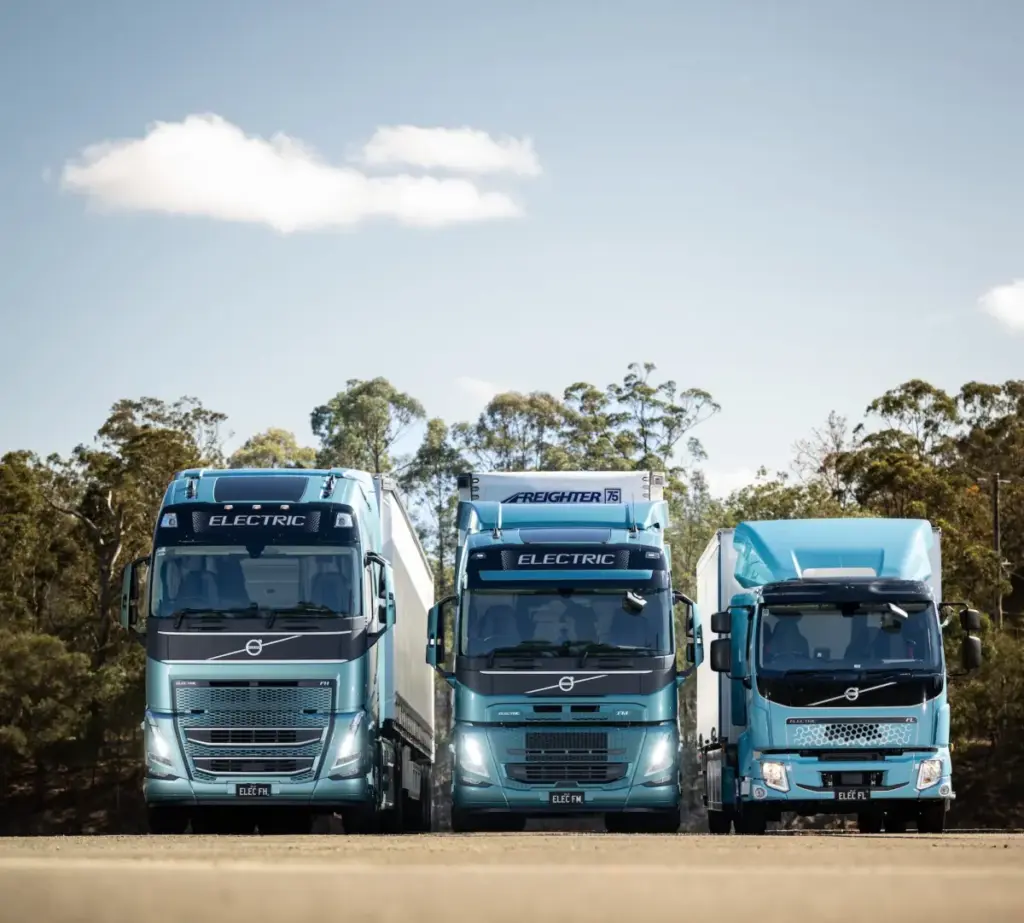
Only a few short years ago, heavy electric prime movers on Australian asphalt were a rarity. Early adopters experimented with a handful of imported Volvo electric trucks, niche local conversions by manufacturers like Janus Electric, Mercedes-Benz eActros models, and emerging international entrants such as Windrose. These pioneers proved the mechanical viability of electric trucks, but widespread adoption was consistently bottlenecked by two primary factors: vehicle availability and, more importantly, a severe lack of high-capacity depot and corridor charging infrastructure.
The Acceleration Phase and Fleet Compression
As global markets in Europe and China aggressively scaled up heavy-duty electrification—showcased heavily at major international transport exhibitions—the technology matured rapidly. Recognizing that vehicle supply would eventually catch up with demand, forward-thinking logistics operators began drafting five-year decarbonization strategies.
However, market realities have drastically compressed these timelines. JET Charge reports that five-year fleet electrification plans are now being aggressively truncated into 18-month execution windows. This acceleration is largely dictated by standard corporate vehicle lease cycles. Companies that opt to renew their diesel truck fleets today will be locked into five-to-six-year commitments, effectively freezing them out of the energy transition until the late 2020s.
By the time those diesel leases expire, market congestion is projected to reach critical levels. Logistics companies will increasingly find themselves competing against heavily capitalized, fast-growing digital data centers for limited electrical grid capacity and high-voltage substation access. In this emerging landscape, grid connectivity is becoming a "first come, best dressed" commodity, making proactive infrastructure planning an existential business requirement.
Supporting Context & Metrics: The Economics of Fleet Electrification
The transition to electric heavy vehicles is ultimately being driven by hard, undeniable mathematics. While upfront capital expenditure (CapEx) for electric trucks and depot charging stations remains substantial, the operational expenditure (OpEx) savings deliver an exceptionally fast payback period.
Fuel and Maintenance Arbitrage
Diesel price instability has introduced acute financial risk to Australian supply chains. With diesel hovering around $2.60 per liter, the cost per kilometer for an internal combustion engine (ICE) heavy truck has skyrocketed. In contrast, electricity costs—particularly when managed via smart depot charging scheduled during off-peak solar or wind generation hours—offer a stable, highly predictable energy source.
Furthermore, electric trucks feature significantly fewer moving parts than their diesel counterparts. The elimination of complex internal combustion engines, multi-speed transmissions, exhaust after-treatment systems, and routine oil changes translates to dramatic reductions in ongoing vehicle maintenance costs. According to Tim Washington, for most commercial operators, the return on investment and payback period for heavy vehicle charging infrastructure is measured in months, rather than years.
Quantifying the Savings: Case Studies and Calculators
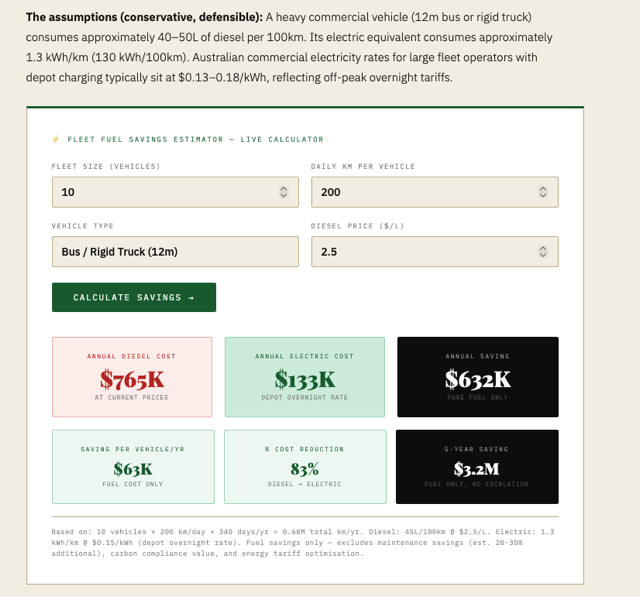
To demonstrate these savings, JET Charge utilizes proprietary fleet fuel calculators designed to project total cost of ownership (TCO) comparisons. While the most dramatic savings are projected for heavy prime movers and long-haul semi-trailers—where transitioning a 100-vehicle fleet can yield upwards of AU$4.5 million in cumulative savings—medium rigid trucks and last-mile delivery vehicles are capturing immediate, highly profitable gains.
+---------------------------+-----------------------------------+-----------------------------------+
| Fleet Metric / Parameter  | Diesel-Powered Fleet (Baseline)   | Electric Vehicle (EV) Fleet       |
+---------------------------+-----------------------------------+-----------------------------------+
| Fuel Cost Basis           | AU$2.60+ per liter (volatile)     | Managed off-peak electricity grid |
| Maintenance Complexity    | High (Engine, exhaust, oil, etc.) | Low (Regen braking, fewer parts)  |
| Payback Period (Infra)    | N/A                               | Measured in months                |
| Supply Chain Risk         | High exposure to oil shocks       | High price stability & resilience |
+---------------------------+-----------------------------------+-----------------------------------+
Major Australian brands have already begun implementing these models at scale. Furniture retail giant IKEA and national grocery titan Woolworths have partnered with infrastructure providers to integrate electric medium rigid and delivery trucks into their daily distribution networks.
Official Statements & Industry Perspectives
The transition from theory to practice is best illustrated by real-world deployments that solve the chicken-and-egg problem of vehicles versus infrastructure. A prime example is IKEA Australia’s aggressive push toward 100% zero-emission home deliveries.
The IKEA Playbook: De-Risking the Supply Chain
When IKEA set its sights on completely decarbonizing its last-mile delivery operations, the primary barrier was not a lack of available electric delivery vans or trucks. Rather, the bottleneck lay with its third-party subcontracted delivery partners—smaller transport operators working on notoriously thin logistics margins who simply could not self-fund expensive depot charging infrastructure.
To break this deadlock, JET Charge collaborated on a major rollout, deploying 59 specialized EV chargers across 7 strategic locations. This targeted infrastructure deployment directly empowered logistics partners—including ANC Delivers, Kings Transport, and All-Purpose Transport—to transition to zero-emission fleets at scale. Integrated with platforms like Chargefox for seamless cost recovery and billing, the network now supports over 100 electric delivery vehicles operating nationwide.
The results speak for themselves: IKEA transformed its zero-emission delivery rate from a modest 5% in 2022 to an impressive 83% by late 2025.
"When IKEA Australia committed to 100% zero-emission deliveries, the barrier wasn’t the vehicles—it was the charging," explains Tim Washington. "Delivery partners operating on thin margins couldn’t fund depot infrastructure. JET Charge’s deployment provided the essential infrastructure that enables these partners to shift to zero-emission vehicles at scale… This is the playbook for every major Australian retailer and logistics operator. If you move the infrastructure barrier, the transition follows."
Navigating Roadblocks: Education and Reimbursement
Despite clear financial incentives, structural hurdles remain. Addressing the current roadblocks holding back broader adoption, Washington emphasizes that industry education is paramount.
Many corporate structures still struggle with archaic budgeting frameworks that fail to account for integrated electric infrastructure as a core operational asset. Additionally, practical challenges—such as developing standardized, automated processes to reimburse commercial drivers for home-charging electricity use—require sophisticated software solutions, which JET Charge has actively developed and integrated into its service ecosystem.
Looking ahead, the trajectory of Australia’s commercial transport sector is firmly anchored to electrification. Private charging infrastructure—which Washington estimates must account for roughly 70% of total commercial charging demand—is expanding rapidly, bolstered by strategic alliances such as JET Charge’s partnership with NewVolt to electrify vital freight corridors across the country.
However, time is of the essence. Fleet operators who fail to commit to infrastructure deployment in the immediate term risk being locked out of critical grid allocations through 2027 and 2028. By that time, tightening federal and state emissions standards will impose severe financial penalties on laggards, compounding the economic pain of fossil fuel reliance.
Ultimately, fleet electrification is evolving beyond an environmental initiative. In an economy grappling with stubborn inflation, rising interest rates, and consumer cost-of-living pressures, transitioning away from volatile imported diesel is emerging as a vital macroeconomic risk-mitigation strategy. By securing clean, predictable, and cost-effective energy for our heavy vehicle networks, Australia can stabilize its supply chains, protect logistics margins, and pave the way for a resilient, zero-emission economic future.