

BODEGA BAY, CA — On August 9, 2026, the rugged, mist-shrouded coastline of Bodega Bay will bear witness to a remarkable convergence of elite athletic endurance and grassroots environmental stewardship. As former NCAA champion and internationally acclaimed open-water swimmer Catherine Breed strokes into the icy waters of Sonoma County during her monumental 900-mile "Swim California" expedition, she will do more than simply log another grueling milestone. She will pause to honor one of the Western Hemisphere’s most inspiring conservation victories: the Greater Farallones Hope Spot.
Breed’s journey is not merely a test of physical fortitude; it is a floating symposium on marine resilience. Traversing the length of the Golden State’s punishing coastline, her expedition serves as a high-profile megaphone for the scientists, volunteers, Indigenous stewards, and grassroots advocates fighting to preserve the Pacific. When Breed arrives at Bodega Bay, she steps ashore into a living laboratory—an ecosystem that proves nature can rebound from degradation if given the time, space, and institutional protection to heal.
Executive Overview: A Symphony of Endurance and Ocean Advocacy
The Swim California initiative is structured around a fundamental philosophy: connection precedes conservation. To inspire the public to defend the oceans, organizers believe people must first fall in love with them and understand the tireless human networks working behind the scenes to keep them alive. Breed’s 900-mile odyssey, documented extensively by exclusive media partner Allez! Sports, maps out 10 strategic stops along the California coast. At each destination, the project spotlights local marine ecosystems and the guardians defending them.
The Bodega Bay stop, scheduled for Sunday, August 9, 2026, at 4:00 p.m. at Westside Regional Park and Campground, is a centerpiece of this multi-month voyage. Co-hosted by Mission Blue®, the Greater Farallones Association (GFA), and Blue Frontier, the community gathering will dive deep into the mechanics of long-term marine protection. Attendees will explore how decades of sanctuary management, community science, and public policy have insulated the region’s kelp forests and rockfish populations against the widespread ecological collapses plaguing other parts of the Pacific Rim.
For Breed, whose open-water resume includes legendary, record-setting crossings of Lake Tahoe, Monterey Bay, and the English Channel, the ocean is both a playground and a patient in critical condition.
"One of the most hopeful things we can learn from Bodega Bay is that when we protect the ocean and give it room to recover, nature can respond," Breed reflects. "Mission Blue connects this extraordinary place to a global movement, Greater Farallones Association brings the science, education, and stewardship to life, and Blue Frontier helps turn that knowledge into public action. Together, they demonstrate exactly what Swim California is about: connecting people to the ocean and celebrating the communities working every day to protect it."
Detailed Chronology: The Anatomy of the Swim California Expedition
To fully grasp the magnitude of the Bodega Bay event, one must understand the sheer logistical and physical undertaking of Swim California. Spanning 900 miles of unpredictable Pacific coastline—characterized by bone-chilling water temperatures, volatile rip currents, shifting winds, and marine wildlife encounters—Breed’s journey is a masterclass in extreme sports administration and athletic grit.
Phase I: Launching the Vision
The groundwork for Swim California was laid years prior, drawing on Breed’s storied background as a U.S. National Team swimmer and dominant collegiate athlete at UC Berkeley. Transitioning from pool racing to the unpredictable wilderness of open-water marathons, Breed developed an intimate understanding of shifting marine climates. Recognizing how rapidly California’s coastal waters were changing due to warming temperatures, pollution, and overfishing, she conceptualized an expedition that would transcend personal athletic achievement.
Partnering with Allez! Sports—a premier global women’s sports media company producing next-generation cultural and athletic narratives—Breed ensured that her strokes would be captured with cinematic precision. Utilizing the cutting-edge Zero Six Zero Tracker, fans, scientists, and maritime enthusiasts can follow her real-time coordinates online, transforming her solitary swims into a shared, interactive public experience.
Phase II: Navigating Northern Sanctuaries
As Breed works her way down the northern stretches of the California coast, her route reads like a roster of marine sanctuaries and rugged coastal landmarks. Epidsodes like Guardians of Humboldt document early legs of the journey, introducing audiences to the unsung heroes monitoring pristine watersheds and rugged headlands.
Every mile through these northern zones tells a story of ecological recovery. Breed passes through waters monitored by generations of grassroots volunteers—such as the Greater Farallones Association’s Beach Watch participants—who brave the elements year after year to log seabird populations, marine mammal strandings, and shifting intertidal zones.
Phase III: The Bodega Bay Milestone (August 9, 2026)
The arrival in Bodega Bay marks a crucial operational and symbolic hub of the tour. Arriving at Westside Regional Park and Campground, Breed will transition seamlessly from athlete to keynote advocate. The afternoon event is designed to bridge the gap between hard-core marine science and accessible public engagement.
- Event Location: Westside Regional Park and Campground, 2400 Westshore Road, Bodega Bay, CA 94923
- Date & Time: August 9, 2026, at 4:00 p.m.
- Featured Organizations: Mission Blue®, Greater Farallones Association, Blue Frontier, and Sea Dreamers.
Supporting Context & Metrics: The Ecological Miracle of the Greater Farallones
To understand why Bodega Bay and the surrounding Greater Farallones National Marine Sanctuary (GFNMS) have been designated as a prestigious global Hope Spot, one must examine the unique oceanographic engine driving this marine wilderness.
Oceanographic Upwelling: The Engine of Life
Just beyond San Francisco’s Golden Gate lies an ecosystem of staggering biological significance. The Greater Farallones Sanctuary encompasses an underwater landscape of dramatic topography—continental shelves, deep submarine canyons, and rocky reefs. When combined with fierce seasonal winds and the southward-flowing California Current, this geography triggers a phenomenon known as upwelling.
Deep, nutrient-rich, cold waters are dragged up from the ocean floor and flooded with sunlight near the surface. This biochemical alchemy sparks massive blooms of microscopic phytoplankton. These blooms form the foundational base of a complex, hyper-productive marine food web:
- Primary Consumers: Zooplankton, krill, and small forage fish feed voraciously on the phytoplankton blooms.
- Secondary Consumers: Salmon, rockfish, lingcod, and seabirds (such as common murres and tufted puffins) feast on the forage species.
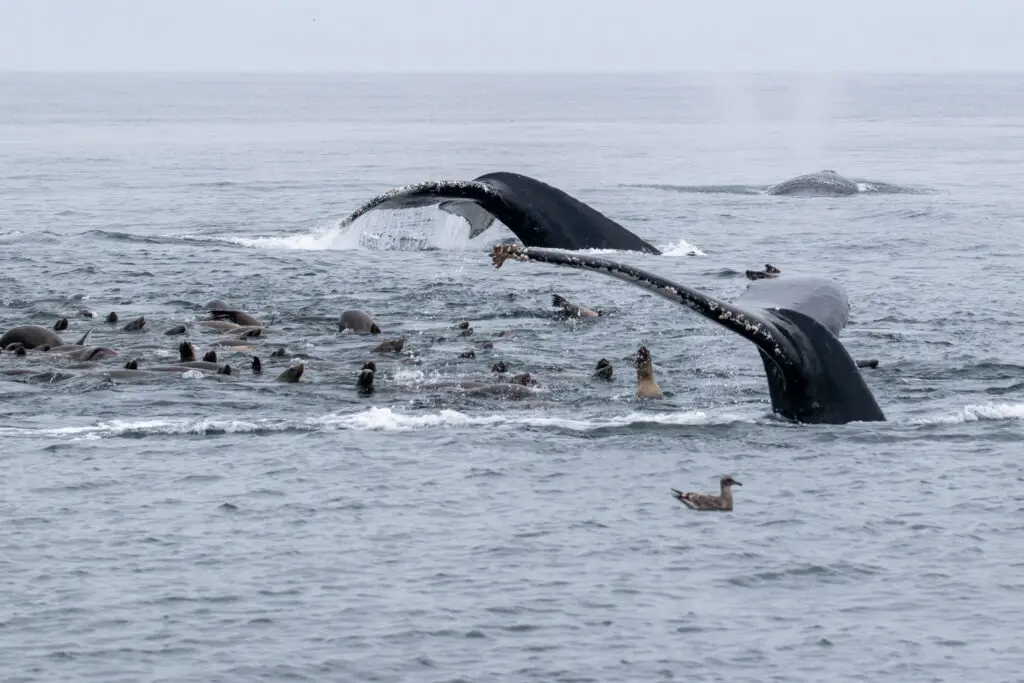
- Apex Predators & Megafauna: Marine mammals—including harbor seals, sea lions, elephant seals, humpback whales, blue whales, and white sharks—rely on this dense concentration of biomass to feed, breed, and migrate.
Resilience Amid Crisis: The Kelp Forest Battleground
Despite global stressors like marine heatwaves ("The Blob") and population explosions of purple sea urchins that have decimated kelp forests from Baja California to Alaska, the waters within the Greater Farallones have shown extraordinary pockets of resilience.
Through aggressive, community-backed restoration efforts—such as the Greater Farallones Association’s bull kelp restoration initiatives—scientists and local stewards are actively fighting back against ecological collapse. These efforts prove that marine sanctuaries are not just passive lines drawn on a nautical map; they are active management zones where human intervention can turn the tide against environmental degradation.
Official Statements: Voices from the Forefront of Ocean Stewardship
The collaborative ethos of Swim California is reflected in the passionate voices of the leaders heading up its core partner organizations.
Shannon McIntyre Rake, Senior Hope Spots Program Manager at Mission Blue, emphasizes the unifying power of the expedition:
"Catherine Breed’s Swim California journey is a powerful celebration of the people and places working to protect our shared ocean. As she swims through the Greater Farallones Hope Spot—and several other Hope Spots along the California coast—she is helping connect these extraordinary marine ecosystems and the communities committed to their care. Hope Spots remind us that meaningful ocean protection begins with local leadership, grows through collaboration, and can inspire action far beyond any one coastline."
Monika Krach, Executive Director of the Greater Farallones Association, highlights the deep historical roots of local conservation:
"Every mile of Catherine’s journey through the Greater Farallones National Marine Sanctuary tells a story of conservation. She’ll swim past beaches monitored by generations of Beach Watch volunteers, through waters where we’re restoring bull kelp forests, and in one of the world’s most productive marine ecosystems. We’re proud to help share the stories of the people and partnerships working to protect this extraordinary place."
Future Outlook: Translating Endurance into Lasting Policy and Public Action
As Swim California pushes past Bodega Bay and continues its historic southbound journey toward the finish line, the long-term impacts of the expedition are already taking shape. The partnership between elite athletics, documentary storytelling (courtesy of Allez! Sports), and grassroots advocacy is establishing a new blueprint for environmental campaigns.
The Role of Partner Coalitions
- Mission Blue®: Founded by legendary oceanographer Dr. Sylvia Earle, the global Hope Spot initiative uses high-profile expeditions to elevate local conservation sites into the international spotlight, building political and financial momentum for permanent legal protections.
- Blue Frontier: By bridging the gap between grassroots leaders, marine scientists, and policymakers, Blue Frontier ensures that the inspiration generated by Breed’s swim is channeled into tangible civic engagement and coastal policy reforms.
- Sea Dreamers: Dedicated to connecting women and girls to the ocean through adventure and education, Sea Dreamers ensures that the next generation of aquatic stewards is diverse, empowered, and equipped to tackle future environmental challenges.
A Legacy Carved in Saltwater
When Catherine Breed finally completes her 900-mile odyssey, she will have done more than cross a physical finish line. She will have woven together a fractured coastline of isolated communities, research institutions, and protected waters into a unified movement.
The story of Bodega Bay—a story of kelp restoration, vigilant citizen science, and sanctuary resilience—will echo far beyond the shores of Sonoma County. Through sweat, endurance, and uncompromising public outreach, Swim California proves that while the challenges facing our oceans are immense, human resolve, collaboration, and hope are infinitely more powerful.



