

Executive Overview
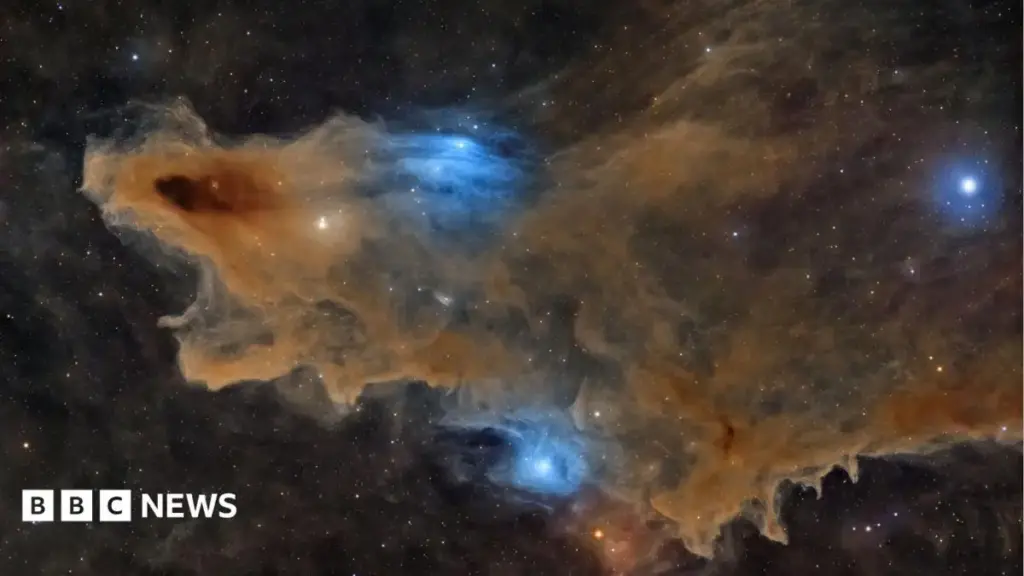
In a stunning triumph for astrophotography, the Royal Observatory Greenwich has crowned Ali Alobaidly as the overall winner of its prestigious Astronomy Photographer of the Year competition for 2026. Alobaidly’s masterwork—a mesmerizing, hyper-detailed capture of the ethereal Shark Nebula—secured the top honor amid a fiercely competitive field of nearly 4,000 entries submitted from 66 countries across the globe.
The winning image, captured from the arid skies of Kuwait, transcends traditional astrophotography by offering an unprecedented visual journey into a massive cloud of interstellar dust situated 650 light-years away from Earth. Characterized by its haunting silhouette that mirrors the predatory grace of an ocean shark, the nebula acts as a cosmic canvas. In Alobaidly’s frame, it is rendered with such depth and precision that distant, ancient galaxies shine through the opaque interstellar medium, revealing the staggering scale of the universe.
For his achievement, Alobaidly was awarded the coveted grand prize of £10,000. Beyond the financial reward, the victory places him in an elite echelon of astrophotographers whose work bridges the gap between hard science and profound artistic expression. The announcement, made during a special ceremony at the Royal Observatory Greenwich, marks another milestone for a competition that has spent over a decade and a half celebrating the intersection of human creativity, technological innovation, and the raw beauty of the cosmos.
Detailed Chronology: From Kuwaiti Skies to Global Recognition
The journey toward this monumental victory began long before the judges at the Royal Observatory Greenwich cast their final votes. Understanding the magnitude of Alobaidly’s achievement requires examining the meticulous, often grueling timeline of modern astrophotography—a discipline where patience, technological mastery, and environmental conditions collide.
Phase One: Preparation and Capture
The winning image was conceived and executed in the skies above Kuwait, a location presenting unique challenges and opportunities for astrophotographers. While the region is renowned for its clear nights, high ambient temperatures, light pollution, and atmospheric turbulence require sophisticated equipment and rigorous calibration techniques.
Alobaidly targeted the Shark Nebula (cataloged scientifically as part of the wider complex in the constellation Cepheus) during optimal viewing windows. Utilizing specialized astronomical cameras, narrowband filters, and equatorial mounts, he accumulated hours of exposure time. Because dark nebulae are inherently opaque—composed of dense cosmic dust that absorbs and scatters optical light—capturing their subtle gradients and internal structures demands extreme integration times. Every photon of starlight cutting through the nebula had to be painstakingly captured, calibrated, and stacked to eliminate noise and atmospheric distortion.
Phase Two: The Global Submission Window
As the submission portal for the 2026 competition opened, hopefuls from 66 countries uploaded their finest celestial portraits. The competition, administered by the Royal Observatory Greenwich and sponsored by leading scientific institutions, received nearly 4,000 entries. These submissions spanned multiple categories, ranging from Aurorae and Planets, Comets and Asteroids to Skyscapes and the fiercely contested Stars and Nebulae category, where Alobaidly initially entered his work.
Phase Three: Rigorous Judging and Technical Verification
The evaluation process for the Astronomy Photographer of the Year competition is notoriously rigorous. A panel comprising world-leading astronomers, professional photographers, and science communicators spent weeks vetting the entries.
The judges look for more than mere aesthetic appeal; they perform technical checks to verify authenticity, assessing the fidelity of data processing and ensuring that digital enhancements do not cross the line into scientific fabrication. Alobaidly’s image of the Shark Nebula successfully navigated these stringent checks, stunning the panel with its technical perfection and revealing layers of the cosmos that typically elude standard amateur setups.
Phase Four: The Grand Announcement
The culmination of this arduous process arrived when the Royal Observatory Greenwich officially announced Alobaidly as the overall winner. The verdict resonated instantly across the global astronomical community, validating the photographer’s exhaustive fieldwork and solidifying the competition’s status as the premier global platform for night-sky imaging.
Supporting Context & Metrics: The Science of the Shark Nebula
To fully appreciate why Alobaidly’s image captivated the judging panel, one must delve into the astrophysical reality of the subject matter, as well as the statistical landscape of the 2026 competition.
The Astrophysical Marvel: The Shark Nebula
Located approximately 650 light-years from Earth, the Shark Nebula is a dark nebula—a type of interstellar cloud so dense that its internal dust grains absorb visual light emitted by background stars. Unlike emission nebulae, which glow from the ionization of gas by nearby energetic stars, or reflection nebulae, which scatter light from nearby stars, dark nebulae loom as silhouetted titans against the luminous backdrop of the Milky Way.
+-----------------------------------------------------------------+
                 THE SHARK NEBULA PROFILE
+-----------------------------------------------------------------+
| Distance from Earth : ~650 light-years                          |
| Classification      : Dark Nebula / Molecular Cloud             |
| Constellation       : Cepheus                                   |
| Primary Feature     : Dense interstellar dust blocking starlight|
| Defining Element    : Transparency revealing distant galaxies   |
+-----------------------------------------------------------------+
The nebula forms part of a vast molecular cloud complex in the constellation Cepheus. Within these stellar nurseries, gravitational forces compress the gas and dust, eventually igniting new generations of stars. However, it was not merely the dark, sweeping fins and head of the cosmic predator that drew acclaim; it was what lay beyond.
As Steve Marsh noted, Alobaidly’s processing resolved the nebula to such a fine degree that distant galaxies—situated millions or even billions of light-years further out in the deep universe—are visible peering through the translucent edges of the dust cloud. This layering of foreground stellar nurseries and background galactic architecture creates a profound sense of three-dimensional depth, transforming a two-dimensional photograph into an existential window across space and time.
Statistical Overview of the 2026 Competition
The scale of the 2026 Astronomy Photographer of the Year competition underscores its international prestige and the booming popularity of astrophotography as both a hobby and an art form:
- Total Entries: Nearly 4,000 submissions.
- Geographic Diversity: Participants representing 66 countries across all inhabited continents.
- Grand Prize Award: £10,000 presented to the overall winner.
- Categories: Encompassing Stars and Nebulae, Aurorae, Galaxies, Our Sun, Our Moon, Skyscapes, Young Competition, and the People’s Choice award.
These figures illustrate a rapidly expanding global community. Driven by advancements in consumer-grade telescope optics, cooled CMOS sensors, and sophisticated stacking software (such as PixInsight and DeepSkyStacker), everyday enthusiasts are now capable of capturing imagery that rivals the output of professional observatories from previous decades.
Official Statements and Expert Analysis
The announcement of Ali Alobaidly’s victory brought forth glowing commentary from the adjudication panel and heartfelt reflections from the winner himself. The consensus among the judges was that Alobaidly had achieved a rare harmony between rigorous technical execution and poetic framing.
The Judges’ Perspective
Steve Marsh, an art editor at BBC Sky at Night Magazine and a veteran judge for the competition, offered a detailed critique of the winning photograph. He praised its execution, stating:
"The image presented by Ali Alobaidly shows flawless presentation, pin-sharp details, and dynamic contrast. The Shark Nebula is already a striking object, but when it is resolved to the point where even detail-rich distant galaxies can be seen through it, you know you’re looking at something very special."
Marsh’s assessment highlights the core challenge of photographing dark nebulae: balancing the intense brightness of foreground or adjacent star fields with the deep, murky shadows of the molecular cloud, all while preserving subtle details hidden deep within the dust lanes.
Other members of the judging panel echoed these sentiments, noting that Alobaidly’s color calibration and star-reduction techniques allowed the true organic textures of the nebula to take center stage without being overwhelmed by bloated star halos.
The Winner’s Reflection
Reflecting on his monumental victory, Ali Alobaidly expressed deep humility and outlined his overarching mission as a visual storyteller of the cosmos. Accepting the award and the £10,000 grand prize, Alobaidly remarked:
"Winning this award is a tremendous honour. Astronomy has the unique power to put our daily lives into perspective, reminding us of our place in a vast, interconnected universe. Through my photography, I hope to make astronomy more accessible, engaging, and meaningful through science communication and education."
Alobaidly’s vision aligns with a growing movement among modern astrophotographers who view their craft not merely as aesthetic documentation, but as an essential tool for public science engagement. By lowering the psychological barrier to entry through stunning visual art, photographers like Alobaidly inspire younger generations to look up, question the cosmos, and pursue careers in STEM (Science, Technology, Engineering, and Mathematics) fields.
Future Outlook: The Evolution of Astrophotography and Public Engagement
As the dust settles on the 2026 Royal Observatory Greenwich competition, industry analysts and astronomical societies are looking ahead to the future of the discipline. The success of Ali Alobaidly’s image of the Shark Nebula signals several transformative trends in how humanity interacts with the night sky.
Technological Horizons
The boundary between amateur and professional astronomy continues to dissolve. With commercial manufacturers introducing increasingly sensitive sensors, adaptive optics systems for home setups, and AI-assisted processing algorithms, the resolution limits of ground-based astrophotography are continually being pushed outward.
In the coming years, we can expect to see even deeper captures of obscure cosmic phenomena from backyard observatories located in dark-sky reserves around the world. As equipment becomes more portable and automated, astrophotographers will increasingly venture into remote regions—much like Alobaidly did in Kuwait—to escape urban light pollution and capture pristine data.
The Role of Art in Science Communication
Institutions like the Royal Observatory Greenwich play a vital role in validating astrophotography as a legitimate artistic and scientific medium. By showcasing works like the Shark Nebula to millions of visitors and digital spectators annually, these exhibitions democratize space exploration.
In an era defined by complex space missions—such as the James Webb Space Telescope and upcoming orbital observatories—ground-based astrophotographers serve as vital ambassadors. They translate abstract scientific data and distant cosmic structures into visceral, emotionally resonant art that resonates with the general public.
Alobaidly’s Next Chapters
For Ali Alobaidly, the £10,000 grand prize and global platform provide a springboard for future educational initiatives. Plans are already underway to utilize his platform for science communication workshops, public exhibitions, and educational outreach programs designed to bring the wonders of deep-space imaging to schools and community centers.
As humanity continues its eternal quest to understand the cosmos, images like Alobaidly’s Shark Nebula serve as luminous reminders of our curiosity. They bridge the chasm between the cold vacuum of space and the warmth of human imagination, ensuring that the night sky will forever remain a source of infinite inspiration.



