

Executive Overview
The global automotive landscape is undergoing a structural transformation, driven largely by the relentless expansion of China’s electric vehicle (EV) export machine. Far from slowing down, Chinese automakers are scaling production and penetrating international markets at an unprecedented velocity. New data released by energy think tank Ember reveals that China shipped a staggering $9.2 billion worth of electric vehicles overseas in May, marking a formidable 49% increase year-over-year. This latest figure eclipses the previous monthly benchmark of $9.1 billion set just a month prior in April.
While much of the Western discourse surrounding Chinese EV expansion focuses heavily on trade friction in Europe and North America, a more profound transformation is quietly taking place in China’s backyard. Southeast Asia (ASEAN) has rapidly evolved into one of the most dynamic, fast-growing consumer bases for electric mobility on the planet. Driven by aggressive governmental policy shifts, localized manufacturing investments, soaring consumer demand for affordable models, and acute macroeconomic pressures—such as volatile fuel prices tied to Middle Eastern geopolitical conflicts—Southeast Asia is supercharging the global EV revolution.
This deep-dive report examines the mechanics behind China’s record-breaking export metrics, explores the localized policy catalysts transforming nations like Thailand, the Philippines, Cambodia, and Laos, and analyzes the broader geopolitical and economic ramifications of an accelerating Asian energy transition.
Detailed Chronology: The Ascent of China’s EV Exports
To understand the magnitude of China’s current export milestone, one must contextualize the sheer speed of its evolution. As recently as 2020, China’s monthly EV exports were valued at under $1 billion. Within a few short years, state-backed industrial policy, aggressive supply chain vertical integration, and hyper-competitive domestic pricing transformed the country into an industrial powerhouse capable of supplying the world.
The Spring 2026 Surge
- April 2026: China establishes a high-water mark for monthly outbound shipments, exporting approximately $9.1 billion worth of electric passenger vehicles. Industry analysts initially viewed this as a seasonal peak, but market momentum proved otherwise.
- May 2026: China shatters its own record, pushing outbound EV shipment values to $9.2 billion—a 49% year-over-year surge.
- Vehicle Breakdown: Out of roughly 448,000 total electric passenger vehicles shipped internationally during May, battery-electric vehicles (BEVs) accounted for approximately 279,000 units, while plug-in hybrid electric vehicles (PHEVs) contributed another 169,000 units.
This diversification in powertrain exports highlights a critical strategic advantage: Chinese manufacturers are not wedded to a single technological approach. By offering both high-efficiency BEVs for urban centers with robust grid networks and adaptable PHEVs for regions with developing charging infrastructure, Chinese brands like BYD, Chery, and Great Wall Motor can capture disparate consumer segments across emerging markets.
Supporting Context & Metrics: The ASEAN Phenomenon
While Europe remains a massive battleground for Chinese EV imports—despite the imposition of contentious tariffs—the Association of Southeast Asian Nations (ASEAN) block has emerged as an exceptionally high-growth frontier. In May alone, Chinese EV exports to ASEAN countries reached an unprecedented $1.2 billion.
Country-by-Country Breakdown
Thailand: The Regional Heavyweight
Thailand continues to anchor Southeast Asia’s electric vehicle transition, importing more than 36,000 Chinese EVs in May alone. Long known as the "Detroit of Asia" for its dominance in traditional internal combustion engine (ICE) vehicle assembly, Thailand has successfully pivoted its automotive strategy. Through targeted subsidies (such as the EV 3.5 package), tax exemptions, and infrastructure development grants, the Thai government has incentivized Chinese automotive giants to establish local manufacturing hubs, ensuring that the country remains a dominant player in the regional supply chain.
The Philippines: Rapid Urban Adoption
Close behind is the Philippines, where imports of Chinese electric vehicles topped 33,000 units in May. Urban centers like Metro Manila, plagued by severe traffic congestion and high urban air pollution, are finding affordable Chinese EVs—particularly compact city cars and electric commercial fleets—to be an attractive solution for lowering urban emissions and mitigating daily commuting costs.
Cambodia: Zero-Duty Incentives
Cambodia has entered the EV race with aggressive fiscal policy levers. In late March, the Cambodian government enacted a sweeping customs duty exemption, cutting tariffs on BEVs down to zero while slashing PHEV tariffs from 35% down to just 7%. While BEVs currently dominate the influx of Chinese vehicles entering the country, the lowered threshold for PHEVs has stimulated a secondary tier of consumer interest, particularly among buyers wary of range anxiety in rural provinces.
Laos: Radical Policy Shifts and Fossil Fuel Reductions
Laos has engineered one of the most aggressive green transportation mandates in the developing world. Alongside reduced vehicle registration and service fees, the Laotian government has instituted a strict mandate requiring commercial transportation companies to ensure that electric vehicles comprise at least 10% of their operational fleets by the end of 2026.
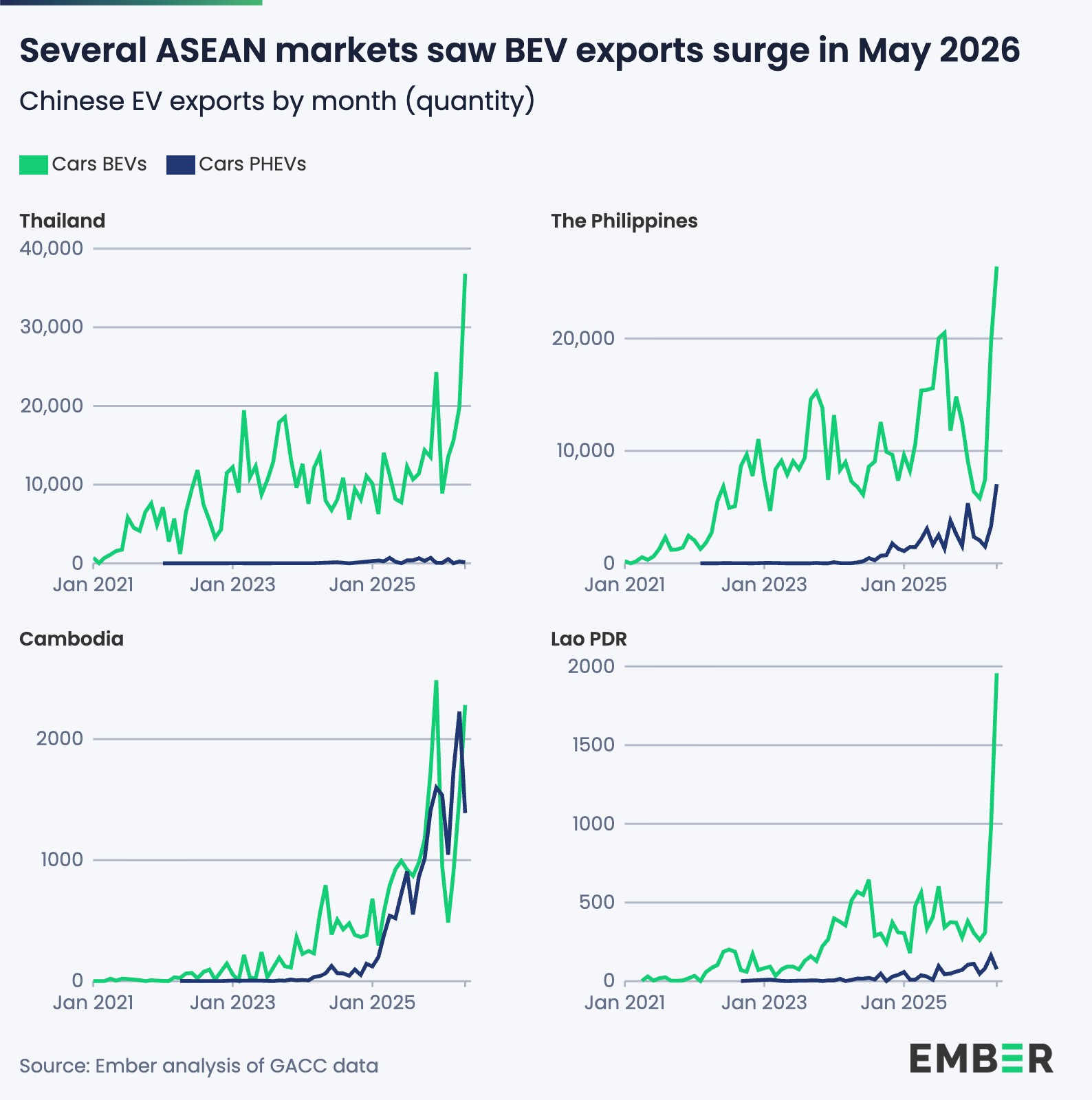
Perhaps most dramatically, in May, Laos implemented a temporary ban on imports of traditional internal combustion engine (ICE) cars through the end of the year. Designed explicitly to curb the nation’s heavy economic dependence on imported fossil fuels, this bold policy experiment is expected to dramatically accelerate local EV adoption metrics as the year progresses.
The Macroeconomic Catalyst: Energy Security and Fuel Pressures
While government incentives have laid the legislative groundwork for electrification, external macroeconomic forces have acted as an accelerant. Global energy markets have faced persistent volatility, driven largely by ongoing conflicts and instability in the Middle East. For import-dependent developing nations across Southeast Asia, fluctuating crude oil prices place an immense burden on national trade balances and consumer pocketbooks.
This vulnerability has forced a fundamental re-evaluation of national energy strategies. Electrification is no longer viewed merely as an environmental crusade, but as an indispensable pillar of national security and economic resilience.
"The current energy crisis has reinforced the value of electrification as a pathway to greater energy security, reduced fuel import exposure, and long-term transport cost savings," noted Lam Pham, Ember’s energy analyst for Asia.
When fuel pumps become unpredictably expensive, the total cost of ownership (TCO) calculation for electric vehicles shifts dramatically in favor of plug-in models—especially in countries where domestic or regional renewable energy generation is expanding. By cutting out imported oil, nations can insulate their economies from external geopolitical shocks while keeping transportation expenditures stable for everyday citizens.

Official Statements and Industry Insights
The pace and scale of this transition have caught the attention of global energy researchers, who view the Southeast Asian market as a bellwether for broader trends in the Global South.
Euan Graham, Senior Electricity and Data Analyst at Ember, emphasized the structural permanence of this shift:
"Southeast Asia is fast becoming one of the most dynamic destinations for electric vehicles, and China is supplying that demand at scale and speed. This is not a temporary blip; it is a fundamental realignment of how emerging economies approach mobility."
Industry analysts point out that Chinese automakers have achieved a rare synergy: they possess the manufacturing capacity to scale production infinitely, the financial backing to weather price wars, and the agility to adapt vehicle configurations to the unique regulatory and infrastructural demands of developing nations. Rather than attempting to force identical models onto every market, Chinese brands have deployed localized strategies—ranging from right-hand-drive adaptations in Thailand to ultra-affordable urban runabouts in the Philippines.
Future Outlook: What Lies Ahead for the Global EV Market
As the global automotive industry looks toward the remainder of the decade, the trajectory of Chinese EV exports to Southeast Asia offers clear signposts for the future.

- Supply Chain Localization: Chinese automakers are moving beyond simple export models. To insulate themselves against potential future trade barriers and to secure long-term market share, companies like BYD, GAC Aion, and Changan are investing billions of dollars into localized manufacturing and assembly plants within ASEAN nations—particularly in Thailand and Indonesia.
- Infrastructure Maturation: As import volumes soar, regional governments are under immense pressure to scale charging infrastructure. We can expect increased public-private partnerships focused on fast-charging corridor development along major ASEAN trade and transit routes.
- Commercial Fleet Electrification: With mandates like those in Laos taking effect, commercial fleets—including logistics providers, ride-hailing networks, and public transit systems—will transition to electric power at an accelerated pace. This will expose millions of daily consumers to EV technology, further driving private adoption.
- Western Strategic Re-evaluations: While Western policymakers focus on erecting protective tariffs to shield domestic automakers from Chinese competition, the rapid electrification of Southeast Asia demonstrates that the rest of the world is embracing affordable electric mobility at breakneck speed. Markets that fail to compete on cost, innovation, and infrastructure risk ceding leadership in the defining industrial transition of the 21st century.
Electrek’s Take
Southeast Asia frequently occupies a blind spot in Western-centric discussions regarding global EV adoption, which tend to disproportionately focus on Europe, the United States, and domestic developments within China. Yet, to overlook ASEAN is to miss one of the most explosive growth engines in modern industrial history.
Chinese automakers have executed a textbook masterclass in market expansion: entering the region with highly competitive price points, securing foundational local partnerships, and capitalizing on progressive government incentives. When compounded with the acute energy crises sparked by Middle Eastern instability, Southeast Asian EV adoption has effectively been shifted into turbo mode.
The record-breaking export figures seen in May are not an isolated anomaly; they are the logical output of a synchronized global supply chain meeting desperate regional demand for energy independence. As long as Chinese manufacturers continue to deliver affordable, high-utility electric vehicles precisely where emerging markets need them most, the upward trajectory of these export records will remain unbroken.



