

Executive Overview
Over the past decade, municipalities across North America and Europe have poured billions of dollars into organic waste collection infrastructure. On paper, the transition is a resounding success: curbside food scrap collection programs are expanding at a historic pace. According to a nationwide survey by BioCycle, approximately 14.9 million U.S. households had access to curbside food waste collection in 2023—a staggering 49 percent increase from the 10 million households recorded just two years prior.
Yet, beneath these encouraging capital deployment figures lies a stubborn operational reality: the "participation gap." While access to green bins has reached record highs, actual household utilization remains highly volatile. In some progressive urban centers, participation approaches near-universal levels; in many others, it languishes below 30 percent.
This utilization gap represents an ecological and financial crisis for municipal solid waste (MSW) departments. Food waste comprises approximately 24 percent of the municipal solid waste stream currently sent to U.S. landfills. Once buried in an anaerobic environment, this organic matter decomposes to produce methane ($CH_4$), a potent greenhouse gas. The Environmental Protection Agency (EPA) estimates that food waste in landfills is responsible for 58 percent of all fugitive methane emissions released from these facilities.
+-----------------------------------------------------------------------+
|                       THE U.S. LANDFILL CRISIS                        |
|                                                                       |
|   [ All Municipal Solid Waste ] ---> 24% is Food Waste                |
|                                                                       |
|   [ Fugitive Methane Emissions ] --> 58% originates from Food Waste   |
+-----------------------------------------------------------------------+
When a household declines to use its municipal organics cart—whether it is green, brown, or black—the municipal investment in collection vehicles, sorting facilities, and processing sites is undermined. An unused bin is not merely a neutral outcome; it is an active failure of climate mitigation infrastructure.
While policy analysts often attribute low participation rates to conceptual hurdles like public confusion or lack of environmental awareness, field research reveals a far more visceral obstacle: the "yuck factor." The physical maintenance of the organic waste cart—characterized by putrid liquids, offensive odors, insect infestations, and the grueling chore of manual bin washing—creates a point of friction that frequently causes households to abandon the program entirely.
To bridge this behavioral gap, modern waste management must look beyond macro-level infrastructure and address the micro-level ergonomics of the household kitchen and curbside cart. This investigative report explores the mechanics of organic waste decay, the systemic limitations of current municipal policies, and the emerging consumer-tech solutions, such as the BagEZ suspension system, designed to eliminate the physical friction of household composting.
Detailed Chronology: The Evolution of Curbside Composting
The trajectory of municipal organic waste recovery can be divided into three distinct phases, mapping the transition from localized conservation efforts to industrialized systems, and finally to the modern behavioral bottleneck.
  PHASE 1: Backyard Composting (Pre-2000s)
  * Grassroots, decentralized, highly localized.
  * Required high user effort and outdoor space.

  PHASE 2: Municipal Infrastructure Boom (2000s–2020s)
  * Massive municipal rollouts of curbside "Green Bins."
  * BioCycle reports 49% growth in access from 2021 to 2023.

  PHASE 3: The Behavioral Friction Era (Present)
  * Infrastructure is ready, but participation is uneven.
  * The "Yuck Factor" emerges as the primary barrier to adoption.
Phase 1: The Decentralized Era (Pre-2000s)
For decades, organic waste recovery was a highly decentralized, grassroots endeavor. Backyard composting was championed by dedicated hobbyists and environmental advocates. However, this model was structurally incapable of achieving scale. It excluded apartment dwellers, multi-family residential complexes, and households lacking the time, physical space, or physical capability to manage a compost pile. The vast majority of household organic waste was routed directly to landfills alongside mixed municipal solid waste.

Phase 2: The Municipal Infrastructure Boom (2000s–2020s)
Recognizing that landfill diversion targets could not be met through voluntary home composting, pioneering cities began piloting municipal organic waste collection programs. Toronto launched its landmark "Green Bin" program in 2002, proving that centralized collection, industrial composting, and anaerobic digestion could process organic matter at an urban scale. Over the next two decades, cities from San Francisco to New York City followed suit, deploying dedicated curbside carts to millions of homes.
By 2023, the scale of this infrastructure was unprecedented. The BioCycle survey documented a massive leap in residential access, reflecting a broader societal shift toward mandatory composting laws, such as California’s landmark SB 1383 legislation, which requires all jurisdictions to provide organic waste collection services to residents and businesses.
Phase 3: The Behavioral Friction Era (Present)
Today, municipal waste management is in its third phase: the behavioral era. The physical infrastructure—the collection trucks, industrial composting facilities, and anaerobic digesters—is largely built and operational. The primary challenge is no longer technological or regulatory; it is behavioral.
As programs expand beyond self-selected, environmentally conscious early adopters to the general public, municipalities are confronting a steep drop-off in sustained participation. The initial novelty of the green bin frequently gives way to frustration when residents encounter the realities of managing decomposing organic material in their homes and yards. This has shifted the focus of industry researchers from logistics to behavioral psychology, seeking to understand exactly why households abandon the green bin.
Supporting Context & Metrics: The Behavioral Science of the "Yuck Factor"
To understand why households quit curbside composting, one must examine the physical and biological processes that occur inside a standard organic waste cart.
The Physics of Decay and Moisture Accumulation
Food waste is primarily composed of water. Common household organic waste, particularly fruit peels, vegetable scraps, and coffee grounds, can consist of up to 80 to 90 percent moisture by weight. As cellular structures break down during cellular respiration and subsequent microbial decomposition, this water is liberated.
In a standard curbside green bin, plastic or compostable bags filled with waste are tossed directly onto the floor of the cart. Under the weight of subsequent additions, these bags compress. The trapped moisture, mixed with soluble organic compounds, leaks through thin compostable liners or escapes during decomposition.
This liquid pools at the bottom of the bin, creating a stagnant, anaerobic slurry. This liquid—often referred to as "leachate" or "bin juice"—is the primary source of the foul odors associated with organic waste.

+-------------------------------------------------------------------+
|                  THE PATHOLOGY OF THE "YUCK FACTOR"               |
|                                                                   |
|   [ High-Moisture Waste ] ---> Cellular Breakdown                 |
|                                                                   |
|   [ Liquid Release ] --------> Pools at Bottom of Cart            |
|                                                                   |
|   [ Anaerobic Slurry ] ------ -> Foul Odor (Volatile Fatty Acids) |
|                                                                   |
|   [ Pest Attraction ] -------> Flies, Maggots, and Rodents        |
+-------------------------------------------------------------------+
The Odor Profile and Pest Vectors
As anaerobic conditions develop at the bottom of the cart, bacteria produce volatile organic compounds (VOCs), including hydrogen sulfide ($H_2S$), ammonia ($NH_3$), and volatile fatty acids. These compounds release a strong, offensive odor that serves as an open invitation to pests.
Houseflies (Musca domestica) and blowflies (Calliphoridae) are highly sensitive to these chemical signatures. They lay eggs in the moist, decaying matter, leading to maggot infestations within days during warm weather. For many residents, the sight of maggots writhing inside their municipal green bin is a psychological point of no return. The bin is wheeled to the side of the house, the lid is closed permanently, and organic waste is redirected back to the standard trash bin, where it is buried in plastic garbage bags that mask the smell and deter pests.
The Quantitative Reality of Household Waste
Many consumers and municipal planners overestimate the physical volume of organic waste generated by the average household, leading to mismatched containment strategies.
The most comprehensive empirical look at this issue is the MITRE-Gallup state of food waste study, which surveyed nearly 10,000 U.S. households. The findings show that the average household produces approximately 6.2 cups of food waste per week, which rises to 8.8 cups when factoring in inedible scraps like fruit peels, vegetable cores, and animal bones.
+-------------------------------------------------------------------+
|               AVERAGE WEEKLY HOUSEHOLD FOOD WASTE                 |
|                                                                   |
|   [ Edible Food Waste ] -------------> 6.2 cups                   |
|   [ Inedible Scraps (Peels/Bones) ] --> 2.6 cups                   |
|   =================================================               |
|   TOTAL WEEKLY OUTPUT ---------------> 8.8 cups (~0.55 Gallons)    |
+-------------------------------------------------------------------+
At roughly 0.55 gallons of total food waste per week, the volume is remarkably small. Yet, municipalities routinely issue large, 13-gallon, 32-gallon, or even 64-gallon carts to handle this waste. When a tiny fraction of a gallon of wet food waste is dropped into a massive, unlined plastic cart, it smears against the walls, dries into a crust, or pools at the bottom. The physical scale of the bin is fundamentally mismatched with the volume of the waste, exacerbating the cleaning challenge.
Comparative Analysis of Waste Management Strategies
| Parameter | Method A: Municipal/Private Cleaning Services | Method B: Large Full-Bin Cart Liners | Method C: BagEZ Suspension System |
|---|---|---|---|
| Financial Model | Recurring service fee ($10–$30 per cleaning). | Recurring cost for oversized specialty bags ($1.50–$3.00/bag). | One-time hardware purchase; uses standard kitchen bags. |
| Environmental Impact | High water consumption; detergent runoff into storm drains. | High plastic/compostable material consumption per household. | Low material footprint; optimizes existing bag usage. |
| Operational Ease | Requires scheduling; bin must be left out for cleaning crew. | Heavy bags can slip, tear, or collapse inside the cart. | Keeps bags suspended and open; clean removal on pickup day. |
| Odour & Pest Control | Reactive (cleans mess after it has already rotted). | Moderate; does not prevent moisture pooling at the bottom. | Proactive; 360° air gap prevents moisture condensation. |
Official Statements and Empirical Evidence
To evaluate solutions to this behavioral bottleneck, waste management experts emphasize the need to study real-world pilot programs.
The Essex County Council Case Study
A major empirical test of low-friction composting interventions occurred during the 2023–2024 fiscal year in the United Kingdom. The Essex County Council launched a comprehensive Food Recycling Project targeting more than 375,000 households. The initiative was designed to test whether providing residents with tools to reduce the mess of food recycling would drive sustained behavioral changes.
The council distributed a targeted kit to residents containing:

- An informative instructional leaflet.
- A prominent reminder sticker placed directly on the lid of the general waste bin.
- A free roll of compostable liners designed to fit household food caddies.
The results were immediate. Over the first three months of the project, food recycling tonnage across the participating areas rose by an average of 21 percent compared to a matched control group that did not receive the kit. This result was more than double the council’s initial 10 percent target.
+-------------------------------------------------------------------+
|             ESSEX COUNTY FOOD RECYCLING PROJECT RESULTS           |
|                                                                   |
|   [ Target Tonnage Increase ] --------> 10%                       |
|   [ Actual Achieved Increase ] -------> 21%                       |
|                                                                   |
|   *Key Takeaway: Providing direct tools to keep bins clean        |
|    more than doubles the efficacy of public outreach alone.       |
+-------------------------------------------------------------------+
While the Essex study proved that providing clean-bin tools works, it also highlighted a structural challenge: cost. Free liner distribution campaigns are expensive public subsidies that most municipalities cannot afford to maintain indefinitely. Once the free rolls run out, households are expected to purchase their own liners. If the purchasing process is inconvenient or expensive, participation rates often slide back toward baseline levels.
The Developer’s Perspective: Engineering Out the Friction
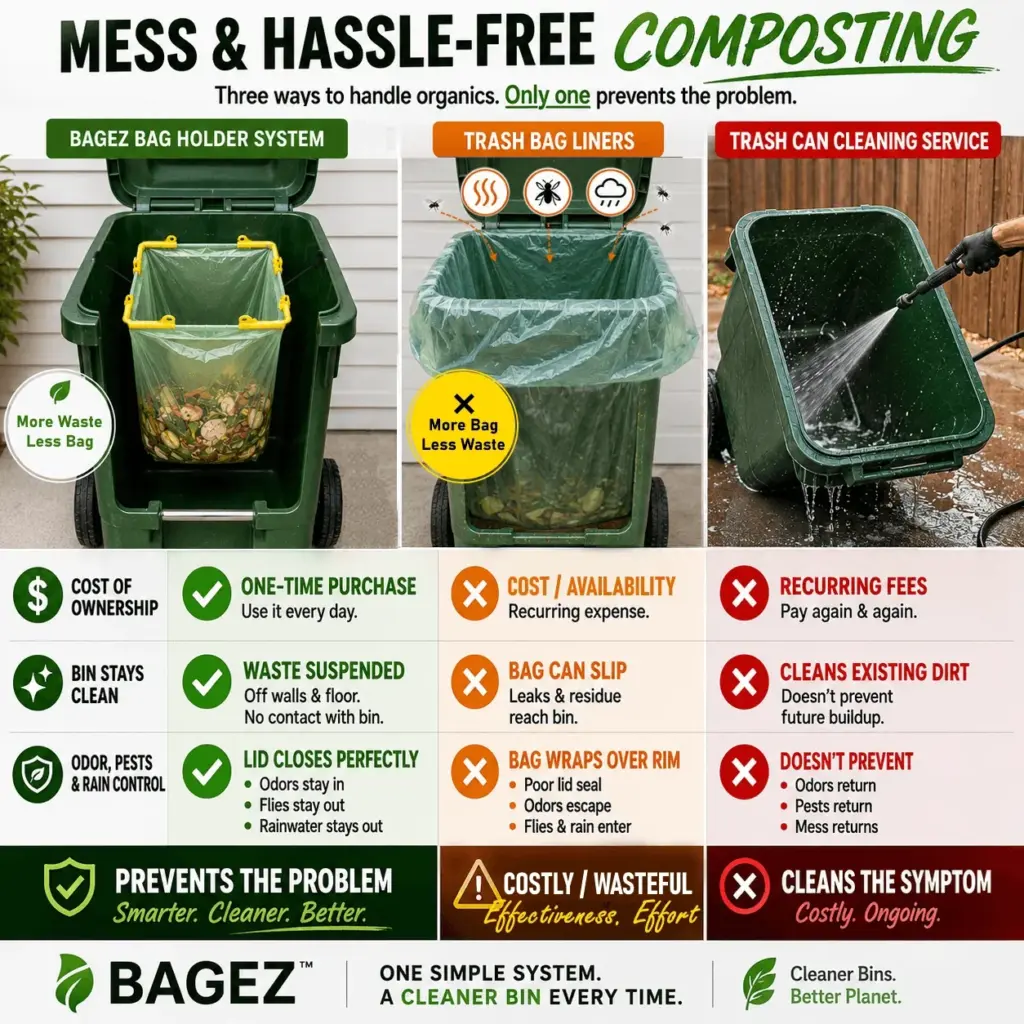
Sean Rana, the founder of the Canadian waste-solutions firm BagEZ, designed his company’s core product to address the financial and mechanical issues that cause people to stop using green bins.
"We constantly hear the same story from homeowners," Rana explains. "They start the green bin program with the best intentions. But within a month, the bin becomes a disgusting mess. Cleaning it out turns into a recurring, unpleasant chore. Eventually, they decide the hassle isn’t worth it, and they quiet-quit the program. We realized that if you want to save the composting program, you have to save the homeowner from the chore of cleaning the bin."
Rana’s engineering team focused on the physics of bag containment inside large municipal carts. "The primary flaw in standard cart usage is that the bag rests directly on the bottom and sides of the bin," Rana notes. "This traps moisture, causes condensation, and leads to tears. By using a suspended steel frame, we keep the bag completely elevated."
   STANDARD METHOD                      BAGEZ METHOD
+--------------------+               +--------------------+
|                    |               |   [BagEZ Frame]    |
|                    |               |        |   /      |
|                    |               |        |  /       |
|  +--------------+  |               |    +------+        |
|  |  Wet Waste   |  |               |    | Wet  |        |
|  |  Compresses  |  |               |    |Waste | <--- 360-Degree
|  |  At Bottom   |  |               |    +------+      Air Flow
|  +--------------+  |               |                    |
| [Moisture Pools]   |               | [No Contact/Dry]   |
+--------------------+               +--------------------+
This suspension mechanism creates a 360-degree air gap around the bag. Air circulates underneath and around the sides, allowing moisture to evaporate naturally rather than condensing and pooling at the bottom. "When the bin walls stay dry, the biological pathways that produce severe odors and attract flies are disrupted," Rana says. "You don’t need to spray out the bin with a hose because the waste never actually touches the cart."
Practical Mitigation: Household Tips for Odor and Pest Control
While mechanical suspension systems like BagEZ provide a strong foundation for a clean cart, households can use several low-cost, scientifically backed techniques to further reduce odor and pest issues.
                  +--------------------------------+
                  |   ADVANCED BIN MAINTENANCE     |
                  +--------------------------------+
                                  |
         +------------------------+------------------------+
         |                                                 |
         v                                                 v
  [ Chemistry-Based ]                               [ Barrier-Based ]
  * Baking Soda (pH buffering)                      * Newspaper Base (absorbs drips)
  * Diatomaceous Earth (larvae control)             * Peppermint/Clove Sachet (pest deterrent)
Chemistry-Based Solutions
- Baking Soda ($NaHCO_3$): A light dusting of sodium bicarbonate inside the waste bag acts as a pH buffer. Many common food odor molecules are highly acidic; baking soda neutralizes these acids, significantly reducing foul odors. Because the BagEZ system keeps the waste concentrated within a smaller, suspended bag rather than scattered across a large cart floor, a small amount of baking soda is highly effective.
- Food-Grade Diatomaceous Earth (DE): For households struggling with flies, diatomaceous earth is an effective organic control agent. DE consists of fossilized diatoms whose silica-rich shells cut through the protective waxy layer of insect larvae, dehydrating them. However, DE loses its effectiveness when wet. Maintaining a dry cart through bag suspension is a necessary prerequisite for DE to control pest populations.
Barrier-Based Solutions
- The Newspaper Base Layer: Placing a few folded sheets of dry newspaper or circular mailers at the very bottom of the green cart serves as a simple safety net. In the rare event of a bag failure or puncture during disposal, the newspaper absorbs any stray liquids, preventing them from baking onto the plastic floor of the bin.
- Natural Olfactory Deterrents: Raccoons, rodents, and urban pests hunt primarily by scent. To deter them, hang a small mesh sachet filled with cotton balls soaked in peppermint oil and whole cloves from the handle of the cart. The strong essential oils mask the smell of food waste, making the bin unappealing to animals.
Future Outlook: Policy, Behavior, and the Scaling of Organics Diversion
As cities push toward zero-waste targets, the relationship between municipal policy and consumer tech will become increasingly important.

+-----------------------------------------------------------------------+
|                    THE FUTURE OF MUNICIPAL ORGANICS                   |
|                                                                       |
|   Policy Mandates (e.g., CA SB 1383)                                  |
|         │                                                             |
|         ▼                                                             |
|   Infrastructure Readiness (Industrial Processing Plants)             |
|         │                                                             |
|         ▼                                                             |
|   User-Level Friction Solutions (BagEZ, targeted design)               |
|         │                                                             |
|         ▼                                                             |
|   High-Yield, Sustainable Diversion (Low Carbon, Low Methane)         |
+-----------------------------------------------------------------------+
The Transition from Voluntary to Mandatory Composting
The policy landscape is shifting rapidly. Following California’s lead, states like Washington, Oregon, and New York, along with major metropolitan areas across Canada, are introducing strict bans on organic waste in landfills. In these jurisdictions, sorting food scraps is no longer a voluntary lifestyle choice; it is a legally mandated utility service.
As these mandates take effect, municipal code enforcement officers are beginning to inspect residential waste bins, issuing warnings and fines to households that mix food waste with standard trash. This regulatory shift raises the stakes for homeowners. The option to simply ignore the green bin is disappearing, making simple, reliable bin maintenance tools a household necessity.
The Limitations of Municipal Standardization
Municipalities excel at procuring heavy machinery, negotiating collection contracts, and processing large volumes of waste. However, they are poorly equipped to manage the diverse everyday needs of individual kitchens. A single, standardized cart design cannot work perfectly for every living situation, from high-density urban apartments to spacious suburban homes.
This gap is where consumer-focused product design plays a vital role. By providing simple, durable hardware solutions that adapt municipal bins to actual household waste volumes, companies are resolving the friction points that top-down policies often overlook.
Conclusion: The Hinge of Environmental Habit-Formation
Ultimately, the success of global organic waste diversion programs depends on a simple, everyday reality: the willingness of a resident to open a bin and drop in a food scrap. If that action is accompanied by a cloud of fruit flies, the smell of decay, or the prospect of a messy cleaning chore, the system breaks down.
By using clever engineering to keep waste bags suspended and dry, systems like BagEZ address the root cause of household composting avoidance. Eliminating the mess makes it easy for residents to build a lasting habit, helping municipal composting programs deliver on their environmental promise.
About the Author
This investigative brief was prepared in collaboration with environmental journalists and waste management professionals. Background data and product specifications were provided by BagEZ, a Canadian firm specializing in ergonomic, sustainable waste management hardware designed to reduce household waste-stream friction. For more information on the BagEZ system, visit bagez.com.



