

Executive Overview
In a strategic move that underscores the rapid maturation of the circular economy infrastructure market, Circular Services has announced the acquisition of New York City-based Re:Dish. Circular Services, the prominent waste diversion infrastructure and operations offshoot of sustainability-focused investment firm Closed Loop Partners, is integrating Re:Dish’s end-to-end reusable container and dishware systems into its expansive national portfolio.
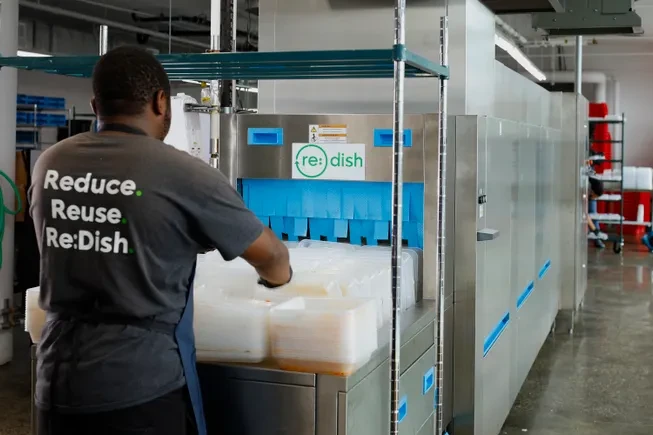
This acquisition signals more than just a corporate consolidation; it represents a fundamental evolution in how large-scale institutions—ranging from corporate headquarters to university campuses—approach materials management. For years, the commercial reuse sector has been plagued by fragmentation, operational silos, and logistical hurdles that made scaling difficult for standalone providers. By absorbing Re:Dish—an operator known for managing everything from program design and collection to industrial-grade washing, tracking, and impact reporting—Circular Services is embedding comprehensive reuse directly into the core of traditional waste management and recycling services.
Re:Dish, which has been operating since 2020, has carved out a vital niche in the Northeast, servicing high-profile enterprise and institutional clients such as Barclays and Aramark. To date, the company has successfully diverted more than 9 million single-use packaging items from municipal landfills. By combining Re:Dish’s specialized operational expertise with Circular Services’ vast national footprint, financial backing, and multimodal logistics network, the newly expanded enterprise is poised to accelerate the transition from single-use disposables to durable, circular systems across the American commercial landscape.
This article provides an in-depth examination of the acquisition, analyzing its strategic drivers, the operational synergies between the two companies, the broader macroeconomic context of the corporate sustainability movement, and a forward-looking assessment of how closed-loop systems will reshape commercial waste infrastructure over the next decade.
Detailed Chronology and Strategic Integration
The path toward this acquisition has been carefully plotted since the inception of Circular Services four years ago. According to Jessica Long, Chief Strategy Officer and Chief Operating Officer of Circular Services, leadership recognized early on that a true materials management portfolio could not be considered complete without a robust, industrial-scale reuse component.
However, timing was everything. The intervening four years served as a crucial proving ground for the commercial reuse sector. During this period, both providers and customers navigated fluctuating supply chains, changing workplace dynamics in the wake of the COVID-19 pandemic, and shifting regulatory landscapes regarding single-use plastics. These years generated invaluable economic data and behavioral change learnings that ultimately validated the financial and operational viability of large-scale reuse systems.
Prior to the formal acquisition, a symbiotic relationship already existed between the two entities. Circular Services had been actively supporting Re:Dish by managing the recycling of its broken polypropylene items—specifically cups, containers, and plates that had reached the end of their usable life within the reuse pool. This existing operational touchpoint laid a foundation of trust and familiarity, streamlining the due diligence and integration processes when the time came for a formal merger.
The acquisition targets several key operational pillars that previously hindered the widespread adoption of reusable dishware in corporate and educational cafeterias:
- Holistic Program Design: Moving away from fragmented vendor management where different entities handle logistics, washing, and procurement.
- Closed-Loop Material Recovery: Ensuring that once a reusable item is finally damaged or degraded, it does not end up in a landfill but is immediately channeled back into recycling infrastructure.
- Unified Logistics: Leveraging existing waste-hauling and diversion routes to introduce reuse pick-ups and drop-offs without multiplying the number of vehicle trips required to service a client.
Supporting Context, Metrics, and Market Dynamics
The commercial rationale behind the acquisition is rooted in changing enterprise demands. Today’s corporate and school campus customers are no longer looking for piecemeal sustainability solutions; they are demanding holistic materials management ecosystems. Procurement departments face mounting pressure to simultaneously drive cost savings, meet aggressive corporate environmental, social, and governance (ESG) targets, and streamline administrative overhead.
Managing waste streams—whether handling traditional recycling, organizing organic food waste diversion, or administering complex reusable dishware programs—traditionally required managing multiple distinct vendors. This fragmentation often drove costs up and administrative burdens higher, occasionally causing sustainability initiatives to stall. By integrating Re:Dish, Circular Services can now offer these services under a single, unified contract.
The Power of Proximity: Food Waste and Reusable Dishware
In modern institutional cafeterias, food waste generation and dishware utilization occur in immediate physical proximity. This creates a natural operational overlap that Circular Services aims to exploit. When a facility management team can coordinate food waste composting, single-use recycling, and reusable dishware collection through a single operational partner, the friction of execution drops dramatically.
Furthermore, Circular Services manages diverse portfolios that extend beyond standard municipal recycling, including secure document shredding and electronics recycling (e-waste). According to Jessica Long, adding reuse services to these existing routes represents a remarkably low incremental effort for the service provider, yet yields massive value for the customer.
"If I’m already servicing a client site, the incremental effort associated with me adding on the reuse service is relatively small for me, but could be huge for you as a customer," Long explained. "So that reuse is now achievable for you in a way that maybe it wasn’t when it was a standalone, one-off service."
Logistical Optimization and Carbon Reduction
From a logistics perspective, consolidating services yields profound carbon and financial benefits. Fleet management in the waste and recycling sector is highly sensitive to route density, fuel costs, and labor allocations. By coordinating collections so that trucks servicing a corporate campus can simultaneously pick up organic waste, deliver recycling bins, and collect used dishware for sanitization, Circular Services minimizes the total number of physical stops and material handlings. This reduces fleet emissions, lowers operational expenditures, and minimizes disruption for the host facility.
Official Statements and Industry Perspective
The integration of Re:Dish into the Circular Services umbrella highlights a broader trend within the circular economy: the transition from experimental, pilot-phase sustainability programs to hardened, institutionalized industrial infrastructure.
Closed Loop Partners, the parent organization behind Circular Services, has long championed investments that bridge the gap between capital markets and practical, on-the-ground waste diversion. By acquiring an operator with a proven track record in high-volume institutional environments like Barclays and Aramark, Circular Services is validating that reuse models can scale beyond trendy coffee shop pilots and succeed in demanding, high-throughput corporate and educational cafeterias.
Jessica Long’s vision for the future is unequivocal: "My goal would be that we are offering reuse services everywhere that we provide recycling or food waste services today."
This ambition reflects a profound structural shift. For decades, the waste management industry was built on a linear "take-make-waste" model, where efficiency was measured by how quickly and cheaply materials could be hauled to landfills or, at best, sorted for traditional recycling. The inclusion of industrial reuse transforms waste management companies into materials stewardship organizations, where the goal is to keep assets in circulation at their highest utility for as long as possible.
Future Outlook: Scaling Reuse for the Next Decade
Looking ahead, the acquisition of Re:Dish is merely the opening salvo in Circular Services’ broader expansion strategy within the reuse economy. Company leadership has outlined several strategic avenues for future growth:
1. Geographic Scaling and Regional Acquisitions
While Re:Dish has established a dominant operational footprint in the Northeast, the demand for corporate and institutional reuse is national. Circular Services plans to leverage its existing nationwide infrastructure, transfer stations, and processing facilities to scale Re:Dish’s operational model into new geographic markets. Additionally, leadership is actively evaluating further regional acquisitions of specialized reuse operators that can be plugged into the national network.
2. Bridging Closed-Loop and Open-Loop Systems
While the Re:Dish acquisition focuses heavily on closed-loop institutional settings (such as corporate cafeterias and closed campus environments where items are tracked and recovered reliably), Closed Loop Partners is simultaneously investing in more complex "open-loop" environments. A prime example is the firm’s involvement in initiatives like the Petaluma Reusable Cup Project in California, which tests consumer behavior, collection infrastructure, and loss rates in decentralized municipal and retail settings. Insights gained from these open-loop pilots will inform how industrial operators manage consumer-facing reuse as municipal regulations increasingly penalize single-use plastics.
3. Anticipating Regulatory Tailwinds and Consumer Shifts
The regulatory landscape across North America is rapidly evolving. Municipalities, states, and federal entities are implementing stringent bans and phase-outs on single-use food service ware, expanded polystyrene, and non-recyclable packaging. Concurrently, enterprise clients face intense scrutiny from investors, employees, and consumers demanding verifiable action against plastic pollution.
In this environment, relying on fragmented, third-party boutique vendors for sustainability initiatives is no longer tenable for Fortune 500 corporations. Enterprises require enterprise-grade reliability, compliance tracking, and robust data reporting to substantiate their sustainability claims and avoid greenwashing allegations. By offering a fully integrated suite that handles recycling, organic waste, shredding, and now industrial-grade dishware reuse, Circular Services provides a bulletproof compliance and operational framework.
Conclusion
The acquisition of Re:Dish by Circular Services marks a watershed moment for the commercial waste diversion industry. By bridging the operational gap between traditional waste collection and advanced institutional reuse, the combined entity is dismantling the logistical and financial barriers that have historically limited the scalability of circular systems.
As Jessica Long noted, the systemic shift toward reuse is not a passing corporate trend; it is an economic and environmental imperative that will accelerate significantly over the next five to ten years. With robust financial backing from Closed Loop Partners, a comprehensive national operational network, and a proven end-to-end service model, Circular Services is uniquely positioned to lead this transformation—turning the ideal of a circular economy into an everyday, scalable industrial reality.



