

By Joanne MacAulay
Special to Global Conservation & Horticulture Review
Executive Overview
After six years of meticulous engineering, horticultural high-wire acts, and an unprecedented botanical decanting operation, the historic Palm Houses at the Royal Botanic Garden Edinburgh (RBGE) have officially reopened to the public. Closed for vital, long-overdue interventions to arrest structural decay, the 19th-century iron-and-glass masterpieces have emerged from a multi-million-pound overhaul. The ambitious project combined modern architectural preservation techniques with a delicate rescue mission for thousands of rare, vulnerable, and historically significant plants.
The reopening marks a monumental triumph for the garden’s curators, horticulturists, and conservationists, who navigated the immense risks of uprooting ancient specimens, executing massive structural repairs, and replacing more than 5,000 panes of glass. While the project achieved an overwhelming rate of botanical survival, it was not without emotional toll: the garden had to bid farewell to a legendary, 200-year-old Sabal palm that had outgrown its architectural bounds. Yet, true to the cyclical nature of botany, its legacy lives on through a thriving descendant planted directly in its footprint.
Today, the redesigned, light-filled sanctuary stands as a testament to Scotland’s dedication to global biodiversity conservation. Beyond serving as a premier destination for visitors, the newly restored Palm Houses remain a frontline defense in safeguarding species that are extinct in the wild, housing invaluable genetic lineages, and preserving pharmacological treasures vital to the future of human health.
Detailed Chronology: The Six-Year Odyssey
The closure of Edinburgh’s Palm Houses was not a matter of choice, but of urgent necessity. Decades of Scottish weather, coupled with the relentless humidity and corrosive condensation inherent to indoor tropical biomes, had taken a severe toll on the Victorian-era structures. Rust had deeply compromised the foundational ironwork, stone masonry was eroding, and thousands of glass panes had grown brittle, leaky, and structurally unsafe.

Phase One: The Great Decant (2018–2019)
Before a single hammer could swing against the corroded iron framework, horticulturists faced a monumental challenge: relocating a living collection of trees, ferns, palms, and delicate understory plants. Moving established tropical and subtropical flora from deep ground beds into temporary greenhouses required surgical precision.
Glasshouse Curator Sadie Barber recalled the immense anxiety surrounding the operation. "I think whenever you move a plant and you take it out of the ground and then you stick it in a pot, it’s going to suffer or it’s going to get under stress," Barber explained. The team had to weigh the risks of root shock against the certainty of losing the plants if they remained in the deteriorating buildings during construction. Through careful root-ball wrapping, specialized climate-controlled holding facilities, and round-the-clock monitoring, the vast majority of the collection survived the multi-year hiatus.
Phase Two: Architectural Reconstruction (2019–2023)
With the botanical inhabitants safely housed elsewhere, structural engineers and heritage restoration specialists descended upon the site. The restoration required an uncompromising blend of historical fidelity and modern engineering durability.
- The Glazing Operation: Artisans and construction crews replaced upwards of 5,000 individual panes of glass, utilizing modern, thermally efficient, and safety-rated glass designed to withstand Edinburgh’s fierce winds while optimizing light transmission for the plants within.
- Iron and Stone Overhaul: Corroding structural ironwork was meticulously stripped, treated, repainted, and, where necessary, reinforced with hidden modern steel supports. Stonework across the Victorian facades was hand-repaired using traditional lime mortars that matched the historical composition of the 19th-century buildings.
- Spatial Redesign: In a bold architectural move, designers knocked down a heavy partition wall that had long separated two distinct sections of the glasshouse. This single intervention created a sweeping, uninterrupted, light-filled vista. The reconfiguration not only showcases the soaring Victorian architecture to dramatic new effect but also optimizes airflow and natural light distribution for the integrated plant displays.
Phase Three: The Return of the Flora (2023–2024)
Once the physical envelope of the Palm Houses was certified weather-tight and climate-controlled, the reverse migration began. Returning the massive, mature specimens to their permanent ground beds was a logistical puzzle requiring heavy lifting equipment, scaffolding, and intense manual labor.
According to David Knott, Director of Horticulture, the horticultural team executed an "exceptional job" orchestrating the reintegration. Rather than looking like a newly transplanted assembly, the interior was masterfully landscaped so that the returning canopy trees, ferns, and exotic blooms instantly appeared as though they had inhabited the space for generations.

Supporting Context & Metrics: Architecture, Biodiversity, and Conservation
The Royal Botanic Garden Edinburgh is far more than a scenic tourist attraction; it is a globally recognized scientific institution operating at the vanguard of plant science and conservation. The reopening of the Palm Houses highlights the critical intersection between historic architecture and modern ecological preservation.
The Scale of the Restoration
- 5,000+ individual glass panes replaced to ensure structural integrity and thermal efficiency.
- 6 years of phased planning, structural overhaul, and plant rehabilitation.
- 100s of individual plant families accommodated within the newly unified floor plan, ranging from towering palms to delicate, shade-loving ferns and vibrant begonias.
Living Museums of Extinct Species
During the reopening events, Professor Julia Knights, Regius Keeper of the Botanic Garden, emphasized the high-stakes nature of the institution’s living collections. Many species sheltered under the protective glass of the Edinburgh Palm Houses no longer exist in their native natural habitats due to deforestation, climate change, and agricultural expansion.
"We’ve got palms, conifers, ferns, begonias, all of those families. Plants are hugely important in our living collection, and many of them are extinct in the wild," Professor Knights noted.
By maintaining these genetically pure specimens, the Palm Houses act as genetic arks. They provide the raw material for scientific research, international breeding programs, and potential future re-wilding initiatives.
The Pharmaceutical Nexus
Beyond their ecological value, the botanical treasures housed within the glass structures hold profound implications for human welfare. A significant proportion of the world’s life-saving pharmaceuticals—ranging from anti-cancer agents to cardiovascular treatments—are derived directly from tropical and subtropical plant compounds.

"So what the palm houses are doing is helping to protect so many of these species, and many of them of course have medicinal properties for human health," Professor Knights explained. "If we don’t save these, we are also potentially not helping to save humanity, so it’s super important."
Official Statements & Human Stories: Loss and Renewal
Every major restoration project carries narratives of sacrifice, and the RBGE overhaul was no exception. Beneath the joy of the reopening lies the poignant story of the Palm House’s most famous historic resident.
The Passing of a 200-Year-Old Giant
For over two centuries, a magnificent Sabal palm tree had reigned supreme inside the Edinburgh glasshouse. Standing as a living relic of the garden’s early Victorian history, the tree had grown to monumental proportions. However, decades of vertical growth meant it had ultimately outstripped the physical capacity of the glasshouse architecture.
When the restoration plans were finalized, horticultural experts faced an agonizing reality: the colossal Sabal palm was simply too massive to be successfully dug up, transported, and stored during the construction phase. Furthermore, even within the newly renovated space, it would have immediately broken through the roof glass.
The decision to cut down the 200-year-old tree was, by all accounts, the most emotionally difficult moment of the entire six-year project.

"There was no way that we were actually going to ever be able to transplant the Sabal palm," reflected Director of Horticulture David Knott. "And that was probably one of the hardest, most poignant parts of the whole process."
A Living Legacy: The Next Generation
Refusing to let the lineage vanish, horticulturists had previously harvested seeds from the ancient giant. During the years of closure, seedlings were carefully nurtured behind the scenes.
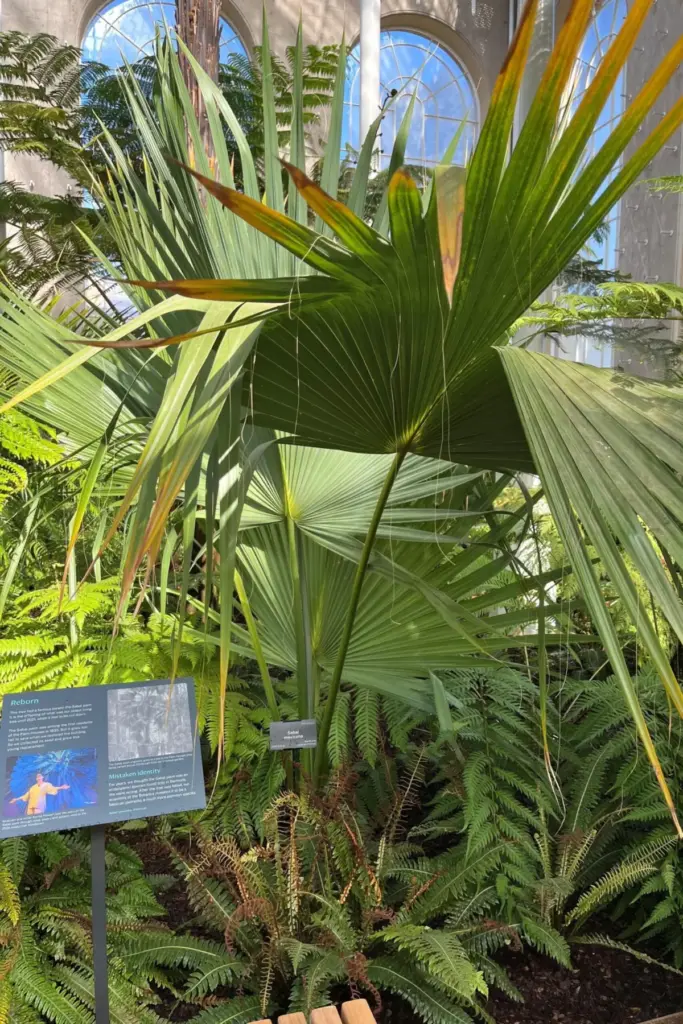
Upon completion of the glasshouse, one of the direct descendants of the original Sabal palm was planted in the exact footprint of its legendary parent. Because the newly renovated glasshouse features optimized roof clearance and redesigned interior zoning, horticulturists are optimistic that the young successor will enjoy an even longer and healthier tenure.
"Hopefully, because we’ve planted it in this glass house which is a bit taller than where it was previously, hopefully it will last a bit longer than the previous one did," Knott said, smiling as he observed the thriving young palm unfurling its fronds beneath the same roof that sheltered its predecessor.
Signs of Life
For Sadie Barber and her team, watching the plants respond to their permanent home has been the ultimate validation of years of painstaking labor.

"You can see new growth coming out of some of those plants that are now in the ground," Barber observed, pointing to the delicate fiddlehead-like formations emerging from the soil. "One thing people will notice is little new croziers coming in, coming up from the fern crowns. When you see that unfurling, you know a plant is happy. And if you look around, there’s just so much life. It’s been an enormous job, but a really well-done job. So we are overjoyed."
Future Outlook: A Landmark Restored for Generations
As the heavy oak-and-glass doors swing open to welcome the public once more, the mood across the Royal Botanic Garden Edinburgh is one of collective relief and visionary optimism. The successful completion of the Palm Houses project secures the physical longevity of these category-A listed structures for decades, if not centuries, to come.
For the local community in Edinburgh, scholars across the UK, and international visitors alike, the return of the Palm Houses restores an irreplaceable architectural landmark to the Scottish capital. More importantly, it re-establishes a vital sanctuary where the fragile beauty of the natural world can be studied, appreciated, and protected against the uncertainties of a changing global climate.
As David Knott aptly summarized: "For many people in Edinburgh, and throughout Scotland and throughout the world, the palm houses in Edinburgh really are one of the most iconic features of the Botanic Garden here. And we hope when we reopen, we will be able to welcome people and they’ll be able to enjoy the space as it was always intended to be."



