Executive Overview
In an era defined by rapid digital transformation and the increasing weaponization of online discourse, organizations dedicated to empirical science and planetary preservation face difficult strategic choices regarding where they invest their digital footprint. Mission Blue, the renowned ocean conservation foundation founded by legendary oceanographer Dr. Sylvia Earle, has officially announced that it is ending its active use of X (formerly Twitter). Moving forward, the organization will channel its social media resources exclusively into platforms that better align with its core values of hope, optimism, and respectful, science-based community building—namely Instagram, Facebook, LinkedIn, and YouTube.
This move is far more than a routine administrative update to a communications strategy; it represents a growing institutional tipping point. Across the global scientific community, environmental nonprofits, and academic institutions, a quiet migration is underway. Organizations that once relied on microblogging platforms for real-time outreach are increasingly concluding that the prevailing digital architecture of X—marked by algorithmic amplification of outrage, unchecked misinformation, and hostility toward scientific consensus—is fundamentally incompatible with the patient, nuanced work of environmental stewardship.
Mission Blue’s departure underscores a profound friction point in modern digital communications: the tension between the viral mechanics of modern social media and the rigorous, solutions-oriented dialogue required to tackle complex planetary crises. By stepping away from X, Mission Blue is drawing a deliberate line in the sand, prioritizing the psychological safety and intellectual integrity of its community over sheer algorithmic reach. This report provides a comprehensive examination of Mission Blue’s strategic pivot, exploring the historical role of digital platforms in conservation, the shifting dynamics of the online information ecosystem, the broader trend of scientific flight from X, and what this means for the future of ocean advocacy in the digital age.
Detailed Chronology: The Evolution and Exit of an Environmental Advocate
To understand the gravity of Mission Blue’s decision to abandon X, one must first examine the historical arc of the organization’s engagement with the platform, tracing the trajectory from early optimism to eventual disillusionment.
The Early Years: Optimism, Connectivity, and the Rise of "Ocean Hope"
When Mission Blue established its initial presence on Twitter more than a decade ago, the platform was heralded as a revolutionary tool for democratic communication. For an organization dedicated to the global protection of the ocean—specifically through the designation of "Hope Spots," which are special places that are critical to the health of the ocean—Twitter offered an unprecedented mechanism for real-time connection.
During this nascent phase, the platform functioned largely as envisioned by its early proponents: a decentralized town square where marine biologists in remote field camps could instantly share dispatches with policymakers in Brussels or Washington, D.C., and where everyday ocean lovers could rally around grassroots conservation campaigns. The early ethos of Mission Blue’s digital engagement was anchored in Dr. Sylvia Earle’s signature philosophy: that hope, combined with empirical data and collective action, is the most powerful catalyst for change. Twitter served as a low-friction conduit for spreading this message, allowing the foundation to build an engaged network of "Champions" who amplified marine protection initiatives across borders and oceans.
The Inflection Point: Shifts in Algorithmic Governance and Platform Culture
Over the subsequent years, however, the structural and cultural landscape of the platform underwent a profound transformation. Following successive changes in corporate leadership, ownership, and platform governance, the underlying mechanics of X shifted dramatically. Trust and safety teams were downsized, verification models were overhauled, and content moderation policies were relaxed or abandoned altogether.
For Mission Blue’s communications team, these macro-level changes manifested as micro-level deterioration in the daily user experience. The platform’s algorithms increasingly favored sensationalism, polarization, and outrage bait over nuanced reporting. More alarmingly for a science-based entity, the digital town square began to host coordinated campaigns of targeted harassment, climate skepticism, and outright scientific denialism. Conversations regarding marine protected areas, overfishing, and climate change—issues that demand rigorous empirical analysis and respectful debate—were frequently hijacked by bad-faith actors operating with impunity.
The Breaking Point: Incompatibility with Core Values
By late 2024, the internal calculus within Mission Blue reached a critical juncture. The organization’s leadership observed that the time and emotional capital expended trying to cut through the noise and correct falsehoods on X were yielding diminishing returns. Worse yet, participating in an environment characterized by hostility and anti-science rhetoric risked compromising the organization’s brand integrity.
Mission Blue’s digital strategy has always been predicated on building a curious, welcoming, and solutions-oriented community. As the platform environment on X grew increasingly toxic and divisive, it became impossible for the foundation to reconcile its core mission with continued participation. The decision was not made lightly, but it was executed decisively: the active publishing of content ceased, the account was transitioned into a static, archived state, and digital resources were immediately reallocated toward platforms fostering more constructive, community-centric engagement.
Supporting Context & Metrics: The Broader Exodus of Science from X
Mission Blue’s departure from X is not an isolated incident; rather, it is part of a sweeping, well-documented macro-trend involving the systematic withdrawal of scientific, academic, and environmental institutions from the platform.
The Quantitative Reality of Scientific Flight
Data analytics firms and digital media researchers tracking platform demographics have noted a steady decline in institutional engagement from scientific bodies since late 2022. Studies examining academic migration patterns reveal that universities, research institutes, meteorological agencies, and conservation NGOs have deactivated thousands of verified accounts.
While exact metrics vary by sector, internal communications audits from major environmental nonprofits suggest that organic reach for science-based content on X plummeted following modifications to platform algorithms that deprioritized external links and favored pay-to-play visibility models. Furthermore, the systematic dismantling of the platform’s legacy verification system—which previously authenticated academic institutions, government bodies, and recognized NGOs—created a fertile breeding ground for imposter accounts spreading misinformation disguised as authoritative science.
The Information Ecosystem Crisis: Misinformation as a Marine Threat
In the realm of ocean conservation, misinformation is not merely an online nuisance; it is a direct threat to ecological preservation. Fabricated narratives regarding marine protected areas—such as false claims that conservation zones are covert mechanisms for land grabs or corporate greenwashing—spread rapidly through algorithmic amplification on X.
Because misinformation travels faster and triggers higher emotional engagement than nuanced scientific corrections, conservation organizations found themselves trapped in a perpetual cycle of defensive debunking. This "firehose of falsehoods" model fundamentally degrades the public’s capacity to engage in rational, evidence-based policymaking. When digital architecture actively rewards content that undermines peer-reviewed science and constructive dialogue, organizations dedicated to empirical truth are forced to evaluate the opportunity cost of their presence. Continuing to feed content into a compromised ecosystem effectively legitimizes it, leading institutions like Mission Blue to conclude that silence on the platform is far more powerful than forced participation.
Official Statements and Institutional Rationale
The formal announcements released by Mission Blue articulate a clear, uncompromising vision for the future of digital advocacy. Below is a synthesized analysis of the foundational statements driving the foundation’s pivot.
The Philosophy of "Ocean Hope" vs. Digital Toxicity
In its official release detailing the platform departure, Mission Blue emphasized the foundational ethos that governs all organizational activities:
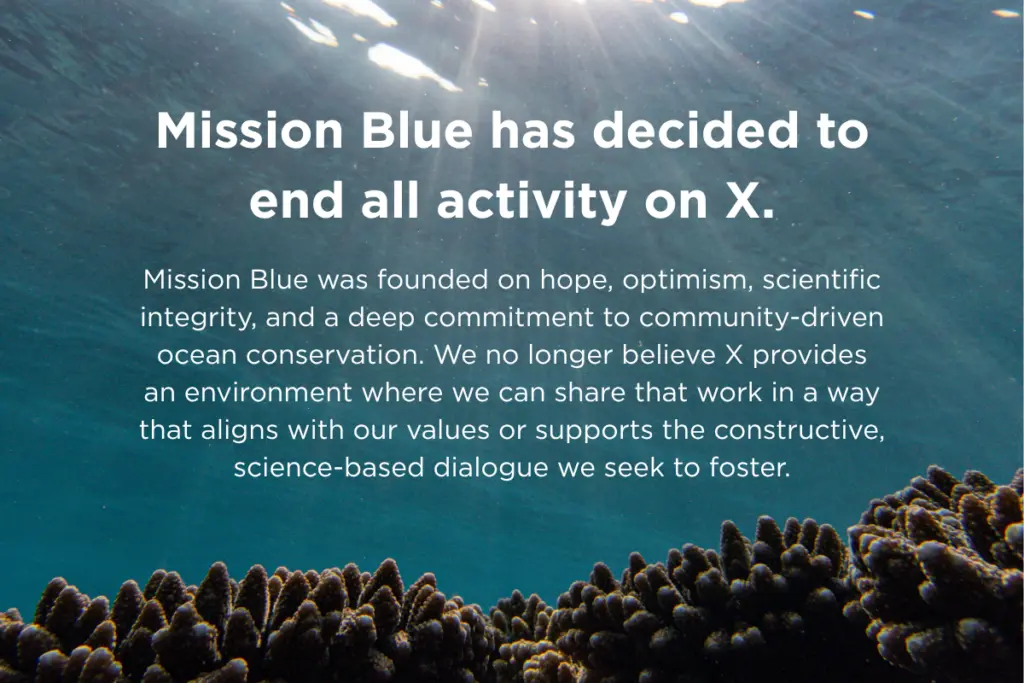
"Mission Blue was founded with a spirit of hope, optimism, and dedication to community-driven ocean conservation. When we first started our Twitter account, it offered a great way to connect with our Champions, scientists in the field, and an audience of people who love the ocean. Thank you for connecting with us there and supporting our mission to spread awareness and ocean hope."
This statement underscores the deep gratitude the organization holds for the early community that rallied around its cause on the platform. However, the foundation was equally candid about the untenable nature of the modern platform environment:
"Over time, however, the environment on X has changed significantly. We have become increasingly concerned about the prevalence of misinformation, hostility, and divisive content on the platform, including content that undermines science and constructive dialogue around environmental issues. We do not believe this environment is aligned with the kind of informed, respectful, and solutions-oriented community Mission Blue seeks to foster."
Redefining Digital Stewardship
By framing the exit not as a retreat, but as a strategic reallocation of energy, Mission Blue is setting a standard for modern environmental communication. The organization stresses that digital spaces should reflect the interconnected nature of the subject matter they address:
"We are all connected to the same ocean. Through our digital strategy, we seek to build a curious, welcoming online community. We cannot, in good faith, continue to use the X platform. The Mission Blue page will remain archived on X, but we do not plan to publish any new material on the account."
This commitment to "good faith" communication is a direct challenge to the engagement-at-all-costs model that dominates contemporary social media design. It signals to donors, partners, and the broader conservation community that organizational integrity supersedes raw impression metrics.
Future Outlook: Rebuilding Community Across Alternative Digital Frontiers
As Mission Blue closes the chapter on X, the organization is aggressively expanding its presence across alternative digital ecosystems designed to foster deeper, more visually compelling, and intellectually rigorous engagement.
Diversifying the Digital Portfolio
Rather than placing all its communications eggs in a single basket, Mission Blue is diversifying its digital footprint across four primary platforms, each serving a distinct strategic purpose:
- Instagram: Serving as the visual anchor of the foundation’s outreach, Instagram allows Mission Blue to leverage stunning underwater photography, reels, and short-form video to showcase the breathtaking biodiversity of global Hope Spots. The platform’s emphasis on visual storytelling resonates powerfully with Dr. Sylvia Earle’s mission to inspire emotional connections with the ocean.
- Facebook: Maintaining its role as a powerful community-building tool, Facebook enables Mission Blue to foster robust discussions among its global network of Champions, host live Q&A sessions with marine scientists, and mobilize grassroots support for regional conservation policies.
- LinkedIn: Recognizing that ocean conservation requires high-level policy intervention, corporate accountability, and cross-sector partnerships, LinkedIn serves as the professional nexus for Mission Blue. Here, the foundation engages with policymakers, corporate sustainability officers, academic researchers, and institutional donors who hold the keys to systemic change.
- YouTube: As the premier repository for long-form educational content, documentary features, and deep-dive expedition logs, YouTube allows Mission Blue to present comprehensive narratives that transcend the superficial soundbites mandated by microblogging platforms.
The Direct-to-Audience Renaissance: The Power of Newsletters
In addition to optimizing its presence across these curated social channels, Mission Blue is placing renewed emphasis on direct-to-audience communication channels, most notably its official email newsletter.
In an era where third-party algorithms dictate who sees an organization’s content, email marketing represents a return to unmediated, reliable communication. By inviting followers to subscribe directly, Mission Blue ensures that critical Hope Spot updates, breaking marine conservation stories, and actionable advocacy campaigns land directly in the inboxes of dedicated supporters without algorithmic interference. This direct pipeline insulates the foundation’s community from the chaotic volatility of commercial social media companies.
Conclusion: A Precedent for the Conservation Movement
Mission Blue’s calculated departure from X serves as a watershed moment for the environmental movement at large. It forces a much-needed industry-wide reckoning regarding the ethics of digital engagement. For decades, nonprofits have operated under the assumption that they must maintain a presence on every major platform regardless of the cultural or structural toxicity of those spaces.
By demonstrating that an organization can walk away from a compromised digital town square without sacrificing its global reach—and indeed, by reinvesting those energies into healthier, more constructive environments—Mission Blue has charted a bold new course. As the global community confronts existential threats to the marine biosphere, the tools we use to communicate about those threats must match the clarity, integrity, and hope required to solve them. Mission Blue’s digital migration proves that when the tide turns toxic, true leaders do not swim with the current; they chart a new course toward cleaner, brighter waters.