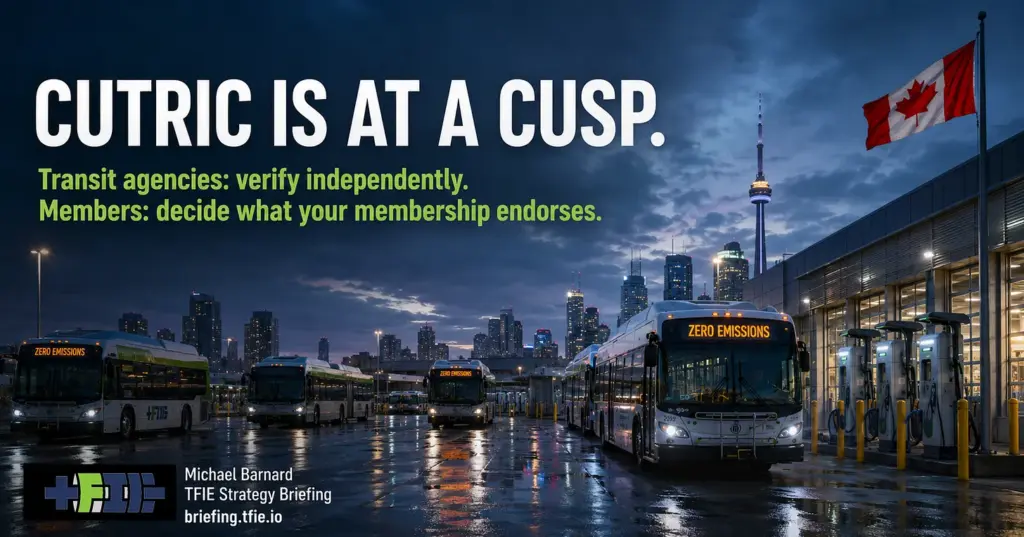
As municipal and regional transit authorities across North America race to decarbonize their fleets, the reliance on specialized advisory bodies has never been higher. Yet, this high-stakes transition brings critical questions regarding institutional neutrality, conflict of interest, and the integrity of public data. At the center of this debate in Canada is the Canadian Urban Transit Research and Innovation Consortium (CUTRIC).
CUTRIC has successfully positioned itself as an indispensable architect of the nation’s zero-emission transit transition. However, a deep-dive strategic analysis from TFIE Strategy Briefing reveals a profound structural tension: CUTRIC acts simultaneously as an industry commercialization advocate, a government lobbyist, and a scientifically neutral advisory body. When an organization’s core mission includes pushing technologies toward market adoption, it faces an inherent conflict of interest when it simultaneously advises public agencies on multi-million-dollar capital investments.
This institutional duality creates a significant credibility problem. While CUTRIC has demonstrated considerable prowess in securing public grants, coordinating cross-sector stakeholders, and fostering battery-electric bus interoperability, its public record lacks a mechanism for self-correction—specifically, the capacity to declare when a technology or commercialization pathway has failed. As transit agencies weigh hundreds of millions of dollars in equipment purchases, the uncritical acceptance of "CUTRIC says so" as a final evidentiary stamp must be replaced with rigorous, independent verification.
Detailed Chronology: The Rise of CUTRIC and the Evolution of Zero-Emission Transit Advocacy
To understand CUTRIC’s current standing, one must examine its trajectory within Canada’s clean transportation landscape. Over the past decade, the organization has evolved from a nascent research network into the country’s dominant transit-planning authority, heavily backed by federal advantages and strategic partnerships.
Phase 1: Foundation and Early Interoperability Success
In its early years, CUTRIC addressed a genuine collective-action problem that threatened to stall early battery-electric bus (BEV) deployments: the fragmentation of charging infrastructure. Transit agencies, charging suppliers, and original equipment manufacturers (OEMs) were drifting toward proprietary, closed-loop vendor ecosystems. CUTRIC played a vital role in converging these stakeholders around common, high-power charging standards. This early interoperability work was widely praised and solved a legitimate coordination failure in the market.
Phase 2: Expansion into Broad Consulting and Modeling Services
Bolstered by its early successes, CUTRIC expanded its operational footprint. It transitioned from standard-setting into project development, government advocacy, operational modeling, professional-development training, and priority-setting for research funding. By offering sophisticated modeling and planning services, CUTRIC positioned its outputs as scientifically objective frameworks for transit agencies attempting to navigate complex electrification pathways.
Phase 3: Entrenchment of Hydrogen Advocacy
As battery technologies matured, CUTRIC concurrently championed hydrogen fuel-cell electric buses (FCEBs), branding them as "essential" for difficult transit operating blocks. Despite rapid advancements in direct-electric alternatives—such as opportunity charging, advanced depot management, and in-motion charging—the organization maintained its bullish stance on hydrogen.
Phase 4: The Current Credibility Crossroads
Today, CUTRIC sits at a strategic crossroads. Its comprehensive zero-emission bus database tracks projects from initial announcement and feasibility studies through financing, procurement, and ultimate commissioning. However, critics argue that this data is primarily used to inflate pipeline totals rather than critically evaluate stalled projects or flawed technology forecasts. The full TFIE Strategy Briefing has brought these concerns to the forefront, challenging transit agencies and CUTRIC member organizations to re-examine the true value and objective weight of the consortium’s analytical endorsements.

Supporting Context & Metrics: Decoding the Data and the Hydrogen Debate
The core of the institutional critique against CUTRIC rests on a fundamental distinction in institutional behavior: the difference between commercialization advocacy and independent scientific analysis.
The Missing Feedback Loop in Public Analytics
In standard industrial commercialization, the guiding question is always supportive: What partnership, funding mechanism, or policy change will accelerate market adoption? Conversely, an independent analytical institution must possess the institutional maturity to ask harder questions: Should this technology reach the market at all? Was our earlier forecast wrong? Does pilot data suggest this is a dead end?
A competent evidence-based institution relies on a rigorous feedback loop:
- Forecast generation
- Real-world deployment
- Observed operational performance
- Quantification of forecast error
- Assumption revision and, if necessary, strategic reversal
While CUTRIC maintains a detailed database tracking zero-emission bus deployments across various stages—announcements, feasibility studies, procurements, and active service—its public record lacks evidence that these stages are used to systematically abandon failing pathways. Procurements that quietly disappear or projects that stall are rarely contextualized as evidence against a technology’s commercial viability.
The Hydrogen Essentialism Fallacy
CUTRIC’s persistent framing of hydrogen fuel-cell buses as "essential" for demanding routes brings this analytical weakness into sharp focus. Transit agencies undeniably face rigorous operational hurdles: extended operating blocks, severe winter climates, steep topography, high passenger loads, and constrained depot facilities.
However, declaring hydrogen "essential" requires proving that these specific operating conditions cannot be met by modern direct-electric architectures. According to strategic analyses, CUTRIC has yet to publish data that clears this evidentiary bar. Meanwhile, globally scalable technologies like conductive and inductive in-motion charging are rapidly closing the operational gap, proving capable of handling demanding routes without the immense infrastructure and fuel-cost complexities associated with green hydrogen.
Direct-electric transit has evolved far beyond the crude, early-generation comparison between a limited depot-only battery bus and an FCEB. Modern transit planners leverage a sophisticated toolkit:
- Managed smart-charging schedules within depots
- Optimized route and block redesign
- Strategic opportunity charging at terminus points
- Shared corridor charging systems
- In-motion charging (IMC) for continuous route replenishment
Skipping these systems-engineering solutions to leap directly from "a battery bus struggles on this grueling block" to "hydrogen is mathematically required" ignores the broader evolution of electric mobility.

Official Perspectives and Industry Implications
The implications of CUTRIC’s dual identity extend far beyond academic debates; they directly impact municipal balance sheets, federal climate targets, and public trust.
The Dilemma for Transit Agencies
For municipal transit operators, the directive is clear: independent verification is paramount. While CUTRIC’s individual datasets, modeling tools, and interoperability standards offer valuable building blocks, transit boards cannot treat the consortium’s recommendations as definitive, infallible authorities.
Major capital procurements must independently test:
- Core service assumptions and route feasibility
- Cold-weather operational performance degradation
- Vehicle replacement ratios and depot capacity constraints
- Local electrical grid upgrade requirements and peak demand charges
- Total lifecycle economics (Total Cost of Ownership)
- Comprehensive comparator sets that include all mature direct-electric alternatives
As industry analysts point out, adopting a procurement strategy simply because "CUTRIC says so" introduces unacceptable operational and financial risk. Public agencies are ultimately accountable to taxpayers, not to the commercialization goals of an industry consortium.
The Responsibility of Member Organizations
CUTRIC’s membership base—comprising transit agencies, manufacturers, and technology suppliers—also faces a reckoning. Participation in the consortium provides practical networking benefits and institutional legitimacy, but members must decide what their continued involvement implicitly endorses. By lending their names and financial support to an organization that combines commercial advocacy with claims of neutral scientific authority, members share responsibility for the policy trajectories and capital allocations influenced by that dual identity.
Future Outlook: Strategic Choices for CUTRIC and the Canadian Transit Sector
As Canada accelerates toward its net-zero emission mandates, CUTRIC faces a definitive strategic fork in the road. The organization can no longer successfully blend uncritical technology advocacy with claims of pure scientific objectivity. Moving forward, it must choose one of three distinct institutional paths:
- True Institutional Separation: CUTRIC could establish an independent evidence-generation arm—completely firewalled from its commercialization, lobbying, and consulting operations. This new entity would operate with explicit mechanisms for retrospective model validation, public error correction, and the willingness to recommend the abandonment of failed technological pathways.
- Transparent Advocacy: The organization could openly pivot to operating strictly as an industry-advocacy and market-commercialization association. In this scenario, its reports, modeling, and policy papers would be evaluated transparently by the market, recognized as the partisan advocacy of an industry stakeholder rather than the gospel of a neutral scientific body.
- The Status Quo Risk: Continuing down the current path—maintaining an entangled mix of commercialization, government lobbying, and uncritical technology promotion while claiming scientific neutrality—will become increasingly difficult to defend as transit agencies demand rigorous, unfettered data.
For the broader Canadian clean-transportation ecosystem, this moment marks a coming-of-age. As zero-emission technologies transition from experimental pilots to backbone infrastructure, the era of uncritical technological cheerleading must give way to hard-nosed, empirical engineering and transparent financial auditing. Only by embracing true analytical independence can transit agencies ensure that public capital is deployed toward the most resilient, cost-effective, and sustainable mobility solutions of the 21st century.