Executive Overview
As modern electrical grids face an unprecedented convergence of decentralized energy resources, soaring artificial intelligence workloads, electric vehicle (EV) adoption spikes, and increasingly volatile weather events, grid software startup Texture has emerged as a critical player in infrastructure management. The company announced today that it has successfully closed a $12.5 million Series A funding round, bringing its total venture backing to approximately $23 million.
The financing round was co-led by prominent climate and infrastructure venture firms VoLo Earth Ventures and Equal Ventures, with strategic participation from Lerer Hippeau and Abstract Ventures. According to company leadership, the fresh capital will be directly allocated toward aggressive engineering recruitment, market expansion, and the scaling of its proprietary, unified grid management platform.
Texture enters the market with a clear diagnostic of modern grid ailments: Legacy power distribution networks—historically engineered for predictable, unidirectional electricity flow from centralized fossil-fuel or hydroelectric plants—are buckling under the strain of a multi-directional energy transition. Today’s operators must simultaneously balance utility-scale solar and wind generation, residential rooftop photovoltaics, surging home battery installations, dynamic EV charging spikes, and the insatiable power demand of newly minted AI data centers.

Rather than forcing utilities to implement yet another siloed, single-purpose software application, Texture’s core value proposition is consolidation. By creating a unified real-time data layer that interfaces directly with smart meters, advanced metering infrastructure (AMI), supervisory control and data acquisition (SCADA) systems, and a vast network of original equipment manufacturer (OEM) hardware, Texture empowers grid operators with a holistic, single-pane-of-glass view of their entire service territory.
Detailed Chronology: The Evolution of Texture’s Grid Management Strategy
The genesis of Texture lies in a fundamental frustration shared by modern utility operators: the staggering complexity of managing decentralized energy resources (DERs) using legacy software architectures built decades ago.
The Early-Adopter Strategy: Targeting Utility Co-ops
While many enterprise-grade energy tech startups traditionally target massive, investor-owned utilities (IOUs) with sprawling budgets, Texture carved out an intentionally distinct initial beachhead: utility cooperatives (co-ops). Serving roughly 42 million Americans—predominantly across rural and semi-rural regions—these cooperatives grapple with the exact same grid modernization and decentralization pressures as their larger urban counterparts, yet they do so operating on severely constrained budgets and leaner engineering staffs.
“Co-ops kept telling me the same thing,” explains Texture co-founder and CEO Sanjiv Sanghavi. “They wanted to run modern grid programs, but didn’t have software built for their scale or budget.”

Recognizing this market gap, Texture designed its platform for rapid deployment. While legacy grid software rollouts traditionally require years of custom implementation, expensive consulting fees, and massive internal IT overhauls, Texture’s software can be integrated into existing utility infrastructure within days. This plug-and-play agility enabled early validation among forward-thinking cooperatives, most notably the Vermont Electric Cooperative (VEC). VEC—recognized as one of the few carbon-neutral utilities in the United States—leveraged Texture’s platform to monitor localized grid conditions while actively orchestrating hundreds of residential and commercial battery systems deployed across its rugged territory.
Expanding Hardware Ecosystems and OEM Integrations
As the platform gained traction, Texture prioritized deep, software-level integrations with the hardware ecosystem. To date, the company has successfully built direct application programming interface (API) integrations with more than 50 major OEMs and distributed energy resource providers. This expansive roster includes household and commercial energy names such as Tesla, FranklinWH, Honeywell, Ecobee, SolarEdge, Leap Energy, and WattTime.
This interoperability proved transformative earlier this year when Ann Arbor’s Sustainable Energy Utility utilized Texture’s framework to successfully launch an innovative community battery program. By pooling FranklinWH residential energy storage systems deployed across 100 distinct homes, the utility demonstrated how distributed hardware could be aggregated to support local grid resiliency without requiring multi-million-dollar substation upgrades.
The NRTC Partnership: Scaling Nationwide Access
The most recent milestone in Texture’s chronological growth is its landmark strategic partnership with the National Rural Telecommunications Cooperative (NRTC). Representing a network of roughly 850 utility cooperatives across the United States, the NRTC provides a massive distribution channel for Texture’s technology.
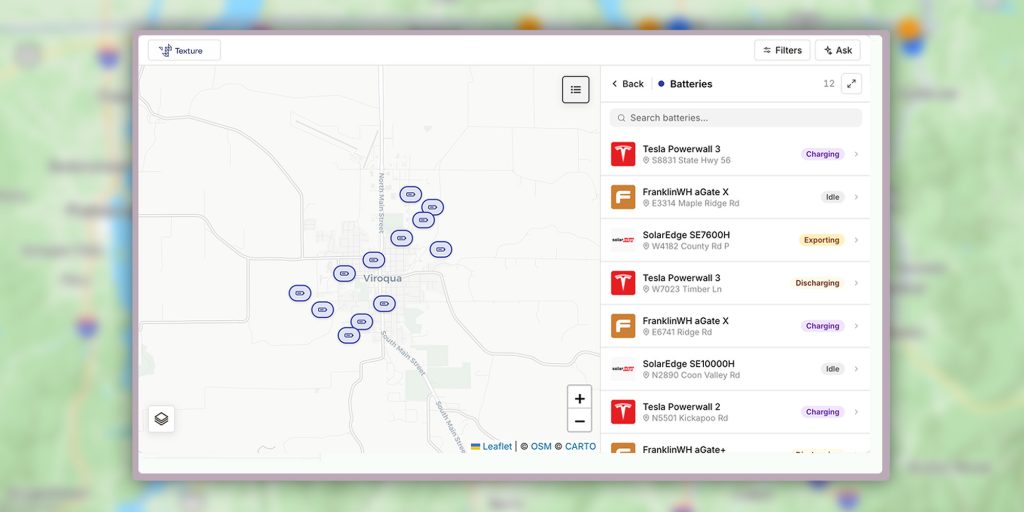
Through this alliance, NRTC member cooperatives gain direct access to advanced Distributed Energy Resource Management Systems (DERMS) software powered by Texture. This software allows rural co-ops to seamlessly coordinate localized residential batteries, smart thermostats, and EV chargers in real-time, bridging a critical gap in the virtual power plant (VPP) and demand response sectors. Historically, many VPP frameworks have operated blindly regarding real-time, meter-level data, forcing operators to make dispatch decisions based on generalized estimates rather than actual, localized grid telemetry.
Supporting Context & Metrics: The Anatomy of Modern Grid Strain
To fully understand why venture capital is flooding into grid software startups like Texture, one must examine the macro-level stressors currently testing the limits of electrical distribution infrastructure.
The EV Charging Paradox and Localized Transformers
While electric vehicle adoption is a cornerstone of global decarbonization targets, unmanaged EV charging represents a massive operational headache for local distribution utilities. Unlike slow, predictable residential loads of the past, simultaneous Level 2 or DC fast-charging sessions can create sudden, concentrated load spikes that push neighborhood transformers and radial feeders well past their thermal and operational limits.
Texture’s software is explicitly designed to detect these localized anomalies at the meter level. By tracing how sudden surges in electricity consumption propagate upstream—impacting specific distribution transformers and substation feeders—the software alerts operators before physical equipment suffers catastrophic failure.

This capability is more vital than ever due to macroeconomic pressures in the supply chain. According to comprehensive market analysis from Wood Mackenzie, global transformer prices have skyrocketed by as much as 95% since 2019. Furthermore, supply chain bottlenecks mean that procurement lead times for large, utility-grade transformers can now stretch well beyond two years. In an environment where replacing a blown transformer is both exorbitantly expensive and logistically delayed, predictive software capable of averting equipment stress is a high-ROI asset for cash-strapped utilities.
The Data Deluge: Meters, VPPs, and the AI Boom
Modern grids are drowning in data, yet starving for actionable insights. Between Advanced Metering Infrastructure (AMI) spitting out interval data every 15 minutes, smart thermostats cycling on and off during heatwaves, rooftop solar systems injecting unpredictable waves of power, and new AI data centers demanding continuous baseload power, utility control rooms face unprecedented cognitive overload.
Texture’s solution is to ingest this multi-channel data stream—spanning batteries, EVs, SCADA systems, and smart appliances—and distill it into a coherent operational picture. By cutting through the noise, the platform allows operators to automate responses to grid fluctuations, optimize demand response events, and extract maximum value from existing grid assets without expanding their headcount.
Official Statements and Industry Perspectives
The convergence of venture capital interest and grassroots utility adoption underscores a broader industry pivot toward software-defined infrastructure.

Sanjiv Sanghavi, co-founder and CEO of Texture, emphasized that the company’s architecture was built specifically to solve the friction of legacy utility software deployment. By avoiding multi-year implementation cycles, Texture allows smaller operators to punch above their weight class in the energy transition.
Investors backing the Series A round echoed these sentiments, highlighting the acute urgency of grid modernization.
"Grids that were built for one-way electricity flow now have to handle EV charging spikes, utility-scale renewables, rooftop solar, batteries, smart thermostats, and growing demand from AI data centers, often all at the same time," noted representatives from the co-leading investment firms VoLo Earth Ventures and Equal Ventures. "Texture provides the foundational software layer required to keep the lights on while integrating the decentralized energy economy."
Industry analysts point out that as extreme weather events—such as the grid anomalies documented during winter weather events like Storm Fern—continue to test the physical resilience of transmission and distribution lines, software platforms that can dynamically balance local supply and demand will transition from "nice-to-have" tools to absolute operational necessities.

Future Outlook: What’s Next for Texture and the Grid Software Market
With $12.5 million in new capital secured and its strategic partnership with the NRTC operational, Texture is positioned for accelerated growth throughout the latter half of the decade.
The immediate roadmap includes expanding the engineering team to scale the platform’s API infrastructure, deepening integrations with emerging OEM hardware classes, and onboarding a larger cohort of utility cooperatives currently sitting on the NRTC waiting list. Beyond co-ops, industry watchers anticipate that Texture may eventually eye expansion into mid-sized investor-owned utilities seeking agile, cloud-native overlays for their legacy enterprise systems.
As the energy transition accelerates—bringing millions of new EVs, home batteries, and commercial solar arrays online—the traditional methods of manual grid monitoring will no longer suffice. By bridging the gap between hardware manufacturers and resource-constrained utility operators, Texture is building the digital connective tissue necessary to ensure that the grids of tomorrow remain resilient, flexible, and capable of handling the relentless demands of a clean energy future.