Executive Overview
The landscape of American energy is undergoing a high-stakes, polarized transformation. According to the newly released Clean Economy Works report by environmental non-profit E2, clean energy developers announced more than 50 new utility-scale solar, wind, and battery storage projects in the first quarter of 2026. This frantic activity is driven by a looming federal deadline tied to the controversial Omnibus Budget and Bilateral Act (OBBA) passed last year.
Companies are scrambling to break ground before July 4, racing to secure lucrative clean energy tax incentives before regulatory hurdles under the new administration make future project financing exceedingly difficult.
Yet, this surge in planned infrastructure exists alongside a stark paradox. The exact same policy uncertainty—marked by aggressive political rhetoric, proposed congressional rollbacks, and shifting federal priorities—is triggering a wave of project cancellations and a severe slowdown in domestic clean energy manufacturing. While developers rush to plug capacity gaps driven by surging electricity demand from AI data centers and transportation electrification, billions of dollars in investments, factories, and jobs are vanishing.
This deep dive examines the dual realities of the American clean energy sector in early 2026, analyzing the metrics of the rush, the anatomy of the manufacturing slowdown, and the broader implications for the U.S. power grid.

The Q1 2026 Rush: Beating the Clock
Between January and March 2026, renewable energy developers announced 54 new large-scale projects across the United States. To put this acceleration into perspective, this single quarter’s output nearly matches the total number of active projects announced during the entirety of 2025.
These 54 projects represent a monumental infusion of capital into the domestic energy market:
- Total Planned Investment: Over $18 billion.
- New Capacity: More than 12 gigawatts (GW) of electricity generation and storage.
- Grid Impact: Enough carbon-free power to supply approximately 2 million American homes.
The Catalyst: The July 4 Deadline
Industry analysts have warned for months that the clock is ticking. The urgent push to break ground stems directly from structural changes implemented under the OBBA. The legislation introduced stricter qualifying criteria and shortened timelines for accessing federal clean energy tax credits established under previous legislative packages.
With a critical regulatory deadline looming on July 4, developers are caught in a race against time. Failing to lock in financing and commence construction before the cutoff risks pricing future solar, wind, and storage assets out of competitive markets, forcing developers to accelerate multi-year timelines into compressed, high-stress quarters.
Cancellations Are Piling Up, Too
While announcements of new generation assets are soaring, the attrition rate among existing proposals is alarming. E2’s data reveals that companies quietly canceled 38 utility-scale solar, wind, and battery projects during the first quarter of 2026 alone.
To contextualize this trend, Q1 cancellations account for nearly half of the 85 projects scrapped during the entire 12-month span of 2025.
The Cost of Uncertainty
The collateral damage of these cancellations translates into tangible economic and energy losses for local communities:
- Generation Capacity Lost: Nearly 8 GW of planned electricity generation—enough to power 2 to 3 million homes.
- Capital Flight: Nearly $13 billion in local private investments wiped off the books.
- Job Losses: Approximately 33,000 high-paying construction and development jobs eliminated or never realized.
For comparison, canceled projects throughout calendar year 2025 accounted for roughly $27 billion in lost investment and 45,000 jobs. The acceleration of these cancellations highlights how policy headwinds are undercutting economic development, often hitting Republican-held congressional districts that capture the largest shares of both investments and project losses.
This contraction arrives at the worst possible moment for the American power grid. Electricity demand is skyrocketing nationwide, fueled by the explosive growth of artificial intelligence (AI) data centers, heavy industrial reshoring, and the rapid electrification of the transportation sector. Despite being the cheapest and fastest sources of new generation to deploy at scale, renewable projects are finding themselves caught in the crossfire of political friction.
The Clean Energy Manufacturing Slowdown Deepens
While utility-scale generation projects are experiencing a last-minute sprint, the manufacturing sector tells a much more sobering story. The momentum that defined American clean energy manufacturing in 2023 and 2024 has hit a severe roadblock.
The Q1 Manufacturing Balance Sheet
During the first quarter of 2026, E2 tracked a net negative trajectory for domestic clean energy factories:
- Canceled, Closed, or Downsized Projects: 7 major manufacturing facilities (spanning Oklahoma, Ohio, North Carolina, and Georgia) representing $1.35 billion in investment and approximately 8,100 jobs.
- New Factory Announcements: Only 12 major projects, totaling roughly $758 million in investment and nearly 2,000 jobs.
This performance stands in stark contrast to previous years, when companies routinely announced an average of more than 60 new clean energy factories every single quarter.
A closer look at the data reveals a bifurcated manufacturing market. Almost all new factory announcements in Q1 were strictly tied to grid equipment, transmission technology, or energy storage components. Conversely, every single canceled or downsized manufacturing project was directly tied to electric vehicles (EVs), solar panels, wind turbines, or clean hydrogen.
Sector-by-Sector Breakdown: EVs vs. Storage vs. Grid
Different segments of the clean energy supply chain are experiencing divergent fortunes under the current political and economic climate.
1. Electric Vehicles (EVs) Hit Hardest
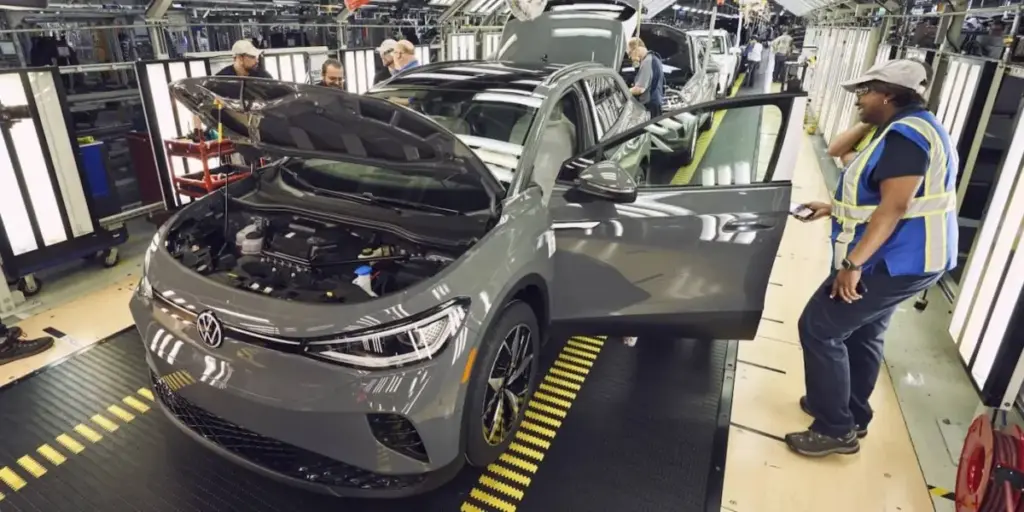
EV manufacturing remains the largest clean energy sector tracked by E2, boasting 166 active manufacturing projects totaling more than $84.4 billion in announced investments. However, it has also suffered the deepest cuts.

Since 2022, E2 has tracked 58 canceled, closed, or downsized EV manufacturing projects, wiping out approximately $25.5 billion in investment—nearly one-quarter of the sector’s total announced capital.
2. Battery Storage: High Growth, High Attrition
Battery energy storage manufacturing has experienced the highest cancellation rate relative to initial capital commitments. While E2 tracks nearly $16.9 billion in active battery manufacturing investments, more than $8.6 billion across 18 separate projects has already been canceled or downsized. This means roughly one-third of all announced battery storage manufacturing capital has evaporated.
3. Renewable Energy and Grid Infrastructure Show Resilience
Not all manufacturing sectors are struggling.
- Solar and Wind: Renewable energy hardware manufacturing has held its ground better than EVs and batteries, boasting 116 active projects and roughly $20.4 billion in investment. Cancellations here remain relatively low, totaling about $2 billion (less than 10% of announced capital).
- Grid and Transmission: Grid modernization manufacturing stands out as the most stable segment. Companies have announced more than $6.4 billion in active investment across 58 grid-related projects since 2022, with only a single project cancellation ($150 million) recorded to date.
Future Outlook: Navigating a Divided Energy Economy
The data from the first quarter of 2026 paints a picture of a clean energy economy divided against itself.
On one front, relentless market forces—principally the surging power demands of the digital economy, automated data centers, and industrial electrification—are forcing developers to build utility-scale solar, wind, and storage assets as fast as humanly possible. Because renewables remain the most economically viable and rapidly deployable generation sources available, the race to build continues unabated ahead of federal deadlines.

On the other front, heavy-handed political attacks and policy uncertainty are effectively freezing long-term capital deployment in domestic manufacturing, particularly within the EV and battery supply chains. Analysts note the profound irony of this dynamic: at a time when the U.S. power grid desperately needs more capacity to support national security, technological leadership, and economic growth, federal policies are actively destabilizing the very industries designed to supply that power.
As the July 4 federal deadline approaches, the coming months will likely see a frantic final wave of project groundbreakings. Beyond that date, however, the trajectory of American clean energy will depend heavily on whether federal policy pivots to support the infrastructure necessary to power the 21st-century economy, or whether political friction continues to stall domestic industrial growth.