For decades, modern municipal planning has treated nature-based solutions as decorative or compartmentalized add-ons to the hard-engineered reality of the concrete jungle. Green roofs, urban forests, bioswales, and protected wetlands have become staples of contemporary climate adaptation plans, dutifully recorded in municipal reports by the number of hectares restored, trees planted, and millimeters of stormwater retained.
Yet, as climate change accelerates erratic precipitation patterns, sea-level rises, and prolonged urban heatwaves, these piecemeal interventions are proving insufficient. A city may successfully sprinkle hundreds of nature-based solutions across its grid, yet still suffer catastrophic urban flooding and ecological degradation if its fundamental water systems remain fragmented.
At the center of this realization is a vital conceptual evolution: blue infrastructure. Traditionally categorized as merely a sub-tool of green infrastructure—comprising rivers, canals, coastlines, and engineered wetlands—blue infrastructure is undergoing a radical reassessment. Urban designers, landscape architects, and hydrologists are arguing that viewing water as a passive "object" to be managed or beautified misses the point entirely. Water is not merely an asset within a city; it is the fundamental organizing system through which all ecological, geological, and infrastructural processes operate.
This article explores the paradigm shift from static water management to holistic hydrological urbanism. By examining pioneering global case studies—such as Shenzhen’s Qianhai district, Paris’s renewed Seine, and Budapest’s urban ecoparks—we analyze how rethinking water as a dynamic system can fundamentally transform the future of city design.
Detailed Chronology: The Evolution of Urban Water Management
To understand how modern cities arrived at the concept of blue infrastructure, it is necessary to retrace the historical relationship between human settlements and water, moving from defensive engineering to holistic ecological integration.
The Era of Separation and Control (Industrial Revolution to Late 20th Century)
For centuries, the primary objective of urban water engineering was efficient disposal. As cities industrialized and expanded rapidly, natural rivers, streams, and wetlands were viewed as obstacles or health hazards.
The Culverting Phase: Municipalities systematically channeled natural streams into underground concrete culverts and pipes. Rivers were straightened, banks were encased in concrete, and floodplains were paved over to maximize real estate development.
The "Pipe-and-Pump" Paradigm: Urban drainage became a mechanical exercise. Rainwater fell on impermeable surfaces, rushed into storm drains, and was rapidly evacuated from the city limits via centralized sewer networks. While this prevented localized nuisance flooding in the short term, it severed the subterranean water table, starved regional ecosystems, and amplified downstream flood risks.
The Green-Infrastructure Turn (Late 1990s to Early 2020s)
As the ecological costs of hard-engineered infrastructure became undeniable, the urban planning paradigm began to shift toward sustainability and "nature-based solutions."
The Rise of Low-Impact Development (LID): Cities in North America, Europe, and East Asia began implementing green roofs, permeable pavements, and rain gardens.
Quantifying Ecology: Municipalities developed metrics focused on localized carbon sequestration, urban heat island mitigation, and surface permeability. However, water within these frameworks was still largely treated as an isolated environmental variable—an object to be captured by a bioswale or filtered by a constructed wetland, rather than an interconnected metabolic system.
The Systemic Horizon (Present Day and Beyond)
Today, forward-thinking urban designers are recognizing the limitations of treating green and blue infrastructure as mere patchworks of localized interventions.
The Sponge City Movement: Popularized extensively in countries facing extreme monsoonal climates, the "Sponge City" concept demands that urban areas absorb, infiltrate, store, and purify water naturally.
Hydrological Integration: Contemporary urban theory insists that water systems must dictate master planning rather than conform to pre-determined property lines. Hydrology now informs zoning, transportation networks, open-space planning, and density allocations. Water is no longer a guest in the urban realm; it is the master architect.
Supporting Context & Metrics: Why the Old Paradigm Fails
The traditional, compartmentalized approach to urban water management is increasingly misaligned with the realities of the 21st-century climate crisis.
The Urban Heat and Deluge Double-Bind
Urban environments are uniquely vulnerable to climate extremes due to the "urban heat island" effect and high ratios of impervious surfaces. Traditional stormwater management systems—designed for historical storm frequencies—are routinely overwhelmed by cloudburst events.
Impermeable Surface Saturation: In a heavily built environment where 70% to 90% of the surface is sealed by asphalt and concrete, natural groundwater recharge drops to near zero.
The Economic Toll of Flooding: According to global municipal data, urban flood damages cost billions of dollars annually in infrastructure repairs, business interruption, and emergency response. Hard infrastructure (dykes, levees, massive underground storage tunnels) requires astronomical capital outlays and carries a high risk of catastrophic failure when capacities are exceeded.
The Flaw in "Object-Oriented" Design
When planners categorize water simply as an aesthetic amenity (such as a decorative downtown reflecting pool) or a defensive hazard (a concrete drainage channel), they fail to account for the complex ecological dependencies governed by hydrology:
Vegetation Health: Plant communities cannot survive on municipal irrigation alone; they depend on the continuous, natural subterranean movement of water tables.
Microclimate Regulation: Evapotranspiration from integrated water-and-plant corridors cools urban air far more effectively than isolated pocket parks.
Biodiversity Corridors: Fragmented water features act as isolated islands. True blue infrastructure establishes continuous ecological corridors that allow aquatic and terrestrial species to migrate through urban matrices.
Official Statements and Expert Perspectives
Urban theorists, landscape architects, and municipal leaders are increasingly vocal about the necessity of redefining infrastructure through a hydrological lens.
"When we design water merely as an object to be landscaped or routed around, we treat symptoms rather than systems. Hydrology is the invisible skeleton of the city. If you ignore how water moves, pools, and sustains life beneath and across the landscape, your surface-level green interventions will ultimately wither under stress."
— Lead Urban Ecologist & Resilience Researcher
Global design firms specializing in waterfront revitalization and landscape architecture echo this sentiment, emphasizing that successful climate adaptation requires deep structural integration.
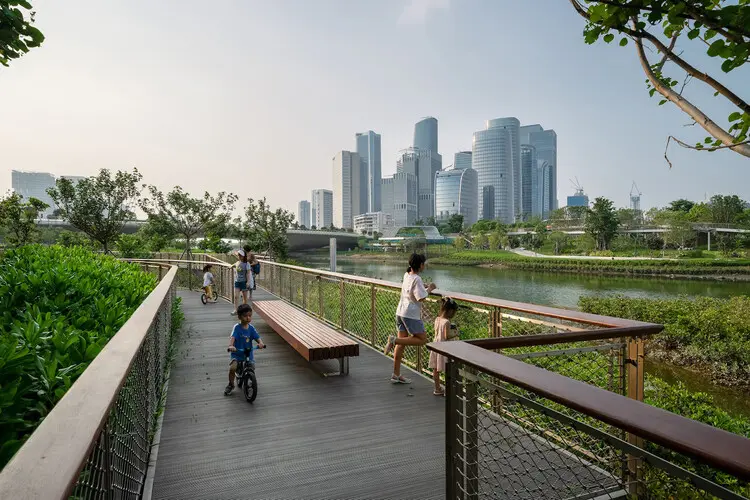
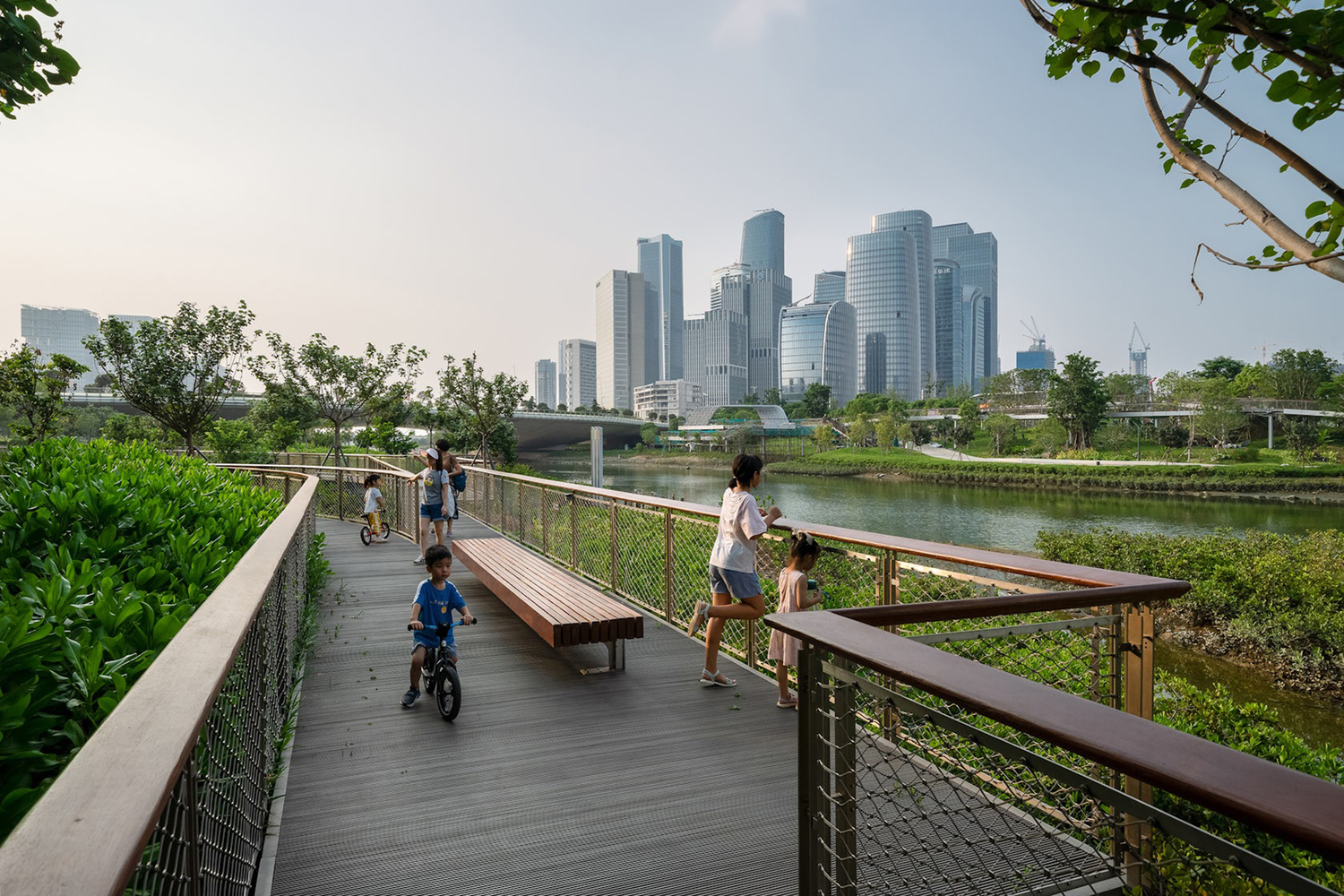
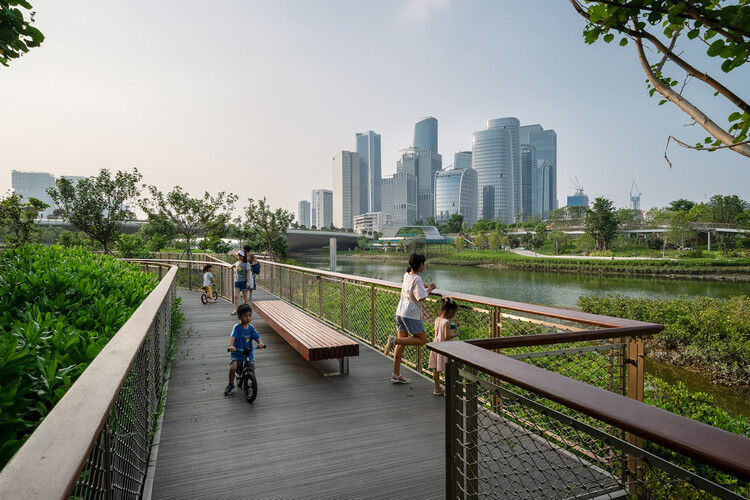
"Projects like Qianhai’s Guiwan Park demonstrate that tidal movements and seasonal flooding should not be fought with walls; they should be choreographed through design. By restoring the dynamic interplay between land and water, we turn vulnerability into a civic asset."
— Principal Landscape Architect, International Design Practice
Municipal planning agencies are also revising their regulatory frameworks. Forward-thinking cities are shifting from rigid engineering codes—which mandate specific pipe diameters and runoff coefficients—to performance-based ecological codes that measure a development’s total hydrological connectivity and watershed health.
Case Studies in Hydrological Urbanism
To see the shift from water-as-an-object to water-as-a-system in action, one must look to pioneering urban projects around the globe that have successfully integrated blue infrastructure into their core designs.
1. Qianhai’s Guiwan Park (Shenzhen, China)
Designed by Field Operations, Guiwan Park serves as a masterclass in tidal and stormwater integration. Located in a dense, rapidly developing financial district prone to coastal flooding and monsoonal deluges, the park rejects the traditional approach of building higher seawalls.
The Dynamic Tidal System: Instead, the park is structured as a series of terraced, finger-like wetlands and forest patches that weave between high-rise developments.
Systemic Function: As tides rise and fall, water flows naturally into the park’s multi-tiered basins, filtering urban runoff, absorbing storm surges, and creating a lush recreational green space during dry periods. Water dictates the spatial organization of the entire district, proving that high-density urbanism and resilient hydrology can coexist.
2. The Seine Open-Air Swimming Sites (Paris, France)
Paris’s ambitious efforts to reclaim the Seine for public recreation and ecological health illustrate how municipal water infrastructure can be revived at a macro-scale.
Beyond Aesthetics: Rather than treating the river as a commercial transport highway or a hidden municipal drain, Paris has invested heavily in upstream retention basins, wastewater treatment upgrades, and decentralized green infrastructure across the metropolitan basin.
Systemic Restoration: By cleaning the entire watershed rather than just treating localized riverbanks, the city has transformed the Seine back into a living ecosystem that supports aquatic biodiversity and human well-being alike.
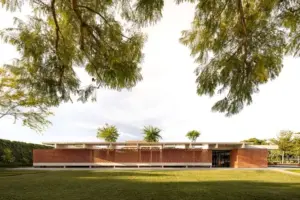
3. Vizafogo Pavilion and Ecopark (Budapest, Hungary)
Designed by Archikon Architects, the Vizafogo Ecopark integrates urban public space with Danube-adjacent hydrological systems.
Floodable Landscapes: The park is explicitly engineered to tolerate seasonal flooding. During dry spells, it functions as a vibrant community park and urban habitat; during high-water events on the Danube, it safely acts as an overflow basin, protecting surrounding residential zones from inundation without relying on industrial floodgates.
Future Outlook: The Next Frontier in City Design
As urban populations continue to swell and climate volatility intensifies, the future of city design will depend on our ability to abandon static engineering models in favor of fluid, adaptive frameworks.
Key Shifts for the Next Decade:
From Hard Infrastructure to Hybrid Ecosystems: Concrete flood walls are giving way to "living shorelines," mangrove restorations, and terraced retention parks that heal rather than harm regional ecosystems.
Data-Driven Hydrology: The integration of real-time sensor networks, IoT-enabled stormwater management, and predictive AI modeling will allow cities to dynamically manage retention basins, sluice gates, and permeable landscapes in anticipation of storms.
Watershed-Scale Governance: Municipalities are realizing that political boundaries do not align with river basins. Future urban planning will require cross-jurisdictional collaboration, uniting upstream and downstream communities under shared hydrological management strategies.
Conclusion
Blue infrastructure is far more than a collection of rivers, lakes, and bioswales tagged onto a municipal sustainability checklist. It is a fundamental mindset shift—a recognition that water is the primary organizing system of our environment. By moving past the outdated notion of water as a passive object to be managed, controlled, or beautified, cities can unlock a new era of resilience. When urban design honors the natural rhythms of hydrology, water ceases to be an existential threat and instead becomes the lifeblood of a thriving, adaptable, and enduring urban future.