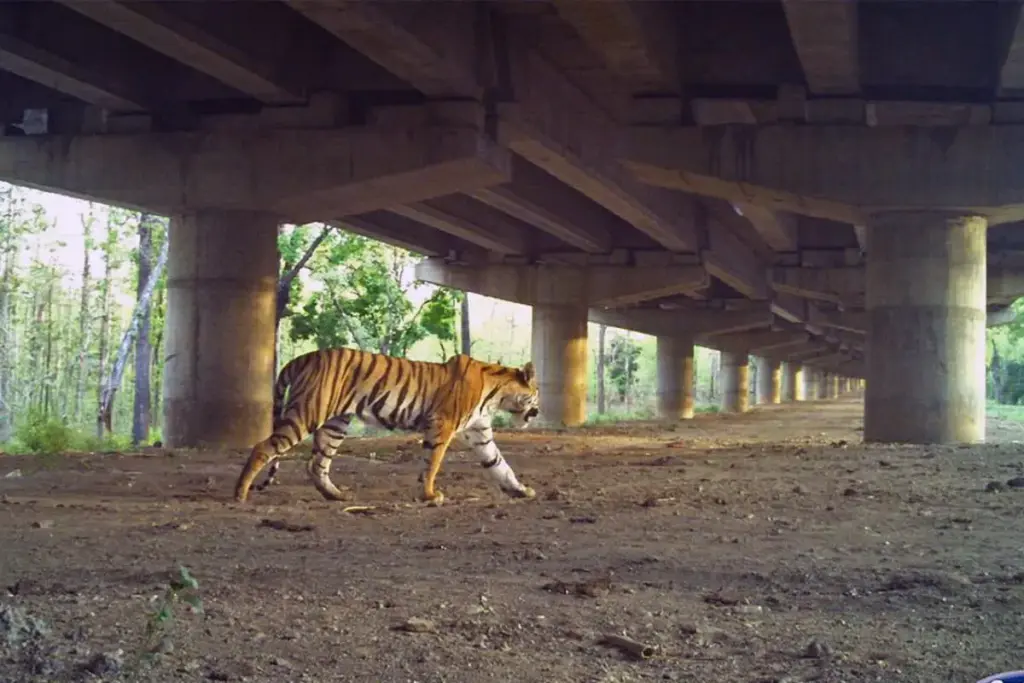
New Delhi — For decades, the narrative surrounding the Royal Bengal tiger (Panthera tigris tigris) was one of desperate, last-ditch preservation. Poaching, human encroachment, and the relentless fragmentation of the subcontinent’s forests pushed the apex predator to the precipice of extinction. Today, however, India’s conservation playbook is being forced to adapt to an entirely different kind of crisis: a population boom.
Home to roughly 75% of the world’s wild tigers, India has more than doubled its feline population, leaping from a precarious low of 1,827 individuals in 1972 to an estimated 3,682 in the latest 2022 national census. But this resounding conservation triumph has birthed a complex spatial emergency. As protected core reserves reach maximum carrying capacity, a significant and growing cohort of tigers is spilling over into human-dominated landscapes.
Conservationists are now sounding the alarm, urging federal and state governments to urgently prioritize the protection and restoration of ecological corridors—the vital migratory pathways connecting isolated forest patches. Yet, beneath the policy debates lies a sharper warning: building green bridges and mapping pathways cannot serve as a sticking plaster for degraded, shrinking core habitats. As India races to build the infrastructure of a modern economic superpower, the country stands at a historic crossroads, forced to decide whether its iconic national animal can survive in a landscape increasingly bisected by asphalt, rail, and steel.
Executive Overview
India’s conservation success is undeniable, but it has generated unprecedented spatial pressures. Approximately 35% of the country’s wild tigers now live outside officially designated protected areas. As young tigers reach maturity, they disperse from their natal territories to establish their own home ranges—a biological necessity that requires immense spatial footprint, with adult male territories stretching up to 200 square kilometers (77 square miles).
To traverse these distances, tigers must increasingly navigate a hostile mosaic of multi-lane expressways, high-speed rail lines, mining operations, and sprawling agrarian and urban developments. Without safe ecological corridors to facilitate gene flow, these isolated populations face severe risks of inbreeding depression, genetic stagnation, and eventual local extinction.
While India has aggressively pioneered infrastructure mitigation measures—constructing some of the world’s largest wildlife underpasses and overpasses—critics argue that these engineering feats are being undermined by systemic regulatory failures. Environmental watchdogs point out that regulatory bodies meant to safeguard critical wildlife habitats have been reduced to rubber stamps, approving the vast majority of commercial projects. As top-tier scientists and wildlife biologists argue, safeguarding India’s future tiger populations requires more than just funneling animals across highways; it demands an uncompromising defense of core wildernesses and a holistic approach to landscape-level conservation.
Detailed Chronology: From the Brink of Extinction to the Fragmented Frontier
The 1970s–1980s: Project Tiger and the Fortress Conservation Era
The modern trajectory of tiger conservation in India began in 1973 with the launch of "Project Tiger," an ambitious federal initiative spearheaded by then-Prime Minister Indira Gandhi. Recognizing that the species was sliding toward oblivion, the government established initial core reserves—fenced or strictly managed sanctuary zones designed to be inviolate spaces free from human disturbance. For decades, this "fortress conservation" model succeeded in halting the immediate freefall of the tiger population, gradually allowing numbers to stabilize through the late 20th century.
The 2000s–2010s: The Looming Shadow of Rapid Infrastructure
As India’s economy accelerated into the 21st century, a massive demand for infrastructure development took shape. Highways were widened, new freight rail corridors were laid, and energy projects cut deep swaths through forested terrain. By the 2010s, field biologists began noticing a disturbing trend: while tiger numbers within well-managed reserves were ticking upward, mortality rates outside reserves were skyrocketing. Tigers struck by vehicles, poisoned by retaliatory farmers, or caught in electrical snares became alarmingly common. The realization dawned that India’s protected areas were becoming ecological islands in a sea of human development.
2017–Present: The Era of Mitigation and the Dispersal Crisis
Recognizing the threat posed by linear infrastructure, India embarked on a massive engineering response starting around 2017. The government began incorporating wildlife mitigation structures into major highway projects, particularly along key migratory routes. The crowning achievement of this phase was the construction of a 12-kilometer (7.5-mile) underpass system beneath the New Delhi-Dehradun expressway. Yet, this period has also been marked by fierce policy battles. Even as underpasses were being poured in concrete, regulatory oversight over forest diversions weakened, setting up a profound contradiction between India’s conservation rhetoric and its developmental realities.
Supporting Context & Metrics: The Scale of the Challenge
To understand the mechanics of India’s tiger dispersal crisis, one must look closely at the numbers, the geography, and the biology of Panthera tigris tigris.
- The Demographic Shift: According to recent wildlife data, roughly 35% of India’s wild tigers now reside outside traditional protected areas like national parks and wildlife sanctuaries.
- Population Growth: The national tiger census recorded an explosive rebound from 1,827 tigers in 1972 to 3,682 tigers in the 2022 census, housing roughly three-quarters of the global wild tiger population within its borders.
- Spatial Requirements: Young tigers dispersing from their mothers require vast expanses of land. While females may settle closer to home, adult males demand home ranges of up to 200 square kilometers (77 square miles) to secure adequate prey and mating opportunities.
- Regulatory Approvals: Research by prominent conservationists and former forestry officials has revealed that the National Board for Wildlife—the apex body tasked with vetting projects in critical wildlife zones—approved an astonishing 97% of all project proposals brought before it over a 12-year window.
- Carrying Capacity: Leading felid experts, such as Ullas Karanth, maintain that India’s landscapes are biologically capable of supporting 10,000 to 20,000 tigers, provided that their foundational habitats are aggressively protected and expanded.
Official Statements and Expert Perspectives
The debate over how to manage India’s rising tiger population has divided conservationists, engineers, and policy analysts into distinct schools of thought regarding the efficacy of engineering versus ecological integrity.

The Engineering Feat: Championing Mitigation Structures
Bilal Habib, a senior scientist at the government-run Wildlife Institute of India (WII), champions the country’s aggressive investment in structural mitigation. According to Habib, India has outpaced every other developing nation in Asia when it comes to funding and constructing wildlife passages.
“I don’t think anywhere in the world, any developing country has spent as much money as we have on mitigation, exclusively for wildlife conservation,” Habib told Mongabay, highlighting massive structures like the multi-kilometer underpasses along National Highway 44 and the New Delhi-Dehradun expressway.
The Regulatory Rubber-Stamp: A Policy Critique
However, this optimism is tempered by severe criticisms from former forestry officials and policy researchers. Prakriti Srivastava, a former principal chief conservator of forests in Kerala, alongside researcher and author Prerna Bindra, have closely scrutinized the institutional mechanisms governing forest clearance. Their investigations reveal that the National Board for Wildlife’s Standing Committee has functioned largely as an administrative rubber stamp rather than a rigorous conservation barrier, sacrificing critical habitats for mining and commercial corridors.
Core Habitats First: The Biological Imperative
Dr. Ullas Karanth, a renowned tiger expert and emeritus director of the Bengaluru-based Centre for Wildlife Studies, argues that building corridors without secure core habitats is a futile exercise.
“Tigers will only use corridors if there is a motivation to cross, which requires healthy habitats on both sides,” Karanth noted. “To me the context is first to secure the core habitat. India could, in fact, accommodate up to 10,000-20,000 tigers if habitats are adequately protected.”
Echoing this sentiment, wildlife biologist Ravi Chellam cautions against over-simplifying animal movement through cartographic lines drawn on a map.
“Elegantly and clearly demarcating narrow wildlife habitats on a map and calling them corridors is not the solution,” Chellam asserted. “Animals don’t limit their movements to corridors. They use a matrix of habitats available in the landscape.”
Future Outlook: Navigating the Road Ahead
As India moves deeper into the 21st century, the conservation community faces a delicate balancing act. The country’s remarkable ability to reverse the decline of its national animal stands as a global conservation benchmark. Yet, the physical reality of a surging apex predator population sharing space with 1.4 billion people demands a paradigm shift that goes far beyond pouring concrete for highway underpasses.
Looking forward, the roadmap for sustainable tiger conservation in India must address several critical fronts:
- Integrated Landscape Planning: Infrastructure projects must be conceptualized through a landscape-level lens rather than piecemeal environmental assessments. Strategic avoidance of critical wilderness areas must take precedence over post-construction mitigation.
- Reforming Governance: Institutions like the National Board for Wildlife must regain their independence and scientific rigor, ensuring that commercial interests do not routinely override ecological imperatives.
- Community Coexistence: With a third of the tiger population living outside reserves, community-based conservation models, timely compensation for livestock loss, and mitigation of human-wildlife conflict are paramount to securing local tolerance for the big cats.
- Restoring Corridors as Living Landscapes: True corridor protection cannot be achieved by drawing narrow green lines on bureaucratic maps. It requires active ecological restoration, curbing local degradation, and ensuring that the matrix of forests, farmlands, and community lands remains permeable and safe for roaming wildlife.
Ultimately, the survival of the Bengal tiger will no longer be decided solely within the protected confines of national parks. It will be decided in the spaces in-between—along the edges of highways, through the working forests, and in the policy boardrooms where India chooses how to balance its economic ambitions with its ecological soul.