Executive Overview
Across the globe, the air quality defining our modern era carries an unmistakable, deeply unsettling scent: the acrid, chemical tang of burning plastic. While wildfires are an ancient, natural earth-system process, the character of contemporary blazes has undergone a grim metamorphosis. Driven by a warming climate, sprawling human developments, and the ubiquitous integration of synthetic polymers into modern architecture, wildfires are no longer merely forest fires—they are industrial-scale chemical disasters.
From North America to Australia, Europe, Asia, and South America, millions of acres burn annually, blanketing hundreds of millions of people in toxic hazes. Yet, the public discourse often misses the most insidious catalyst of this crisis: our heavily plasticized built environment. Modern homes, commercial structures, municipal infrastructure, and everyday consumer furnishings are saturated with flammable, toxic petrochemical derivatives. When wildfires breach the wildland-urban interface, they do not just consume timber and brush; they incinerate vast repositories of synthetic materials, releasing a lethal cocktail of persistent organic pollutants, heavy metals, and carcinogenic VOCs (volatile organic compounds).
This comprehensive report examines the alarming chemistry behind plastic-fueled wildfire smoke, evaluates the staggering public health toll projected for the coming decades, highlights critical research from organizations like the Plastic Pollution Coalition and Habitable, and outlines actionable pathways for structural reform and community resilience.
Detailed Chronology of an Escalating Crisis: The Modern Convergence of Climate, Development, and Synthetics
To understand the current state of atmospheric toxicity, one must trace the compounding vectors that have elevated wildfires from localized ecological events to planetary health hazards.
The Evolution of the Wildland-Urban Interface (WUI)
For decades, human expansion has pushed deeper into historically fire-prone ecosystems. This zone of transition between unoccupied land and human development is known as the wildland-urban interface (WUI). As suburbs, industrial parks, and commercial hubs proliferate within the WUI, the fuel matrix of wildfires fundamentally changes.
Historically, fires encountered native flora—grasses, shrubs, and timber—yielding smoke primarily composed of carbon, water vapor, and reactive organic gases that dissipated relatively predictably. Today, a wildfire sweeping through the WUI encounters thousands of residential and commercial structures. These structures are packed with synthetic carpets, vinyl siding, polyurethane foam insulation, PVC piping, electronic components, and synthetic textiles.

The January 2025 Los Angeles Wildfires: A Case Study in Plastic Cities
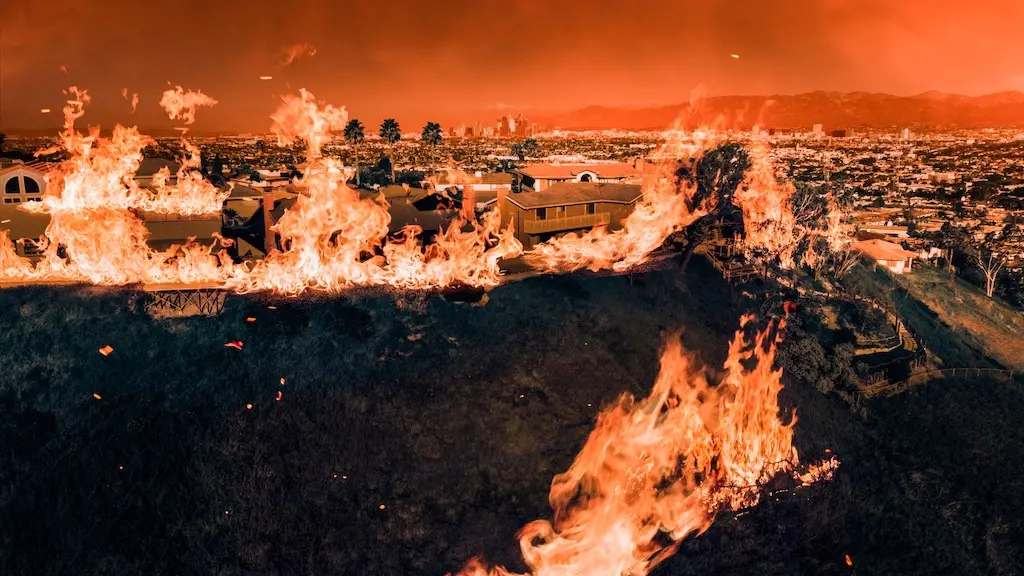
The grim reality of the modern WUI was vividly illustrated during the catastrophic January 2025 wildfires in Los Angeles, California. These fires tore through densely populated residential neighborhoods with terrifying speed and intensity. Rather than a slow-burning brushfire, emergency responders and atmospheric scientists witnessed firestorms capable of vaporizing entire communities within minutes.
The intense heat generated by burning plastics created dynamic fire behaviors, including extreme localized updrafts and erratic wind patterns. More alarmingly, the smoke plume carried an unprecedented load of industrial chemicals directly over metropolitan centers. The Los Angeles disaster served as a watershed moment, prompting researchers to designate such events as "plastic-fueled urban firestorms"—a phenomenon that demands an entirely new paradigm in emergency management, urban planning, and environmental toxicology.
Globalized Impact: From Regional Events to Continental Plumes
Because modern fires burn hotter and generate greater thermal energy due to the high caloric value of synthetic polymers, the resulting smoke plumes rise higher into the troposphere. Once aloft, jet streams and high-altitude winds transport these toxic cargoes across continental divides.
Residents thousands of miles away from active burn zones now routinely experience eerie orange- or yellow-colored skies. This atmospheric chromatic shift occurs when dense concentrations of sub-micron particulate matter scatter shorter wavelengths of blue light, allowing longer red wavelengths to dominate the visual spectrum. What appears visually as a dramatic sunset is, in reality, a persistent atmospheric highway carrying toxic industrial fallout across borders, oceans, and hemispheres.
Supporting Context & Metrics: The Toxic Chemistry of Modern Smoke
The sensory experience of smelling burning plastic in wildfire smoke is underpinned by rigorous atmospheric chemistry. When natural biomass burns, it releases wood smoke compounds. However, when synthetic polymers ignite, a vastly different chemical pathway is initiated.
Why Smoke Smells Like Chemicals and How Toxicity Increases Over Time
Near the fire source, smoke retains a traditional campfire aroma due to rapidly reacting organic compounds from vegetation. However, as the plume travels downwind, chemical transformations occur via photolysis and oxidation. Complex petrochemical derivatives—such as benzene, formaldehyde, polycyclic aromatic hydrocarbons (PAHs), dioxins, and furans—linger in the atmosphere.

Consequently, wildfire smoke frequently becomes more toxic the further it travels from its source. While the physical mass of particulate matter may dilute over distance, the chemical complexity and persistence of secondary pollutants pose unique hazards to populations hundreds of miles away, who have no immediate visual cues of a nearby fire.
Particulate Matter ($PM_2.5$) and Systemic Pathology
At the heart of the wildfire smoke hazard is particulate matter measuring 2.5 micrometers or less in diameter ($PM_2.5$). These microscopic particles are small enough to bypass the body’s natural filtration systems in the nose and upper respiratory tract, lodging deep within the alveolar sacs of the lungs.
From the lungs, ultra-fine particles and associated chemical toxins cross the alveolar-capillary membrane directly into the bloodstream. Once systemic circulation is achieved, these pollutants trigger widespread endothelial dysfunction and systemic inflammation. The health consequences documented in recent epidemiological and toxicological literature are profound:
- Cardiovascular Disease: Systemic inflammation accelerates atherosclerosis, precipitating myocardial infarctions (heart attacks) and ischemic strokes.
- Respiratory Pathology: Chronic and acute exposure exacerbates asthma, induces chronic obstructive pulmonary disease (COPD), and degrades lung function over time.
- Oncological Risks: Long-term exposure to the chemical cocktail found in synthetic-heavy wildfire smoke is increasingly linked to elevated incidences of lung cancer and other malignancies. Research published by the American Association for Cancer Research (AACR) underscores that even limited, repeated exposures significantly elevate baseline cancer risks.
- Neurological and Mental Health Impacts: Emerging studies indicate that neuroinflammation caused by ultrafine particles crossing the blood-brain barrier contributes to cognitive decline, "brain fog," anxiety, depression, and increased rates of mental health crises in affected populations.
- Reproductive Health: Prenatal exposure to wildfire smoke has been causally linked to an increased risk of premature birth, low birth weights, and developmental complications in infants.
Staggering Epidemiological Projections
The global human toll is rapidly mounting. Experts estimate that wildfire smoke is directly responsible for tens of thousands of premature deaths annually on a global scale. Looking forward, the projections are deeply alarming. Predictive models published in leading scientific journals estimate that wildfire smoke containing high levels of particulate matter and industrial toxins could cause 1.9 million excess deaths worldwide between 2026 and 2055.
Historical data already reveals a heavy domestic toll; scientists calculate that more than 24,100 people died prematurely in the contiguous United States alone due to wildfire smoke exposure between 2006 and 2020. Public health agencies concur: there is no safe level of wildfire smoke exposure. Both acute, high-concentration events and chronic, low-level baseline exposures carry measurable, cumulative damage to human physiology.
Official Statements and Institutional Insights
As the scientific community coalesces around the urgency of the plastic-wildfire nexus, institutional leaders and advocacy groups are raising the alarm.

The Landmark 2025 Report: How Plastics Fuel Wildfires & How to Rebuild Better
In September 2025, the Plastic Pollution Coalition, in collaboration with the research and advocacy organization Habitable, released a groundbreaking special report examining the integration of plastics in building materials and construction. The report details how the mass production, utilization, and disposal of plastics within the built environment directly amplify the frequency, intensity, and toxicity of wildfires.
Targeting architects, urban planners, building engineers, and policymakers, the report serves as a diagnostic tool and a blueprint for reconstruction. It highlights that traditional rebuilding efforts often replace burned structures with the exact same synthetic, highly flammable materials, locking communities into a continuous cycle of vulnerability.
Leadership Perspectives
Dianna Cohen, Co-Founder and CEO of the Plastic Pollution Coalition, emphasized the systemic nature of the threat during the release of the 2025 report:
"Plastics not only make wildfires worse; their production also fuels climate change, compounding the risks. We must urgently eliminate plastics from our built environment, and build and rebuild better with nontoxic and plastic-free alternatives."
This perspective reframes plastics not merely as a localized waste management issue, but as a structural climate vulnerability and a direct chemical hazard to human survival. The reliance on petrochemical building blocks creates a feedback loop: fossil fuel extraction drives climate change, which intensifies droughts and wildfires; these fires then ignite petrochemical-based buildings, releasing massive quantities of greenhouse gases and toxic chemicals back into the atmosphere, further accelerating environmental degradation.
Future Outlook: Mitigation, Policy, and the Path to Resilient Communities
Addressing the convergence of plastics and wildfires requires a multi-tiered approach spanning regulatory reform, material science innovation, and community-level preparedness.

1. Reforming Building Codes and Material Standards
Governments and regulatory bodies must fundamentally overhaul building codes, particularly within high-risk WUI zones. Agencies such as the California Business, Consumer Services, and Housing Agency, alongside national building standard authorities, must incentivize and mandate the adoption of healthier, fire-resistant, plastic-free building materials. Transitioning away from PVC, polyurethane foams, and synthetic composites toward mineral-based, timber-alternative, and bio-based non-toxic materials will dramatically reduce the toxic chemical yield of future fires.
2. Upgrading Infrastructure and Urban Planning
Urban planners must rethink the concept of defensible space and structural zoning. Creating robust buffer zones between natural ecosystems and human settlements is essential, but equally important is the internal composition of communities. Fire-hardening infrastructure must extend beyond ember-resistant roofing to include the elimination of toxic exterior cladding and synthetic landscaping materials that act as accelerants during ignition events.
3. Public Health Preparedness and Personal Protection
Until structural changes are fully realized, populations living under the shadow of wildfire seasons must adopt rigorous protective measures:
- Indoor Air Filtration: Utilizing high-efficiency particulate air (HEPA) filters in HVAC systems and standalone purifiers can drastically reduce indoor $PM_2.5$ concentrations.
- Respiratory Protection: When ambient air quality degrades to hazardous levels, utilizing properly fitted N95 or P100 respirators is critical for outdoor protection.
- Monitoring and Evacuation: Relying on real-time air quality index (AQI) tracking enables vulnerable populations—such as children, the elderly, pregnant individuals, and those with pre-existing respiratory or cardiovascular conditions—to limit outdoor exposure proactively.
- Water and Environmental Safety: Beyond air pollution, communities must remain vigilant regarding drinking water contamination caused by chemical runoff from burned plastic infrastructure entering municipal watersheds.
4. A Call to Action
The burning of our plasticized cities is a stark symptom of a broader ecological overshoot. Protecting human health and stabilizing our global climate requires an immediate, coordinated departure from the age of disposable synthetics. By holding regulatory bodies accountable, supporting sustainable architectural transformations, and prioritizing non-toxic rebuilding strategies, society can break the cycle of plastic-fueled devastation and work toward restoring the safety of our air, our communities, and our natural world.