
By Grist and WABE
Executive Overview
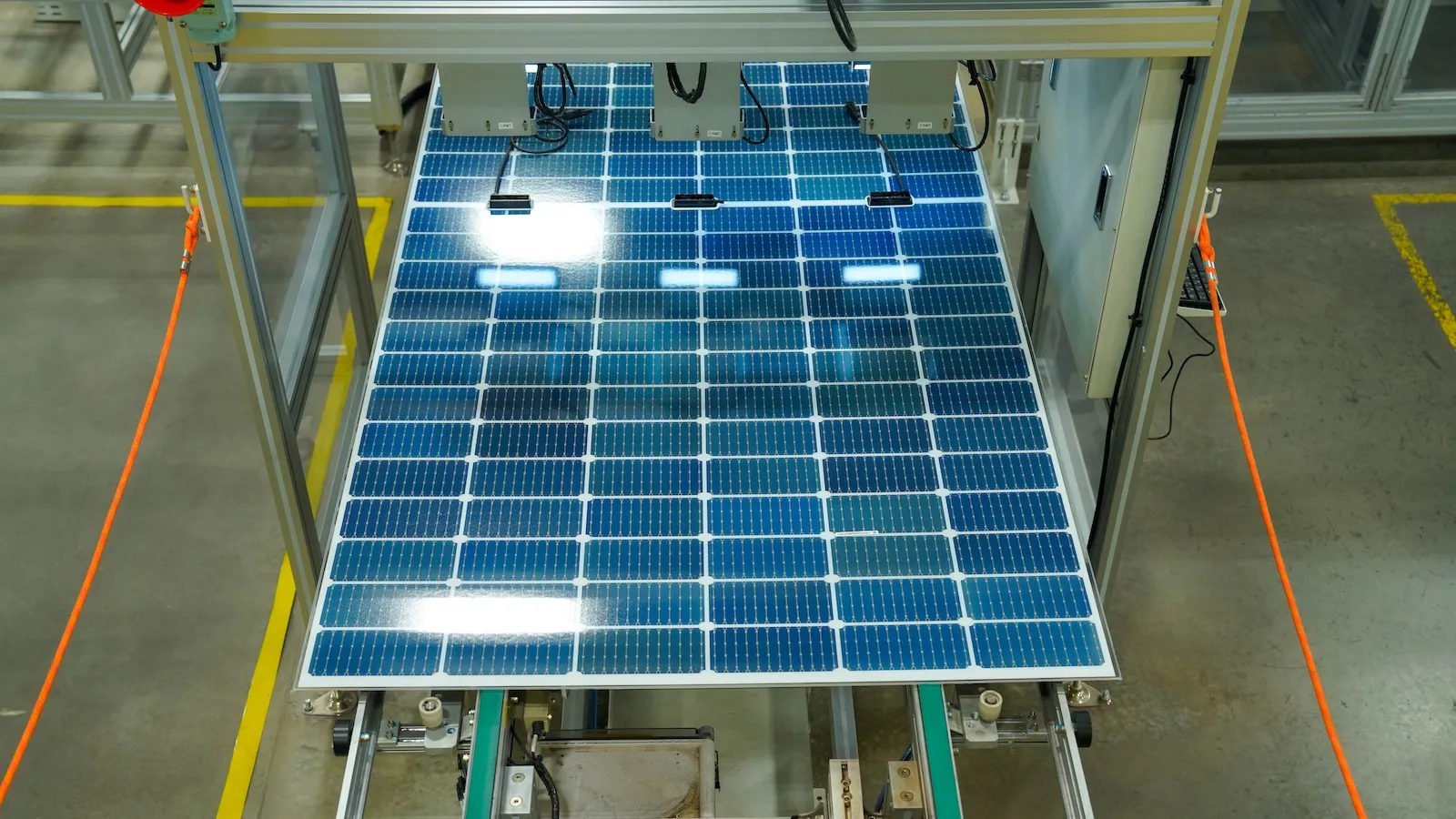
Deep inside a sprawling, high-tech manufacturing plant in Cartersville, Georgia, a quiet industrial revolution is underway. Rows of precision robotics and human technicians work in tandem, guiding ultra-thin wafers of polysilicon through a complex gantlet of chemical baths and advanced machinery. The ultimate product of this massive $2.5 billion, football-field-sized infrastructure is deceptively simple: a paper-thin, electric-blue solar cell.
Yet, this small silicon square represents a monumental milestone for the American energy sector. For over a decade, China has dominated the global solar supply chain, flooding international markets with inexpensive panels that made domestic manufacturing economically unviable. Today, however, the United States is aggressively working to claw back control of its renewable energy future. Spurred by national security priorities, labor standards, and the promise of robust domestic job creation, facilities like the South Korean-owned Qcells plant are bringing the entire solar manufacturing process—from raw polysilicon to finished panel—under one roof.
This domestic manufacturing renaissance, however, is navigating a turbulent political and economic landscape. Over the past several years, the U.S. solar sector has experienced massive policy whiplash. While the Biden administration deployed a "carrot" approach through the 2022 Inflation Reduction Act (IRA)—offering lucrative tax credits to incentivize domestic sourcing—the incoming Trump administration has pivoted decisively to a "stick" methodology. Recent legislative overhauls, such as the One Big Beautiful Bill Act (OBBBA), have dismantled many of these clean energy tax incentives while introducing aggressive new tariffs and minimum import pricing on foreign polysilicon.
While these protectionist measures aim to shield domestic manufacturers like Qcells from cheap foreign competition, they have also injected severe uncertainty into the broader market. Developers face a complex maze of shifting regulations, abandoned projects, and rising component costs. Even so, industry experts remain bullish. Driven by skyrocketing electricity demand, crippling backlogs for natural gas turbines, and record-low technology costs, solar power continues to dominate new grid capacity additions. The core question facing the nation is no longer whether solar will power America’s future, but how much it will cost, how fast it can be deployed, and who will control the manufacturing supply chain.
Detailed Chronology: The Evolution of U.S. Solar Policy
To understand the current state of American solar manufacturing, one must examine the rapid, often jarring shifts in federal industrial policy that have defined the sector over the past decade.
The Era of Chinese Dominance (2010s–2022)
Throughout the 2010s, China cemented its status as the undisputed titan of global solar manufacturing. Backed by state subsidies, cheap energy, and integrated supply chains, Chinese firms scaled production to unprecedented levels. By the time global climate urgency accelerated clean energy deployment, foreign manufacturers supplied the vast majority of U.S. solar projects. While this kept installation costs low for American developers, it created deep vulnerabilities in national infrastructure, leaving the U.S. heavily reliant on geopolitical competitors for critical green tech.
The "Carrot" Approach: The Inflation Reduction Act (2022)
The strategic paradigm shifted dramatically in August 2022 with the passage of the federal Inflation Reduction Act. The legislation introduced a suite of supply-side incentives, most notably bonus tax credits for renewable energy projects utilizing domestically manufactured components.
This financial framework acted as an immediate magnet for foreign direct investment. Qcells, a flagship subsidiary of South Korea’s Hanwha Group, responded by announcing and subsequently executing plans for its massive Cartersville, Georgia, complex—an investment designed to localize every tier of solar production on American soil. For a brief window, domestic manufacturers enjoyed a predictable, incentive-rich environment.
The "Stick" Approach: The One Big Beautiful Bill Act and New Tariffs (2025–Present)
The policy landscape experienced another seismic shift with the legislative interventions of the Trump administration. Through the enactment of the One Big Beautiful Bill Act (OBBBA), the federal government systematically dismantled the vast majority of the IRA’s clean energy tax credits.
Simultaneously, the administration closed critical regulatory loopholes that had previously permitted Chinese-backed companies to establish final-assembly operations within the United States. To further protect domestic producers, the administration announced stringent new tariffs and minimum import price floors on polysilicon—the foundational raw material for photovoltaic cells—set to take full effect in December.
This pivot from fiscal incentives to aggressive trade barriers has left corporate boardrooms scrambling to adapt, transforming long-term capital planning into a high-stakes exercise in risk management.
Supporting Context & Metrics: The Anatomy of a Modern Solar Plant
Operating a fully integrated solar manufacturing facility requires immense resource mobilization. According to operational metrics shared by Qcells representatives at the Cartersville facility, the scale of domestic production is staggering:
- Capital Investment: $2.5 billion poured into state-of-the-art infrastructure.
- Water Consumption: Approximately 3.5 million gallons utilized in the delicate chemical processing and wafer-cleaning stages.
- Energy Demand: 90 megawatts of continuous power required to run the automated assembly lines.
- Chemical Utilization: 60 tons of specialized industrial chemicals maintained on-site.
- Physical Footprint: Infrastructure spanning the equivalent of multiple football fields.
Despite this immense industrial scale, the domestic supply chain remains vulnerable in the short term. Coco Zhang, an energy researcher at the global financial institution ING, notes that while major, well-capitalized firms like Qcells possess the financial resilience to weather regulatory shifts, smaller domestic players face severe headwinds.
Furthermore, the broader deployment market is absorbing significant shockwaves. Data compiled by clean energy advocacy group E2 reveals that the policy uncertainty surrounding expiring tax credits and federal permitting hurdles led to nearly $13 billion in abandoned clean energy investments during the first quarter of the year alone. Conversely, developers rushed to announce roughly $18 billion in new projects just to beat regulatory deadlines, creating an erratic boom-and-bust cycle across the development landscape.
Official Statements and Industry Perspectives
The rapid oscillation of federal policy has elicited mixed reactions from technology developers, financial analysts, and industrial engineers who view the domestic manufacturing push through varied lenses.
Ben Damiani, Chief Technology Officer at Cherry Street Energy (Atlanta-based solar developer):
"Having the full supply chain is critical. Moving that supply chain to the U.S. hasn’t been a smooth road. Probably the biggest hindrance has been the constant change of our own policies."
Damiani remains a steadfast advocate for the technology itself, emphasizing its fundamental economic and operational superiority over fossil fuel alternatives:
"We absolutely should make solar, right? Like it is the fastest deployed, lowest cost foreseeable. Solar will be, for the next hundred years, a good portion of our energy."
Coco Zhang, Energy Researcher at ING:
"The two policy approaches [Biden’s IRA vs. Trump’s OBBBA and tariffs] have the same ultimate goal: building an independent American industrial base. But it’s been whiplash for companies."
Zhang points out that while closing regulatory loopholes regarding foreign ownership strengthens the integrity of domestic supply chains in the long run, the abrupt policy back-and-forth introduces painful friction:
"Limited U.S. supply means many developers will still depend on imports and face higher costs. While tariffs help domestic manufacturers compete, they drive up immediate expenditures for those trying to build clean energy projects today."
Future Outlook: Navigating the Road Ahead
As the U.S. solar industry looks toward the horizon, the path forward is defined by a complex dichotomy: robust underlying demand colliding with administrative friction.
On the demand side, solar energy remains exceptionally resilient. According to data from the Solar Energy Industries Association (SEIA), solar and battery storage installations accounted for an astonishing 90 percent of all new power generation capacity added to the U.S. electrical grid in the first quarter of the year. This dominance is propelled by two primary factors:
- Economic Efficiency: Solar remains one of the absolute cheapest sources of electricity available, a critical advantage at a time when nationwide electricity demand—driven by data centers, artificial intelligence, and vehicle electrification—is surging at historic rates.
- Supply Chain Bottlenecks Elsewhere: While solar panels and storage components are readily accessible, competing generation technologies face crippling delays. Traditional gas turbines, for instance, currently carry industry-wide backorders spanning multiple years.
Yet, the ultimate trajectory of the American solar market depends heavily on how federal regulators, courts, and manufacturers navigate the coming months. Legal challenges have successfully blocked or modified several executive attempts to cancel clean energy funding and restrict installations on federal public lands, but these ongoing court battles continue to generate costly delays.
Ultimately, industry consensus suggests that solar development is an unstoppable force in the modern energy economy. The lingering uncertainties are procedural rather than existential: Exactly how quickly can domestic factories ramp up production? To what extent will protective tariffs inflate short-term project costs? And, most importantly, which nations and corporations will ultimately capture the economic windfall of the global clean energy transition?
For workers on the polished concrete floors of factories in Cartersville, Georgia, the answer is being forged one silicon wafer at a time.