Executive Overview
Ground cover plants are the unsung heroes of landscape design. Far more than mere aesthetic fillers, these living mulches play a vital ecological and practical role in modern horticulture. By forming dense canopies that intercept sunlight, high-performing ground-cover species starve weed seeds of the light they need to germinate, drastically reducing the need for back-breaking weeding and chemical herbicides. Simultaneously, their root systems stabilize vulnerable slopes, prevent soil erosion during torrential downpours, and insulate the earth against extreme temperature fluctuations.
Yet, selecting the right plant for the right place remains a perennial challenge for gardeners. A plant that thrives in the sun-baked, dry soil of a rockery will quickly wither in the damp, heavy shade beneath a dense canopy of deciduous trees. This comprehensive guide examines twenty of the most reliable, visually striking, and functionally diverse ground-cover plants available to horticulturists today. Backed by rigorous botanical data, planting specifications, and expert advice, this exhaustive inventory provides the authoritative roadmap needed to transform barren patches, stubborn shade traps, and challenging slopes into thriving, low-maintenance horticultural displays.

Detailed Chronology and Plant Profiles: The Top 20 Ground Covers
1. Hardy Geraniums (Geranium spp.)
An indispensable backbone of the herbaceous perennial border, hardy geraniums form neat, low mounds typically under knee-high. Their blooming season stretches from late spring well into early autumn, followed by foliage that can burnish to a rich copper tone as autumn temperatures drop. Specific varieties are remarkably adaptable, performing admirably across dry soils, full sun, or dappled shade.
- Standout Cultivar: The multi-award-winning Geranium ‘Rozanne’ (‘Gerwat’) produces dazzling purple-blue flowers from June through November when planted in sun or partial shade.
- Plant Type: Herbaceous perennial
- Planting Distance: 50–90cm apart
- Ideal Deployment: Perfect when continuous, season-long color is the primary landscape objective.
2. Japanese Spurge (Pachysandra terminalis)
A stalwart of woodland and shade gardening, this diminutive evergreen perennial forms lush green carpets beneath deciduous trees and shrubs. Its glossy green rosettes are accented by small, whiskery white flowers in early summer. While requiring generous watering during its initial establishment year, it matures into a resilient, drought-tolerant asset.

- Standout Cultivar: Pachysandra terminalis ‘Green Carpet’.
- Plant Type: Evergreen perennial
- Planting Distance: 15–30cm apart
- Ideal Deployment: The premier solution for dark, shady corners that desperately require a transfusion of vibrant green foliage.
3. Creeping Thyme (Thymus serpyllum)
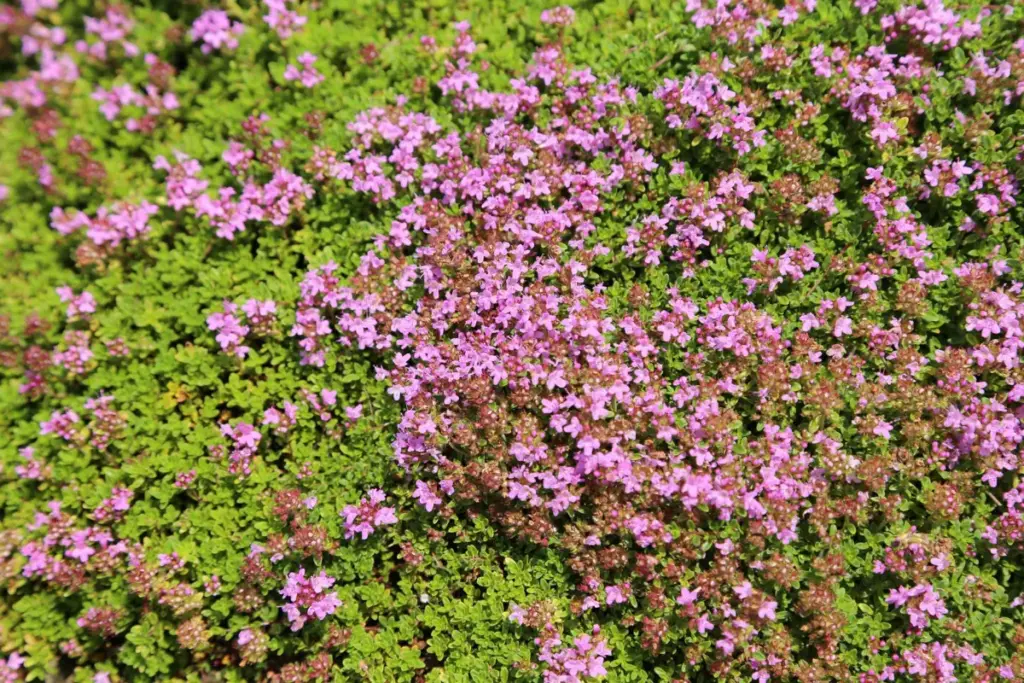
Comprising a diverse array of low-growing, aromatic varieties, creeping thyme weaves a fragrant, low cushion of color across open ground. Featuring tiny leaves—ranging from silver-grey to variegated—it erupts in summer with dense clusters of white and pink flowers that act as magnets for beneficial pollinators.
- Standout Cultivars: Thymus serpyllum ‘Snowdrift’ (pure white blooms) and Thymus ‘Silver Posie’ (white-edged grey-green leaves with lavender-pink flowers).
- Plant Type: Evergreen perennial
- Planting Distance: 20–30cm apart
- Ideal Deployment: Hot, dry microclimates, rockeries, or tightly knit spaces between paving stones.
4. Elephant’s Ear (Bergenia spp.)
Renowned for their architectural, leathery, and glossy evergreen leaves, bergenias offer striking visual weight to garden beds. Certain cultivars take on dramatic burgundy winter foliage. In spring, stout architectural spikes of pink or white flowers emerge, frequently supported on striking red or claret-colored stems.

- Standout Cultivar: Bergenia ‘Overture’.
- Plant Type: Evergreen perennial
- Planting Distance: 40–50cm apart
- Ideal Deployment: Bold evergreen edging alongside pathways in sunny or partially shaded positions.
5. Periwinkle (Vinca spp.)
Periwinkles deploy creeping stems and cheerful white or purple flowers to rapidly colonize bare earth across both sunny and shaded exposures. Smaller varieties light up dull soils with variegated foliage, while larger counterparts suit expansive landscapes.
- Standout Cultivar: Vinca minor ‘Ralph Shugert’ (violet flowers set against cream-margined foliage).
- Plant Type: Evergreen sub-shrub
- Planting Distance: 30–60cm apart
- Ideal Deployment: Stabilizing and adding visual interest to steep, difficult-to-manage banks.
6. Lady’s Mantle (Alchemilla mollis)
Do not let the delicate appearance of lady’s mantle fool you; this plant is as tough as iron. It features scalloped leaves covered in fine hairs that trap rainwater into shimmering, mercury-like droplets. Throughout summer, it sends up frothy sprays of zesty yellow-green flowers that endure for weeks.

- Plant Type: Herbaceous perennial
- Planting Distance: 40–50cm apart
- Ideal Deployment: Low-maintenance borders where self-sufficiency is paramount.
7. Flower Carpet Roses (Rosa FLOWER CARPET series)
Yes, roses can successfully function as ground cover. Bred specifically for this habit, these shrubs remain relatively compact (reaching up to 80cm) with an arching, spreading growth habit. Most feature single flowers followed by decorative autumn rosehips.
- Standout Cultivars: WHITE (‘Noaschnee’) and SUNSET (‘Deseo’), which features vibrant red-orange tones.
- Plant Type: Shrub
- Planting Distance: 1–1.2m apart
- Ideal Deployment: Sunny banks, sloping terraces, or cascading over retaining walls.
8. Bishop’s Hat (Epimedium spp.)
Undemanding and remarkably resilient, epimediums form delicate, airy carpets of ground cover in dappled shade. Their intricately veined, heart-shaped leaves often display brilliant autumn color, complemented by nodding, wiry flowers in shades of white, yellow, pink, and orange.

- Standout Cultivar: Epimedium × versicolor ‘Sulphureum’ (lemon-yellow flowers).
- Plant Type: Evergreen/semi-evergreen/herbaceous perennial
- Planting Distance: 40–50cm apart
- Ideal Deployment: Challenging dry shade zones beneath mature trees.
9. Knotweed (Persicaria affinis ‘Darjeeling Red’)
Forming dense mats of slim green foliage, this resilient perennial thrives in sun or part shade. From midsummer to autumn, it produces upright brick-red stems crowned with long plumes of soft pink flowers that gradually mature into a deep rusty red.
- Plant Type: Semi-evergreen perennial
- Planting Distance: 50–60cm apart
- Ideal Deployment: Naturalistic cottage gardens and informal planting schemes.
10. Siberian Waldsteinia (Waldsteinia ternata)
An absolute horticultural workhorse, Siberian waldsteinia tolerates a wide spectrum of soil conditions, from sand to heavy clay, and wet to dry profiles. Glossy, lobed leaves form a dense understorey beneath sprays of bright yellow, strawberry-like flowers in late spring without displaying invasive tendencies.

- Plant Type: Semi-evergreen perennial
- Planting Distance: 50–60cm apart
- Ideal Deployment: Lush underplanting beneath the canopy of deciduous trees.
11. Wood Spurge (Euphorbia amygdaloides)
Wood spurges provide a distinctively moody, woodland aesthetic. Cultivars like ‘Purpurea’ offer rich beetroot-colored foliage paired with lime-green spring bracts. Euphorbia amygdaloides var. robbiae is exceptionally tough, thriving even in dry shade. (Note: Spurge sap is an irritant to skin and eyes, and toxic if ingested; protective gear is advised.)
- Plant Type: Evergreen perennial
- Planting Distance: 50–60cm apart
- Ideal Deployment: Introducing vibrant chartreuse spring contrast to dark garden corners.
12. Alpine Strawberry (Fragaria vesca)
An underutilized treasure, cultivars such as ‘Semperflorens’ produce small, exceptionally sweet berries from June through November alongside dainty white spring flowers and tidy green foliage.

- Plant Type: Semi-evergreen perennial
- Planting Distance: 40–50cm apart
- Ideal Deployment: Edible landscaping in dappled shade.
13. Mexican Fleabane (Erigeron karvinskianus)
This charming daisy-like perennial features shifting pink and white blooms. It readily self-seeds into crevices, gravel paths, and poor, rocky soils, offering robust drought tolerance and minimal maintenance requirements.
- Plant Type: Herbaceous perennial
- Planting Distance: 30–40cm apart
- Ideal Deployment: Patios, dry-stone walls, and gravel pathways.
14. Wall Bellflower (Campanula portenschlagiana)
Forming vigorous, spreading mounds, the wall bellflower produces an abundance of deep purple, bell-shaped flowers throughout the summer months. It thrives in well-drained soils under full sun or light shade.

- Plant Type: Semi-evergreen perennial
- Planting Distance: 40–50cm apart
- Ideal Deployment: Rockeries, raised beds, or cascading over low stone walls.
15. Candytuft (Iberis sempervirens)
A Mediterranean native, candytuft forms a spreading carpet of deep green foliage that explodes into pure-white, scented blossoms in late spring. It demands light, well-drained soil and full sun to perform at its peak.
- Plant Type: Evergreen perennial
- Planting Distance: 50–60cm apart
- Ideal Deployment: Pollinator-friendly rockeries and gravel gardens.
16. Lungwort (Pulmonaria spp.)
Valued for its shade tolerance, lungwort features long, white-speckled leaves and early spring trumpet flowers in shades of pink, purple, and white that provide crucial early nectar for waking bees.

- Standout Cultivar: Pulmonaria OPAL (‘Ocupol’).
- Plant Type: Herbaceous/semi-evergreen perennial
- Planting Distance: 40–50cm apart
- Ideal Deployment: The front line of moist, partially shaded borders.
17. Lily of the Valley (Convallaria majalis)
Combining spear-shaped foliage, iconic white bell-shaped flowers, and an intoxicating fragrance, lily of the valley handles damp, shady conditions with ease. (Note: Highly toxic if ingested.)
- Plant Type: Herbaceous perennial
- Planting Distance: 20–30cm apart
- Ideal Deployment: Scented understoreys beneath damp, deciduous shrubs.
18. Ivy-Leaved Cyclamen (Cyclamen hederifolium)
Featuring marbled, heart-shaped leaves and swept-back pale pink autumn flowers, this tuberous perennial delivers exceptional seasonal interest in woodland settings.

- Plant Type: Tuberous perennial
- Planting Distance: 10–20cm apart
- Ideal Deployment: Extended autumn and winter color beneath deciduous trees.
19. Siberian Bugloss (Brunnera macrophylla)
Delicate sprays of sky-blue, forget-me-not flowers rise above large, heart-shaped leaves in spring. Brunnera is a vigorous grower that self-seeds reliably over time.
- Plant Type: Herbaceous perennial
- Planting Distance: 50–60cm apart
- Ideal Deployment: Illuminating dark, shaded garden beds.
20. Common Chamomile (Chamaemelum nobile)
Featuring feathery foliage and white daisy flowers, this aromatic perennial releases an apple-like scent when crushed. The non-flowering cultivar ‘Treneague’ can even substitute for traditional turf under light foot traffic.

- Plant Type: Herbaceous perennial
- Planting Distance: 25cm apart
- Ideal Deployment: Aromatic alternative lawns and sunny garden pathways.
Supporting Context & Comparative Metrics
When designing an effective landscape matrix, understanding plant spacing, light requirements, and ecological function is critical. The table below provides a comparative analysis of the featured varieties to assist landscape architects and home gardeners alike:
| Common Name | Botanical Name | Plant Type | Ideal Light Exposure | Optimal Planting Distance | Primary Landscape Utility |
|---|---|---|---|---|---|
| Hardy Geranium | Geranium spp. | Herbaceous Perennial | Sun to Part Shade | 50–90 cm | Continuous border color |
| Japanese Spurge | Pachysandra terminalis | Evergreen Perennial | Shade | 15–30 cm | Dense green shade carpet |
| Creeping Thyme | Thymus serpyllum | Evergreen Perennial | Full Sun | 20–30 cm | Hot rockeries & paving joints |
| Elephant’s Ear | Bergenia spp. | Evergreen Perennial | Sun to Part Shade | 40–50 cm | Bold path edging |
| Periwinkle | Vinca spp. | Evergreen Sub-shrub | Sun to Shade | 30–60 cm | Slope stabilization |
| Lady’s Mantle | Alchemilla mollis | Herbaceous Perennial | Sun to Part Shade | 40–50 cm | Low-maintenance fillers |
| Flower Carpet Rose | Rosa FLOWER CARPET | Shrub | Full Sun | 1.0–1.2 m | Slopes & retaining walls |
| Bishop’s Hat | Epimedium spp. | Perennial | Dappled Shade | 40–50 cm | Dry shade under canopy |
| Knotweed | Persicaria affinis | Semi-Evergreen | Sun to Part Shade | 50–60 cm | Naturalistic mats |
| Siberian Waldsteinia | Waldsteinia ternata | Semi-Evergreen | Part to Full Shade | 50–60 cm | Woodland underplanting |
| Wood Spurge | Euphorbia amygdaloides | Evergreen Perennial | Dappled Shade | 50–60 cm | Structural woodland color |
| Alpine Strawberry | Fragaria vesca | Semi-Evergreen | Dappled Shade | 40–50 cm | Edible ground cover |
| Mexican Fleabane | Erigeron karvinskianus | Herbaceous Perennial | Full Sun | 30–40 cm | Patios & gravel cracks |
| Wall Bellflower | Campanula portenschlagiana | Semi-Evergreen | Sun to Light Shade | 40–50 cm | Rockeries & wall edges |
| Candytuft | Iberis sempervirens | Evergreen Perennial | Full Sun | 50–60 cm | Pollinator rockeries |
| Lungwort | Pulmonaria spp. | Perennial | Part Shade | 40–50 cm | Early pollinator nectar |
| Lily of the Valley | Convallaria majalis | Herbaceous Perennial | Shade | 20–30 cm | Scented damp shade |
| Ivy-Leaved Cyclamen | Cyclamen hederifolium | Tuberous Perennial | Dappled Shade | 10–20 cm | Autumn woodland interest |
| Siberian Bugloss | Brunnera macrophylla | Herbaceous Perennial | Sun to Part Shade | 50–60 cm | Brightening dark corners |
| Common Chamomile | Chamaemelum nobile | Herbaceous Perennial | Full Sun | 25 cm | Aromatic lawn alternative |
Official Horticultural Guidelines & Best Practices
Horticultural experts emphasize that successful ground cover establishment relies heavily on pre-planting soil preparation and post-installation management. According to leading botanical institutions, the following protocols must be observed:

- Eradication of Perennial Weeds: Before introducing ground-cover plugs or potted specimens, all persistent perennial weeds (such as bindweed, couch grass, and docks) must be completely eradicated. Once a dense ground cover is established, weeding becomes significantly harder due to interlocked root systems.
- Moisture Management During Establishment: Even drought-tolerant species—such as Pachysandra and Thymus—require consistent irrigation throughout their first growing season to develop deep, anchoring root structures.
- Strategic Spacing: Planting too densely wastes financial resources, while spacing plants too far apart allows invasive weed seeds to colonize the intervening bare earth. Adhering to species-specific planting distances ensures rapid, uniform canopy closure.
Future Outlook: The Evolution of Sustainable Landscaping
As climate change introduces more extreme weather volatility, prolonged summer droughts, and unpredictable precipitation patterns, the role of traditional lawns is undergoing a profound reassessment. Resource-heavy turfgrasses that demand constant irrigation, chemical fertilization, and fossil-fueled mowing are increasingly being viewed as unsustainable in residential and municipal planning.
In response, ground cover plants are stepping into the spotlight as the future of ecological landscape design. By deploying resilient, drought-tolerant, and native or acclimatized ground covers—such as creeping thymes, alpine strawberries, and hardy geraniums—property owners can drastically reduce water consumption, suppress carbon emissions from maintenance equipment, and actively foster urban biodiversity. The transition toward intelligent ground-cover matrixes represents a permanent shift toward smarter, more harmonious integration between human habitation and the natural environment.