By Jim Giles
Special Report for Trellis Group
Executive Overview
Shifting freight from highways to railways stands out as one of the most pragmatic and immediate pathways for corporations aiming to slash supply chain carbon footprints. The efficiency math is compelling and straightforward: while a single gallon of diesel fuel can move one ton of cargo roughly 150 miles by heavy-duty truck, that same gallon propels a train over 400 miles. On a macro scale, converting long-haul highway freight to rail has the potential to eliminate millions of tons of carbon dioxide emissions annually.
Yet, realizing the full environmental promise of the rail sector requires the major carriers to clean up their own backyard. The locomotive fleets that power transcontinental trade are major consumers of fossil fuels and significant emitters of greenhouse gases. To evaluate how the industry is managing this dual mandate—growing rail’s market share against trucking while aggressively decarbonizing its internal operations—Trellis examined the progress of Norfolk Southern, one of the six major "Class I" freight railroads operating in the United States.
As Norfolk Southern approaches the halfway mark of its timeline to meet a near-term science-based climate target, the organization finds itself navigating a complex matrix of technological transitions, fuel economics, novel carbon-accounting schemes, and high-stakes regulatory scrutiny surrounding a proposed mega-merger. While efficiency gains and fleet-wide technology deployments are driving steady headway, overcoming the cost premiums of low-carbon fuels and addressing regulatory and stakeholder concerns regarding industry consolidation remain formidable hurdles.
Detailed Chronology: The Roadmap to 2034
To understand where Norfolk Southern stands today, it is essential to trace the historical milestones and policy frameworks guiding its current environmental strategy. The railroad’s journey toward comprehensive decarbonization is not a recent pivot, but a structured, long-term operational overhaul.
-
2021: Setting the Science-Based Standard
A critical turning point occurred when the Science Based Targets initiative (SBTi) officially validated Norfolk Southern’s emissions reduction goals. This validation locked the company into a rigorous, independently verified trajectory designed to align corporate operations with the goals of the Paris Agreement. Under this target, the railroad committed to slashing both its Scope 1 and Scope 2 emissions intensity by 42% between the baseline year of 2019 and the target year of 2034. -
Mid-2020s: The Shift Toward Alternative Fuels
During the initial phases of its climate journey, Norfolk Southern concentrated heavily on operational efficiency and the incremental adoption of biodiesel—a plant-based fuel blend capable of displacing up to 20% of conventional fossil diesel without engine modifications. However, as the decade progressed, supply chain dynamics and fuel technology evolved, shifting executive attention toward 100% drop-in replacements like renewable diesel. -
Late 2024: Launching the "Book and Claim" Mechanism
Recognizing the logistical impossibility of physically routing low-carbon renewable diesel to every locomotive across its expansive eastern network, Norfolk Southern engineered an innovative financial instrument. In late 2024, the company launched a "book and claim" system utilizing Environmental Attribute Certificates (EACs). This framework allowed shippers to purchase verified emissions reductions independently of the physical fuel consumed by the specific trains hauling their cargo. -
June 2025: SBTi Validates Scope 3 Accounting Standards
A major external catalyst arrived when the SBTi updated its corporate net-zero standards to officially permit the use of EACs for meeting Scope 3 supply chain reduction targets. This regulatory clarity brought corporate customers off the sidelines, unlocking commercial demand for Norfolk Southern’s available carbon certificates. -
Late 2025/Early 2026: The Sustainability Report Check-In
In its comprehensive sustainability report released in late 2025, Norfolk Southern documented a 12% decline in carbon dioxide equivalent emissions ($tCO_2e$) per million ton-miles traveled. Simultaneously, the company logged a 5% year-over-year improvement in core fuel efficiency, setting the stage for an aggressive push into the second half of its 2019–2034 timeline.
Supporting Context & Metrics: Operating in the Eastern Corridor
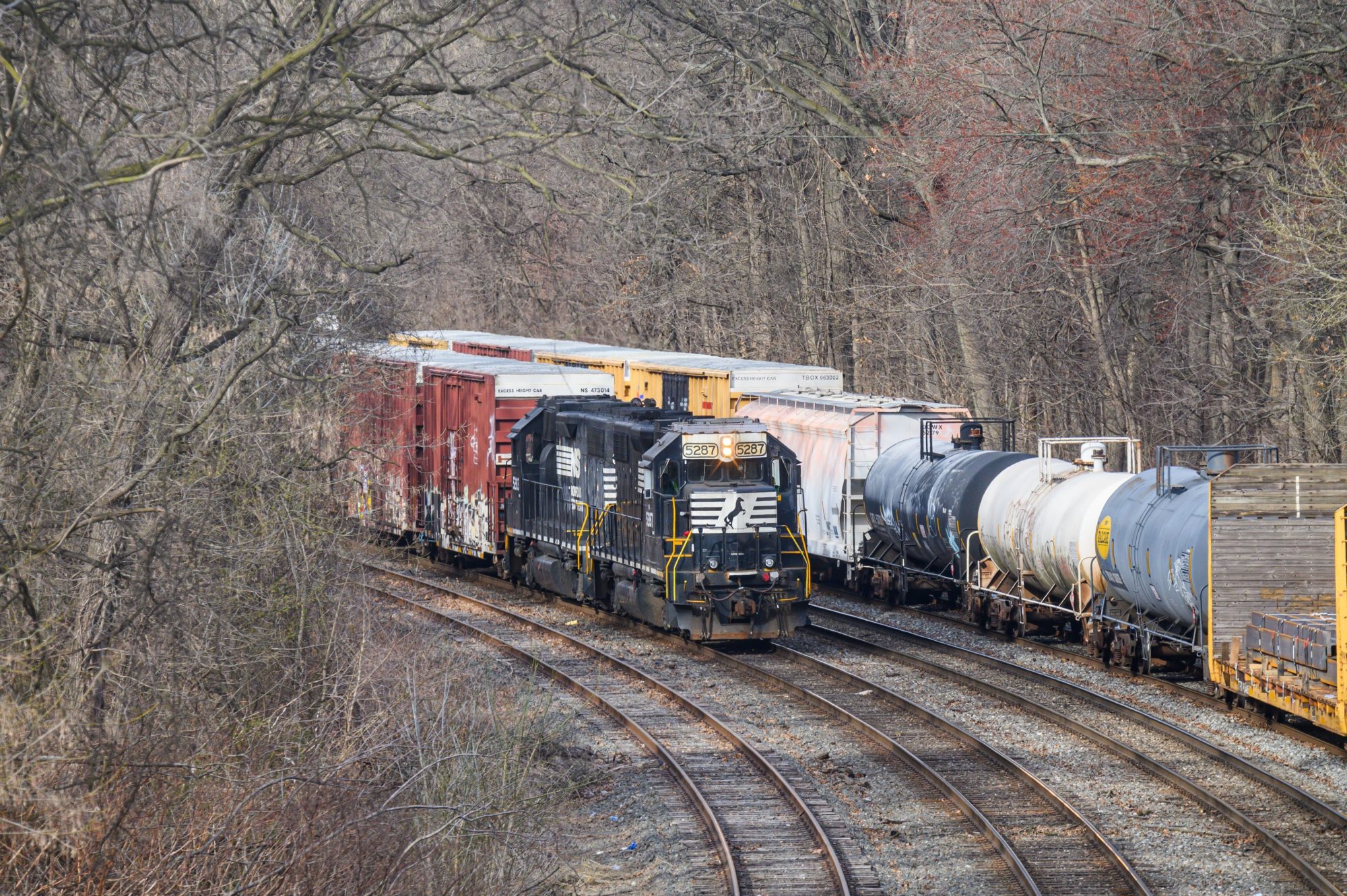
The sheer scale of Norfolk Southern’s operations underscores the magnitude of its decarbonization challenge. Operating across more than 19,000 miles of track throughout the eastern United States, the company commands a fleet of approximately 3,000 heavy-duty locomotives. In fiscal year 2025, these operations generated $12 billion in revenue while releasing 5.8 million tons of carbon dioxide equivalent emissions ($tCO_2e$).
A granular breakdown of these emissions reveals where intervention is most urgently required:
- Scope 1 Emissions (Locomotive Fleet Operations): More than two-thirds of Norfolk Southern’s total greenhouse gas inventory is directly tied to the combustion of diesel fuel in its locomotive engines. Consequently, any meaningful progress toward the 2034 target depends entirely on transforming this core operational vector.
- Scope 2 Emissions (Purchased Electricity and Facility Energy): While critical for corporate accountability, emissions associated with facility lighting, office operations, and electrified auxiliary assets represent a relatively minor sliver of the company’s overall footprint.
- Intensity Metric Tracking: To normalize emissions against fluctuating freight demand and economic cycles, the industry relies on a metric of $tCO_2e$ per million ton-miles traveled. The company’s recent 12% reduction in this metric demonstrates positive momentum, yet executives acknowledge that current trajectories must accelerate to hit the 42% reduction threshold by 2034.
Official Statements & Technological Innovations
To evaluate the operational realities behind these metrics, Trellis spoke directly with Joshua Raglin, Chief Sustainability Officer at Norfolk Southern. Raglin offered an unvarnished assessment of the technological and economic levers the company is pulling to bridge the gap between steady progress and ultimate goal attainment.
The Fuel Transition: From Biodiesel to Renewable Diesel
For years, the railroad relied on standard biodiesel blends to nibble away at its fossil fuel dependence. However, Raglin expressed strong optimism regarding the scaling prospects of renewable diesel, a chemically distinct plant-based fuel. Unlike traditional biodiesel, renewable diesel can completely replace fossil diesel without requiring costly retrofits or mechanical modifications to existing locomotive engines.
"We’ve had a lot more suppliers reaching out to us, specifically related to renewable diesel," Raglin noted, highlighting a burgeoning market that is finally beginning to achieve industrial-scale maturity.
Cruise Control for Locomotives: Maximizing Efficiency
Beyond fuel chemistry, mechanical optimization has delivered immediate, measurable results. In 2025, Norfolk Southern completed the deployment of advanced energy management equipment across 100% of its active locomotive fleet. Functioning essentially as an automated cruise control system for freight trains, the technology engages once a train reaches approximately 10 miles per hour and manages throttle and braking profiles for the vast majority of the journey.
"That’s been a huge lever for us," Raglin explained. "Just using energy management alone versus an engineer operating the train can improve fuel efficiency 6 to 8 percent." Combined with other operational adjustments, these systems drove a 5% overall fuel efficiency improvement across the network in 2025.
Solving the Economic Puzzle with "Book and Claim"
While fuel efficiency initiatives inherently pay for themselves by lowering operating costs, the procurement of low-carbon fuels introduces a stiff economic penalty. Outside of regulatory incubators like California—where state subsidies enforce price parity—renewable diesel commands roughly a 20% price premium over conventional fossil diesel.
Because matching specific low-carbon fuel shipments to individual customer cargo loads is logistically impossible on an interconnected national rail grid, Norfolk Southern’s "book and claim" model bridges the economic gap. The system fractionalizes environmental benefits into Environmental Attribute Certificates (EACs). Each certificate represents one ton of verified carbon emissions saved.
Corporate clients eager to decarbonize their Scope 3 supply chains can purchase these EACs independently of physical rail routing. Following the SBTi’s June ruling allowing EAC utilization for Scope 3 compliance, corporate hesitation has evaporated. Shippers are actively moving to claim a stake in the 40,000 certificates currently made available by the railroad.
Future Outlook: The Proposed Merger and Its Environmental Trade-Offs
As Norfolk Southern works to hit its 2034 climate milestones, its long-term environmental horizon is heavily shadowed by a massive corporate maneuver: a proposed merger with Union Pacific. Designed to weld two rail giants into a single trans-continental network, the merger is currently undergoing rigorous antitrust and operational scrutiny by federal regulators.
The Pro-Merger Environmental Thesis
Executives from both railroads argue that a unified single-line network will drastically reduce transit times, eliminate costly and time-consuming interchange delays between regional lines, and dramatically enhance the competitiveness of rail against long-haul trucking.
According to projections cited by Raglin, the combined trans-America network is estimated to successfully convert 2.1 million truckloads of freight from highways to rails annually. If realized, this modal shift would prevent the emission of approximately 3.8 million tons of $CO_2$ every year—a massive environmental dividend that would dwarf the internal efficiency gains of either individual company.
The Criticisms and Industry Skepticism
Not everyone shares this optimistic outlook. Labor unions, agricultural shippers, and critical industrial sectors—most notably the chemical manufacturing industry—have voiced vocal opposition to the merger. Their primary concerns center on market concentration, potential service degradation, and rising shipping rates.
Critics argue that if the merger results in poorer customer service or higher freight tariffs, shippers will abandon the rails and revert to trucking. Such a regression would trigger a reverse modal shift, driving freight back onto highways and ultimately accelerating carbon emissions rather than curbing them.
Conclusion
Norfolk Southern’s pursuit of its 2034 climate goals illustrates both the profound potential and the complex operational realities of decarbonizing heavy industry. Through disciplined deployments of automated energy management systems, strategic shifts toward renewable diesel, and innovative financial instruments like EAC "book and claim" schemes, the railroad is proving that carbon reduction and commercial viability can coexist.
However, the ultimate success of these corporate ambitions extends far beyond internal engineering. As the debate over transcontinental consolidation demonstrates, the future of rail decarbonization is inextricably linked to macroeconomic policy, regulatory oversight, and the broader structural efficiency of the North American supply chain. For shippers, investors, and environmental advocates alike, the coming decade will determine whether the freight sector can successfully navigate these crossroads to deliver a genuinely sustainable logistics network.