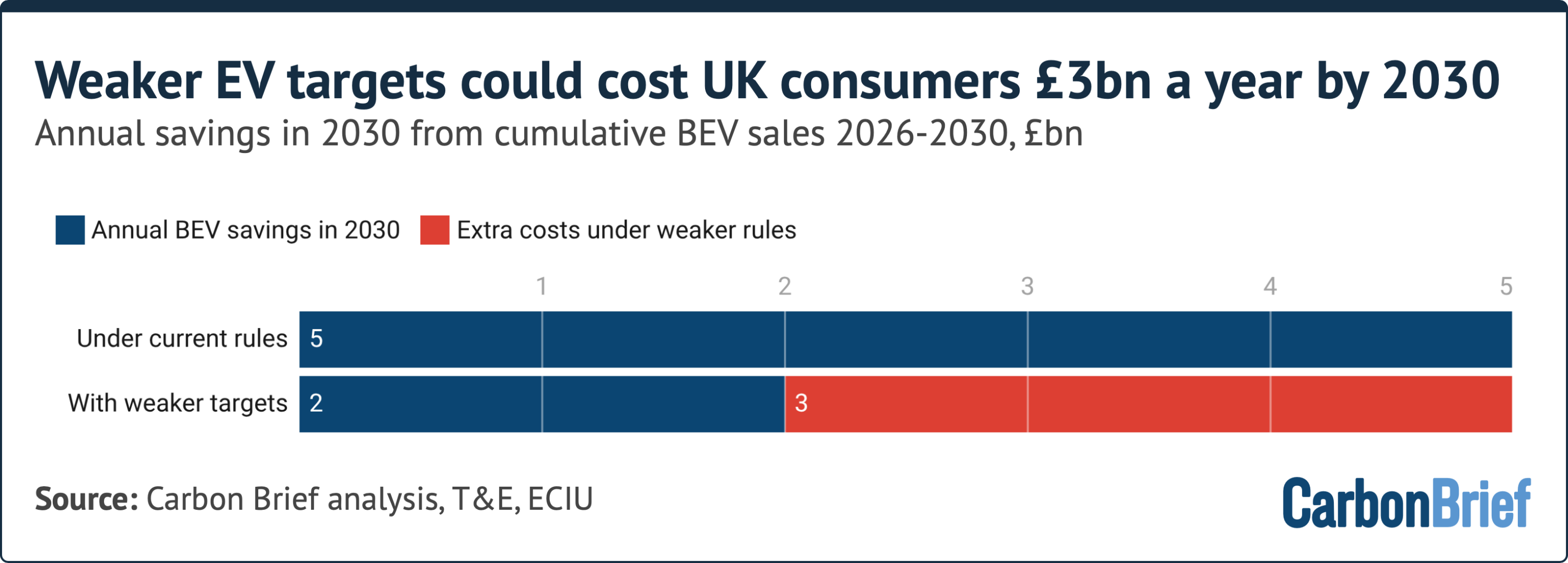
An impending UK government decision to weaken statutory electric vehicle (EV) sales targets threatens to inflict a £3bn annual financial penalty on British consumers by 2030, according to an in-depth analysis conducted by Carbon Brief. The proposed policy reversal, currently under high-level review at Number 10 Downing Street, arrives following aggressive lobbying from segments of the automotive manufacturing sector seeking relief from binding zero-emission mandates.
Beyond the direct consumer impact, scaling back the UK’s Zero Emission Vehicle (ZEV) mandate would severely undermine national energy security and climate goals. The analysis reveals that weakening EV sales benchmarks would force the UK to import an additional 17 million barrels of oil in 2030 alone, expanding projected net oil imports by 8%. Furthermore, the resulting surge in tailpipe pollution would add an extra 7.4 million tonnes of carbon dioxide ($MtCO_2$) to the atmosphere in 2030, representing a 2.5% increase in total national emissions against the UK’s legally binding international climate commitments.
While vehicle manufacturers argue that sluggish organic consumer demand justifies a policy pause, energy sector leaders, environmental economists, and consumer advocates warn that dismantling regulatory targets will destroy green investment, lock drivers into inflated fossil fuel expenses, and derail the central pillar of the UK’s transport decarbonisation strategy.
Detailed Chronology
The Genesis of the ZEV Mandate
The framework governing the UK’s transition to zero-emission mobility was established under the previous Conservative administration. Designed as a key mechanism to fulfill the UK’s legally binding target of net-zero carbon emissions by 2050, the Zero Emission Vehicle (ZEV) mandate established legally binding, incrementally rising annual quotas for zero-emission car sales.
2024: Battery Electric Vehicles (BEVs) were required to constitute 22% of new car sales.
2026: The target rises to 33%.
2030: The statutory benchmark reaches 80%, paving the way for a total phase-out of traditional internal combustion engine (ICE) vehicles.
To assist automakers during the industrial transition, the policy incorporated built-in "flexibilities." These mechanisms allowed manufacturers to trade compliance credits, bank outperformance from early years, or offset shortfalls against low-emission vehicle sales. When accounting for these statutory flexibilities, the effective target for 2026 stands at approximately 25% of overall car sales.
The Automaker Lobbying Campaign
Despite these built-in allowances, automotive industry groups—led by the Society of Motor Manufacturers and Traders (SMMT)—launched an intensive campaign urging ministers to dilute the framework. Automakers argued that high interest rates, inflationary pressures, and inadequate public charging infrastructure had chilled retail consumer demand, forcing car manufacturers to fund billions of pounds in retail discounts and promotional finance packages to meet statutory thresholds.
The Political Shift and Number 10’s Consultation
Following the election of the Labour administration under Prime Minister Andy Burnham, policy debates surrounding the transport sector reached a critical juncture. Reports emerged that the Prime Minister’s Office is currently reviewing a formal government consultation paper that proposes softening the 2030 ZEV mandate target.
Rather than maintaining the statutory 80% BEV requirement for 2030, Downing Street is evaluating options to lower the target to 70%, 60%, or as low as 50% of new car sales. Industry analysts from the non-governmental organisation Transport & Environment (T&E) calculate that dropping the 2030 target to 50%—coupled with maximum reliance on regulatory flexibilities—would result in up to 3 million fewer electric vehicles on UK roads by the end of the decade.
Supporting Context & Metrics
+-----------------------------------------------------------------------+
|                    IMPACT OF A WEAKENED ZEV MANDATE                   |
|                                                                       |
|   Consumer Expense:        +£3 Billion / year by 2030                 |
|   Oil Imports:             +17 Million Barrels (+8% Net Imports)      |
|   Emissions Impact:        +7.4 MtCO2 (+2.5% to National Total)       |
|   EV Fleet Reduction:      Up to 3 Million Fewer BEVs on the Road     |
+-----------------------------------------------------------------------+
Household Economics and Total Cost of Ownership
The economic case against diluting EV targets rests on the substantial operational savings offered by battery electric vehicles compared to fossil-fuelled alternatives. Independent modeling by Carbon Brief demonstrates that BEVs are roughly £1,100 per year cheaper to fuel than equivalent petrol cars, driven by the superior energy efficiency of electric powertrains over internal combustion engines.
When evaluating the comprehensive Total Cost of Ownership (TCO)—which incorporates initial purchase price, depreciation, insurance premiums, maintenance, fuel costs, and proposed pay-per-mile road taxation structures—research by the Energy and Climate Intelligence Unit (ECIU) confirms that BEVs maintain a structural cost advantage:
Annual TCO Advantage: BEVs remain over £1,000 per year cheaper to own and operate than either pure petrol vehicles or plug-in hybrid electric vehicles (PHEVs).
Aggregate Consumer Cost: Lowering EV sales targets deprives millions of drivers of these structural operational savings. By 2030, the cumulative economic burden passed onto UK households in higher running and ownership costs would reach £3bn annually.
+-----------------------------------------------------------------------+
|               ANNUAL DRIVING & OWNERSHIP COST COMPARISON              |
|                                                                       |
|   Battery Electric Vehicle (BEV)  [====================] Baseline     |
|   Plug-in Hybrid (PHEV)           [========================] +£1,000+   |
|   Petrol Internal Combustion      [========================] +£1,000+   |
|                                                                       |
|   *BEV fuel savings alone average £1,100/year against petrol cars.     |
+-----------------------------------------------------------------------+
Macroeconomic Exposure and Energy Security
Retreating from zero-emission vehicle targets significantly alters the UK’s macroeconomic trade balance and fossil fuel dependency. The transport sector remains the largest consumer of petroleum products in the national economy.
Carbon Brief’s modeling indicates that scaling back EV deployment to proposed lower thresholds would compel the UK to import an additional 17 million barrels of crude oil and refined fuels in 2030. This surge would expand projected net oil imports by 8% in that year alone, exposing the UK economy to international commodity price volatility, geopolitical supply chain disruptions, and adverse trade deficits.
Climate Accounting and Net-Zero Trajectory
From an environmental governance perspective, the ZEV mandate serves as the single largest contributor to carbon reductions within the UK’s official Carbon Budget Delivery Plan.
If the government adopts a diluted 50% target for 2030:
Carbon dioxide emissions from the domestic transport fleet would increase by 7.4 million tonnes ($MtCO_2$) in 2030 alone.
This increase corresponds to a 2.5% addition to total net national greenhouse gas emissions that year.
Such an increase directly imperils the UK’s ability to meet its international commitments under the Paris Agreement, including its Nationally Determined Contribution (NDC) target to reduce emissions by 68% relative to 1990 levels by 2030.
Metric / Dimension
Statutory ZEV Mandate (Current)
Proposed Weakened Mandate (50% Target Option)
Net Impact / Variation
2030 BEV Sales Share
80%
50%
-30 percentage points
UK BEV Fleet Size (2030)
Baseline Growth
Up to 3 million fewer BEVs
Loss of 3m zero-emission cars
Consumer Ownership Costs
Baseline Efficiency
+£3 Billion per year
£3bn added financial burden
Annual Oil Import Volume (2030)
Projected Baseline
+17 million extra barrels
+8% increase in net oil imports
Transport Sector Emissions (2030)
Net-Zero Aligned Trajectory
+7.4 $MtCO_2$ increase
+2.5% to total UK emissions
Official Statements & Stakeholder Perspectives
The Automotive Manufacturing Sector
Car industry trade bodies, led by the Society of Motor Manufacturers and Traders (SMMT), contend that the existing regulatory mandate ignores underlying market realities. SMMT officials maintain that vehicle manufacturers have invested billions of pounds in consumer discounts, subsidized finance rates, and marketing campaigns to stimulate EV adoption.
"The car industry is committing billions in discounts, finance incentives, and marketing support to drive battery electric vehicle adoption," stated an SMMT representative. "However, natural demand among retail buyers remains below the aggressive statutory targets imposed by the mandate. Without enhanced consumer subsidies and rapid public charging infrastructure rollouts, the current targets are unachievable without causing severe structural harm to the automotive sector."
Clean Energy Advocates and Industry Groups
Conversely, clean energy advocates, infrastructure investors, and environmental policy organizations strongly refute the automotive sector’s claims, describing attempts to roll back the targets as economically short-sighted.
Energy UK, the principal trade association for the UK energy sector, emphasized that the ZEV mandate is functioning precisely as designed and serves as the structural foundation for private investment across the clean energy transition.
"The ZEV mandate is working in the way it was designed to work," stated Energy UK in an official policy assessment. "It represents the single biggest driver of emissions reductions in government climate plans. Transitioning the vehicle fleet to electric power reduces household energy bills for everyone—not only through direct ownership savings for EV drivers, but by spreading the fixed costs of upgrading the electricity grid across a significantly broader user base."
Clean transport advocacy group Transport & Environment (T&E) disputed the SMMT’s narrative regarding market demand, warning that regulatory instability would jeopardize British industrial competitiveness:
"A government flip-flop on the ZEV mandate would be bad for drivers, bad for the environment, and bad for British manufacturing. The auto industry’s case for weakening the mandate simply does not stack up when examined against vehicle profit margins and international market trajectories."
BusinessGreen reported that infrastructure investors have issued formal warnings to Number 10, emphasizing that policy hesitation puts billions of pounds in committed capital investments at risk—particularly in gigafactory battery production, smart grid software development, and the nationwide deployment of public fast-charging stations.
Future Outlook & Strategic Implications
The choice facing Downing Street carries implications that extend far beyond annual vehicle registration statistics. Weakening the Zero Emission Vehicle mandate risks triggering systemic ramifications across the UK’s industrial and economic landscape:
+-----------------------------------------------------------------------+
|                    SYSTEMIC RISKS OF POLICY RETREAT                    |
|                                                                       |
|   [Capital Flight]       Incentives shift to jurisdictions with       |
|                          binding green mandates (e.g., EU, China).    |
|                                                                       |
|   [Infrastructure]       Charging network investments stall due to    |
|                          reduced fleet volume assumptions.            |
|                                                                       |
|   [Economic Shock]       Households locked into £3bn/yr excess fuel   |
|                          costs and volatile oil import prices.        |
+-----------------------------------------------------------------------+
1. Capital Flight and Industrial Competitiveness
Automotive manufacturing and green infrastructure capital operate on multi-year deployment cycles. Regulatory stability is the primary criterion for foreign direct investment in battery gigafactories and assembly line retooling. If the UK signals policy volatility by retreating from its 2030 targets, global vehicle manufacturers may reallocate capital to jurisdictions with firm statutory commitments, such as the European Union and East Asian markets. Consequently, the UK risks becoming a secondary market for higher-emission internal combustion engine vehicles phased out elsewhere.
2. Stranded Infrastructure Capital
Charging point operators (CPOs) have deployed capital based on government projections for EV fleet growth. A reduction of up to 3 million BEVs by 2030 would depress utilization rates across public charging networks, threatening the financial viability of early-stage infrastructure projects and driving up charging tariffs for existing EV owners.
3. Grid Modernisation Dynamics
The broader decarbonisation of the UK economy relies on coupling renewable power generation with flexible electrical demand. Electric vehicles equipped with smart-charging and Vehicle-to-Grid (V2G) capabilities serve as decentralized battery storage systems that stabilize the power grid during peak demand windows. Slowing EV adoption deprives the National Grid of a key flexibility tool, potentially increasing the overall system costs associated with balancing intermittent wind and solar generation.
Conclusion
As Downing Street finalizes its policy position, the decision will test the administration’s commitment to both its net-zero framework and economic growth strategies. While diluting the ZEV mandate offers short-term regulatory relief to legacy carmakers, the Carbon Brief analysis indicates that the long-term trade-offs—including a £3bn annual penalty on consumers, increased oil dependency, and higher national greenhouse gas emissions—will present substantial economic and environmental costs for the UK economy.