Executive Overview
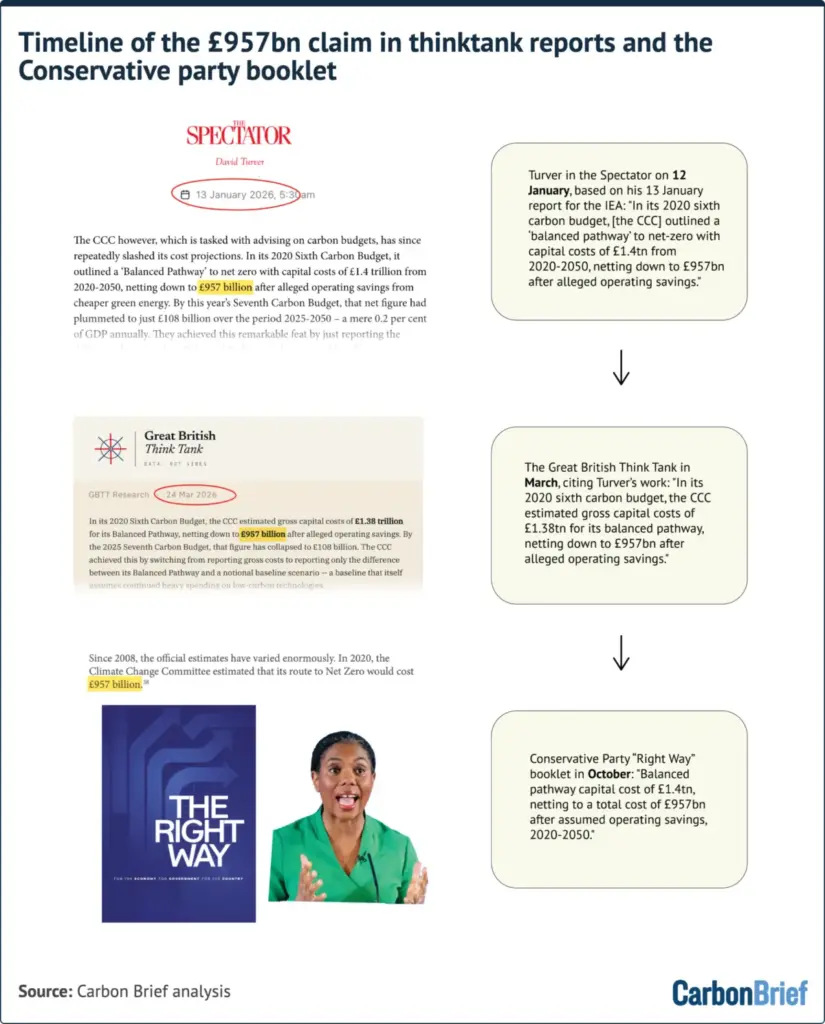
In October 2026, the UK’s opposition Conservative Party released a headline policy pamphlet titled "The Right Way", framed as a blueprint for political competence, fiscal realism, and common-sense governance. Aimed at dismantling the official economic logic behind Britain’s decarbonization targets, the document argued that complex financial modeling had replaced sound political judgment. However, an analysis of the policy booklet reveals that its central argument against the transition—a staggering claim that achieving net-zero carbon emissions would cost the British public nearly £1 trillion—was derived from a fundamental Excel spreadsheet error.
The policy document asserted that in 2020, the Climate Change Committee (CCC)—the UK government’s independent statutory advisory body—had estimated the national route to net-zero would cost £957 billion. In reality, the CCC’s actual net cost projection published in its landmark Sixth Carbon Budget was £478 billion, exactly half the figure claimed by the Conservatives. By 2025, that figure had been further revised downward to £108 billion, driven by steep cost reductions in green technology, particularly electric vehicles (EVs) and renewable power generation.
The origin of this doubled figure traces back to a third-party analyst who accidentally summed both individual sectoral costs and pre-aggregated total rows within a public CCC dataset. This accounting oversight created a phantom quote that migrated through right-leaning think tanks, op-eds, and national policy reports before ultimately finding a place in the Conservative Party’s official platform.
The inclusion of this faulty metric underscores a widening divide between political rhetoric and empirical climate economics. As heatwaves, grid pressures, and global energy price volatility continue to test the UK’s infrastructure, the reliance on flawed numbers raises critical questions regarding evidence-based policymaking in British politics.
Detailed Chronology: The Anomaly’s Paper Trail
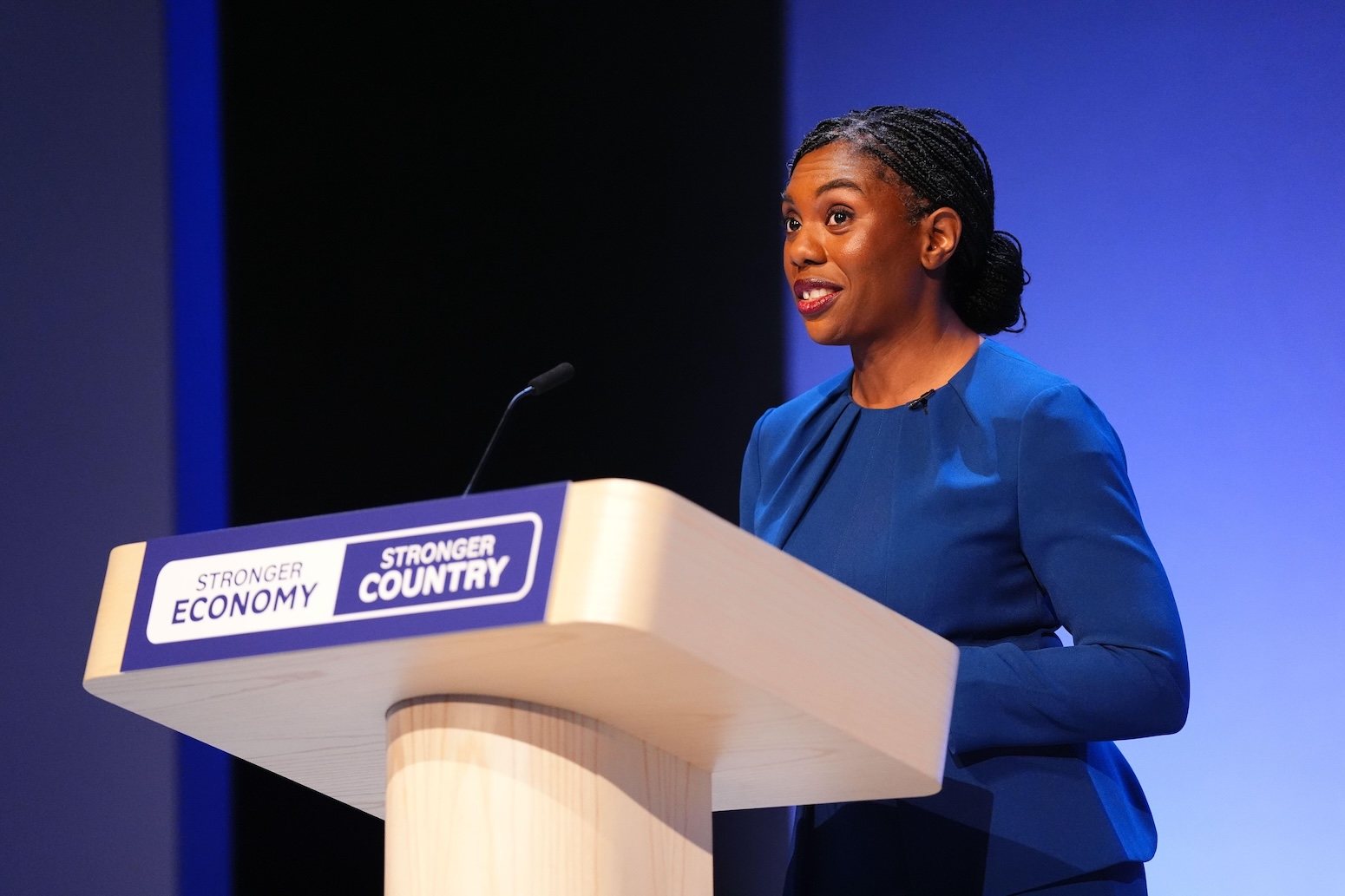
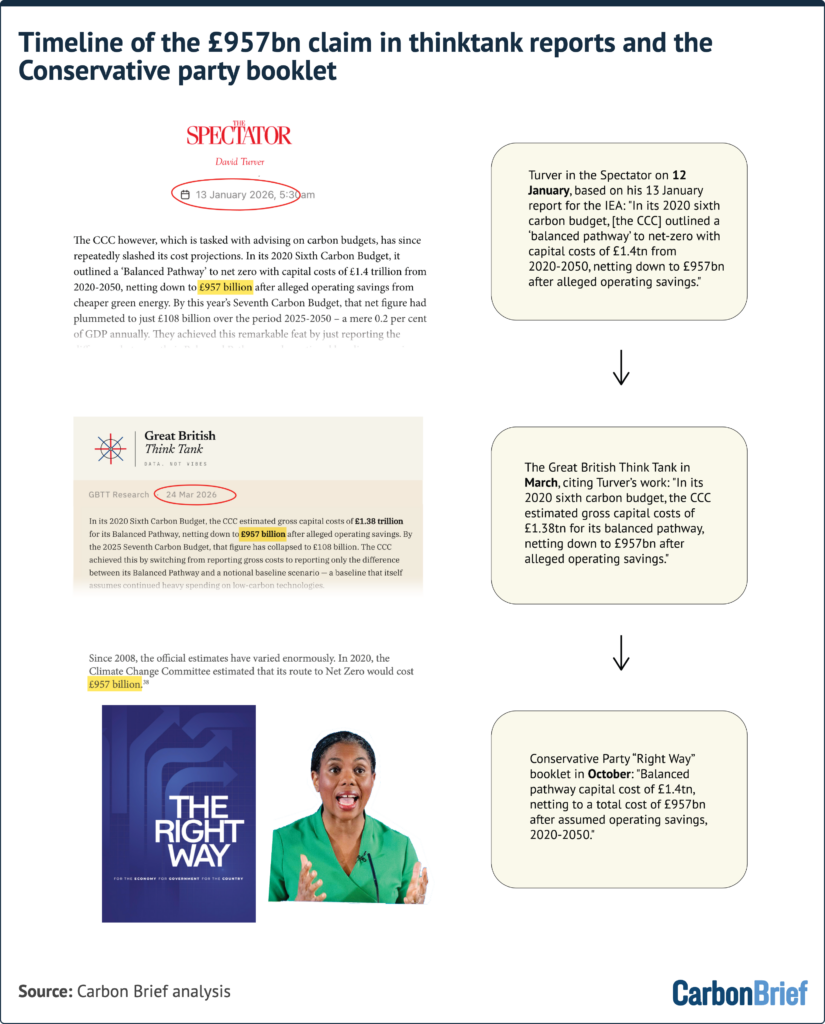
The journey of the £957 billion phantom figure demonstrates how an operational accounting flaw can propagate through the policy ecosystem, transforming an accidental error into an accepted political narrative.
       [December 2020]
  CCC releases 6th Carbon Budget Data
  (Net Cost: £478bn | CAPEX: £1.38tn, OPEX: -£0.90tn)
              │
              ▼
       [January 12, 2026]
  David Turver publishes Spectator article
  Accidentally double-counts CCC spreadsheet data (£957bn)
              │
              ▼
       [January 13, 2026]
  Turver releases Institute of Economic Affairs (IEA) paper
  Sensationalized numbers spawn headlines (£7.6tn - £9tn)
              │
              ▼
       [March 2026]
  Great British Think Tank repeats £957bn figure
  Cites "data, not vibes" using flawed source
              │
              ▼
       [October 2026]
  Conservative Party publishes "The Right Way"
  Official policy document cites doubled £957bn cost
December 2020: The Baseline Dataset
The Climate Change Committee published its dataset supporting the Sixth Carbon Budget. The accompanying Excel spreadsheet included detailed tables itemizing the capital expenditure (CAPEX) required across key sectors—such as low-carbon power, building heating, and transport—alongside operational expenditure (OPEX) savings achieved through reduced fossil fuel consumption.
To assist researchers, the CCC included both itemized rows per sector and a calculated summary row providing annual net totals across all sectors combined.
January 12–13, 2026: The Initial Double-Count
The earliest recorded appearance of the £957 billion figure emerged in an article for The Spectator written by David Turver, a retired engineer and self-described "accidental energy analyst." The following day, Turver authored a formal research paper published by the Institute of Economic Affairs (IEA), a influential free-market think tank based in Westminster.
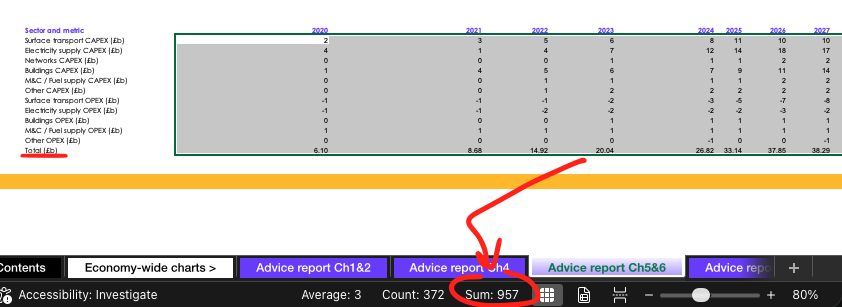
In analyzing Figure 5.3 of the CCC’s 2020 dataset, Turver attempted to calculate the net total manually. However, he accidentally selected the entire array of numbers—including both the individual sectoral lines and the pre-calculated annual combined total line. By executing a formula that summed these duplicate fields, the net figure of £478 billion was inadvertently multiplied by two, arriving precisely at £957 billion.
Turver’s IEA paper extended this math further, producing headlines claiming that the true lifetime burden of net-zero could reach £7.6 trillion or £9 trillion. These larger figures relied on additional baseline assumptions—most notably treating future fossil fuels, petrol vehicles, gas boilers, and power generation infrastructure as if they were entirely cost-free to purchase and operate over thirty years.
March 2026: Media and Think Tank Reinforcement
In early March 2026, the error was echoed by the Great British Think Tank, an organization whose public manifesto highlights a commitment to "data, not vibes" and claims every metric is sourced directly from official public bodies. Repeating the £957 billion figure without auditing the underlying mathematical mechanics, the organization helped validate the metric across online political communities and policy forums.
October 2026: Adoption into Official Opposition Policy
By October 2026, the erroneous figure moved from third-party commentaries into official opposition policy. The Conservative Party embedded the £957 billion figure directly into "The Right Way", presenting it as evidence of the financial burden imposed by climate targets and official advisory boards.
Ironically, the section containing this claim urged the public to abandon "sophisticated modeling" in favor of baseline political judgment and standard competence, failing to spot that its own flagship statistic was the product of a basic addition error.
Supporting Context & Economic Metrics
To evaluate the impact of this oversight, it is necessary to compare the doubled claim against the actual financial trajectory calculated by independent economic analysts and statutory advisory bodies.
The Real Cost Trajectory: 2020 vs. 2025 Baseline
The mechanics of net-zero economics rely on balancing upfront capital investments against long-term operational savings. Low-carbon systems—such as wind farms, heat pumps, and electric vehicles—require higher initial capital expenditure (CAPEX) compared to fossil-fuel alternatives. However, once constructed, they operate at dramatically lower fuel and maintenance costs (OPEX).
| Metric | CCC 2020 Estimate (2020–2050) | CCC 2025 Revised Estimate (2025–2050) | Conservative Party Pamphlet Claim |
|---|---|---|---|
| Gross Capital Expenditure (CAPEX) | +£1.38 Trillion | +£670 Billion | Not Separated |
| Operational Savings (OPEX) | -£0.90 Trillion | -£562 Billion | Omitted |
| True Net Cost | £478 Billion | £108 Billion | £957 Billion (Double-Counted) |
| Percentage of GDP | < 1.0% | < 0.2% | ~2.0% (Implied) |
Technological Deflation and the EV Factor
Between 2020 and 2025, the underlying cost assumptions for the energy transition shifted considerably. The primary driver behind the CCC downgrading its net cost projection from £478 billion to £108 billion was the rapid global fall in technology costs, most notably battery storage and electric vehicles.
Recent transport sector evaluations highlight this structural change:
- Driving Efficiency: By late 2026, running an electric vehicle in the UK became up to nine times cheaper per mile than operating an equivalent petrol or diesel car, driven by home charging tariffs and lower mechanical maintenance requirements.
- Capital Cost Parity: The upfront purchase price gap between internal combustion engine (ICE) vehicles and EVs narrowed far faster than predicted in 2020 models, reducing the gross capital outlay required from UK households.
       [2020 Net-Zero Estimate]                   [2025 Net-Zero Estimate]
        Total Net: £478 Billion                    Total Net: £108 Billion
┌──────────────────────────────────────┐   ┌──────────────────────────────────────┐
│  CAPEX: +£1.38tn                     │   │  CAPEX: +£670bn                      │
│                                      │   │                                      │
│  OPEX Savings: -£0.90tn              │   │  OPEX Savings: -£562bn               │
└──────────────────────────────────────┘   └──────────────────────────────────────┘
  (Spreadsheet Error doubled this to £957bn)   (Plunging EV & battery costs cut net total)
Macroeconomic Exposure and Externalities
The assertion that net-zero represents an unmitigated economic drag ignores both the co-benefits of transition and the direct costs of climate inaction:
- Avoided Fuel Price Shocks: In early 2026, the CCC published macroeconomic modeling demonstrating that completing the transition to domestic clean power would cost the UK economy less than absorbing a single major international fossil-fuel price shock, such as those experienced during the 2021–2022 energy crisis.
- Co-Benefits: The committee calculated that clean power generation, improved thermal insulation in housing, and lower urban air pollution produce wider health and economic benefits valued at approximately £110 billion annually.
- The Risk of Inaction: Environmental realities continued to impact public infrastructure throughout 2026. For example, England’s severe June 2026 heatwave triggered record heat-related emergency calls and ambulance demand, highlighting the operational burdens imposed on public services by rising global temperatures.
- Sectoral Challenges: Failing to coordinate decarbonization creates structural vulnerabilities across other sectors. Aviation modeling indicates that without strategic management and technology scaling, expansion proposals at airports like Heathrow could push aviation emissions to represent up to 80% of the UK’s total remaining carbon budget by 2050, necessitating severe and disproportionate economic cuts across other domestic industries.
Official Statements and Analysis of Political Impact
The emergence of the £957 billion error highlights broader challenges facing public political debate surrounding national climate strategy and fiscal policy.
The Conservative Policy Framing
In "The Right Way", the Conservative Party positioned its economic assessments as a pragmatic correction to official civil service projections. A key passage within the document reads:
"What people ultimately want is a government competent enough to solve the problems for which it takes responsibility… Sophisticated modeling must not become a substitute for baseline political judgment."
However, climate policy analysts note that relying on third-party calculations that contain fundamental mathematical errors undermines claims of administrative oversight and administrative competence.
Fact-Checking and Industry Responses
The proliferation of inflated net-zero estimates has drawn sharp criticism from independent fact-checkers, climate scientists, and economic research groups. Analysts point out that mathematical errors of this magnitude warp public perception, making manageable national investments appear fiscally impossible.
Fact-checking organizations monitoring national discourse noted that hyper-inflated claims regarding climate costs frequently rely on three methodological flaws:
- Double-counting raw cost inputs: Failing to distinguish between sub-totals and cumulative sums within primary datasets.
- Ignoring operational savings: Presenting gross capital expenditures (CAPEX) while omitting running-cost reductions (OPEX) in fuel, maintenance, and power generation.
- Applying zero-cost baselines: Assuming that maintaining legacy fossil-fuel systems—including importing gas, maintaining aging grid networks, and running combustion engines—requires no future capital outlay or replacement costs over a multi-decade timeframe.
Similar patterns of misinformation have been identified across other political platforms. Fact-check reviews of policy literature distributed by parties such as Reform UK identified dozens of false or misleading assertions regarding energy costs, grid stability, and renewable infrastructure performance, indicating a broader trend of data distortion within mainstream energy policy debates.

Future Outlook: Policy Realities vs. Rhetoric
The revelation of the Conservative Party’s spreadsheet error comes at a critical juncture for UK energy and economic policy. As the UK prepares for its next statutory carbon budget milestones, the disconnect between public political claims and economic realities presents distinct challenges for national planning.
Rebuilding Technical Accountability
The adoption of an unverified £957 billion statistic within an official opposition pamphlet highlights a vulnerability in how political parties audit technical information. Observers argue that if political organizations bypass official non-partisan analysis—such as data produced by the Office for Budget Responsibility (OBR) or the Climate Change Committee—in favor of unverified think-tank reports, public policy risks becoming disconnected from real-world economics.
Moving forward, policy groups across the political spectrum face pressure to establish more rigorous internal fact-checking mechanisms, particularly when presenting complex quantitative modeling to the electorate.
The Fiscal Imperative of the Transition
As international markets pivot toward low-carbon technology, economic projections consistently indicate that nations delaying investment risk higher long-term capital outlays, continued exposure to volatile global fossil-fuel pricing, and reduced competitiveness in manufacturing and automotive exports.
With the actual updated net cost of UK net-zero standing at £108 billion over 25 years—representing under 0.2% of projected national GDP—economic consensus suggests that the transition remains fiscally manageable. Furthermore, when balanced against avoided climate impacts, lower healthcare expenditures from air quality improvements, and the creation of clean technology supply chains, the net economic case for decarbonization remains structurally sound.

Whether future political debates can transition from inflated rhetoric toward evidence-based engagement will determine not only the credibility of Britain’s political parties, but also the stability and resilience of the UK economy through 2050.