Executive Overview
In a coordinated policy push signaling an elevated strategic imperative for climate action, China’s Ministry of Ecology and Environment (MEE), alongside 18 key government entities—including the National Development and Reform Commission (NDRC) and the National Energy Administration (NEA)—has officially unveiled the 15th Five-Year Plan for a National Response to Climate Change. Covering the critical 2026–2030 planning cycle, the document codifies a unified policy blueprint designed to transition China from high-carbon industrial momentum to a systemized, lower-emissions growth paradigm.
While the plan refrains from instituting radical new headline quantitative targets, it achieves a crucial structural objective: for the first time in the history of China’s Five-Year Plan (FYP) framework, Beijing has established an all-encompassing, cross-sectoral climate governance mechanism under a single dedicated plan. Rather than introducing unvetted mandates, the document consolidates existing national commitments—such as peaking carbon emissions before 2030 and attaining carbon neutrality prior to 2060—while drastically elevating targeted policy mechanisms. Notable among these are unprecedented directives addressing non-carbon dioxide ($textnon-CO_2$) greenhouse gases, expanding international carbon market influence, and asserting a proactive stance in global climate governance under the banner of the "Global Governance Initiative."
                  CHINA'S 15TH FIVE-YEAR CLIMATE ARCHITECTURE
                                  (2026–2030)
                                       │
      ┌────────────────────────────────┼────────────────────────────────┐
      │                                │                                │
┌─────┴─────┐                    ┌─────┴─────┐                    ┌─────┴─────┐
│ Decarbon- │                    │ Non-CO₂   │                    │ Carbon    │
│  ization  │                    │ Mitigation│                    │ Governance│
└─────┬─────┘                    └─────┬─────┘                    └─────┬─────┘
      │                                │                                │
      ├─ Peak CO₂ before 2030          ├─ 30 MtCO₂e capacity target     ├─ Expand CCER & ETS
      ├─ Reduce carbon intensity       ├─ Coal-mine methane capture     ├─ Article 6 rules alignment
      │  >65% (vs. 2005 levels)        ├─ Industrial N₂O & HFCs         ├─ EU-Brazil-China Coalition
      └─ 2035 target: Cut GHGs         └─ SF₆ recovery in power grid    └─ Host China Carbon Market
         7-10% below peak                                                  Conference
Analysts point out that this consolidation moves China beyond fragmented, industry-specific measures toward a integrated carbon control economy. By aligning domestic administrative levers with international market frameworks, the 15th FYP for Climate Response positions China not merely as an executor of domestic abatement, but as an ambitious architect of international climate policy.
Systemic Policy Architecture: Context and Chronology
To understand the weight of this latest policy release, it must be viewed within the context of China’s broader macro-planning framework. Historically, China’s top-level climate directives were interspersed across general economic blueprints or sector-specific strategies—such as individual five-year plans focused on renewable energy expansion, building a "Beautiful China," or reforming energy security under a "new-type energy system."
The last time Beijing issued a top-level policy document explicitly titled for "responding to climate change" was in 2014 under the NDRC. However, that initiative was a standalone strategy decoupled from the formal Five-Year Plan cadence. The arrival of the 15th FYP for Climate Response (2026–2030) marks the formal alignment of climate strategy with the nation’s core medium-term economic engine.
CHRONOLOGY OF CHINA'S HIGH-LEVEL CLIMATE GOVERNANCE PLANS

2014 ────────► NDRC publishes standalone National Climate Response Strategy (unlinked to FYP cycle)
2020 ────────► President Xi Jinping announces dual carbon goals (Peak before 2030; Neutrality before 2060)
2021–2025 ───► 14th FYP embeds general energy intensity targets across discrete sector plans
Late July ───► MEE & 18 agencies release dedicated 15th FYP Climate Response Strategy (2026–2030)
2026–2030 ───► Full deployment of cross-departmental target systems and carbon market integration
According to an official Q&A released by the MEE, this climate strategy acts as the central coordinating instrument across bureaucratic boundaries. It integrates economic planning (NDRC), industrial regulation, energy generation policies (NEA), and environmental monitoring (MEE) into a single operational matrix.
Financial analysts at CIB Research, an economic research organization affiliated with Industrial Bank, emphasize that this matrix signals a transition from policy formulation to deep structural capacity-building. Rather than continually raising top-line targets, China is establishing the institutional architecture—ranging from advanced emission accounting to rigorous verification enforcement—required to ensure its long-term decarbonization trajectory remains resilient against short-term economic headwinds.
Metrics & Deep-Dive: Curbing Non-$textCO_2$ Super-Pollutants
One of the significant policy revelations within the 15th FYP for Climate Response is its explicit target framework for non-$textCO_2$ greenhouse gases ($textGHGs$). While primary carbon reduction targets—such as cutting carbon intensity by over 65% from 2005 levels by 2030—remain the core metrics, non-$textCO_2$ emissions are receiving concerted regulatory focus.
The Non-$textCO_2$ Landscape in China
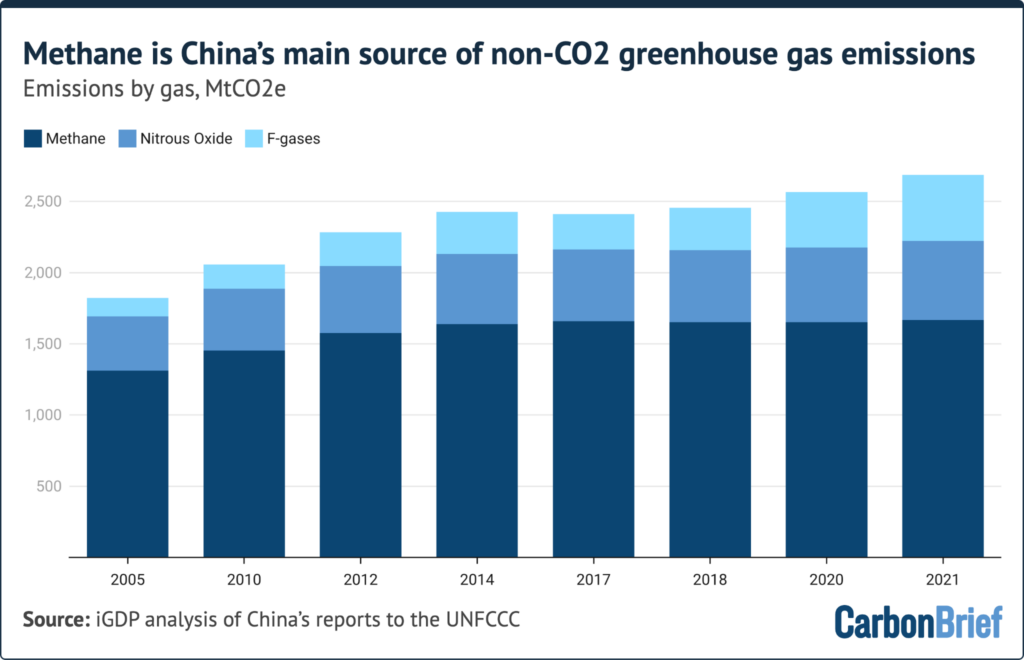
According to analysis by the Institute for Global Decarbonization Progress (iGDP) based on official national submissions to the UNFCCC, China’s total greenhouse gas emissions stood at approximately 14,000 million tonnes of $textCO_2$ equivalent ($textMtCO_2texte$) in 2021 (excluding land use, land-use change, and forestry). Non-$textCO_2$ pollutants accounted for approximately 2,700 $textMtCO_2texte$, or 19% of the national total.
CHINA'S GHG EMISSIONS BREAKDOWN (2021 DATA)
Total Emissions: ~14,000 MtCO₂e (excl. LULUCF)

┌─────────────────────────────────────────────────────────────┬───────────────────────────┐
│ Carbon Dioxide (CO₂)                                        │ Non-CO₂ GHGs              │
│ ~11,300 MtCO₂e (81%)                                        │ ~2,700 MtCO₂e (19%)       │
└─────────────────────────────────────────────────────────────┴─────────────┬─────────────┘
                                                                            │
                         ┌──────────────────────────────────────────────────┼─────────────────────────────────┐
                         │ Methane (CH₄)                                    │ Nitrous Oxide (N₂O)             │ Fluorinated Gases (F-Gases)
                         │ Dominant Share (~1,100+ MtCO₂e)                  │ Secondary Share (~800 MtCO₂e)   │ Growing Share (~800 MtCO₂e)
                         └──────────────────────────────────────────────────┴─────────────────────────────────┘
Methane ($textCH_4$) represents the overwhelming majority of China’s non-$textCO_2$ baseline, followed by Nitrous Oxide ($textN_2textO$) and Fluorinated Gases (HFCs, PFCs, and $textSF_6$). To tackle this high-warming sector, the 15th FYP explicitly reaffirms a national target to establish an emissions "reduction capacity" of 30 $textMtCO_2texte$ for non-$textCO_2$ gases by 2030.
Abatement Pathways and Sectoral Priorities
Chen Meian, program director and senior analyst at iGDP, notes that this 30 $textMtCO_2texte$ reduction capacity is practical and achievable through existing industrial methodologies and target programs:
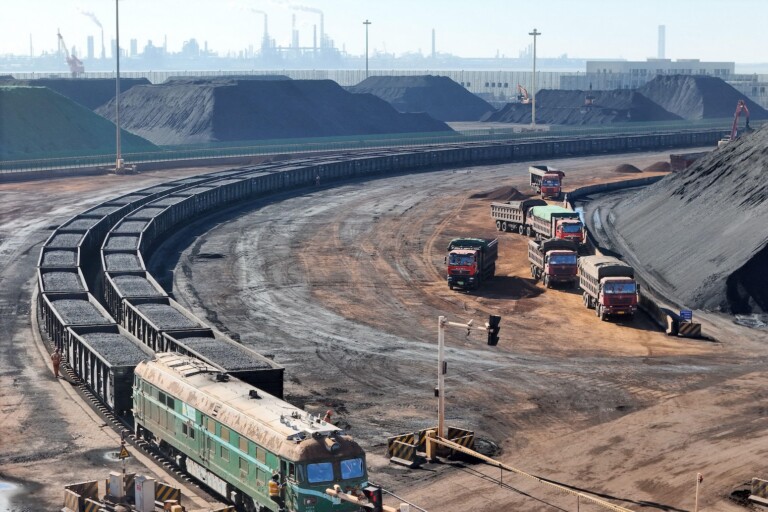
- Coal-Mine Methane ($textCMM$) & Ventilation Air Methane ($textVAM$): Methane released during extraction forms the largest share of industrial non-$textCO_2$ emissions. Under updated methodologies for the China Certified Emission Reduction ($textCCER$) voluntary carbon offset market, projects utilizing low-concentration methane (concentrations below 8%) and ventilation air methane could deliver up to 20 $textMtCO_2texte$ of reductions annually by 2030. Current operational projects generate roughly 4.5 $textMtCO_2texte$ per year, pointing to a major planned expansion in capture technology deployment over the 15th FYP period.
- Industrial Nitrous Oxide ($textN_2textO$): Mitigated via mandatory installation of catalytic decomposition systems in chemical production plants, specifically nitric acid and adipic acid manufacturing facilities.
- Hydrofluorocarbons ($textHFCs$): Targeted via strict end-of-pipe thermal destruction systems in industrial refrigeration and chemical manufacturing.
- Sulphur Hexafluoride ($textSF_6$): Characterized by an extraordinary global warming potential (23,500 times greater than $textCO_2$ over a 100-year horizon), $textSF_6$ is widely utilized as an insulating gas in electrical switchgear. The 15th FYP marks the first instance of comprehensive policy attention directed toward mandatory recovery, recycling, and synthetic substitution of $textSF_6$ across China’s expanding ultra-high voltage ($textUHV$) power grids.
| Non-$textCO_2$ Gas | Key Sources | 15th FYP Abatement Strategy | Targeted Impact |
|---|---|---|---|
| Methane ($textCH_4$) | Coal extraction, oil & gas systems | Expansion of low-concentration $textCMM$ and $textVAM$ capture via $textCCER$ offsets | ~20 $textMtCO_2texte$ potential abatement |
| Nitrous Oxide ($textN_2textO$) | Chemical synthesis (Adipic/Nitric acid) | High-efficiency catalytic abatement technology deployment | Contributes to remaining ~10 $textMtCO_2texte$ target balance |
| Fluorinated Gases ($textHFCs$) | Refrigeration, foam blowing | Phased down production lines and mandated thermal destruction | Supports Montreal Protocol / Kigali Amendment alignment |
| Sulphur Hexafluoride ($textSF_6$) | Power grid switchgear, $textUHV$ transformers | Mandated recycling, leak detection, and eco-friendly gas substitution | Prevention of long-term baseline growth in grid assets |
Carbon Pricing, Offsets, and International Rule-Making
A central pillar of the new plan is its strategy regarding market-based environmental mechanisms. China is pivoting from developing domestic carbon market infrastructure toward expanding its international influence and market integration.
                     CARBON MARKET STRATEGY UNDER THE 15TH FYP
                                         │
        ┌────────────────────────────────┴────────────────────────────────┐
        │                                                                 │
┌───────┴────────────────────────┐                       ┌────────────────┴────────────────┐
│ Domestic Consolidation         │                       │ International Expansion         │
└───────┬────────────────────────┘                       └────────────────┬────────────────┘
        │                                                                 │
        ├─ Expand ETS beyond power generation                            ├─ Article 6 UN rule-making alignment
        ├─ Scale CCER voluntary offset scheme                            ├─ EU-Brazil-China Carbon Coalition
        └─ Sector-specific carbon accounting                             └─ Global carbon offset acquisition strategy
Expanding the Domestic ETS and $textCCER$
The plan outlines a multi-pronged expansion of China’s national Emissions Trading Scheme ($textETS$) and the re-launched voluntary $textCCER$ market. While the national $textETS$ initially focused exclusively on the power generation sector, the 15th FYP period will formalize the inclusion of additional heavy-emitting industrial sectors, including steel, cement, and electrolytic aluminum. Simultaneously, the $textCCER$ scheme is positioned as a key liquidity provider, offering regulated entities a mechanism to fulfill compliance obligations while directing capital into low-carbon innovation, non-$textCO_2$ mitigation, and forestry projects.
Strategy for International Rule-Setting
Internationally, China aims to transition from a passive participant in market frameworks to an active voice in international carbon pricing standards. The strategy mandates that China enhance its influence by:
- Building Alliances: Expanding cooperation through initiatives such as the compliance carbon market open coalition launched alongside the European Union and Brazil, designed to foster cross-border regulatory alignment and integrity.
- Hosting Global Platforms: Utilizing domestic venues, such as the upcoming China Carbon Market Conference, to establish regional and global standards for carbon accounting, offset verification, and trading protocols.
- Navigating Article 6: As China continues its green transition, its domestic industrial base will require access to high-integrity market mechanisms. Qin Yan, principal analyst at ClearBlue Markets, notes that China could potentially become the world’s largest carbon offset buyer over the longer term as its industrial sectors approach strict absolute cap constraints. Consequently, shaping the rulebook for Article 6 under the Paris Agreement allows Beijing to protect domestic industrial interests while building trade channels with developing economies in the Global South.
Official Statements and Stakeholder Reactions
The release of the 15th FYP for Climate Response has generated significant commentary from domestic institutions, international policy experts, and carbon market analysts.
The Ministry of Ecology and Environment (MEE) emphasized in an official public statement:
"For the first time at the Five-Year Plan level, this document establishes an all-encompassing, cross-sectoral target system that covers all domains of climate policy. It serves as the primary policy instrument for guiding and advancing China’s national climate strategy from 2026 through 2030."
Qin Yan, Principal Analyst at ClearBlue Markets, highlighted the institutional significance of the plan:
"The publication of this comprehensive document demonstrates that climate governance within China has reached an unprecedented strategic level. It translates high-level political pledges—such as the 2030 peaking goal and 2035 targets—into an actionable policy matrix supported by real economic mechanisms and cross-departmental accountability."
Prof. Thomas Hale, Professor of Public Policy at the University of Oxford’s Blavatnik School of Government, observed a clear evolution in China’s diplomatic positioning:
"This plan marks a major rhetorical and strategic shift. China is increasingly signaling that it is not merely responding to international pressure, but is fully prepared to lead, shape, and set the parameters of global climate action and environmental governance."
Chen Meian, Program Director at the Institute for Global Decarbonization Progress (iGDP), commented on the operational focus on niche gases:
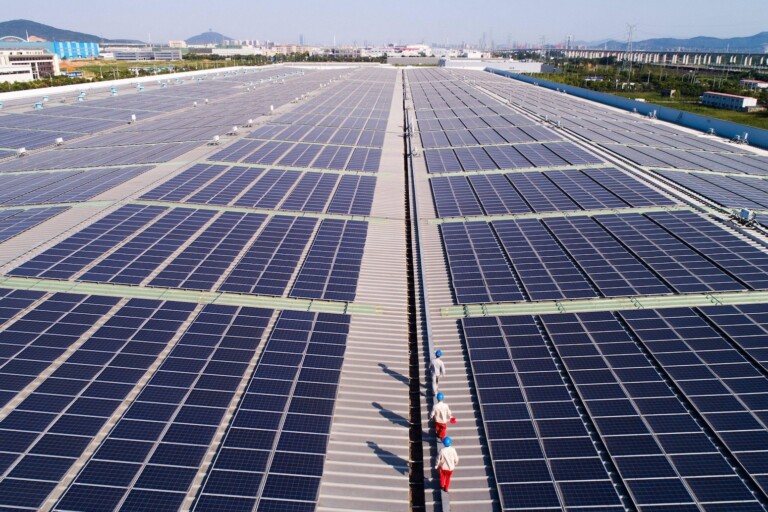
"The strategic inclusion and elevated focus on sulphur hexafluoride ($textSF_6$) and ventilation air methane is timely. As China’s power grid undergoes rapid expansion to absorb mega-watt scale renewable energy bases, proactively addressing high global-warming-potential gases like $textSF_6$ prevents a hidden surge in non-$textCO_2$ emissions."
Future Outlook & Strategic Implications
The 15th Five-Year Plan for a National Response to Climate Change underscores a fundamental truth: China’s climate transition has entered a phase focused on institutional maturity, regulatory enforcement, and global integration. Rather than chasing headline numbers, Beijing is establishing the deep infrastructure required to ensure its emissions peak occurs well before the 2030 deadline, paving the way for sustained absolute emission reductions through 2035 and beyond.
┌────────────────────────────────────────────────────────────────────────────────────────┐
│                        CHINA'S DECARBONIZATION TIMELINE & MILESTONES                   │
└────────────────────────────────────────────────────────────────────────────────────────┘

    2005 Baseline              2026–2030 Target             2030 Peak Target           2035 Target Goal             2060 Neutrality Goal
 ┌─────────────────┐        ┌────────────────────┐       ┌────────────────────┐     ┌────────────────────┐       ┌────────────────────┐
 │ Carbon Intensity│ ─────► │ Deploy 15th FYP    │ ────► │ Peak CO₂ Emissions │ ───► │ Absolute GHG Cut   │ ────► │ Full Carbon        │
 │ Reference Point │        │ Climate Framework  │       │ Carbon Intensity   │     │ 7%–10% below peak  │       │ Neutrality         │
 │                 │        │ Non-CO₂ Cap Focus  │       │ Reduced >65%       │     │ "Strive to excel"  │       │ Economy            │
 └─────────────────┘        └────────────────────┘       └────────────────────┘     └────────────────────┘       └────────────────────┘
Looking ahead to the 2026–2030 operational window, several critical indicators will determine the success of this strategy:
- Provincial Execution and Verification: Local government alignment will be paramount. As provincial authorities update their local Five-Year Plans, central authorities must ensure regional industrial incentives align with national non-$textCO_2$ and carbon-intensity enforcement mechanisms.
- Integrity of Voluntary Carbon Markets: The rapid scaling of the $textCCER$ market—particularly in capturing complex offset categories like low-concentration mine methane—will require stringent monitoring, reporting, and verification ($textMRV$) protocols to maintain credibility among international institutional investors.
- Geopolitical Alignment on Carbon Borders: As the European Union unfolds its Carbon Border Adjustment Mechanism ($textCBAM$), China’s efforts to build standard-setting coalitions with emerging markets and trade partners will be tested. Aligning domestic carbon market pricing and carbon footprint accounting standards with international frameworks will be vital to safeguarding China’s global trade flows.
By formalizing its climate architecture within the 15th Five-Year Plan, China has signaled that its economic transition is deeply tied to systematically lowering carbon reliance. The key question for global markets is no longer whether China will hit its climate targets, but how effectively its evolving governance framework will reshape global supply chains, international offset markets, and energy policy dynamics over the coming decade.