Executive Overview
The decarbonization of the aviation industry has long been plagued by grand spectacles, speculative capital, and technology paradigms that promise radical reinventions of global mobility. From the breathless hype surrounding urban air taxis to the seemingly insurmountable logistical chasm of hydrogen-powered commercial fleets, billions of dollars have flowed into sectors struggling to cross the valley of death between proof-of-concept and commercial viability.
Yet, as the industry chases these silver bullets, a quieter, far more consequential revolution is taking shape on the tarmac.
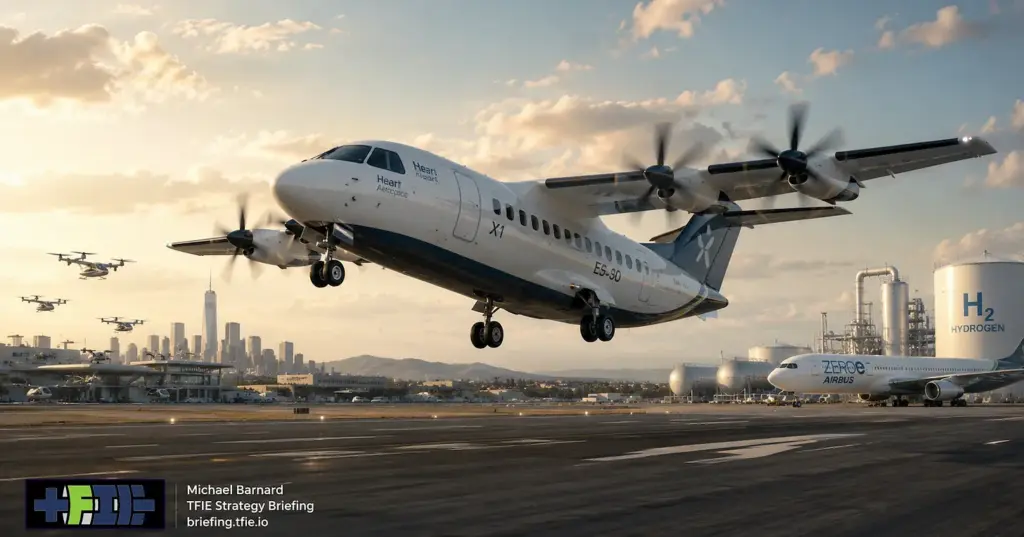
On August 12, Heart Aerospace’s X1 demonstrator took to the skies from Plattsburgh International Airport for a successful 27-minute, battery-powered flight. Boasting a 106-foot wingspan, a takeoff weight exceeding 25,000 pounds, and a peak draw of over one megawatt, the X1 is heralded by its creators as the largest battery-electric aircraft ever flown.
However, the historical significance of the X1 lies not merely in its physical dimensions or its record-breaking power consumption, but in its denominator: this is a full-scale aircraft explicitly engineered for an existing regional aviation market. Rather than attempting to conjure a brand-new transportation category out of thin air, Heart Aerospace is targeting established routes, conventional airports, and organic passenger demand.
As the aviation sector grapples with the sobering failures and financial insolvencies of high-profile eVTOL (electric vertical takeoff and landing) pioneers and the heavy infrastructure hurdles of hydrogen, Heart’s pragmatic approach offers a blueprint for what credible, incremental aviation decarbonization looks like.
Detailed Chronology: The Flight of the X1 and the Path to 2031
The journey of the X1 demonstrator to its maiden flight on August 12 is the product of years of iterative aerospace engineering, but the milestone marks the definitive transition of Heart Aerospace from a drawing-board concept into tangible hardware testing.
The Plattsburgh Milestone
Operating out of Plattsburgh International Airport, the X1’s 27-minute flight was executed entirely under battery power. Throughout the flight profile, telemetry captured critical data regarding thermal management, battery discharge rates under heavy loads, and aerodynamic performance across the aircraft’s expansive 106-foot wingspan. Pulling in excess of a megawatt of power at peak performance, the test provided engineers with real-world datasets that simulation software alone cannot replicate.
[Design & Simulation] ➔ [Hardware Assembly] ➔ [Ground Rig Testing] ➔ [Aug 12: X1 Maiden Flight (27 mins)] ➔ [ES-30 Production] ➔ [2031 Service Target]Navigating the Road to Commercialization
Despite the jubilation surrounding the August 12 flight, industry analysts and company leadership are quick to contextualize the achievement. Heart Aerospace is still years away from delivering a certified, revenue-generating commercial airliner.
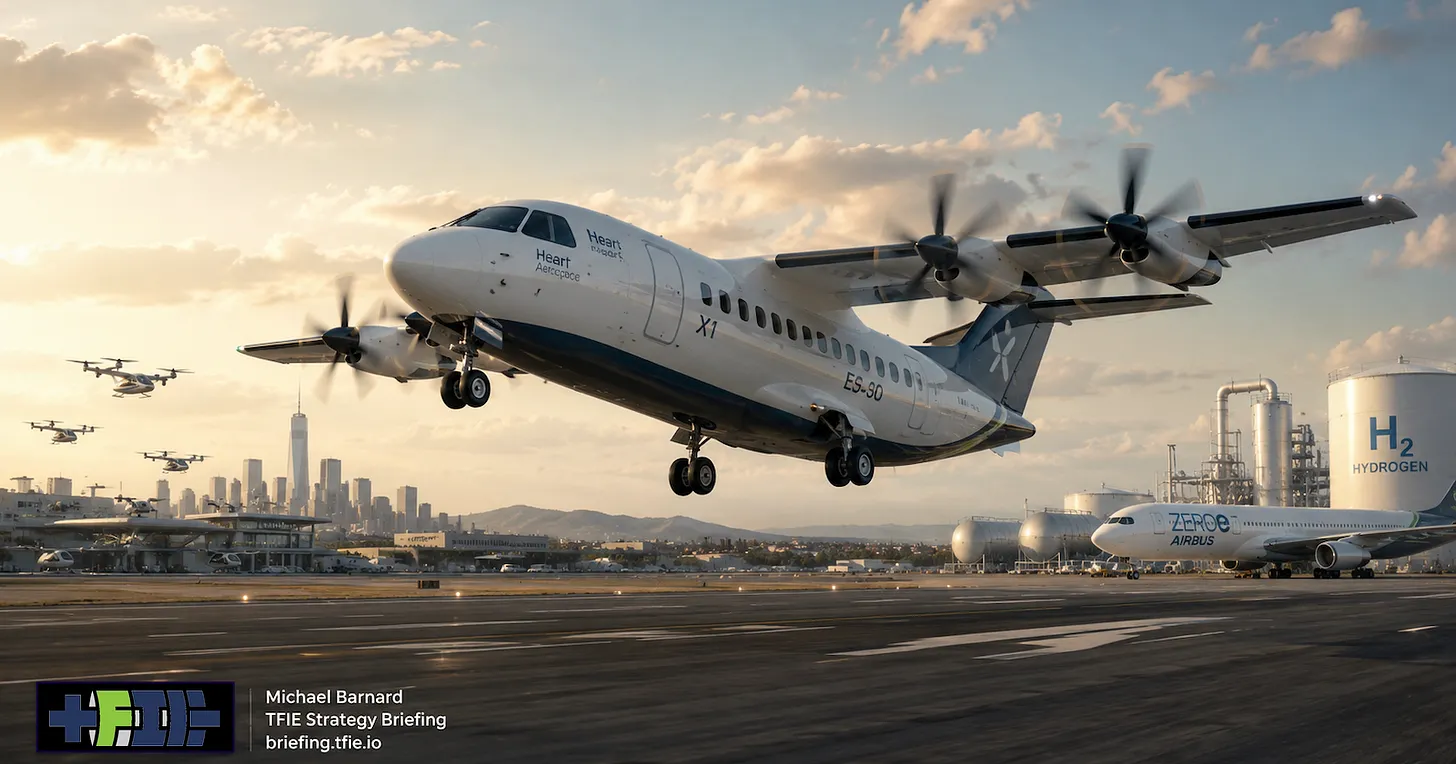
- The X1 vs. The ES-30: The X1 is a technology demonstrator, not the final production configuration of the planned ES-30 regional hybrid-electric aircraft.
- The Regulatory Horizon: The aircraft must still traverse the grueling gauntlet of Federal Aviation Administration (FAA) and European Union Aviation Safety Agency (EASA) certification processes.
- Industrialization: Moving from a hand-assembled demonstrator to an industrialized assembly line requires massive capital expenditure and supply chain maturation.
- The 2031 Target: Heart’s current service entry target is set for 2031, leaving a critical five-year window to resolve the hard engineering and economic hurdles that have tripped up previous clean-tech aviation ventures.
Supporting Context & Metrics: The Misallocation of Aviation Capital
To understand why Heart’s approach is gathering serious attention from seasoned aviation strategists, one must examine where transition capital has been misallocated over the past decade.
The eVTOL Bubble and the "Vertiport" Illusion
Aviation has never suffered from a shortage of speculative capital, but that capital has frequently chased the wrong problems. According to estimates by Jefferies analysts, roughly $12 billion has been poured directly into the eVTOL sector. High-profile investments underscore this trend: Boeing injected $450 million into Wisk in 2022, while Hyundai backed Supernal with at least $1 billion.
Simultaneously, pioneers like Lilium and Volocopter faced severe financial distress, culminating in insolvency proceedings that shocked investors.
The core issue plaguing the urban air mobility market was never purely engineering; it was commercial viability. Even if sophisticated powered-lift aircraft could be successfully engineered to hover, transition to forward flight, and pass rigorous safety certifications, a massive economic question remained: Would enough passengers pay enough money, often enough, to support the astronomical costs of aircraft fleets, dedicated urban vertiports, and complex air traffic management systems required for a mass urban-air-taxi market?
The Hydrogen Roadblock
Concurrently, hydrogen-powered aviation ran into an entirely different denominator problem. The obstacle was never merely getting a hydrogen-fueled plane into the air—prototype demonstrations have proven that concept before.
The fatal flaw lies in the complete logistical system required to sustain hydrogen operations at scale:
- Sourcing genuinely low-carbon (green) hydrogen.
- Managing energy-intensive liquefaction or high-pressure cryogenic storage.
- Constructing specialized airport handling infrastructure and handling new safety protocols.
- Designing bulky fuel tanks that sacrifice valuable passenger or cargo payload space.
- Operating a propulsion system that converts hydrogen back into useful thrust, incurring substantial energy losses along the way.
When stacked on top of the already brutal economics and engineering challenges of developing a standard commercial aircraft, the hydrogen burden becomes an almost insurmountable commercial mountain for the near-to-medium term.
Comparative Analysis: The Decarbonization Landscape
| Technology Sector | Primary Capital Inflow | Core Infrastructure Challenge | Market Realities & Commercial Viability |
|---|---|---|---|
| eVTOL / Urban Air Mobility | ~$12 Billion (Jefferies estimate) | Vertiport networks, urban airspace integration, high operating costs. | High speculative investment; corporate insolvencies (Lilium, Volocopter); unproven mass-market passenger demand. |
| Hydrogen Aviation | Moderate to High (Government & VC grants) | Cryogenic fueling infrastructure, low-carbon hydrogen supply chains, bulky tank integration. | Severe energy conversion losses; massive airport infrastructure overhauls required from scratch. |
| Regional Electric / Hybrid (Heart Aerospace) | Growing venture & strategic backing | Megawatt airport grid connections, battery mass optimization, high-cycle durability. | High credibility; leverages existing airports, regional routes, and established passenger demand. |
Industry Perspectives & Strategic Implications
Heart Aerospace is by no means enjoying an easy path. Commercial aircraft development is notoriously capital-intensive, and the successful flight of the X1 does not automatically guarantee that the ES-30 will be certifiable, reliable, or profitable.

However, Heart’s strategic genius lies in its choice of battlefield. By addressing a market that already exists—regional airlines operating short-to-medium routes between existing regional airports—the company bypasses the infrastructural dead-ends that plague urban air mobility and hydrogen.
If electric and hybrid propulsion can shoulder even a meaningful fraction of regional flying, the infrastructure and customer acquisition hurdles shrink dramatically. Airports already have terminals, runways, and security checkpoints. Regional airlines already have route networks, ticket-booking systems, and passenger loyalty.
As detailed in industry strategy briefings focusing on aviation’s long-term capital allocation:
"Heart has moved one real rung up the evidence ladder, but the harder questions are still ahead… The next aviation investment cycle should be much less impressed by spectacle. The useful question is whether capital is resolving uncertainties that stand between today’s aviation system and a lower-carbon version of it."
Future Outlook: The Credible Path Forward Through 2100
The decarbonization of global aviation will not be achieved by a single, monolithic technology. The laws of physics dictate that different flight missions demand vastly different energy solutions.
- Short-to-Medium Regional Routes: Batteries and hybrid-electric powertrains are positioned to work their way upward from smaller aircraft and shorter routes. This is where electricity’s inherent thermodynamic efficiency and low operating energy costs matter most.
- Long-Haul Transoceanic Routes: Intercontinental flights will inevitably require energy-dense liquid fuels for decades to come. This reality places an absolute premium on scaling genuinely sustainable aviation fuels (SAFs) derived from low-carbon feedstocks, rather than assuming one miracle technology will serve every single mission profile.
The Road Ahead for Heart Aerospace
For Heart Aerospace, the years leading up to the 2031 service target will be defined by the hard, unglamorous work of engineering validation. Investors, regulators, and airline operators will be watching closely to see how the company tackles remaining uncertainties:
- Battery Mass and Energy Density: Pushing chemistry limits to maximize passenger payloads.
- Hybrid Range Extension: Balancing battery weight with reliable backup generators for safety reserves.
- High-Cycle Durability: Ensuring commercial battery packs can withstand the punishing daily turnaround schedules of regional carriers.
- Megawatt Charging Infrastructure: Partnering with regional airports to upgrade local electrical grid connections and high-power charging stations.
The X1’s flight over Plattsburgh is a welcome antidote to years of aerospace vaporware. It proves what progress looks like when brilliant engineering is coupled with a realistic market strategy and a plausible energy pathway. As aviation enters its next major funding cycle, the industry would do well to trade empty spectacles for the hard-nosed pragmatism demonstrated by Heart Aerospace.