Executive Overview
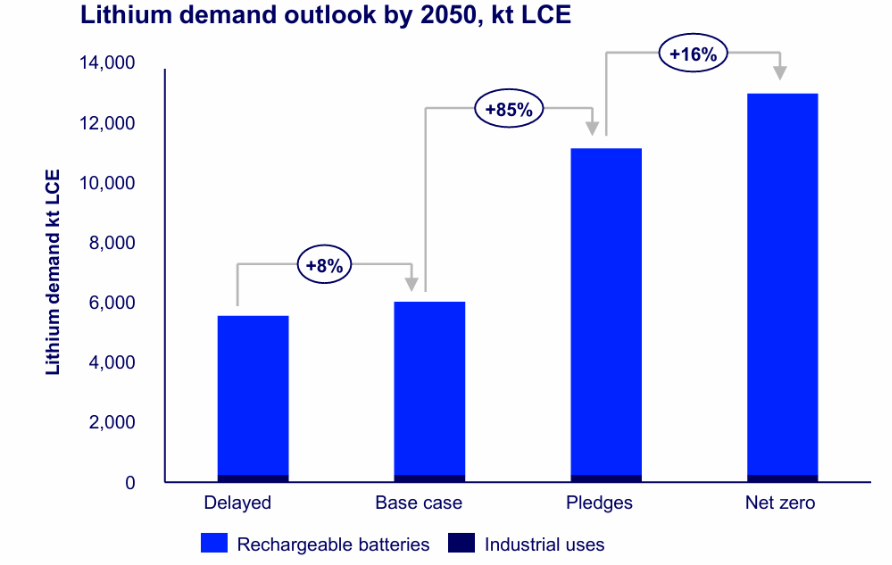
As the global economy accelerates its race away from fossil fuels, a critical vulnerability threatens to derail the clean energy revolution. According to a sweeping new analysis published in Wood Mackenzie’s latest Energy Transition Outlook for Lithium, worldwide demand for lithium—the indispensable chemical backbone of modern electrification—is projected to skyrocket to an astonishing 13 million tonnes annually by 2050.
However, the headline figure masks an alarmingly near-term crisis. Industry experts warn that without an unprecedented, coordinated injection of capital into mining, refining, and supply chain infrastructure, severe lithium shortages could materialize as early as 2028.
The impending supply crunch is driven by the hyper-growth of electric vehicles (EVs) and stationary energy storage systems (ESS). While circular economy initiatives, such as battery recycling, offer long-term hope, they cannot scale quickly enough to prevent deficits in the decade’s closing years. To close the widening gap between supply and demand, the global mining and processing sectors must undergo a massive financial buildout estimated to cost between $100 billion and $276 billion.
The question is no longer whether the world will need more lithium, but whether industrial and financial markets can mobilize fast enough to fund and construct the necessary capacity before the bottleneck chokes the energy transition.
Detailed Chronology: The Evolution of the Lithium Market
To understand the severity of the upcoming 2028 crunch, one must examine how the lithium narrative has evolved over the past decade from a niche specialty chemical market to the geopolitical "white gold" of the 21st century.
2015–2020: The Awakening of the Gigafactory Era
For decades, lithium was primarily used in ceramics, glass, lubricants, and early-generation consumer electronics. The market was small, predictable, and heavily balanced. However, the mid-2010s marked a paradigm shift. Propelled by declining lithium-ion battery costs and the commercialization of long-range electric vehicles—spearheaded by companies like Tesla—automakers began committing billions of dollars to transition away from the internal combustion engine.
During this window, mining companies in the "Lithium Triangle" of South America (Chile, Argentina, and Bolivia) and hard-rock pegmatite miners in Western Australia scaled up extraction. Yet, investment cycles lagged behind the exponential growth curve of EV adoption, setting the stage for future volatility.
2021–2023: The Boom, the Bust, and Extreme Volatility
The post-pandemic economic recovery triggered a historic commodity super-cycle. By late 2022 and early 2023, surging demand coupled with sluggish supply chains sent lithium carbonate prices to historic highs. Automakers scrambled for off-take agreements, and governments woke up to the strategic vulnerability of their supply dependencies, prompting landmark legislative actions like the United States’ Inflation Reduction Act (IRA) and the European Union’s Critical Raw Materials Act.
However, a temporary oversupply correction in late 2023 and 2024 caused spot prices to plummet, creating a false sense of security and causing some junior miners to pull back on capital expenditures—a delay that analysts now fear will deeply exacerbate the 2028 deficit.
2025–2028: The Precipice of the Supply Crunch
As we look toward the immediate horizon, Wood Mackenzie’s models indicate that the buffer of excess capacity will evaporate. By 2028, under ambitious climate and net-zero policy scenarios, primary extraction rates will flatline relative to the exponential vertical trajectory of global EV sales. This structural imbalance marks the transition from market cyclicality to a chronic structural deficit, forcing automakers, energy firms, and policymakers into a high-stakes scramble for secure, long-term supply.
Supporting Context & Metrics: Decoding the Numbers
Wood Mackenzie’s comprehensive modeling evaluates four distinct energy transition pathways, painting a vivid numerical picture of how different policy speeds dictate raw material requirements.
Demand Scenarios Through 2050
Depending on the aggressiveness of global climate policies, total lithium demand (measured in Lithium Carbonate Equivalent, or LCE) varies dramatically by mid-century:
- Delayed Transition Scenario: Demand reaches 5.6 million tonnes LCE, reflecting sluggish regulatory support, delayed infrastructure rollouts, and persistent consumer hesitation.
- Base Case / Country Pledges Scenario: Demand surges as governments meet their current nationally determined contributions, requiring massive raw material inputs.
- Net Zero Scenario: Demand reaches an extraordinary 13.2 million tonnes LCE, assuming an uncompromising global commitment to limiting warming to 1.5°C.
What is Driving the Surge?
The forces behind this unprecedented demand curve can be broken down into two primary sectors:
- Electric Vehicles (72% to 80% of Total Demand):
Light-, medium-, and heavy-duty electric transport remains the undisputed engine of lithium consumption. Under a standard Country Pledges pathway, EVs are projected to capture roughly 75% of global new vehicle sales by 2040. Under a strict Net Zero pathway, that adoption rate accelerates to an astonishing 95%. By 2050, rechargeable battery applications across all sectors will account for 96% to 98% of all lithium consumed worldwide. - Grid-Scale Energy Storage Systems (ESS):
As wind and solar generation dominate new power capacity additions, electrical grids require unprecedented balancing capabilities. Large-scale battery energy storage systems (BESS) are critical to smoothing out intermittency. Wood Mackenzie projects that energy storage lithium demand will compound at an annual growth rate of 6% to 7% across all forward-looking scenarios.
The Recycling Reality Check
A common counter-argument to mining expansion is the promise of battery recycling. While the circular economy is vital for long-term sustainability, its near-term impact is severely constrained by physics and fleet turnover times.
- The Time Lag: Modern EV batteries typically have a lifespan of 10 to 15 years. The vast majority of batteries powering today’s roads will not reach end-of-life until the late 2030s and 2040s.
- Growth Projections: Recycled supply is projected to grow at an impressive 13% to 16% annually, ramping up significantly in the 2040s. By 2050, recycling could supply between 2.3 million and 2.7 million tonnes LCE under ambitious scenarios.
- The Persistent Gap: Even with a thriving recycling ecosystem operating at peak efficiency by mid-century, massive shortfalls remain. Under the Country Pledges scenario, the cumulative supply shortfall reaches 6.7 million tonnes LCE by 2050, while the Net Zero scenario widens this deficit to a staggering 8.5 million tonnes LCE.
The $100B–$276B Capital Expenditure Requirement
Bridging these enormous gaps requires an unprecedented industrial mobilization. Wood Mackenzie estimates the total capital expenditure (CapEx) needed to build out the required mines, extraction facilities, chemical refineries, and regional supply chains:

- Delayed Transition: ~$104 billion
- Base Case: ~$114 billion
- Country Pledges: ~$236 billion
- Net Zero: ~$276 billion
Crucially, industry investment must peak aggressively between 2030 and 2034 to bring these complex, capital-intensive megaprojects online before the mid-century deficits cripple downstream manufacturing.
Official Statements & Industry Perspectives
The urgency of Wood Mackenzie’s findings has triggered sharp warnings from market authorities and researchers alike.
"The lithium market is heading into a supply crunch much sooner than many industry players expect," warned Allan Pedersen, Research Director at Wood Mackenzie. "Under ambitious climate scenarios, we see deficits emerging from 2028. The industry needs to act now, as governments progress policies toward Net Zero."
Pedersen’s remarks underscore a fundamental disconnect in the modern energy economy: while policymakers continue to pass aggressive legislation banning internal combustion engines and mandating renewable integration, the permitting, financing, and construction timelines for upstream mining assets remain notoriously slow—often taking 7 to 10 years from initial discovery to first commercial production.
Mining executives and financial analysts echo these concerns, noting that traditional capital markets have been hesitant to fund greenfield mining projects following the price volatility of the early 2020s. Without long-term off-take contracts guaranteed by major automotive OEMs or government-backed loan guarantees, securing nine-figure project financing remains an uphill battle.

Future Outlook: Navigating the Critical Decade
As the global community stands on the precipice of the 2028 crunch, the trajectory of the energy transition will be defined by how the industry responds to the lithium bottleneck. Meeting this challenge requires a multi-pronged strategy:
- Accelerating Technological Innovation:
The industry must fast-track alternative extraction methods, such as Direct Lithium Extraction (DLE) from geothermal brines and oilfield wastewaters—such as pioneering projects emerging in the United States—which promise faster production cycles and lower environmental footprints compared to traditional evaporation ponds or hard-rock open-pit mines. - Streamlining Permitting and Policy:
Governments must balance stringent environmental safeguards with the urgent national security imperative of securing critical minerals. Lengthy, bureaucratic permitting processes must be streamlined without sacrificing community engagement and ecological responsibility. - Deepening Supply Chain Partnerships:
Automakers can no longer remain mere downstream buyers. To guarantee survival in a constrained market, major automotive groups must follow the lead of industry pioneers by directly investing equity into mining startups, securing long-term off-take agreements, and vertically integrating their supply chains.
The bottom line is undeniable: the world has committed to an electrified future, but the physical reality of extracting, refining, and processing the necessary raw materials remains a formidable hurdle. Whether the global economy can successfully navigate the 2028 lithium deficit will determine whether the net-zero carbon future is realized on schedule or delayed by structural resource scarcity.