Executive Overview
As nations worldwide race to meet aggressive climate targets while securing reliable, domestic energy supplies, the intersection of waste management and renewable fuel production has never been more critical. In southwestern Ontario, a major infrastructure upgrade is quietly reshaping the future of sustainable energy. Generate Upcycle—a leading sustainable infrastructure platform and a subsidiary of Generate Capital—is driving a transformative expansion of its flagship anaerobic digestion and renewable natural gas (RNG) facility located in London, Ontario.
This ambitious project, backed by a strategic infusion of public and private capital, is set to more than double the facility’s processing capacity. By converting complex waste streams—ranging from municipal post-consumer organics to industrial and commercial food waste—into pipeline-grade green energy, the London plant serves as a textbook example of the circular economy in action.
The endeavor is supported by a significant financial commitment from the Canadian federal government through Natural Resources Canada’s Clean Fuels Fund. This public-private partnership underscores Ottawa’s broader strategy to position Canada as a global clean energy superpower. It leverages homegrown innovation to cut greenhouse gas emissions, generate sustainable local employment, and relieve mounting pressure on municipal landfills.
Beyond its immediate environmental and economic benefits in Ontario, the London expansion mirrors Generate Upcycle’s broader corporate trajectory across North America and the United Kingdom. As regulatory frameworks evolve and public policy increasingly rewards low-carbon infrastructure, the success of facilities like the London digester is accelerating the maturation of North America’s anaerobic digestion sector. This in-depth report explores the mechanics of the expansion, the financial and regulatory frameworks enabling it, the technological milestones involved, and the broader implications for the future of waste-to-energy conversion.
Detailed Chronology: From StormFisher Origins to Generate Upcycle’s Modern Renaissance
To understand the current scale of the London biogas facility, one must examine its evolutionary trajectory, which spans corporate acquisitions, engineering phases, and strategic capital allocation.
The Genesis: StormFisher Environmental Services
The roots of the London, Ontario site trace back to its original developer, StormFisher Environmental Services Ltd., a pioneer in the alternative fuel and organic waste-to-energy space. StormFisher engineered and constructed the London facility to tackle a persistent regional challenge: the heavy reliance on landfills for municipal solid waste (MSW) and the underutilization of organic byproducts generated by food processors, commercial entities, and municipalities.
For years, the facility operated as a vital node in Ontario’s environmental infrastructure, capturing methane emissions from decomposing organics and converting them into usable energy. However, scaling capital-intensive waste infrastructure requires deep pockets and sophisticated portfolio management—qualities that found a natural home in Generate Capital.
The 2022 Acquisition and the Birth of Generate Upcycle
A watershed moment arrived in May 2022, when sustainable infrastructure investment pioneer Generate Capital formally launched its integrated circular economy platform, Generate Upcycle. As part of this strategic launch, Generate Capital acquired the food-waste-to-energy division of StormFisher Environmental Services Ltd., absorbing the London facility and integrating it into a burgeoning international portfolio of organic waste management and RNG assets.
The acquisition provided the London site with the financial backing, operational synergy, and strategic vision necessary to unlock its next phase of growth. Rather than operating as a standalone localized project, the London facility became part of a larger North American blueprint designed to institutionalize anaerobic digestion as a mainstream municipal and industrial utility.
Phase One: Upgrading the Biogas Pipeline (2024)
With Generate Upcycle at the helm, modernization efforts commenced in earnest. The transformation of the London facility was mapped out in distinct operational phases to ensure continuous processing of incoming waste while simultaneously expanding the plant’s physical and technological footprint.
The first major milestone was achieved in 2024 with the completion of Phase One. This initial stage focused heavily on modernizing and scaling the site’s core biogas upgrading systems and overall RNG production capacity. By retrofitting the facility with state-of-the-art gas-cleaning and conditioning technologies, Generate Upcycle significantly increased the purity and volume of methane extracted from the anaerobic digestion process, preparing the plant for the massive influx of organic feedstock slated for Phase Two.
Phase Two: Front-End Modernization and Full Run-Rate Integration
Building upon the successes of 2024, Phase Two of the expansion is currently well underway. While Phase One concentrated on the back-end processing of gas, Phase Two fundamentally transforms the front-end capabilities of the plant.
This ongoing phase involves a comprehensive overhaul and expansion of the facility’s feedstock receiving infrastructure and its anaerobic digestion tanks. Managing director and industry veteran Caesar noted that throughout this construction blitz, the site has managed to maintain operational continuity, processing incoming materials even as new engineering marvels are bolted into place.
However, bringing complex industrial biotechnology online requires rigorous calibration. While the facility has been operating concurrently with construction crews, it has not yet achieved its maximum full run-rate. According to project timelines, full run-rate operations are scheduled to commence in January, with final fine-tuning, systemic testing, and optimization concluding during the first quarter of next year. Once fully operational, this expansion will more than double the facility’s baseline output, cementing its status as an elite waste-conversion engine.
Supporting Context & Metrics: Financial Structures, Waste Diversion, and Government Backing
The viability of modern renewable energy projects relies on a delicate balance of public policy incentives, corporate capital deployment, and rigorous operational logistics.
The Clean Fuels Fund and Public-Private Co-Financing
The Canadian federal government’s aggressive pivot toward a low-carbon economy has manifested in targeted legislative and financial instruments. Chief among these is the Clean Fuels Fund, established under the federal budget with an allocation of 1.5 billion Canadian dollars over a five-year period. Designed to de-risk capital-intensive projects across every stage of development and supply chain integration, the fund provides crucial financial scaffolding for pioneering green energy initiatives.
In the case of the London facility, the public financing is structured as a four-year loan backed by Natural Resources Canada (NRCan). Crucially, this loan features a performance-aligned repayment schedule: Generate Upcycle is not required to begin servicing the loan until the London facility officially achieves profitable operations. The remainder of the multi-million-dollar capital expenditure is being covered entirely by Generate Upcycle’s private balance sheet, exemplifying a textbook public-private partnership where government support unlocks private-sector liquidity.
Diverting MSW and Saving Municipal Landfill Space
The true genius of anaerobic digestion lies in its dual utility: it simultaneously solves a critical waste management crisis while generating clean, dispatchable energy. The London facility processes a complex, heterogeneous mix of post-consumer organic waste sourced from municipal curbside collection contracts alongside industrial and commercial food waste generated by food processors, restaurants, and institutional partners.
By capturing these high-moisture organic fractions, the facility plays a foundational role in helping the province of Ontario meet its ambitious waste diversion targets. Caesar emphasized the long-term systemic savings inherent in this process:
"It’s the material that is the core of what Ontario is keeping out of landfills. They’re not having to build new landfills. A meaningful portion of the overall MSW, the organic fraction of MSW, is never making it to a landfill."
Landfill diversion yields compounding ecological dividends. When organic matter is buried in traditional landfills without oxygen, it breaks down anaerobically to produce massive quantities of fugitive methane—a greenhouse gas with a global warming potential significantly higher than carbon dioxide over a 20-year timeline. By intercepting these organics and processing them within a sealed, engineered anaerobic digester, Generate Upcycle captures 100% of the biogas generated, flaring or upgrading it while converting the remaining digestate into valuable organic fertilizers and soil amendments.
The Broader Generate Upcycle Portfolio: The Cayuga Precedent
The London project is not an isolated initiative; it is part of a broader, aggressive North American expansion strategy executed by Generate Upcycle. A prime structural parallel can be found in the company’s recent operations in upstate New York.
Last year, Generate Upcycle celebrated the major expansion and reopening of its Cayuga, New York anaerobic digester and biogas plant. That facility underwent a $30 million capital investment upgrade to optimize its processing capabilities and now produces an impressive 195,000 million British thermal units (mmBtus) of RNG annually. Much like the Canadian model, a portion of the Cayuga upgrade was catalyzed by supportive federal policies, specifically leveraging Investment Tax Credits (ITCs) generated directly at the site.
By scaling parallel operations in both Canada and the United States, Generate Upcycle is establishing economies of scale, standardizing best practices in bio-waste engineering, and building deep institutional relationships with municipal waste authorities across international borders.
Official Statements and Policy Perspectives
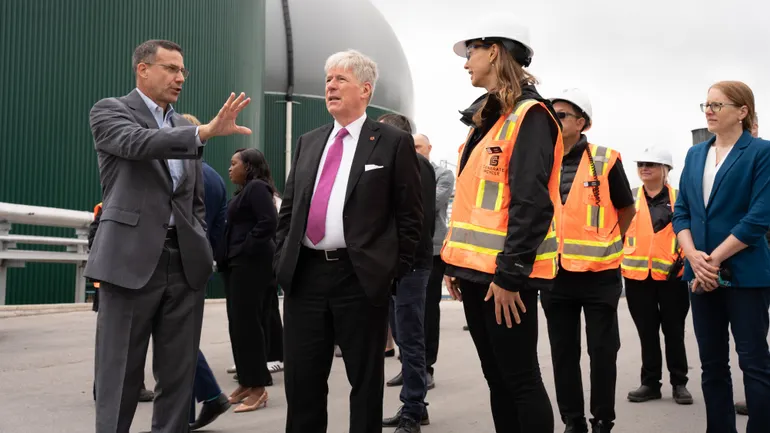
The convergence of economic development, job creation, and climate regulation has generated enthusiastic support from top-tier political leadership in Canada. The strategic importance of the London expansion was highlighted directly by federal officials.
Tim Hodgson, Canada’s Minister of Energy and Natural Resources, emphasized the multi-faceted victory that projects like the London facility represent for the Canadian federation. In an official statement, Hodgson remarked:
"By supporting projects like Generate Upcycle’s RNG facility, we are leveraging homegrown innovation and existing resources into reliable, low-carbon energy while growing domestic clean fuel production and creating jobs — a win-win-win."
Hodgson’s comments reflect a deliberate policy shift within Ottawa: viewing natural resources not merely through the lens of traditional fossil fuel extraction, but through a diversified energy matrix where waste streams are reframed as domestic energy reserves.
From an industry perspective, Caesar articulated the vital role that stable, forward-looking public policy plays in accelerating the adoption of industrial biotechnology in North America. Historically, North America has lagged behind Western Europe—particularly countries like Germany, Denmark, and Sweden—in deploying widespread anaerobic digestion infrastructure. However, Caesar believes that proactive regulatory frameworks and co-investment models are rapidly closing that gap.
"It does reduce the risk of an investment, and it helps people demonstrate the utility of food waste-based anaerobic digesters," Caesar noted regarding the impact of government backing. "This is part of what you do to get an industry off the ground."
By de-risking early-stage and expansion-stage capital expenditures, programs like the Clean Fuels Fund allow private investors to test, refine, and scale complex engineering paradigms that might otherwise be deemed too speculative by traditional commercial lenders.
Future Outlook: The Maturation of Anaerobic Digestion in North America
As the London, Ontario facility prepares for full run-rate operations in January and final fine-tuning throughout the first quarter of next year, industry analysts are looking ahead to what this milestone portends for the broader clean energy landscape.
Overcoming Historic Hurdles
The anaerobic digestion sector has historically faced structural hurdles in North America, including fragmented municipal waste-hauling contracts, inconsistent tipping fees, regulatory hurdles surrounding interconnecting with natural gas pipelines, and public skepticism regarding facility siting (often referred to as the "Not In My Back Yard" or NIMBY syndrome).
However, as projects like the London digester prove their operational safety, odor control, and economic utility, community pushback is steadily diminishing. Municipalities burdened by skyrocketing costs for expanding or constructing new landfills are increasingly viewing companies like Generate Upcycle not as industrial neighbors to be feared, but as essential municipal utility partners.
The Convergence of Decarbonization and Circular Economies
Looking to the horizon, the convergence of stringent corporate environmental, social, and governance (ESG) mandates, net-zero municipal goals, and federal clean fuel standards creates an unprecedented tailwind for RNG producers. Natural gas utilities across North America are under mounting pressure to green their supply grids by injecting biomethane into existing pipeline networks. RNG derived from organic waste boasts a carbon intensity (CI) score that is often neutral or even deeply negative, making it one of the most sought-after commodities in compliance carbon markets.
Generate Upcycle’s successful execution of the London expansion demonstrates that the blueprint for circular economy infrastructure is not only viable—it is highly scalable. By transforming society’s discarded food scraps and municipal refuse into pipeline-quality energy, the facility bridges the gap between environmental stewardship and heavy industrial engineering.
As the London plant reaches its full operational capacity early next year, it stands as a testament to what can be achieved when visionary private-sector capital aligns intelligently with progressive public policy. For Ontario, for Canada, and for the broader North American clean energy movement, the fires burning within the London anaerobic digesters represent more than just converted methane—they illuminate a sustainable, self-sufficient pathway toward a truly circular future.