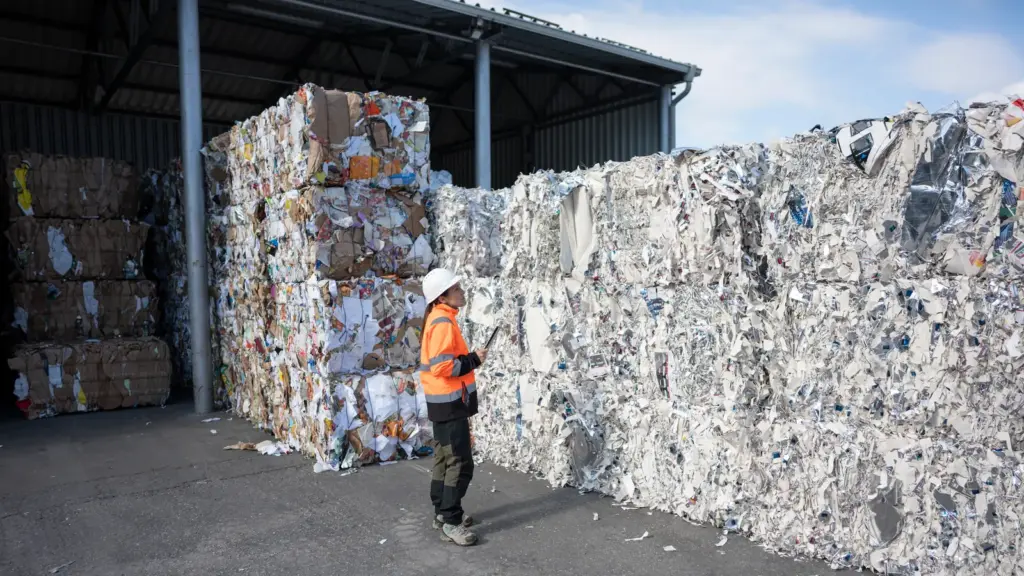
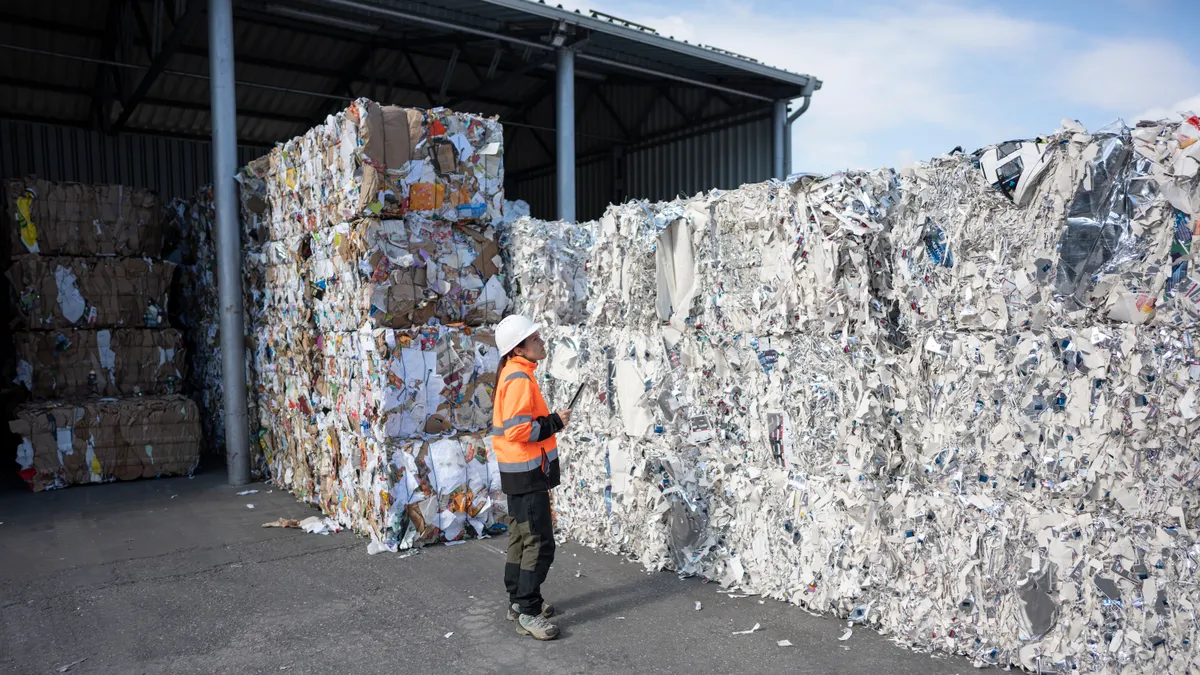
The American manufacturing and recycling sectors navigated a complex economic landscape throughout 2025, marked by production recalibrations, facility closures, and evolving international trade policies. Despite a notable contraction in total U.S. paper and paperboard production—which naturally compressed the absolute volume of recovered paper available in the recycling stream—national paper recycling rates held remarkably steady.
According to data released by the American Forest & Paper Association (AF&PA), this stability highlights the structural resilience of the domestic fiber recycling ecosystem. While containerboard manufacturers engaged in strategic capacity adjustments that resulted in facility closures and a nearly 10% reduction in total annual operating capacity, the underlying recovery mechanisms functioned with high efficiency.
At the same time, the industry faced shifting macroeconomic headwinds. The U.S. recycling sector managed a rebound in export volumes—which ticked upward to 29% in 2025 compared to 27% the previous year—while closely monitoring brewing trade tensions, notably the cross-border friction between the United States and Canada. This comprehensive report explores the multifaceted dynamics of the 2025 paper and paperboard recycling sector, analyzing how industry leaders, mills, and policymakers are adapting to a changing industrial climate.
Detailed Chronology: The 2025 Paper and Packaging Landscape
Q1–Q2 2025: Production Cuts and Capacity Realignment
The seeds of the 2025 recycling trends were planted long before the calendar turned, driven by a post-pandemic inventory correction and softening consumer demand that forced containerboard manufacturers to reassess their footprint. Throughout the opening quarters of 2025, major packaging producers announced sweeping facility rationalization programs.
These operational strategies culminated in a nearly 10% pullback in aggregate production capacity across the United States. Older, less efficient mills were decommissioned or idled, and production lines were streamlined to match real-world demand.
For the recycling sector, these structural adjustments meant a direct reduction in the generation of old corrugated containers (OCC) and other recovered paper grades. When primary production drops, the amount of generated scrap and post-consumer material entering the collection stream inevitably contracts. Industry analysts initially feared that this drop in raw material availability would destabilize sorting facilities and trigger volatility in recycling markets. However, collection infrastructure demonstrated unexpected flexibility.
Q3 2025: Mid-Year Stabilization and Operating Efficiency
By the middle of 2025, the U.S. paper industry began to find a new equilibrium. AF&PA tracking revealed that while absolute production volumes were lower, the operating rates of the remaining active mills actually climbed. Total paper and paperboard operating rates increased to 89.4% in 2025, up from 88.1% in 2024.
This improvement in capacity utilization meant that operating mills were running more efficiently and demanding a steady, reliable stream of recycled fiber. The drop in raw material supply was counterbalanced by optimized mill processing, ensuring that available recovered paper was absorbed quickly and effectively. Concurrently, export markets began to show signs of life. Following a multi-year slump driven by reduced demand from Asian markets—which had forced exports down to 27% in 2024—overseas shipments rebounded slightly, capturing 29% of the total recycled paper pool in 2025.
Late 2025: Emerging Trade Tensions and Policy Focus
As the year drew to a close, the industry’s attention shifted away from routine supply-demand balancing and toward macroeconomic and geopolitical pressures. The most prominent looming challenge was the escalating U.S.-Canada trade dispute. Given the deeply integrated nature of the North American forestry, pulp, and paper supply chains—where raw materials, semi-finished goods, and finished packaging cross the border continuously—the threat of tariffs created an undercurrent of uncertainty.
Industry leadership pivoted toward proactive engagement with federal policymakers, emphasizing the need to protect supply chains while continuing multi-million-dollar investments in modern domestic recycling infrastructure.
Supporting Context & Metrics: Dissecting the 2025 Data
To fully appreciate the significance of the 2025 recycling performance, one must examine the quantitative metrics provided by industry watchdogs and trade organizations.
Capacity Retraction vs. Recovery Rates
The nearly 10% capacity reduction implemented by containerboard producers in 2025 was one of the most aggressive supply-side contractions in recent memory. Historically, such steep drops in virgin and recycled paper production led to severe disruptions in recycling collection economics, as municipal programs struggled with depressed commodity values.
However, the 2025 data proved that the domestic system has matured. Key metrics tell the story:
Total Operating Rates: Rose to 89.4% in 2025, compared to 88.1% in 2024.
Export Share: Increased from 27% of total recovered paper in 2024 to 29% in 2025.
System Stability: Overall recycling rates remained within established historical percentage ranges, defying predictions of a steep decline.
The Evolution of Recycling Rate Methodologies
Understanding these metrics requires looking at how the industry measures success. A few years ago, the AF&PA faced intense scrutiny regarding its traditional recycling rate calculations. Critics and industry observers questioned whether single-digit precision metrics were overly optimistic or failed to account for complex, shifting global trade flows.
In response to this controversy, the AF&PA overhauled its reporting methodology. In 2023, the association introduced an “effective recycling rate” alongside traditional measurements. By 2024, the association transitioned entirely to a percentage range approach rather than exact point estimates. This methodological shift provided a more transparent, resilient framework that accounts for the fluid nature of international commodity markets without sacrificing data integrity. The 2025 figures, reported within this modern framework, confirm that the system is performing predictably within its calculated bounds.
Official Statements and Industry Insights
Industry leaders have been vocal about what these 2025 figures mean for the broader packaging and recycling sectors. Rather than viewing the production declines as a sign of weakness, experts emphasize that the data underscores structural adaptability.
Abigail Sztein, Executive Director of Recovered Fiber at the American Forest & Paper Association, offered critical perspective on the numbers:
"Containerboard capacity adjustments demonstrate the industry adapting to shifting global market and operational strategies," Sztein noted. "Our industry shows continued resilience. The paper industry operates at a significant scale, and it’s adapting to changing market conditions. The rate shows that the paper recycling system is functioning as designed, and the system held steady."
Addressing the interplay between domestic operations and international trade, Sztein pointed out that trade flows remain a core component of the association’s economic modeling:
"We can’t really speculate or predict future outcomes, but AF&PA is committed to engaging with the administration and ensuring we can continue to invest in modernizing and expanding domestic mills," she stated.
These statements reflect a broader strategic consensus: while individual facilities may open or close in response to short-term market corrections, the fundamental architecture of paper and paperboard recycling in the United States remains robust, backed by ongoing capital investments in domestic processing technology.
Future Outlook: Challenges and Opportunities Ahead
Looking beyond 2025, the U.S. paper and paperboard recycling sector stands at a critical crossroads. While the industry successfully weathered a year of capacity reductions and fluctuating export demands, several emerging trends will shape its trajectory in the years to come.
1. The North American Trade Equation
The unfolding U.S.-Canada trade dynamics represent a primary wild card for the fiber sector. Because the North American paper industry relies heavily on cross-border logistics—moving pulp, recycled fiber, and finished packaging back and forth across the northern border—any imposition of broad tariffs could introduce significant cost pressures. AF&PA’s ongoing engagement with federal officials will be vital in safeguarding these supply chains and preventing unnecessary regulatory friction.
2. Continued Capital Investment in Domestic Mills
To reduce vulnerability to international trade shocks and shifting foreign demand (such as the historical declines in Asian markets), the U.S. industry continues to pour capital into domestic modernization. Upgrading mill infrastructure allows domestic facilities to process a wider variety of mixed paper and lower-grade fiber streams. These investments ensure that even if export markets contract, domestic end-markets remain strong enough to absorb high volumes of recycled material.
3. Evolving Consumer and Regulatory Pressures
Municipalities and state governments are implementing increasingly stringent recycling mandates and extended producer responsibility (EPR) laws. As these regulations take effect across various states, paper and packaging producers will face heightened accountability for end-of-life recovery. The proven resilience of the paper recycling system in 2025 provides a strong foundation, but mills and material recovery facilities (MRFs) must continue to innovate to meet rising expectations for circularity.
Conclusion
The 2025 performance of the U.S. paper recycling sector serves as a testament to industrial adaptability. Despite a significant 10% contraction in containerboard production capacity and ongoing shifts in global trade, recycling rates held firm. Through strategic operational efficiencies, modernized calculation methodologies, and proactive advocacy against looming trade barriers, the paper industry has demonstrated that its recycling infrastructure is not only surviving economic headwinds—it is built to last.