Executive Overview
Deep within the emerald-green expanses of Liberia’s Grand Gedeh county, a profound ecological and economic transformation is quietly unfolding. Once defined by ancient, unbroken primary rainforests—which famously covered nearly 99% of the county prior to 2020—the region has increasingly given way to the systematic clearing of land for cocoa cultivation. This agricultural pivot has driven a striking 30% surge in Liberian cocoa exports to the European Union over a two-year period, with the bloc importing upwards of 17,000 metric tons in 2024 alone.
However, this surging trade is now barreling toward a monumental regulatory wall. The European Union, Liberia’s largest market for cocoa, is preparing to strictly enforce the EU Deforestation Regulation (EUDR). This sweeping piece of legislation bans the import of forest-risk commodities—including cocoa, timber, and coffee—produced on land deforested after December 31, 2020.
Because the vast majority of forest loss and cocoa expansion in Grand Gedeh has accelerated precisely after this 2020 threshold, a massive collision between local livelihoods and international environmental policy is imminent. Liberia lacks the advanced national traceability infrastructure seen in neighboring cocoa powerhouses like Côte d’Ivoire and Ghana, leaving its rural farmers, middlemen, and exporters dangerously unprepared. As policymakers in Brussels defend the strict cut-off dates as a non-negotiable safeguard for the planet’s remaining lungs, local agricultural communities face an uncertain future where their primary source of income threatens to be locked out of its most lucrative global market.
Detailed Chronology: The Rise of Liberia’s Cocoa Frontier
To understand the gravity of the current crisis, one must trace the rapid timeline of environmental and agricultural shifts that have taken place in southeastern Liberia over the past decade.
Pre-2020: The Untouched Wilderness
For generations, Grand Gedeh county stood as a testament to West Africa’s rich, biodiverse natural heritage. Up until 2020, satellite data and environmental assessments indicated that an astonishing 99% of the county’s total landmass remained cloaked in dense, primary forest cover. While neighboring nations like Côte d’Ivoire and Ghana saw their massive forest reserves systematically decimated by decades of unmonitored cocoa farming, Liberia’s forests remained largely insulated, preserved by a combination of historical conflict, relative geographic isolation, and delayed integration into the global agro-commodity market.
Post-2020: The Post-Pandemic Clearing Wave
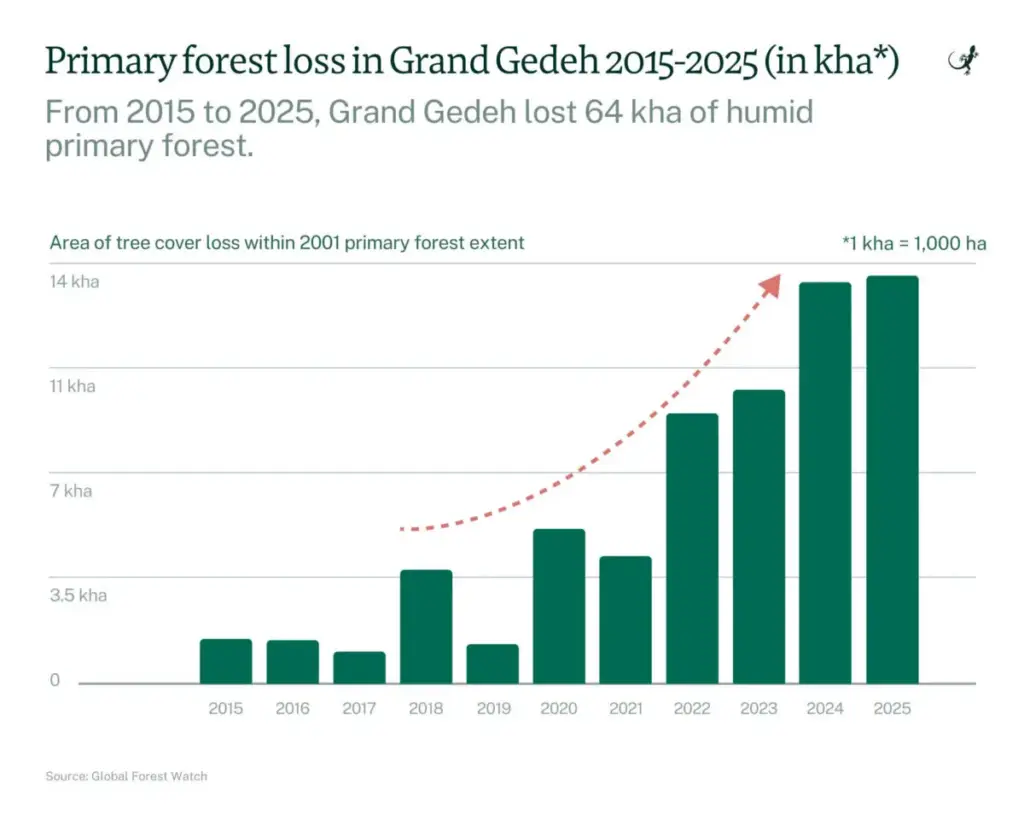
The turning point arrived concurrently with global economic shifts following 2020. Driven by rising international demand, fluctuating commodity prices, and a desperate search for rural income, clearing rates in Grand Gedeh soared. Smallholders, local syndicates, and commercial interests began carving deep into the previously untouched jungle.
Crucially, this rapid clearing bypassed traditional agricultural zones. Plantations began pushing deep into the forest interior, encroaching upon communally owned lands, privately leased tracts, and even ecologically sensitive zones such as the proposed Kwa National Park area, where commercial agriculture is strictly prohibited by law.
The 2024 Export Peak
By 2024, the localized rush to clear land manifested tangibly in global trade statistics. The European Union absorbed more than 17,000 metric tons of raw cocoa from Liberia—a staggering 30% increase compared to volumes recorded just two years prior. Yet, beneath the celebratory metrics of economic growth lay an inconvenient truth: a vast proportion of these surging bean yields were being harvested from trees planted on recently cleared forest soils, setting the stage for regulatory rejection.
Supporting Context & Metrics: The Traceability Deficit and the EUDR Trap
The core dilemma facing Liberian cocoa is not merely ecological; it is logistical, bureaucratic, and structural. The EU Deforestation Regulation demands unprecedented transparency from supply chains, requiring European importers to collect precise geolocation data (polygon mapping) for every individual plot of land where their imported commodities were grown, alongside verifiable proof that the land was not deforested after December 31, 2020.

The Traceability Gap
Meeting these stringent criteria is an extraordinary logistical undertaking. Major West African producers have spent years attempting to comply. Côte d’Ivoire and Ghana—which together account for a massive share of the global cocoa supply—have spent years investing heavily in national traceability architectures, farmer registries, and polygon-mapping campaigns.
Liberia, by contrast, is severely lagging behind. According to Owen Gibbons, senior manager for global advocacy and UK public affairs at the Rainforest Alliance:
"Liberia is at a very early stage on all these fronts. There is no national traceability infrastructure comparable to what exists in Côte d’Ivoire or Ghana."
While the Liberian government has recently initiated preliminary steps to build an agricultural commodity traceability system, the initiative is in its infancy. Local cooperatives and middlemen lack the digital tools, satellite mapping training, and administrative capacity to trace beans from remote forest clearings in Grand Gedeh all the way to container ships docked in Monrovia.
The Decisive Cut-Off Date
Even if Liberia miraculously fast-tracked a nationwide traceability system over the next several months, the fundamental geography of its recent agricultural expansion presents an insurmountable barrier. Because the majority of Grand Gedeh’s forest loss and subsequent cocoa planting occurred after December 31, 2020, successful tracing will actually work against the farmers.
As Owen Gibbons starkly noted:
"If cocoa from Liberia was produced on land cleared after that EUDR cutoff date, it would fail on deforestation grounds."
In essence, proving where the cocoa came from will automatically confirm that it violates the EU’s environmental timeline, guaranteeing its rejection at European ports.
Official Statements and Local Perspectives
The clash between international environmental imperatives and local economic survival has created a profound disconnect between Brussels policymakers and the rural laborers of Grand Gedeh.

The Ground-Level Reality: Lincoln Daslah
On the ground, the very people driving the trade pipeline remain largely unaware of the seismic regulatory shifts happening across the ocean. Lincoln Daslah serves as the secretary of a local cocoa-buying collective, acting as a critical middleman who bridges isolated producers deep within Grand Gedeh and major exporters operating out of the capital city of Monrovia.
When informed about the impending enforcement of the EUDR and its potential to halt the country’s multi-million-dollar trade, Daslah expressed a mixture of resignation and frustration. While acknowledging that the local landscape is visibly changing and that the forests are disappearing, Daslah questioned the fairness and logic of European lawmakers seeking to penalize rural livelihoods thousands of miles away: he failed to understand why authorities in the EU would intentionally implement policies that effectively criminalize and devastate his business and the families relying on it for daily survival.
The European Perspective: Delara Burkhardt
Conversely, European lawmakers maintain that the regulations are non-negotiable tools required to halt global climate change and biodiversity collapse. Delara Burkhardt, a German Member of the European Parliament, acknowledged the difficult human element of the transition while standing firm on the absolute necessity of ecological accountability.
"I understand the frustration of farmers in Liberia that just started production in that sense and aren’t ready," Burkhardt stated. "I think still in the long term we have to make sure that sustainable practices are supported, and clear-cutting forests is something that breaches the law."
For EU legislators, exemptions or grace periods for newly emergent frontier zones like Grand Gedeh would undermine the foundational integrity of the Green Deal, creating loopholes that could drive global deforestation elsewhere.
Future Outlook: What Lies Ahead for Liberia’s Green Economy?
As the deadline for EUDR enforcement draws nearer, Liberia stands at a critical historical crossroads. The path forward is fraught with intense economic peril, yet it also forces a long-overdue reckoning regarding how the nation manages its remaining natural assets.
- Economic Vulnerability: If European markets close their doors to Liberian cocoa due to compliance failures, thousands of smallholder farmers and supply-chain intermediaries like Lincoln Daslah risk absolute financial ruin. Finding alternative international buyers who do not enforce similar anti-deforestation laws will be difficult, and such markets typically offer significantly lower profit margins.
- The Threat to Protected Areas: Without alternative economic incentives, desperate farmers may continue to push deeper into fragile ecosystems—such as the proposed Kwa National Park—in a race to maximize short-term yields before complete regulatory lock-out occurs. This risks turning Grand Gedeh into a cautionary tale of resource degradation.
- The Urgent Need for Institutional Support: To salvage what remains of its sustainable agricultural sector, Liberia desperately requires international technical and financial assistance. Partnerships with organizations like the Rainforest Alliance, alongside direct aid from the European Union, must focus immediately on building robust digital traceability frameworks, mapping existing agricultural plots, and shifting local farmers away from slash-and-burn expansion toward regenerative, climate-smart agroforestry.
Ultimately, the vanishing forests of Liberia’s cocoa frontier serve as a glaring microcosm of a global dilemma: balancing the urgent, localized human right to economic development with the planetary imperative to preserve the Earth’s final green frontiers. Unless a concerted, well-funded intervention takes place immediately, the trees of Grand Gedeh—and the livelihoods built upon them—may become casualties of a changing global economy.