Deep beneath the concrete grid of New York City, a quiet public health emergency plays out every summer. As global temperatures shatter historical records—cemented by a string of blistering summers that have made extreme heat the leading weather-related killer in the United States—the city’s sprawling, subterranean rail network is mutating into a sprawling heat trap.
While everyday commuters maintain a hardened, time-tested stoicism, brushing off the stifling environment as an inevitable tax of urban living, a growing body of scientific research and grassroots activism reveals a starkly different reality. The New York City subway, built more than a century ago for a vastly different climatic era, is overheating at a rate that far outpaces aboveground conditions. Station platforms routinely morph into underground saunas, with heat indices soaring past 130°F (55°C)—thresholds where heatstroke ceases to be a distant risk and becomes an imminent danger.
This crisis has catalyzed an unlikely coalition of guerrilla data collectors, academic researchers, transit labor unions, and municipal leaders. Among them is Jack Klein, a 31-year-old construction site manager who has taken it upon himself to track the subterranean misery using magnetic thermometers and social media documentation. His efforts mirror a broader institutional reckoning.
Recognizing that the status quo is both dangerous and unsustainable, city and state officials—including Mayor Zohran Mamdani, MTA Chief Executive Janno Lieber, and Governor Kathy Hochul—have unveiled an ambitious, first-of-its-kind initiative: a study to deploy thermal energy networks. By capturing ambient station heat and pumping it deep into the earth to warm municipal buildings during winter, New York hopes to engineer a resilient, circular solution to a problem that threatens the future of urban mass transit.
Detailed Chronology: The Summer of Subterranean Extremes
Mapping the Hades-Like Platforms
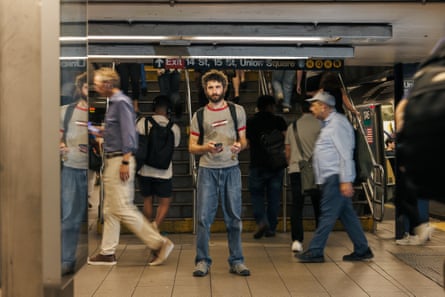
The genesis of the current public awareness campaign began not in municipal boardrooms, but on the platforms of Manhattan’s deepest and busiest transit hubs. Over the past two years, Jack Klein—an Ohio transplant unaccustomed to the grueling normalization of underground heat—embarked on a self-assigned mission as a guerrilla subway heat operative.
Armed with teardrop-shaped magnetized thermometers, Klein began adhering monitors directly to the steel structural beams of seven of Manhattan’s notoriously sweltering subway stations. His findings, broadcasted widely across social media channels, revealed temperatures that defied casual acceptance.
On a searing August afternoon at the 14th Street-Union Square 4/5 line platform, Klein watched in real-time as his mobile device logged platform temperatures of 99°F (37°C)—a full 10°F (5.5°C) hotter than the street level above. Factoring in New York’s notorious humidity, the calculated heat index climbed to a staggering 116°F (46°C). Moments later, as trains idled and crowds compressed, the digital readouts breached 101°F (38°C), sending the heat index soaring to a delirious 132°F (55°C).
From Data Collection to Direct Action
As transit police officers shifted uneasily in heavy, bulletproof vests and international tourists fanned themselves with subway maps, Klein realized that passive data collection was no longer enough. Many of his magnetized sensors had vanished—either scraped off by maintenance crews or jarred loose by constant vibrations.
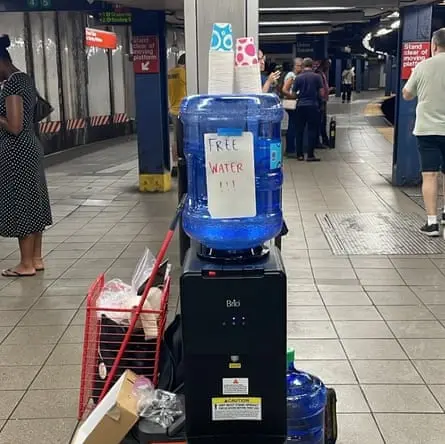
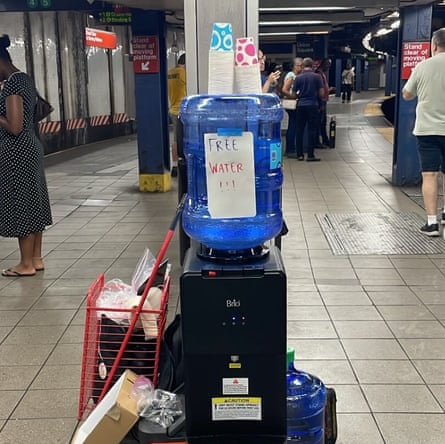
Pivoting his approach, Klein shifted from tracking the heat to actively mitigating it. He began hauling heavy water coolers down subway stairs, offering free cold hydration to parched commuters and exhausted transit workers alike. In a striking statement of artistic and social commentary, Klein also designed a literal wooden sauna to be erected directly on the 14th Street-Union Square platform—a provocative stunt meant to shock native New Yorkers out of their institutionalized complacency.
"I didn’t grow up as a kid riding this, so I have a different, outsider perspective," Klein reflects. "A lot of people just say ‘suck it up.’ I get that. But I still see this as a public health issue. It really is like a sauna."
Supporting Context & Metrics: The Anatomy of an Underground Oven
To understand why the New York City subway behaves like an industrial kiln, urban climatologists and environmental engineers point to a convergence of century-old architecture, mechanical physics, and accelerating global climate change.
The Physics of a Subterranean Heat Trap
Built primarily at the turn of the 20th century, the foundational architecture of the New York subway system was never engineered to dissipate the colossal thermal loads of modern urban life. Stations act as thermal accumulators, soaking up heat in massive subterranean deposits of concrete, brick, and steel during the summer months and slowly radiating that energy back into the environment.
The heat is continuously regenerated and compounded by several mechanical sources:
Braking and Propulsion: As heavy steel trains decelerate into stations, their braking systems release immense kinetic energy converted directly into heat.
The Air-Conditioning Paradox: While modern subway cars are fully air-conditioned (a standard achieved fully by 1993), the units function by drawing heat out of the passenger cabins and aggressively dumping it directly onto the open station platforms.
Human Metabolism: During peak commuting hours, millions of bodies packed tightly onto platforms contribute a baseline of roughly 100 watts of thermal energy per person.
Piston Ventilation Limits: The system relies heavily on a "piston effect," where moving trains push hot air upward through street-level ventilation grates while pulling cooler air down. However, this crude ventilation is completely overwhelmed during prolonged heatwaves.
Academic Findings and Public Health Warnings
Scientific research underscores the severity of the crisis. Giorgia Chinazzo, an environmental engineer at Northwestern University whose research focuses on urban microclimates, notes that underground spaces are overheating at rates significantly higher than surface-level environments.
"The underground is overheating more than aboveground, which is creating these extreme temperatures," Chinazzo explains. "This summer is a clear sign that we are facing a climate crisis and our built environment isn’t designed for it. In older systems like in London and New York, the metro systems just can’t deal with this."
Coupled with research from Alessandro Rotta Loria and institutions tracking urban mortality, the data is unequivocal: heat is no longer just an uncomfortable inconvenience; it is a lethal occupational and public health hazard. Transit union representatives, such as those from TWU Local 100, have repeatedly warned that maintenance workers, cleaners, and station agents forced to toil for hours in these environments face genuine risks of heat exhaustion and heatstroke.
Official Statements: Confronting the "Chamber of Horrors"
Faced with mounting public pressure and viral documentation of platform temperatures, municipal and transit authorities have begun acknowledging the gravity of the situation with unprecedented candor.
The MTA’s Structural Dilemma
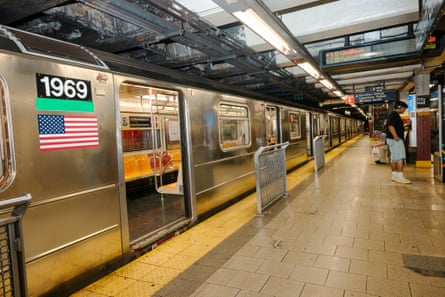
Janno Lieber, chief executive of the Metropolitan Transportation Authority (MTA), has been frank about the structural limitations facing North America’s largest transit network, which spans 472 stations—283 of them underground.
"The subway isn’t a submarine, it’s not an enclosed environment," Lieber said during a joint briefing. "Bringing down the temperature is a complex problem in a system where the stations are 100 years old. We know this is no fun for New Yorkers. It’s brutal underground in the summertime and every year is getting hotter because of climate change."
Because stations are inherently "leaky"—open to the street via stairwells, turnstile areas, and ventilation grates—simply installing commercial air conditioning across hundreds of underground stations is economically and physically unviable.
A Bold Municipal Vision
At a press conference held at the notoriously decrepit Brooklyn Bridge-City Hall and Chambers Street complex—a station Mayor Zohran Mamdani colorfully likened to a "chamber of horrors" and a stage set from the video game Street Fighter II—city leaders unveiled a radical strategic pivot.
"We would be making these stations cool again, and we’d be making what is old new again," Mayor Mamdani declared. "That means lower energy costs, a more resilient subway system and a cleaner energy future for New York City."
Future Outlook: Engineering the Underground Thermal Battery
Rather than attempting to pump chilled air into an open, porous cave system, New York’s newly announced joint city-state study is shifting focus downward, exploring a revolutionary method to extract heat directly from the environment.
How Thermal Energy Networks Work
The proposed solution draws inspiration from ancient geothermal management techniques—echoing the brilliant engineering of Persian yakhchals that kept ice frozen in the desert millennia ago—while scaling them up for 21st-century urban infrastructure.
The mechanism operates as a closed-loop thermal energy network:
Heat Extraction: A network of pipes circulating chilled liquid will be installed behind station walls and beneath platform flooring.
Thermal Absorption: As ambient platform heat radiates outward, the liquid absorbs it, actively pulling thermal energy away from the waiting areas.
Deep Storage: The warmed liquid is then funneled away from the station and pumped deep underground—into storage boreholes drilled up to 600 feet into the earth.
Winter Reutilization: During New York’s freezing winters, this trapped thermal energy can be retrieved and redirected to heat municipal buildings, including City Hall and nearby courthouses.
According to transit engineers, this system could shave platform temperatures down by several degrees—representing the critical threshold between "total misery and merely sweltering," in the words of Janno Lieber.
The Road Ahead: Scale, Cost, and Interim Survival
While the Brooklyn Bridge-City Hall complex pilot study represents a monumental step forward, transit experts emphasize that scaling such infrastructure across the entire subway network will require billions of dollars and decades of intensive construction. It is part of a broader, globally necessary reallocation of capital—amounting to hundreds of billions of dollars annually—required to adapt dense urban environments to a rapidly warming planet.
In the immediate term, as the 4 million daily riders of the New York City subway navigate future summers, interim solutions remain vital. Advocates continue to pressure the MTA to implement systemic measures—such as standardized free drinking water stations akin to airport terminals, modified uniform requirements for transit staff, and increased train frequencies to minimize platform dwell times.
Until the deep-earth thermal batteries are successfully drilled and operational, New York’s underground transit network will remain a fiery crucible of urban resilience—a place where the ingenuity of everyday guerrillas and the ambition of municipal engineers are locked in a race against a changing climate.