A landmark global attribution study published in Science Advances has revealed a striking demographic disparity at the heart of the climate crisis: children under the age of 10 are experiencing significantly higher exposure to climate-change-driven humid heat stress than any other age group on Earth.
According to the research, led by scientists at Vrije Universiteit Brussel, more than 44% of the world’s children under ten—translating to roughly 583 million young people—are already living through at least 20 additional "heat-stress days" every year strictly due to human-induced global warming.
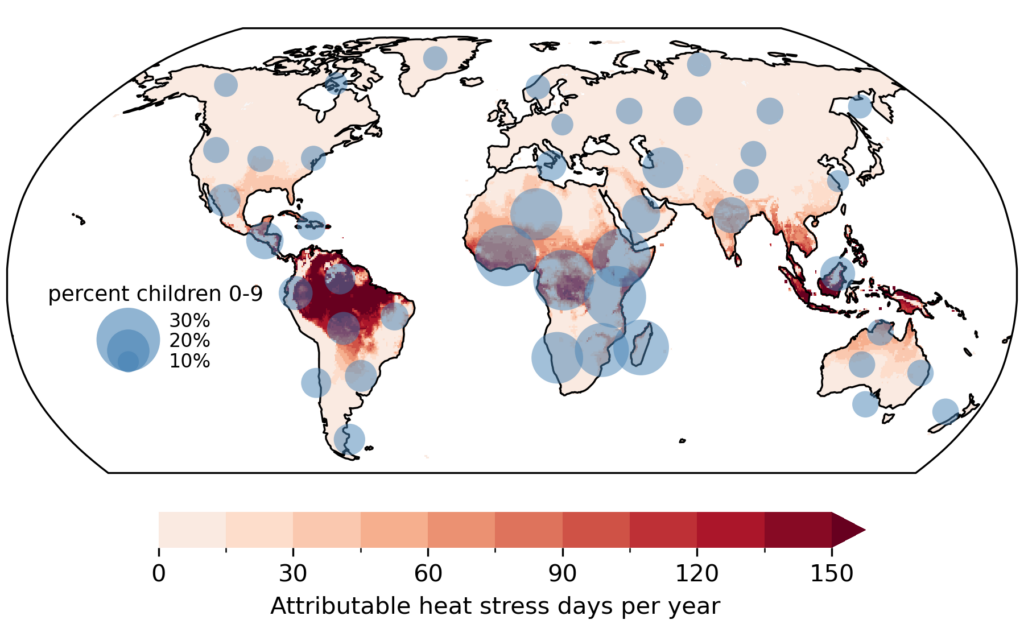
This disproportionate burden is driven by a potent convergence of climate physics and global demography. Low-latitude, tropical regions—most notably across West Africa and South Asia—are experiencing the most intense baseline increases in dangerous humid heat. Simultaneously, these regions possess the planet’s youngest and fastest-growing populations. Consequently, millions of developing-world infants and children who have contributed virtually zero historical greenhouse gas emissions are now stranded on the frontlines of planetary warming.
As global temperatures continue their upward trajectory, researchers warn that this intergenerational exposure gap will widen. The findings urgently challenge existing climate adaptation frameworks, calling for an overhaul of public health metrics, international disaster reporting, and policy discussions surrounding climate justice and intergenerational equity.
Detailed Chronology: The Evolution of Intergenerational Climate Research
The effort to quantify how climate change discriminates across generations has accelerated rapidly over the past five years, moving from broad lifetime projections to granular, real-time demographic maps.
       2021                       2025                       2026
┌─────────────────┐        ┌─────────────────┐        ┌─────────────────┐
│  Initial Study  │───────>│ Follow-up Study │───────>│ Current Study   │
│ Unmatched life- │        │ 62M children    │        │ 583M children   │
│ time extremes   │        │ face extreme    │        │ experience 20+  │
│ for 21st century│        │ heatwaves even  │        │ extra heat days │
│ children.       │        │ at 1.5°C target.│        │ per year now.   │
└─────────────────┘        └─────────────────┘        └─────────────────┘
The 2021 Foundation: Lifetime Extremes
In 2021, a seminal attribution study broke new ground by demonstrating that children born in the 21st century would face vastly more extreme weather events—including heatwaves, wildfires, floods, and crop failures—over their lifespans than their parents or grandparents. This research laid the theoretical groundwork for examining climate impacts through a demographic lens.
The 2025 Refinement: The 2020 Cohort Benchmark
Building upon their early models, the same research collective published updated findings four years later focusing specifically on infants born in 2020. The team determined that over half of this cohort—approximately 62 million children—were locked into experiencing "unprecedented lifetime exposure" to severe heatwaves, even under an optimistic scenario where global warming is capped at 1.5°C above pre-industrial levels.
The 2026 Milestone: Real-Time Humid Heat Mapping
Published in Science Advances (Pietroiusti et al., 2026), the latest investigation shifts the timeline from future projections to present-day reality. Utilizing observational data and climate simulations anchored to a 2023 baseline (representing 1.3°C of human-caused warming), the study captures the immediate, daily lived experience of children today.
This chronology unfolds against a backdrop of escalating real-world climate impacts. The devastating European heatwaves of summer 2026, which resulted in tens of thousands of excess deaths, served as a grim backdrop to the study’s release—underscoring that while extreme heat wreaks lethal havoc in temperate zones, a continuous, underreported crisis of humid heat is quietly unfolding across the equatorial world.
Supporting Context & Metrics: Decoding Humid Heat and Demographic Shifts
Understanding the Wet-Bulb Globe Temperature (WBGT)
To assess thermal stress accurately, the study moves beyond standard dry-bulb air temperature, focusing instead on Wet-Bulb Globe Temperature (WBGT). WBGT incorporates air temperature, relative humidity, wind speed, and solar radiation into a unified index.
The human body relies primarily on the evaporation of sweat to cool its internal core. In environments where high heat coexists with high humidity, moisture cannot easily evaporate from the skin, rendering natural thermoregulation ineffective.
The researchers defined a "heat-stress day" as any 24-hour period where the WBGT exceeds 28°C—the universally recognized threshold for moderate-to-severe physiological heat stress in human populations.
Comparative Attribution Methodology
To isolate the fingerprint of human activity, the research team implemented a multi-step modeling process:
Present-Day Simulation: Climate models simulated global weather patterns under contemporary conditions (anchored to 2023 levels at ~1.3°C warming).
Pre-Industrial Simulation: Parallel climate models simulated an alternative world featuring zero human-caused greenhouse gas emissions.
Attributable Heat-Stress Calculation: By subtracting the pre-industrial baseline from present-day results, the authors calculated the exact number of "extra" or "attributable" heat-stress days generated specifically by industrial emissions.
Demographic Integration: High-resolution population datasets from the Inter-Sectoral Impact Model Intercomparison Project (ISIMIP) and the Wittgenstein Centre were overlaid onto climate grids to categorize exposure by precise age brackets.
Geographical Disparities: Tropics vs. Mid-Latitudes
The data reveals an immense geographical divide in climate-driven heat stress. Low-latitude tropical nations endure far more attributable heat-stress days than temperate northern nations.
Country / Region
Average Annual Attributable Heat-Stress Days
Primary Drivers & Demographic Context
Côte d’Ivoire
~56 days(out of 112 total heat-stress days)
Tropical baseline; high humidity; ~50% of stress days directly caused by anthropogenic climate change.
High population density; major youth cohort; extreme seasonal humidity during monsoon transitions.
Germany
0.1 days
Mid-latitude climate; humid heat thresholds >28°C WBGT are rarely crossed in average annual grids.
Demographic Convergence and Cohort Metrics
The primary reason children face greater exposure than older demographics comes down to global demographic structure:
Global Cohort Size: Worldwide, there are approximately 1.3 billion children under the age of 10, compared to 600 million adults aged 60–69.
Spatial Alignment: The global youth population is concentrated overwhelmingly in Sub-Saharan Africa and South Asia. Conversely, older populations are concentrated heavily in northern, cooler mid-latitude nations (such as Europe, East Asia, and North America).
Demographic Distribution vs. Heat Stress Exposure (Present Day)

Children (<10 years)
[█████████████████████████████████████████████] 44% exposed to 20+ extra heat days (583M)

Older Adults (60-69 years)
[██████████████████████──────] 30% exposed to 20+ extra heat days (190M)
Future Trajectories Under 1.5°C and 2.0°C Warming
Using the Shared Socioeconomic Pathway 2 (SSP2)—which projects global population peaking above 9 billion with sustained growth in sub-Saharan Africa—the authors modeled exposure levels under future global warming targets:
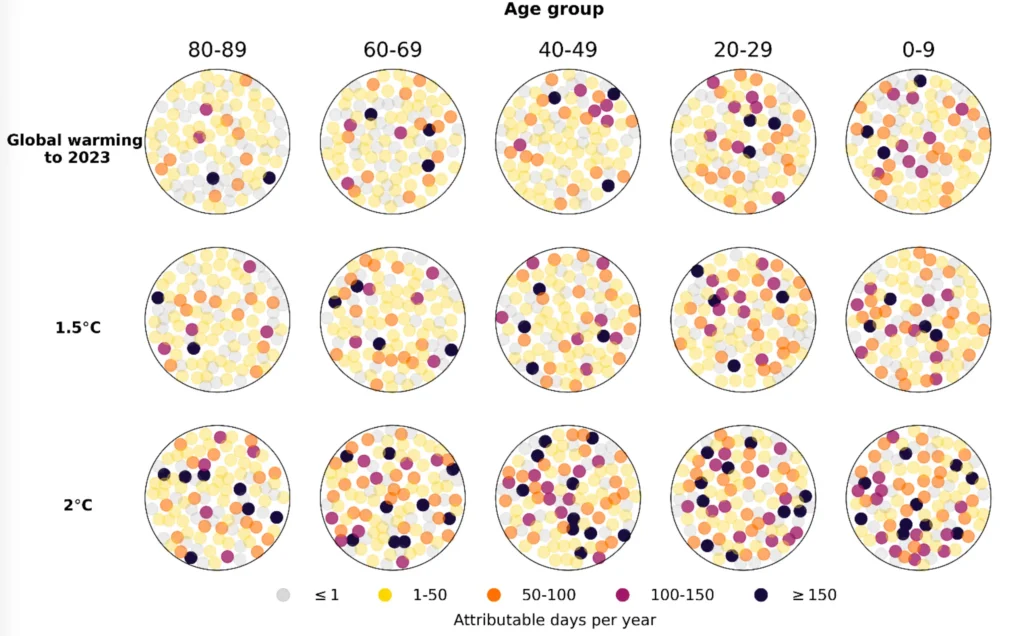
Present Day (1.3°C): 11% of all children under 10 endure 100 or more attributable heat-stress days annually. For adults aged 60–69, this metric stands at 6%.
1.5°C World: 13% of under-10s will face 100+ attributable heat-stress days per year (compared to 9% of adults aged 60–69).
2.0°C World: 23% of under-10s will face 100+ attributable heat-stress days per year (compared to 17% of adults aged 60–69).
Official Statements & Expert Commentary: Nuances, Vulnerabilities, and Gaps
The study has sparked vital discussion within the scientific, public health, and climate policy communities. Key researchers involved in the work—alongside independent external experts—have offered critical commentary regarding the implications and limitations of the findings.
Lead Author on Climate Justice and Metrics
Rosa Pietroiusti, PhD researcher at Vrije Universiteit Brussel and lead author of the study, emphasized the profound moral implications of the team’s empirical findings when speaking to Carbon Brief:
"Children in developing countries have contributed the least to historical greenhouse gas emissions, yet they are bearing the heaviest burden of climate-driven humid heat… Studies like this, which start directly from climate data, can begin to fill major reporting gaps in global disaster tracking."
Addressing the technical limitations of standard meteorological indicators, Pietroiusti noted that while Wet-Bulb Globe Temperature is a robust standard, it was not engineered specifically to assess pediatric physiological vulnerabilities:
"A really important step forward in the research community would be to link up climate science and health science experts to do research on what metrics are really most representative of, for example, health impacts and educational impacts that children will be suffering."
She also highlighted that the study’s spatial grid resolution could not fully capture local microclimates:
"Our data doesn’t capture the urban heat island effect, due to the resolution of the data we use, which would lead to underestimations of heat stress locally, and lead to a mismatch with what people are experiencing at local scales, particularly in cities."
Independent Expert Analysis: Demographic Nuance vs. Social Vulnerability
Dr. Qinqin Kong, a postdoctoral researcher in medicine and health policy at Stanford University who was not involved in the study, praised the paper’s methodology while offering an important counterweight regarding older demographics:
"The study provides timely quantitative evidence for discussions of climate justice, children’s rights, and intergenerational equity. However, it may overstate the contrast between children and the elderly and underestimate the relative burden of older adults.
"The elderly may also be more vulnerable due to their social circumstances. Children often benefit from parental supervision and caregiving, whereas many older adults live alone, have limited mobility, and face barriers to accessing cooling or emergency assistance during heat events."
Dr. Kong further noted that absolute exposure to high WBGT does not automatically translate directly to mortality risk, pointing to mid-latitude acclimatization gaps:
"People and societies in mid-latitudes are less adapted to heat. Europe shows substantially stronger relative risk of heat mortality likely due to less heat-acclimatised populations, lower air conditioning prevalence, and urban designs that don’t favour heat dissipation."
Physiology and Acclimatization
Dr. Daniel Vecellio, a heat resilience researcher at the University of Nebraska who was also unaffiliated with the study, identified both vulnerabilities and adaptive capacities within pediatric cohorts:
"Children remain an understudied cohort in climate science. However, there is reason for hope because children are typically pretty good behavioural adapters to extreme heat, and people who are chronically exposed to extreme heat will have a better chance at better acclimatisation over time."
The Information Gap in Global Disaster Databases
A critical issue raised by the study is the structural bias present in global disaster recording systems, such as the International Disaster Database (EM-DAT). Historically, heatwaves across sub-Saharan Africa and parts of South Asia are rarely recorded due to a lack of formal local health reporting and media coverage. The climate-modeling approach of Pietroiusti et al. bypassed these observational blind spots, revealing a massive, previously invisible landscape of heat exposure in low-income nations.
Future Outlook & Strategic Imperatives
The findings of this research present urgent directives for international policymakers, public health authorities, and climate negotiators.
┌────────────────────────────────────────────────────────────────────────┐
│                     Strategic Action Roadmap                           │
├────────────────────────────────────────────────────────────────────────┤
│ 1. Child-Centric Climate Metrics                                       │
│    Formulate pediatric WBGT standards measuring health & learning loss │
├────────────────────────────────────────────────────────────────────────┤
│ 2. Targeted Adaptation Funding                                         │
│    Direct Loss & Damage capital to tropical pediatric health systems   │
├────────────────────────────────────────────────────────────────────────┤
│ 3. Infrastructure Adaptation                                           │
│    Passive cooling for schools and healthcare facilities in Sub-Africa │
└────────────────────────────────────────────────────────────────────────┘
1. Re-engineering Heat Stress Metrics for Children
Future public health interventions must move beyond generic adult thermal thresholds. Children possess higher surface-area-to-mass ratios, underdeveloped sweating mechanisms, and different behavioral patterns than adults. Interdisciplinary initiatives combining climate science, epidemiology, and pediatrics are urgently required to formulate child-specific heat risk indexes that capture risks to physical development, cognitive performance, and school attendance.
2. Operationalizing Climate Justice and Loss & Damage
The clear empirical proof that 583 million young children in low-emitting nations are experiencing dozens of extra heat-stress days per year provides strong scientific backing for Loss and Damage claims under UN climate frameworks. International funding mechanisms must prioritize climate adaptation capital—such as off-grid solar cooling for schools, shaded urban play zones, and community heat-health warning systems—toward high-exposure tropical developing nations.
3. Mitigating the Urban Heat Island Effect
As urbanization accelerates across West Africa and South Asia, city planners must confront the urban heat island effect, which amplifies baseline WBGT levels beyond regional macro-models. Retrofitting dense urban settlements with reflective roofing materials, expanding green canopy coverage, and guaranteeing access to clean drinking water will be essential to protect young populations from compounding heat stress.
Conclusion
The research by Pietroiusti et al. makes it clear that climate change is not a distant threat for future generations—it is actively altering the childhoods of over half a billion young people today. Without rapid reductions in global greenhouse gas emissions coupled with targeted adaptation investments in the Global South, millions of children will spend an ever-increasing portion of their developmental years struggling against dangerous thermal environments they played no part in creating.