

Executive Overview
India’s monumental strides in wildlife conservation over the past half-century represent one of the most successful species recovery programs in modern history. From a precarious low of less than 1,900 individuals in the 1970s, the nation’s wild tiger population has rebounded dramatically, reaching an estimated 3,682 according to the 2022 national census. Today, India harbors nearly 75% of the world’s wild tigers, distributed across 58 designated reserves.
Yet, this remarkable ecological triumph has triggered an unforeseen, complex crisis: a sharp escalation in human-wildlife conflict. As core protected areas reach and sometimes exceed their biological carrying capacities, apex predators are increasingly spilling over into shared, human-dominated landscapes. Young tigers seeking territories, alongside older or injured cats struggling to secure natural prey, are venturing into agricultural fields and village peripheries.

The consequences for rural communities living on the forest fringes of states like Karnataka, Madhya Pradesh, and Maharashtra have been devastating. Fatal encounters, severe maulings, and the permanent incapacitation of local breadwinners have sparked intense fear, community protests, and urgent debates over wildlife management protocols. As conservationists, policymakers, and local residents grapple with this shifting paradigm, the central question for India’s next phase of conservation is no longer just how to save the tiger, but how humans and big cats can safely coexist across rapidly shrinking shared spaces.
Detailed Chronology: Encounters on the Forest Edge
The human cost of India’s growing tiger population is acutely visible in the villages bordering the Bandipur and Nagarhole Tiger Reserves in the southern Indian state of Karnataka. Here, the boundary between wilderness and civilization has blurred, leading to a harrowing sequence of events in late 2025.

The Attack on Mahadeva Gowda
In mid-October 2025, 45-year-old Mahadeva Gowda was tending to his cotton farm in Badagalapura village, situated on the edge of the forest department’s designated "tiger landscape." Unbeknownst to Gowda—who was unaware that forest authorities were actively tracking a tiger roaming the vicinity—the apex predator lunged from behind.
Before he could react, the tiger swiped viciously at his face. Despite undergoing multiple reconstructive surgeries, Gowda was left permanently blinded, his eyes destroyed, his mouth capable of only partial movement, and his speech severely slurred. His wife, Indrani, highlights the stark reality of rural survival: as the household’s primary breadwinner, Gowda can no longer work, rendering him entirely dependent on family members for his most basic daily needs.

Escalating Fatalities
The terror in Badagalapura was not an isolated incident. Just two weeks after Gowda’s attack, another tragedy struck nearby agricultural lands. Fifty-five-year-old Rajashekarappa was grazing his cattle in a field when he encountered a tiger; the ensuing attack proved fatal.
Subsequent weeks brought further devastation. Rukmini, a resident of Hale Heggudilu village and the wife of Chowda Naika, was killed by a tiger while working in a local maize field. This cluster of fatal encounters sent shockwaves through Mysuru district, sparking massive public demonstrations. Farmers and residents staged protests in front of the Mysuru Deputy Commissioner’s office, demanding immediate intervention, the suspension of local safari and trekking activities in Nagarhole and Bandipur, and stricter legal action against unauthorized resorts encroaching upon wildlife corridors.

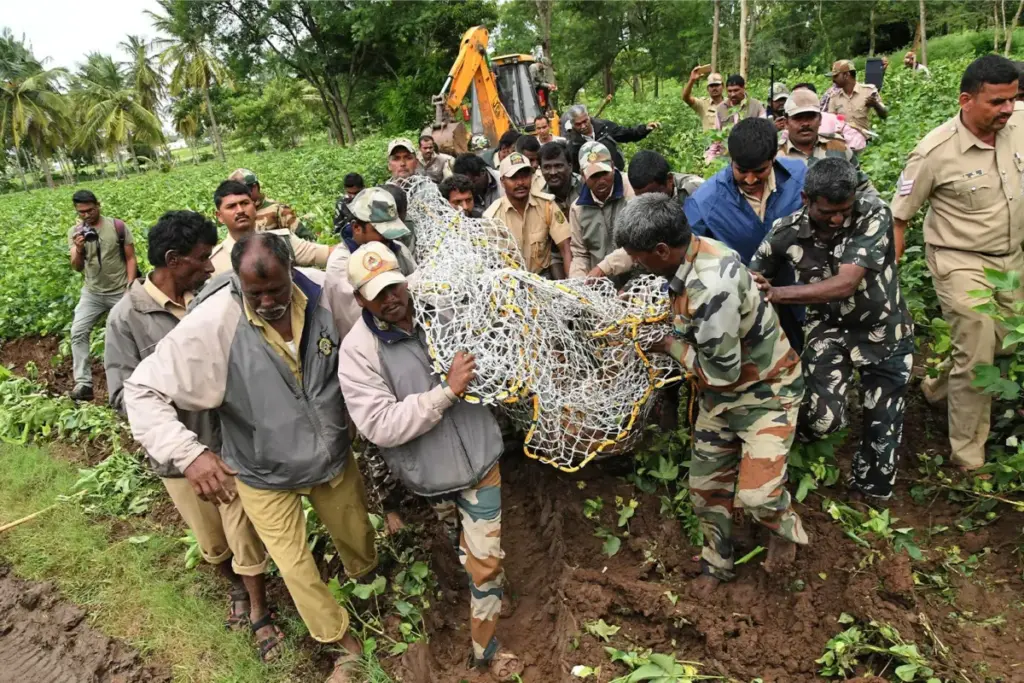
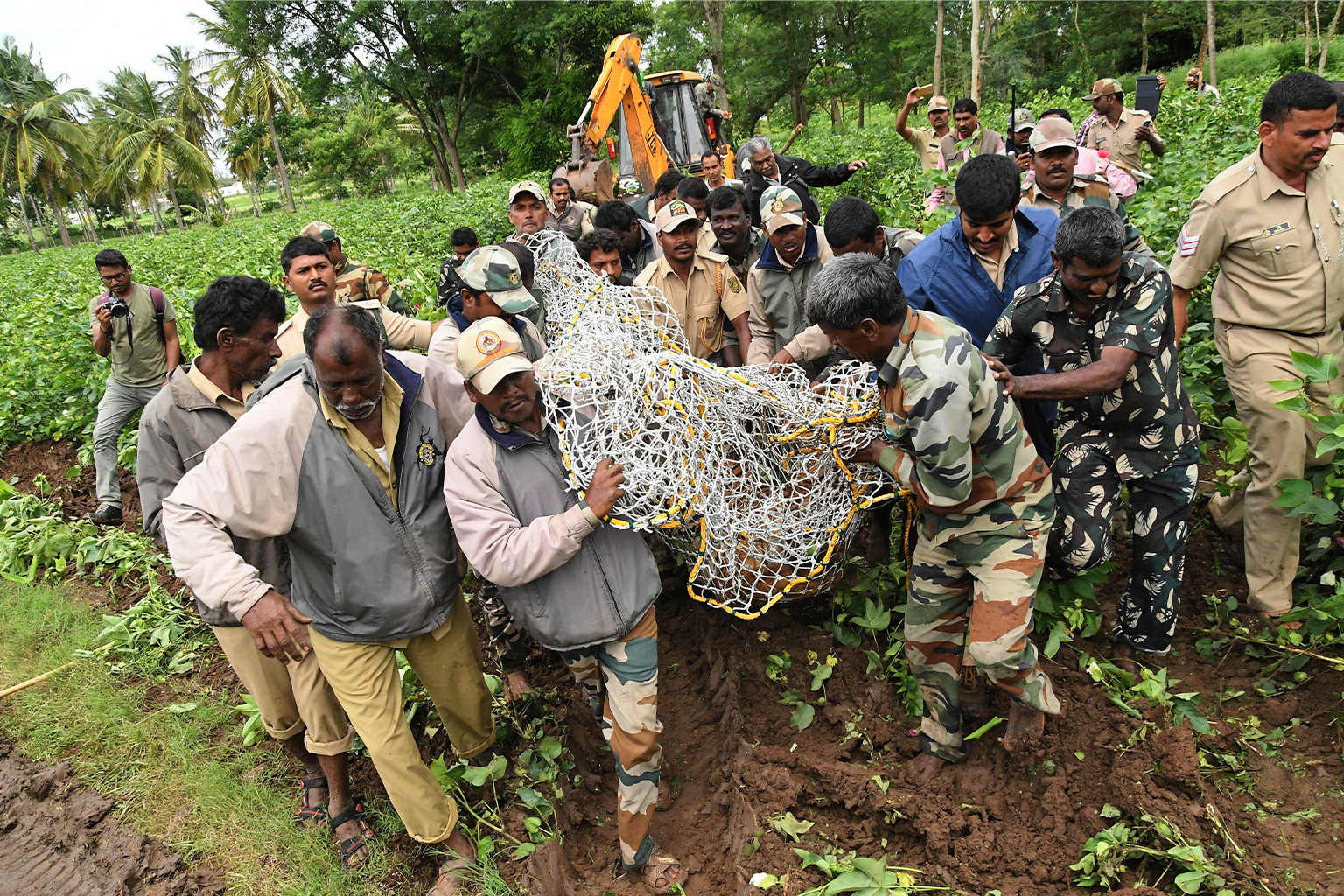
In response to mounting public pressure, the Karnataka Forest Department ramped up capture operations. Records indicate that between September 2025 and May 2026, authorities captured 30 tigers across the state. While the majority of these big cats were safely relocated back into the core zones of the forest, the sheer frequency of these operations underscores a profound structural shift in how tigers and humans interact.
Supporting Context & Metrics: The Paradox of Conservation
To understand the current crisis, experts emphasize the need to examine the broader numerical and ecological landscape of India’s tiger population.

The Numbers Game: Overflowing Reserves vs. Empty Habitats
India’s tiger distribution is profoundly uneven. While top-tier reserves in the Western Ghats—such as Bandipur and Nagarhole, which together host nearly 75% of Karnataka’s tigers across five reserves—are operating at maximum capacity, other sanctuaries sit virtually empty.
According to recent national data and independent analyses:
- Overcrowding: Approximately 30% to 35% of India’s 3,682 tigers now live outside officially protected areas.
- Depleted Sanctuaries: Conversely, 18 tiger reserves host fewer than 10 big cats, with at least five reserves recording zero tiger populations.
- Habitat Scale: India’s total potential tiger habitat spans approximately 400,000 square kilometers (roughly 154,000 square miles). However, renowned tiger expert K. Ullas Karanth notes that roughly 80% of this potential habitat remains vacant or supports very low tiger densities, while the vast majority of big cats are concentrated in just 20% of the landscape.
Biological Imperatives and Aging Predators
Kumar Pushkar, Karnataka’s principal chief conservator of forests (wildlife), explains that tiger movements into human-dominated zones are generally driven by two primary factors:
- Territorial Dispersal: Young, sub-adult tigers must leave their natal territories to find unoccupied habitat, naturally bringing them into contact with human settlements.
- Impaired Hunting: Older or injured tigers find it increasingly difficult to hunt wild ungulates. Hunting is an energetically demanding task; even healthy tigers fail in roughly 19 out of 20 hunting attempts. Consequently, impaired or aging cats often drift toward village peripheries to target easily accessible livestock.
Pushkar emphasizes that tigers do not inherently view humans as prey. Instead, deadly conflicts almost invariably stem from accidental, startling close-range encounters in agricultural fields or grazing lands.

Official Statements & Management Strategies
As human-tiger interactions multiply across states like Madhya Pradesh (near Bandhavgarh), Maharashtra (near Tadoba-Andhari), and Karnataka, forestry officials and conservation scientists are locked in debate over the best mitigation strategies.
Translocation and Its Limits
When tigers wander too close to human habitations, standard protocol dictates capture via darting or cage traps, followed by medical evaluation. Between September 2025 and May 2026, Karnataka forest officials successfully captured 30 tigers, releasing all but two back into the wild. Of the exceptions, an aged, injured tiger was transferred to a zoo, and an injured male was sent to a rehabilitation center. Nationwide, approximately 100 tigers are captured and moved to zoos annually.

Proponents of translocation point to success stories like Zeena, a tigress translocated in 2024 across a distance of 1,000 kilometers from Tadoba-Andhari Tiger Reserve to Similipal Tiger Reserve in Odisha. Despite an extensive exploratory phase where she traversed three states—walking up to 26 kilometers a day—Zeena eventually established a home range, found a mate, and gave birth to four cubs in June 2026. Vaibhav C. Mathur, a senior forestry official with Project Tiger at the Ministry of Environment, Forest and Climate Change, defends translocation as a vital tool for balancing high-density source populations with under-populated reserves.
However, critics remain skeptical. Y.V. Jhala, a senior scientist and former dean of the Wildlife Institute of India (WII), argues that problem tigers involved in deliberate attacks on humans should not be released back into the wild. "They will try to get back home—or disperse," Jhala notes. "So basically, you’re moving a problem from one area to another."

Furthermore, S. Prabhakaran, former conservator of forests at Bandipur, explains that removing a territorial tiger often destabilizes the local social structure. The vacuum is quickly filled by another dispersing tiger, which can trigger bloody territorial fights and infanticide, where incoming dominant males kill the cubs of their predecessors.
Future Outlook: Toward Landscape-Level Coexistence
Solving the modern human-tiger conflict requires moving beyond reactive emergency responses and rethinking long-term conservation frameworks. Experts agree that several critical pillars must guide India’s future environmental policy:

1. Defining and Managing Carrying Capacity
K. Ramesh, a human-wildlife conflict expert at the WII, argues that evaluating carrying capacity requires looking beyond simple numerical counts. True carrying capacity encompasses three dimensions:
- Numerical Capacity: The raw number of animals a space can hold (which fails for territorial species like tigers due to uneven habitat quality).
- Ecological Capacity: The availability of natural prey, water, and shelter. (Some experts, including Karanth and Jhala, caution that aggressive habitat management—such as artificially creating watering holes and open grasslands—has artificially inflated prey and predator numbers beyond natural limits).
- Social Capacity: The tolerance level of human communities sharing the landscape.
2. A Landscape Approach and National Land-Use Policy
With nearly a third of India’s tiger population residing outside formal reserves, experts advocate for regional zoning. Rather than altering protected area boundaries, authorities must manage wildlife corridors and multiple-use forests to maintain ecological connectivity. India currently lacks a comprehensive national land-use policy incorporating wildlife needs, a gap that Ramesh argues must be filled to reduce friction between development and conservation.

3. Modernizing Protocols and Financial Support
Government protocols for handling problem animals were largely drafted decades ago when tiger populations were critically endangered. Jhala suggests a more pragmatic, case-by-case protocol: confirmed "man-eaters" should be humanely euthanized rather than condemned to a life in a zoo, while cattle-lifting predators operating near forest interiors can often be managed through improved livestock compensation schemes.
Simultaneously, the Indian government is investing in modern solutions. An allocation of 887 million rupees ($9.33 million) under the "Management of Tigers Outside Tiger Reserves" initiative is funding advanced monitoring, staff training, and anti-poaching surveillance. Increasingly, forestry departments are deploying artificial intelligence and drone technology to track animal movements and prevent illicit human incursions into vital wildlife corridors.

Conclusion
India’s return-from-the-brink conservation story is an undeniable triumph of political will and ecological science. Yet, as the nation’s human population approaches 1.5 billion, the frontline of conservation has shifted from deep forests to agricultural fringes and rural villages.
For villagers like Mahadeva Gowda, broad conservation victories offer little solace in the face of permanent disability and economic destitution. Ultimately, experts agree that the next chapter of India’s tiger legacy will be judged not merely by counting the total number of big cats in the wild, but by successfully securing the pathways between reserves and ensuring that rural communities can safely coexist with the nation’s most iconic predator.



