Executive Overview
The American electric vehicle (EV) revolution is facing a severe identity crisis. Despite years of aggressive regulatory pushes, billions in venture capital, and a cultural pivot toward sustainability, electric vehicles account for less than 10% of total new-vehicle sales in the United States—and that market share is actively declining. From a climate perspective, this stagnation is nothing short of dismal. The transportation sector remains the single largest source of greenhouse gas emissions in the country, meaning decarbonizing personal mobility is non-negotiable if national and global climate targets are to be met.
Yet, the status quo of American automotive electrification has relied on a flawed premise: that EVs must mirror, or even exceed, the excess of traditional internal combustion engine (ICE) vehicles. For years, the prevailing wisdom in Detroit, Silicon Valley, and Seoul dictated that American consumers would only buy electric vehicles if they offered blistering acceleration, futuristic styling, opulent digital cockpits, and a massive battery pack capable of pushing 300 to 400 miles on a single charge.
This obsession with high performance and hyper-extended range birthed massive, expensive behemoths like the Ford F-150 Lightning and heavy luxury SUVs. But it also priced everyday buyers out of the market. With the average cost of a new vehicle in the U.S. hovering near $50,000, and nearly half the country struggling to afford basic necessities like gas and groceries amidst an ongoing affordability crisis, the luxury-first EV playbook has hit a brick wall. Compounding matters, the political landscape shifted dramatically with the second Trump administration, which systematically slashed federal tax credits and stripped away regulatory supports designed to accelerate EV adoption.
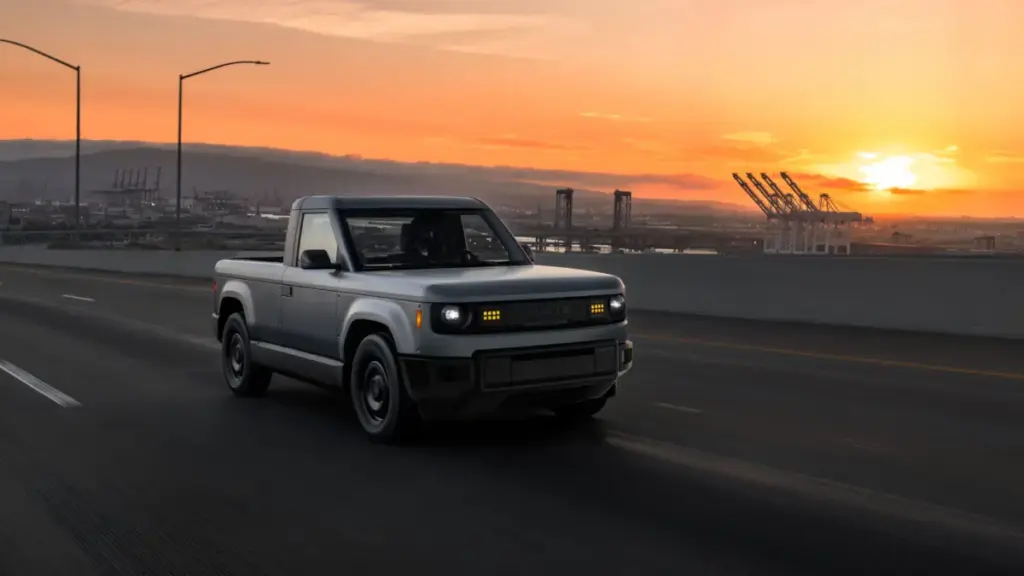
Enter Slate Auto. In a market fixated on bigger, faster, and more expensive, Slate is making a contrarian bet on radical minimalism, austerity, and extreme affordability. The company’s flagship product is a tiny, two-door electric pickup truck that is shorter than a Honda Civic and proudly sports 20th-century features like hand-crank windows on its base model. By deliberately downsizing the battery, accepting a modest 205-mile range, and stripping away unnecessary digital frills, Slate has managed to price its base model at less than $25,000.
Backed by nearly $1.4 billion in funding from heavy-hitters like Jeff Bezos, and riding a wave of thousands of preorders ahead of late 2026 deliveries, Slate Auto is directly challenging the American automotive dogma. If Slate succeeds, it could fundamentally rewrite the rules of engagement for EVs in the Western world, proving that when it comes to electric mobility, less isn’t just more—it’s the only way forward.
Detailed Chronology: From the Rise and Fall of the "Hero" EV to the Birth of Slate Auto
To understand how radical a departure Slate Auto represents, one must examine the recent history of the American EV landscape—a timeline defined by high hopes, structural miscalculations, and abrupt reversals.
2021–2022: The False Dawn of the Electric Workhorse
A few years ago, the undisputed hero of U.S. automotive electrification was supposed to be the Ford F-150 Lightning. Announced to great fanfare in 2021, the Lightning was marketed as a masterstroke: an electric variant of America’s best-selling vehicle for decades. Industry analysts predicted that by electrifying the quintessential American pickup, mainstream consumers would inevitably follow.
When customer shipments began in the spring of 2022, the optimism seemed justified. The base model carried an MSRP of roughly $40,000, positioning it as a viable, hard-working alternative to gas-powered fleet trucks. But cracks in the foundation were visible almost immediately.
2023–2025: Inflation, Battery Bloat, and Political Shifts
As production ramped up, the F-150 Lightning fell victim to economic realities and engineering choices. To achieve a near-300-mile range—a figure deemed mandatory to satisfy nervous American truck buyers—Ford had to install a massive, heavy lithium-ion battery pack with roughly double the capacity of what an efficient, lightweight commuter truck actually required.
This battery bloat drove production costs skyward. By the time the vehicle reached its final production year, relentless price increases had pushed the baseline cost of a Lightning well past $54,000, putting it out of reach for the very working-class buyers it was supposed to convert.
The death blow came from multiple directions. Supply chain bottlenecks squeezed margins, and the political climate underwent a tectonic shift. With the inauguration of the second Trump administration, federal EV tax credits were slashed, and regulatory mandates designed to spur fleet electrification were rolled back. Facing contracting demand and escalating production costs, Ford officially discontinued the F-150 Lightning in December 2025—just four years after its high-profile introduction.
2025–2026: The Pivot to Austerity
The demise of the Lightning forced a brutal reckoning across the domestic automotive sector. It became glaringly obvious that trying to build high-range, full-size electric trucks for middle-class buyers was a losing game under current economic conditions.
Recognizing this vacuum, Slate Auto accelerated its development timeline. Eschewing the conventional wisdom of trying to out-Tesla Tesla, Slate stripped the vehicle concept down to its bare structural bones. The result was a diminutive, unpretentious two-door pickup designed not for cross-country towing, but for everyday utility.
Media coverage immediately seized upon the vehicle’s most jarring retro feature: hand-crank windows on the base model. Yet, behind the sensationalized headlines lay a disciplined engineering philosophy. By refusing to install power window motors, complex multi-screen infotainment systems, and oversized battery modules, Slate engineered a vehicle that could be sold at a price point unseen in the modern American EV market: under $25,000.
With factory capacity slated to reach 100,000 vehicles in its first year of operation (and scaling to 150,000 shortly thereafter), Slate is moving swiftly toward initial customer deliveries in late 2026. Thousands of preorders have already flooded the company’s digital portals, proving that a dormant, price-sensitive demographic of American drivers is eager for an alternative.
Supporting Context & Metrics: The Myth of the Range-Obsessed Driver
The entire business model of Slate Auto rests on a counter-intuitive premise: American drivers do not need the massive driving ranges they obsess over. To evaluate whether this gamble will pay off, one must examine the stark disconnect between consumer perception and empirical driving data.
The Reality of Daily Driving Habits
In the collective psyche of the American car buyer, a vehicle must be capable of handling the absolute worst-case scenario—the annual 800-mile holiday road trip—even if that trip occurs only once or twice a year. This psychological anchor has locked automakers into a perpetual "range war," pushing battery capacities higher and higher.
Yet, government and transportation data tells a profoundly different story. According to the Federal Highway Administration and the Oak Ridge National Laboratory’s National Household Travel Survey:
- The average American driver logs less than 35 miles a day on their vehicle’s odometer.
- Nearly 90% of all trips taken in a personal vehicle are 20 miles or less.
EV-specific telematics data mirrors these findings. A comprehensive study by Recurrent tracking real-world EV usage across the United States revealed that drivers typically utilize less than 20% of their vehicle’s total range on any given day.
Despite these metrics, the U.S. market has continued to demand ever-larger batteries. In 2025, the average new EV sold in the United States boasted an EPA-estimated range of 329 miles.
Global Perspectives: How China and Europe Approach Mobility
The obsession with 300+ mile ranges is largely an American and Canadian phenomenon. In other major automotive markets, consumers and manufacturers have embraced efficiency and smaller battery footprints:
- China: The undisputed global leader in electrification, China has over 40 million EVs and plug-in hybrids on its roads, with roughly half of all new vehicle sales being electric. In 2025, the average range for a new EV sold in China was just 247 miles. Chinese automakers have successfully normalized affordable, city-friendly electric mobility.
- Europe: Sitting between the U.S. and China, the average new EV sold in Europe in 2025 offered a range of 281 miles, balancing tighter urban streetscapes with longer inter-city corridors.
The American Affordability Crisis
The timing for Slate’s launch aligns with a profound macroeconomic shift in the United States. According to a landmark Harris Poll and subsequent reporting by The Guardian, 95% of Americans believe the country is currently stuck in a severe affordability crisis. Roughly half of the population is actively struggling to pay for basic necessities such as gas and groceries.
In this economic climate, spending $50,000 to $60,000 on a high-end EV with features the average driver will never fully utilize is an untenable proposition. An unpretentious, highly efficient utility vehicle that costs under $25,000 and allows the owner to permanently bypass the gas station represents a powerful financial relief valve.
Official Statements & Industry Perspectives
The disruptive nature of Slate Auto’s strategy has drawn intense scrutiny, financial backing, and competitive reactions from established industry titans.
Investor Confidence and Venture Capital Backing
Wall Street and Silicon Valley have historically treated automotive startups with extreme skepticism—a caution validated by the high-profile bankruptcies of numerous EV hopefuls over the last decade. However, Slate’s disciplined approach to capital expenditure and manufacturing simplicity has won over some of the world’s most astute investors.
Across three major funding rounds, Slate Auto has secured nearly $1.4 billion in funding. Most notably, Amazon founder Jeff Bezos has personally and through his investment vehicles thrown his financial weight behind the company. Financial backers see Slate not as a luxury play, but as the foundational utility brand for the next decade of mass-market electrification.
Legacy Automakers Respond: Ford’s Strategic Pivot
Slate’s success—or even its potential to capture a lucrative market segment—has not gone unnoticed by traditional Detroit manufacturers. Having learned hard lessons from the discontinuation of the F-150 Lightning, Ford Motor Company is actively re-entering the compact EV arena.
Industry insiders note that Ford is currently developing a new, purpose-built small electric truck—unofficially tied to project designations like the Fathom platform—slated for a commercial debut in 2027. Unlike its predecessor, this upcoming vehicle is projected to target a retail price point of around $30,000, signaling that legacy automakers are finally pivoting away from battery bloat toward accessible, utility-first designs.
Future Outlook: Can Minimalism Save the American EV Movement?
As Slate Auto prepares to open its factory gates and begin fulfilling preorders in late 2026, the company stands at the vanguard of a potential industry transformation.
The Core Test: Shedding the Status Quo
The ultimate determinant of Slate’s success will not be engineering capability or manufacturing volume, but a psychological hurdle: Can American consumers untangle vehicle worth from luxury and excess?
For decades, automobiles in the U.S. have served as mobile living rooms and status symbols. Convincing buyers to accept a smaller vehicle with a 205-mile range, unpainted composite body panels, and manual roll-down windows requires a cultural shift. Yet, necessity is a powerful catalyst. As cost-of-living pressures mount and the promise of cheap, subsidized luxury EVs fades into political and economic reality, utility and thrift are regaining their appeal.
The Verdict
If Slate Auto proves that thousands of Americans are willing to trade digital excess for a rock-bottom price tag, it will trigger a seismic shockwave through the global automotive industry. It will force legacy manufacturers to abandon unprofitable battery-bloated flagships and return to the fundamentals of accessible transportation.
At this juncture, betting against the appeal of a sub-$25,000 electric vehicle in an affordability crisis is a losing proposition. Slate Auto’s gamble on austerity may well turn out to be the exact spark the American EV movement has been desperately waiting for.