By Trellis Expert Contributors Special Investigative Report
Executive Overview
Over the past decade, the global sustainability movement has constructed an intricate architecture of accountability. Corporations worldwide have embraced science-based targets, published detailed net-zero transition plans, and subjected their carbon footprints to unprecedented scrutiny. Yet, a fundamental flaw has exposed itself at the heart of this framework: we have built an ecosystem that scrutinizes climate delivery far more effectively than it enables it.
Nowhere is this contradiction more starkly visible than in the explosive ascent of artificial intelligence. As tech giants race to secure the hyper-scale data centers required to power the generative AI revolution, their electricity-related emissions are surging. Despite aggressive investments in clean energy and steadfast long-term climate commitments, companies like Amazon, Google, and Microsoft are finding that the grid cannot keep pace with their insatiable demand for power.
The market is asking an increasingly urgent question: Can corporate climate commitments survive the AI boom?
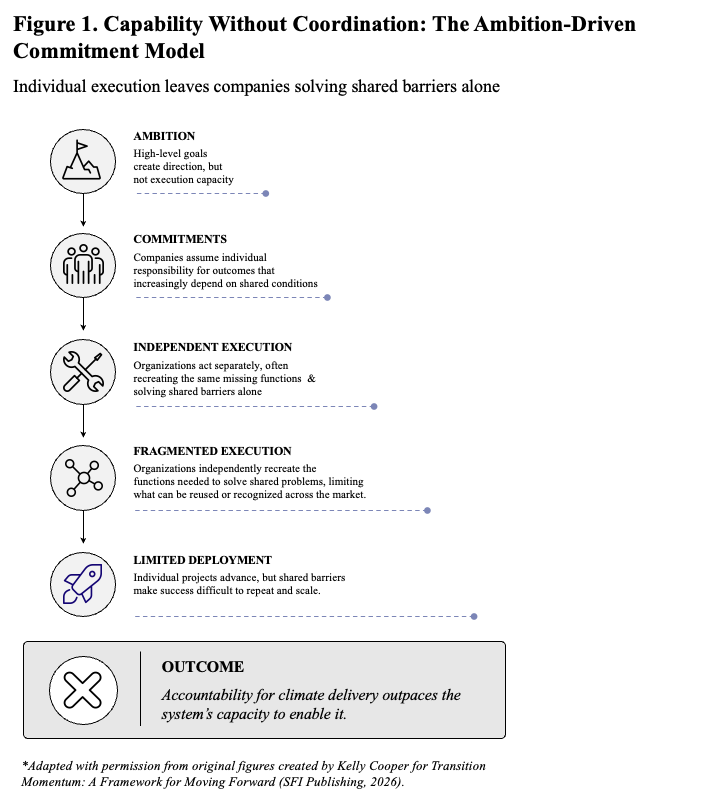
However, framing this solely as a technology or energy problem misses the point. The deeper crisis is systemic. When every major corporation faces the exact same structural bottlenecks—whether in clean power access, critical infrastructure, or supply chain resilience—and is left to solve them independently, the rules of the market actively work against collective climate progress. Net-zero pledges have not necessarily changed, but the fundamental conditions required to deliver them are rapidly deteriorating.
This report investigates why traditional sustainability frameworks are failing to address externalized constraints, how the AI boom is rewriting the rules of corporate resource competition, and what practitioners must do to transition from fragmented corporate survivalism to shared execution capacity.
Detailed Chronology: From Accountability Architecture to the AI Energy Crunch
To understand how corporate sustainability arrived at this current crossroads, it is necessary to examine the evolution of the modern climate economy over the last ten to fifteen years.
Phase 1: The Decade of the Commitment (2010–2020)
For the better part of the last decade, global climate strategy was defined by target-setting. Propelled by the Paris Agreement, growing consumer pressure, and investor demands for environmental, social, and governance (ESG) transparency, corporations rushed to establish ambitious carbon-reduction goals.
The Focus: The primary emphasis was placed on internal metrics—Scope 1, 2, and eventually Scope 3 emissions calculations.
The Tools: Standards bodies, carbon accounting software, and disclosure frameworks proliferated. The underlying theory was simple: if you make companies account for their emissions, they will independently re-engineer their operations to eliminate them.
Phase 2: The Infrastructure Reality Check (2021–2023)
As companies began moving from target-setting to active implementation, cracks in the model began to show. Organizations quickly realized that the primary obstacles to decarbonization were no longer internal matters of corporate willpower or operational efficiency; they were systemic bottlenecks sitting entirely outside individual organizational control. Upgrading national power grids, scaling green hydrogen supply chains, and permitting renewable energy installations required structural, macroeconomic interventions that individual corporate actors could not manifest through willpower alone.
Phase 3: The AI Shock and the Scramble for Power (2024–Present)
The arrival of the generative AI boom blew the lid off these latent structural limitations. Large language models and massive machine-learning clusters demanded computational power at an unprecedented scale.
The Grid Crunch: Electricity demand from data centers skyrocketed faster than regional transmission organizations (RTOs) could expand generation capacity.
The Fossil Fuel Fallback: Faced with existential commercial competition, hyperscalers were forced to secure energy by any means necessary—frequently bypassing green transition timelines and locking in long-term fossil fuel generation to guarantee uninterrupted uptime.
The Shift: Power is no longer merely an operational input for the tech sector; access to electricity has become the primary competitive battleground in the AI race itself.
Supporting Context & Metrics: The Cost of Fragmented Execution
The friction generated by the AI boom exposes a wider, pervasive pattern across the entire climate tech and sustainability landscape. Recent research conducted alongside more than 200 practitioners actively involved in climate deployment reveals systemic dysfunctions that go far beyond Big Tech:
Capital and Demand Disconnection: Billions of dollars in climate capital sit waiting for investable projects, while project developers struggle to secure predictable offtake agreements and reliable financing terms.
Duplicated Diligence: Across sectors, organizations endlessly reinvent the wheel. Companies, investors, and suppliers repeatedly rebuild bespoke validation processes, technical specifications, and risk-assessment frameworks from scratch, wasting precious time and capital.
Misplaced Risk: Critical systemic risks remain dumped on individual corporate actors who lack the balance sheet strength or operational mandate to absorb them.
Informal Workarounds: Where durable execution infrastructure is missing, companies resort to informal, inefficient workarounds to get projects across the finish line.
The True Cost of Fragmentation
When markets are forced to navigate systemic constraints through isolated, competitive behavior, the collateral damage is immense. The costs manifest across four distinct dimensions:
Delayed Deployments: Projects stall as companies fight over scarce inputs like grid connections, transformers, and clean energy PPAs (Power Purchase Agreements).
Wasted Capital: Billions are lost to duplicated efforts, redundant administrative overhead, and competing proprietary standards.
Eroded Trust: Persistent gaps between high-flying corporate climate ambitions and messy, fossil-reliant delivery schedules invite accusations of greenwashing, exposing companies to intense regulatory and political backlash.
Stifled Innovation: When energy and capital are spent merely securing survival in a constrained market, very little is left over for breakthrough innovation.
Official Statements and Industry Perspectives
The tension between corporate climate governance and physical reality has forced executives, policymakers, and sustainability leaders to rethink the fundamentals of corporate responsibility.
"We have spent the last ten years perfecting the art of asking companies what they plan to achieve, while doing almost nothing to guarantee that the physical conditions required to achieve those goals actually exist," notes a leading sustainability strategist specializing in corporate transition models. "When critical enabling infrastructure is scarce, rational commercial actors will inevitably compete for it. You cannot lecture a company out of securing the power it needs to survive a market war."
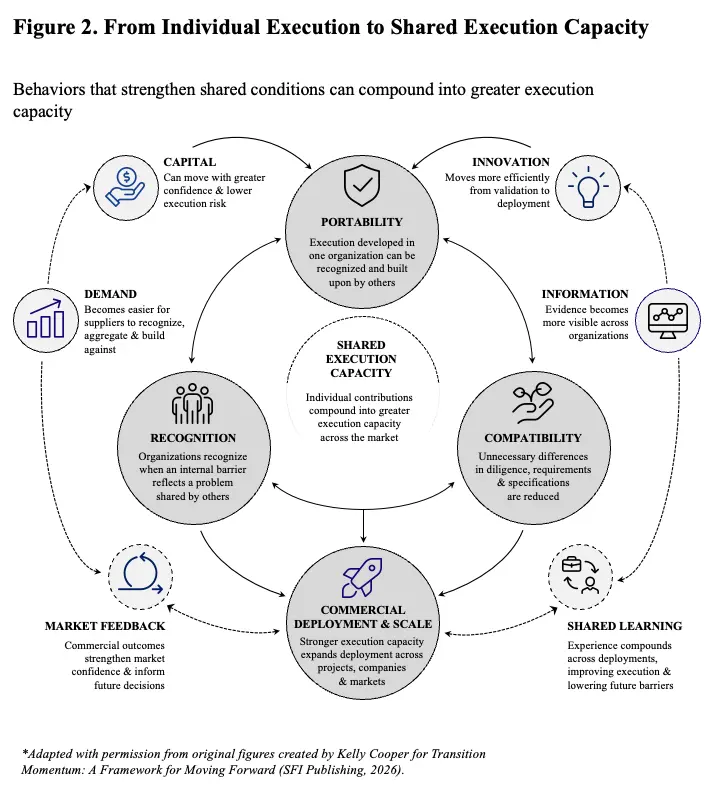
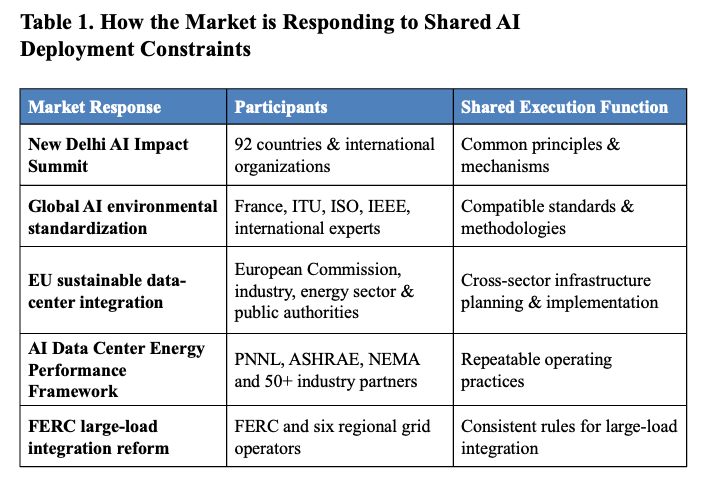
Industry analysts point out that the response emerging around AI infrastructure offers a vital blueprint. In response to grid overload, unexpected coalitions are forming between technology firms, utility providers, regulators, and energy developers. Rather than engaging in pure zero-sum competition, these stakeholders are beginning to pool resources, establish common rules, and build shared deployment capacity.
"The lesson of the AI boom is not that technology is inherently incompatible with decarbonization," observes an infrastructure finance expert. "The lesson is that when a constraint becomes commercially critical, the market stops waiting for individual workarounds and starts building shared infrastructure. The question is: why does it take an existential commercial crisis to make us build the systems we needed for climate deployment all along?"
Future Outlook: Building the Other Half of the System
As the corporate world looks toward the 2030 climate milestones, the path forward requires a fundamental evolution in how sustainability is conceptualized and practiced. If the sustainability ecosystem spent the 2010s building the architecture for accountability, disclosure, and commitments, the 2030s must be dedicated to building execution capacity.
Moving From Isolation to Shared Capacity
For individual practitioners sitting inside modern enterprises, waiting for macroeconomic or regulatory reform is not a viable strategy. While individual managers cannot single-handedly fix the national electrical grid, restructure global capital markets, or dictate corporate tech strategy, they can choose whether their day-to-day operations add to market fragmentation or help resolve it.
Practitioners can operationalize this shift by taking four concrete steps:
1. Define the Shared Problem
Evaluate whether internal initiatives are solving unique organizational challenges or simply reinventing a function the broader market is failing to provide. Look for identical workarounds appearing across suppliers, technology vendors, and financiers.
2. Eliminate Unnecessary Fragmentation
Challenge bespoke internal specifications, custom diligence procedures, and proprietary requirements that do not generate distinct commercial value or meaningfully mitigate material risk. When credible industry standards already exist, adopt them.
3. Choose System-Strengthening Solutions
Avoid short-term quick fixes that merely get an individual project across the finish line. Prioritize technological, financial, and operational approaches that create repeatable frameworks—building capabilities that partners, competitors, and subsequent developments can utilize.
4. Make Execution Portable Across Organizational Boundaries
Anchor sustainability initiatives in shared tools, open specifications, unified demand signals, and standardized diligence processes that external actors can recognize and adopt without starting from scratch.
Conclusion: The Defining Challenge of the Next Decade
Corporate climate commitments have successfully galvanized global demand for sustainable outcomes. However, they have failed to create an equally powerful economic incentive to build the shared physical and institutional foundations required to deliver those outcomes.
The AI boom has laid bare this structural disconnect in dramatic fashion. It has demonstrated both the dangers of operating without shared execution capacity and the remarkable speed with which markets can mobilize when constraints threaten commercial growth.
The ultimate challenge for the next era of corporate sustainability is clear: We must make it economically rational to build the other half of the system. By transitioning from fragmented competition over scarce resources to collaborative, system-wide execution capacity, enterprises can finally align their commercial survival with a livable planetary future.