Executive Overview
Rescue and recovery operations along the rugged Nepal-Tibet border were abruptly thrown into chaos on Friday as an unstable debris dam—formed in the wake of a catastrophic mid-week glacial collapse—overflowed, threatening to unleash a fresh wall of water down already devastated river valleys. The disaster, which began on Wednesday when a massive wall of mud, rocks, and glacial melt slammed into the border hub of Gyirong in Tibet, has triggered unprecedented devastation across the Himalayas, severing critical transport links, obliterating mountain settlements, and stranding hundreds of foreign tourists and locals alike.
Official figures released on Friday place the confirmed death toll in Nepal at 469, with more than 1,300 individuals reported missing across both Nepal and Tibet. Chinese authorities have thus far confirmed five fatalities on their side of the border, though information emerging from the tightly controlled region remains severely restricted. The unfolding humanitarian catastrophe has prompted an outpouring of international offers of assistance, yet geopolitical sensitivities and logistical nightmares continue to hamper relief coordination. As rescue helicopters battle volatile weather and rising waters, scientists are issuing increasingly urgent warnings that this tragedy may be a terrifying harbinger of accelerating climate destabilization in fragile mountain ecosystems.
Detailed Chronology of the Disaster
Wednesday: The Glacial Collapse and Initial Impact
The disaster materialized without warning in the early hours of Wednesday, August 27, when a high-altitude glacial collapse in the Himalayas triggered an immense torrent of water, mud, and debris. The slurry crashed down the steep mountain slopes, directly striking Gyirong, a vital trade and transport hub on the border between Tibet and Nepal.
As the debris surge cascaded down the river valleys, it completely overwhelmed local infrastructure. Power stations, vital stretches of highways, and historic suspension bridges were swept away as if made of paper. The route connecting Kathmandu to Lhasa in Tibet—a vital artery heavily relied upon by international trekkers, religious pilgrims, and cross-border traders—was fractured in multiple places.
In the Nepalese district of Rasuwa, the catastrophe hit with terrifying speed. Entire villages along the Trishuli River were erased, leaving residents with mere moments to react. Survivors later recounted harrowing tales of scrambling up vertical hillsides, clutching at tree roots and rock outcroppings, as a thundering wall of sludge swallowed their homes and livelihoods.
Thursday: Engineering Surveys and Rising Peril
By Thursday, the massive volume of displaced earth and rock had formed a formidable natural barrier lake near the base of the mountains close to the Nepal-Tibet border. Recognizing the extreme secondary threat posed by this unstable reservoir, Chinese authorities deployed an eight-member engineering team equipped with advanced 3D modeling and aerial survey drones to assess the integrity of the blockage.
Their initial estimates calculated the volume of the barrier lake at between 1.5 million and 2 million cubic metres. However, satellite telemetry and aerial observations quickly revealed that the basin was swelling at an alarming rate as upstream meltwater and trapped tributary flows continued to accumulate behind the unstable wall of debris.
Friday: The Breach and Evacuation Chaos
The latent threat materialized violently on Friday morning. Fueled by continuous inflows and structural erosion, the barrier lake breached its banks, sending a renewed surge of water cascading down the Trishuli River basin.
In Bidur, the capital of Nepal’s Nuwakot district in Bagmati province, the rising waters forced an immediate halt to all ongoing search-and-rescue operations. An army officer confirmed that authorities ordered a mandatory suspension of recovery efforts for at least 90 minutes. Witness accounts described chaotic scenes as residents who had cautiously returned to salvage what remained of their belongings were forced to flee for their lives a second time, scrambling frantically up surrounding hillsides as sirens wailed and river levels visibly surged.

Concurrently, Chinese state broadcaster CCTV reported that rescue personnel and vehicles on the Tibet side of the border were forced to execute an emergency tactical withdrawal to designated safe zones as the risk of a catastrophic outburst flood escalated.
Supporting Context & Metrics
The human and physical toll of the Nepal-Tibet glacial flood is staggering, casting a harsh light on the vulnerability of Himalayan communities to extreme climate-induced events.
Casualties and Missing Persons Breakdown
- Confirmed Fatalities: 469 in Nepal; 5 in Tibet (as reported by Chinese state media).
- Total Missing: Over 1,300 people unaccounted for across the trans-boundary disaster zone.
- Foreign Nationals Affected: Police and tourism officials in Nepal reported that more than 500 foreign citizens were among the 826 missing persons registered on the Nepalese side. The breakdown includes:
- India: 177 nationals
- United States: 90 nationals
- Australia: 34 nationals
- United Kingdom: 33 nationals
- Canada: 25 nationals
- Tibet Region Disappearances: Chinese state media confirmed that at least 558 individuals remain missing on the northern side of the border, with at least 260 identified as foreign nationals. Safe evacuations included 499 Chinese citizens and 555 foreign nationals transported out of the impact zones by Friday.
Infrastructure and Geomorphic Devastation
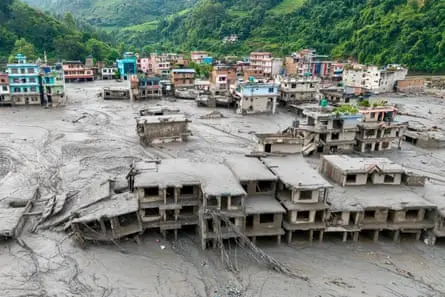
The physical destruction spans miles of rugged terrain. Towns like Bidur, once thriving economic hubs along the Trishuli River, have been reduced to surreal landscapes of hardened gray sludge. Structural engineering remnants—such as the mangled concrete shells of banks, government administrative offices, and ATM kiosks—stand half-submerged in metres of mud. Local officials noted that human remains likely lie trapped within these waterlogged structures, but recovery operations remain suspended due to extreme structural instability and toxic sludge depths.
Further compounding the crisis is the isolation of the affected zones. The majority of impacted valleys are entirely inaccessible by road, leaving army helicopters as the sole lifeline. At the Bidur military camp, serving as the central coordination hub, rotary-wing aircraft have been landing and taking off in five-minute intervals, ferrying in traumatized survivors who lost family members, homes, and every possession they owned within a matter of minutes. In some harrowing instances, rescue teams reported recovering human bodies hundreds of miles downstream in Nepal’s lowland Chitwan district.
The Hydropower Tunnel Crisis
Among the most critical operational hurdles on Friday was the desperate race to save approximately 100 workers and locals trapped deep inside the subterranean tunnels of the flooded Trishuli 3A hydropower project.
Nepal Army spokesperson Raja Ram Basnet detailed the intense logistical challenge: "Our focus is in the search and rescue of people… some people are trapped in the tunnel of the Trishuli 3A hydropower project. Two helicopters have been dispatched, but it is challenging because it is tough to even locate the entry points of the tunnel."
Later in the day, the Prime Minister’s office confirmed that military engineering units operating under extreme conditions successfully reached and evacuated 350 trapped workers and local residents from the subterranean complex.
Official Statements and Diplomatic Tensions
As the rescue operations grapple with natural obstacles, a diplomatic friction point has emerged regarding international aid offers.
Nepal’s Stance on Foreign Assistance
In the immediate aftermath of the disaster, a broad coalition of nations—including India, China, the United States, Great Britain, Japan, South Korea, Sri Lanka, and Bangladesh—formally approached the Nepalese government, offering specialized search-and-rescue teams, heavy engineering equipment, and emergency medical supplies.
However, Kathmandu formally declined foreign deployment, insisting that domestic security agencies were fully capable of managing the crisis. Lok Bahadur Chhetri, spokesperson for Nepal’s Ministry of Foreign Affairs, addressed the international community’s overtures on Friday: "The offer for help is natural. Our security agencies are doing the search and rescue operation. For now, we don’t require such help."
This refusal sparked immediate speculation among geopolitical analysts. Dinesh Bhattarai, a former Nepalese ambassador to the United Nations in Geneva, suggested to Reuters that Kathmandu’s reluctance may stem from the acute geopolitical sensitivity of the Rasuwa district, given its direct international border with China’s Tibet Autonomous Region. "They may have thought about the locational sensitivity of the region and decided not to accept foreign teams," Bhattarai noted.
Chhetri, however, forcefully rejected these assertions, maintaining that the decision was based strictly on operational efficiency and that domestic rescue units were adequately meeting the demands of the disaster zones without political interference.
The Information Blackout in Tibet
In stark contrast to the transparent, albeit chaotic, flow of information out of Nepal, the situation in Tibet remains shrouded in administrative opacity. Tibet is widely recognized as one of the most tightly controlled regions within the People’s Republic of China. Official information regarding the true scale of the disaster has been tightly filtered through state-controlled media channels, which have emphasized government-led rescue coordination while keeping casualty reports minimal. Observers note that this discrepancy in reporting highlights the starkly different administrative approaches to disaster management across the Himalayan frontier.
Future Outlook: Climate Vulnerability on the Roof of the World
The catastrophic events of late August 2026 have laid bare the terrifying acceleration of climate-induced hazards in high-altitude mountain environments. Glaciologists and environmental scientists have issued repeated warnings that global heating is destabilizing Himalayan cryosphere systems at an unprecedented rate.
As rising global temperatures cause glaciers to retreat and thin, they leave behind unstable moraine walls that hold back massive glacial lakes. These natural dams are inherently fragile, susceptible to sudden structural failure triggered by seismic activity, ice avalanches, or extreme monsoon cloudbursts. When these barrier lakes fail, they unleash catastrophic outburst floods (Glacial Lake Outburst Floods, or GLOFs) that travel with immense velocity down narrow mountain gorges, wiping out decades of infrastructure development in mere minutes.
For Nepal and Tibet, the immediate priority remains the preservation of human life—locating the more than 1,300 missing individuals, treating the injured, and delivering clean water and food to isolated communities. However, as the waters eventually recede, policymakers, engineers, and international climate bodies will face a sobering long-term reality: the infrastructure of the Himalayas must be entirely re-engineered to withstand a rapidly warming world where historical weather patterns and geological norms no longer apply. Without preemptive engineering interventions, sophisticated early-warning systems, and cross-border environmental cooperation, the valleys of the Nepal-Tibet border will remain perpetually exposed to the ticking time bombs of the high Himalayas.