Executive Overview
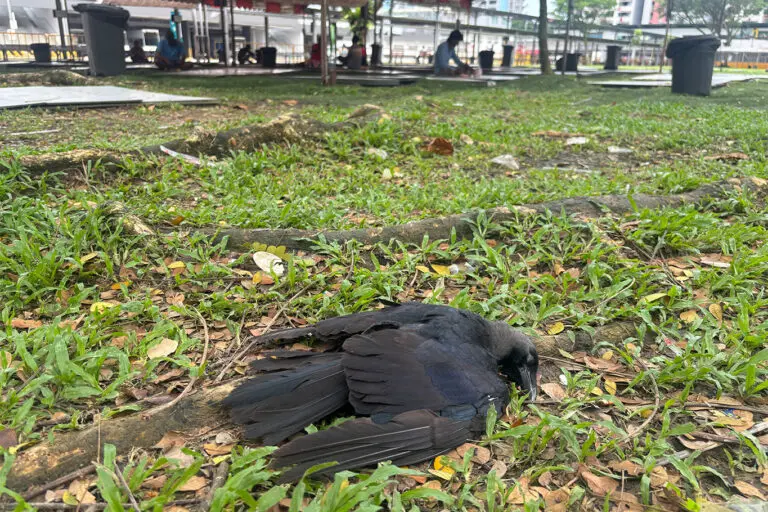
In the sleek, highly manicured, and fiercely regulated city-state of Singapore, a familiar and contentious conflict has re-erupted high in the canopy: a government-backed, lethal wildlife management campaign targeting the house crow (Corvus splendens). Amid public outcry over aggressive dive-bombing incidents targeting pedestrians, cyclists, and the elderly, the state has resurrected an old-school remediation method—shooting.
Announced by National Development Minister Chee Hong Tat, the resumption of the crow-shooting program in March follows the failure of softer, more passive interventions. Despite the removal of nearly 9,000 nests, intensive tree pruning, and localized trapping campaigns throughout 2025, the proliferation of urban-adapted bird species continues unabated.
Yet, this tactical deployment of lethal force has reignited a fierce, polarized debate among conservationists, wildlife officials, and urban ecologists. Critics argue that culling is an expensive, reactive placebo—a superficial performance designed to reassure a frustrated public while leaving the structural root causes of the avian boom entirely unaddressed.
As continuous forest clearance for public housing developments reshapes the island’s landscape, Singapore finds itself locked in a deeper ecological paradox. The nation’s rapid urbanization creates a hyper-abundant, calorie-rich sanctuary for opportunistic species. Without fundamental changes to how humans manage waste, design urban infrastructure, and interact with wildlife, Singapore risks trapping itself in an endless, cyclical war against some of the planet’s most intelligent and resilient avian survivors.
Detailed Chronology of the Crisis
The escalation of Singapore’s human-avian tensions did not happen overnight. It is the culmination of decades of shifting ecological dynamics, urban expansion, and escalating friction between citizens and wildlife.
The Escalation (2023–2025)
By the early 2020s, complaints regarding aggressive house crows had begun to steadily climb. Unlike their shy forest-dwelling counterparts, house crows are hyper-intelligent, highly social corvids that thrive in hyper-dense human settlements. By 2025, public grievances reached a boiling point as residents reported unprovoked attacks. Prams were dive-bombed, cyclists were knocked off their balance, and senior citizens walking through housing estates were left with lacerations as protective parent crows defended their territory.
In response, the National Parks Board (NParks) scaled up non-lethal and low-intervention measures. Teams worked around the clock to prune the lush yellow flame trees (Peltophorum pterocarpum) that line Singapore’s avenues—the favorite nesting real estate of Corvus splendens. Simultaneously, municipal workers systematically targeted and removed nearly 9,000 crow nests across the island, while deploying specialized cage traps in heavily impacted districts.
The Turning Point (March 2026)
Despite these aggressive interventions, the populations of house crows, alongside co-existing Javan mynas (Acridotheres javanicus) and feral rock pigeons (Columba livia), remained stubbornly high. The breaking point arrived in March 2026, when National Development Minister Chee Hong Tat formally announced the return of the crow-shooting campaign.
Confronted with data showing that trapping and nest removal alone were insufficient to mitigate public safety risks, the government authorized targeted lethal operations. Wildlife management directors at NParks defended the decision, asserting that combining firearms with ongoing environmental modifications would eventually yield a "gradual and sustained reduction" in crow densities.
However, the return of sharpshooters to the streets immediately galvanized animal welfare groups and conservationists. Incidents such as the poisoning of crows by private pest control companies—documented in mid-2026 at locations like Sungei Tengah Lodge, where groups like Animal Concerns Research and Education Society (ACRES) had to step in to rescue poisoned birds with activated charcoal slurries—underscored the brutal realities of urban pest management. The re-emergence of lethal controls brought latent ethical, scientific, and urban planning questions to the forefront of national discourse.
Supporting Context & Metrics: The Biology of an Urban Boom
To understand why traditional culling methods struggle to make a long-term dent in Singapore’s crow population, one must look past municipal boundaries and examine the global science of urban ecology.
The Global and Local Science of Urban Adaptability
A comprehensive global review analyzing more than 400 scientific studies reveals a universal trend: most crow species expand dramatically in abundance as cities grow. Urban ecosystems provide a winning combination for generalist species. They offer an abundance of predictable, high-calorie food sources, secure overhead nesting sites protected from natural predators, and a microclimate insulated from extreme wilderness pressures.
This global phenomenon is mirrored locally. A landmark 2003 Singapore-specific study on the distribution of invasive and nuisance bird species highlighted how human infrastructure dictates avian settlement patterns. House crows favor the dense canopy of roadside trees like the yellow flame tree, offering strategic vantage points over pedestrian pathways. Meanwhile, pigeons and mynas have successfully colonized the countless artificial ledges, air-conditioning compressor brackets, and sheltered walkways characteristic of Singapore’s public housing (HDB) estates.
The Role of Waste and Feeding Habits
Urban wildlife populations are ultimately limited by two primary ecological factors: food availability and nesting sites. On both fronts, modern human behavior in Singapore provides an infinite subsidy.
Singapore’s vibrant hawker centers and open-air dining areas generate a constant supply of discarded food waste. Furthermore, despite stringent government regulations and public education campaigns making bird-feeding illegal, a persistent subculture of residents continues to feed pigeons and crows out of misplaced compassion.

+-----------------------------------------------------------------+
                    THE URBAN AVIAN FEEDBACK LOOP
+-----------------------------------------------------------------+
       [ Rapid Urbanization & Forest Clearance ]
                          │
                          ▼
       [ Proliferation of Artificial Nest Sites ]
         (Yellow Flame Trees, AC Ledges, Shelters)
                          │
                          ▼
       [ Abundant Anthropogenic Food Sources ]
         (Hawker Waste, Illegal Bird Feeding)
                          │
                          ▼
       [ Exponential Growth of Nuisance Bird Populations ]
         (House Crows, Javan Mynas, Feral Pigeons)
                          │
                          ▼
       [ Public Incidents: Attacks & Aggression ]
                          │
                          ▼
       [ Reactive Response: Culling & Nest Removal ]
                          │
                          └──────► (Loop Repeats: Symptoms Treated, Not Causes)
+-----------------------------------------------------------------+
As John Marzluff, a prominent professor of wildlife science at the University of Washington, dryly noted to Mongabay contributor Robin Hicks:
"As long as we keep providing unlimited food and increasing numbers of nest sites, the population will grow. This is not rocket science — it is plain biology."
Compounding the issue, ongoing forest clearance to accommodate Singapore’s continuous public housing expansion actively displaces native forest species while simultaneously widening the perimeter of manicured urban environments where generalist, adaptable edge species thrive. Every cleared hectare of secondary forest effectively rolls out the red carpet for more crows, mynas, and pigeons.
Official Statements and Divergent Perspectives
The debate over the culling campaign highlights a profound philosophical chasm between municipal administrators tasked with immediate public safety and conservation scientists looking at long-term ecological sustainability.
The Government Stance: Balancing Safety and Scale
For the Singaporean government, wildlife management is first and foremost a matter of public health, safety, and urban livability. Officials from the Ministry of National Development (MND) and the National Parks Board argue that the state has a fundamental duty to protect citizens—particularly vulnerable populations like children and the elderly—from physical harm caused by aggressive wildlife.
How Choon Beng, director of wildlife management at NParks, maintains that culling cannot be viewed in isolation. When integrated as part of a multi-pronged strategy that includes habitat modification, nest destruction, and waste management, shooting acts as an immediate pressure-release valve. According to NParks, this layered approach is designed to systematically lower population density thresholds to levels where aggressive interactions become statistically rare.
The Conservationist Critique: Treating Symptoms, Not Causes
In sharp contrast, conservation scientists and non-governmental organizations argue that lethal management is fundamentally flawed.
Albert Liu, assistant director for conservation at Nature Society Singapore, cuts straight to the core of the issue, stating that culling programs primarily serve "to show the public that something is being done" and ultimately "treats the symptoms, not the cause."
From an ecological standpoint, culling creates a temporary vacuum. In biology, this is known as compensatory reproduction or the "vacuum effect." When an apex urban scavenger population is artificially suppressed through shooting or poisoning, the remaining birds experience reduced competition for food and space. This triggers higher breeding success and survival rates among juveniles, or prompts neighboring populations to quickly migrate in to fill the ecological niche. Within months, population levels often rebound to—or even exceed—their pre-cull numbers.
Liyin Lim, founder of the community group Urban Birds Initiative, points to the deeper psychological and systemic contradictions defining Singapore’s relationship with nature. She warns that unless society learns the mechanics of coexistence, the island will remain trapped in an exhausting loop of perpetual killing:
"There is an unspoken painful contradiction: Urbanization plays a key role in driving the population expansion of urban-adapted birds."
Future Outlook: Breaking the Cycle of Perpetual Culling
As Singapore marches further into the 21st century as a self-styled "City in Nature," its policymakers face a defining test of ecological philosophy. Can a hyper-dense, highly engineered metropolis successfully coexist with some of the most intelligent avian generalists on the planet, or is perpetual lethal management the inevitable price of urban perfection?
To break free from the Sisyphean cycle of culling and population rebounds, experts argue that Singapore must pivot from reactive pest control to proactive environmental engineering. This transition requires three critical shifts:
- Stricter Waste and Sanitation Enforcement: The availability of accessible food is the single greatest driver of the avian boom. Mandating fully enclosed, crow-proof waste disposal systems in hawker centers, parks, and residential estates, coupled with draconian enforcement against illegal wildlife feeding, will naturally compress carrying capacities.
- Architectural and Landscape Deterrence: Urban planners must incorporate bird-deterrent design principles into new public housing developments. This includes eliminating exposed nesting ledges on building facades and strategically selecting urban flora that minimizes dense roosting clusters near high-traffic pedestrian zones.
- Public Education on Behavioral Coexistence: Shifting public perception is perhaps the hardest hurdle. Communities must be educated on wildlife behavior—such as understanding why parent crows become aggressive during nesting season—to minimize panic and reduce the knee-jerk demand for extermination.
Until Singapore addresses the structural invitation it extends to urban wildlife through its built environment, the crack of sharpshooters’ rifles will remain a recurring soundtrack in its otherwise tranquil streets—a noisy, temporary fix for a problem of our own making.