Executive Overview
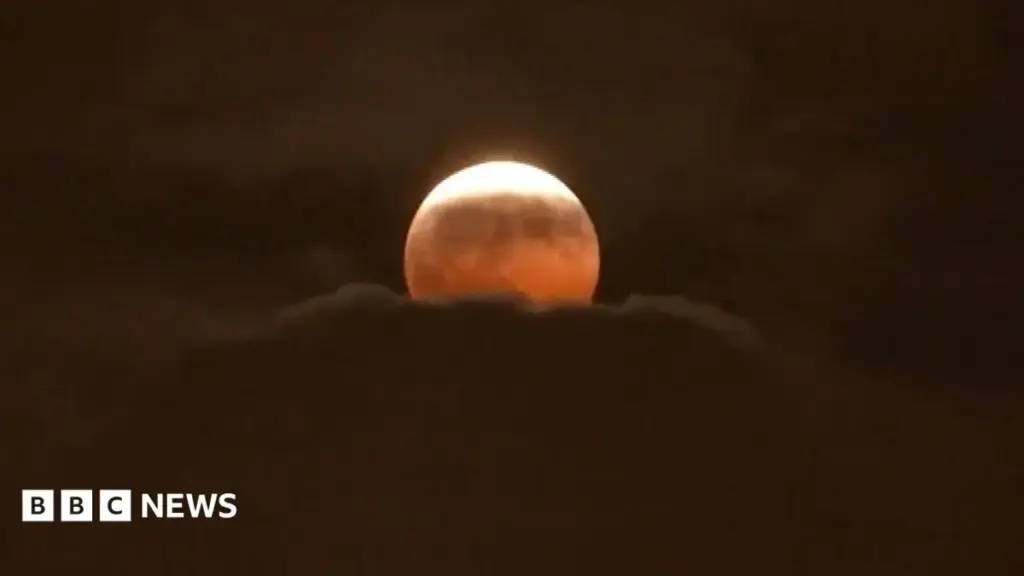
On Thursday night and extending into the early hours of Friday morning, millions of astronomy enthusiasts, casual stargazers, and professional scientists alike turned their gazes upward to witness a breathtaking celestial alignment. A magnificent near-total lunar eclipse swept across the night sky, offering observers in various regions of the globe a rare glimpse of a cosmic phenomenon frequently referred to as a "Blood Moon."
This awe-inspiring event occurred precisely when the Sun, Earth, and Moon locked into a near-perfect celestial alignment. As Earth positioned itself directly between our star and its natural satellite, our planet cast a deep, crimson-tinted shadow across the lunar surface. For cultures around the world throughout history, the sudden darkening and reddening of the Moon have inspired myth, folklore, and scientific inquiry alike. In the modern era, however, it serves as a unifying global event, drawing communities together in public parks, observatories, and backyards to marvel at the mechanics of our solar system.
Coming on the heels of a historic solar eclipse just weeks prior—an event that plunged millions into daytime darkness in what many astronomers dubbed the most significant solar alignment in nearly three decades—this lunar spectacle marks an unusually active and visually stunning season for observational astronomy. Together, these consecutive celestial events have reignited public fascination with space science, prompting an unprecedented surge in telescope sales, planetarium attendance, and educational outreach programs worldwide.
This comprehensive report examines the chronological progression of Thursday night’s lunar eclipse, analyzes the scientific mechanisms and data metrics behind the alignment, reviews official statements from leading space agencies and astronomical societies, and looks forward to the future outlook of upcoming celestial milestones.
Detailed Chronology of the Eclipse
To fully appreciate the scope of Thursday night’s event, it is necessary to examine the precise timeline of the eclipse’s phases. Unlike a solar eclipse, which can be viewed only within a narrow geographical band, a lunar eclipse is visible to anyone on the nighttime side of the Earth, provided skies remain clear.
Phase 1: The Penumbral Ingress
The celestial drama began quietly as the Moon entered Earth’s penumbra—the lighter, outer part of our planet’s shadow. During this initial phase, which commenced late Thursday evening, the casual observer might have noticed only a very subtle, gradual shading on the eastern edge of the lunar disk. To the naked eye, the change was barely perceptible, but sensitive instruments and astrophotographers recorded a distinct loss of brilliance as the Moon drifted deeper into the Earth’s atmospheric wake.
Phase 2: The Umbral Onset (Partial Eclipse Begins)
The excitement escalated significantly as the Moon made first contact with the umbra—the dark, central region of Earth’s shadow where our planet completely blocks direct sunlight. This transition marked the official start of the partial lunar eclipse. A distinct, curved bite appeared to be taken out of the lunar disk as the shadow advanced steadily across craters, maria, and highlands. Over the course of roughly an hour, the umbral shadow consumed more than 95 percent of the Moon’s visible surface, creating a striking visual contrast between the stark white illuminated sliver and the dark, charcoal-hued shadow consuming the rest.
Phase 3: Maximum Eclipse and the ‘Blood Moon’ Phenomenon
The climax of the evening occurred during the peak of the near-total eclipse, when the alignment reached its zenith. While the eclipse narrowly missed being a total eclipse by a fraction of a percent, the visual effect for regions positioned under optimal viewing skies was virtually indistinguishable from totality.
As the Earth’s shadow enveloped nearly the entire lunar disk, the Moon did not go completely black. Instead, it was illuminated by a haunting, deep coppery-red glow. This phenomenon occurs because sunlight filtering through the edges of Earth’s atmosphere is bent—or refracted—toward the Moon. As sunlight passes through hundreds of miles of Earth’s atmosphere, shorter wavelengths (like blue and violet) are scattered away by molecules and particles via Rayleigh scattering, while longer wavelengths (like red and orange) pass through relatively unimpeded.
Viewed from the surface of the Moon looking back at Earth, an astronaut would see a brilliant, glowing red ring—simultaneously witnessing every sunrise and sunset on Earth happening all at once. For those on Earth, this filtered light painted the lunar surface in dramatic shades of crimson, rust, and amber, earning the event its dramatic moniker: the "Blood Moon."
Phase 4: The Umbral Recession and Conclusion
Following the peak of the eclipse, the cosmic choreography reversed itself. The umbral shadow began its slow retreat across the lunar landscape, revealing the bright, familiar details of the lunar highlands and maria. As the Moon cleared the umbra entirely, it drifted back into the fading penumbral shadow before finally emerging into the uninhibited, brilliant light of the full moon. By the early hours of Friday morning, the celestial alignment had concluded, leaving millions of stargazers with lasting memories and high-resolution imagery that quickly flooded social media platforms and scientific databases alike.
Supporting Context & Metrics
To understand the rarity and scientific significance of Thursday’s near-total lunar eclipse, one must look at the underlying mechanics, orbital mechanics, and statistical data that govern such alignments.
Orbital Mechanics and the Node Intersection
Lunar eclipses do not happen every month, despite the Moon orbiting Earth roughly once every 29.5 days (a synodic month). This is because the plane of the Moon’s orbit around Earth is tilted by approximately 5 degrees relative to the plane of Earth’s orbit around the Sun (the ecliptic). Most of the time, when the Moon reaches the "full moon" phase, it passes either slightly above or slightly below Earth’s shadow, resulting in no eclipse at all.
An eclipse can only occur when the Moon is near one of the two orbital nodes—the points where the Moon’s orbital plane intersects the Earth’s orbital plane. Thursday night’s event occurred because the full moon coincided almost precisely with the Moon passing through one of these nodes, perfectly positioning it to intercept Earth’s shadow.
Statistical Metrics of the Alignment
- Obliquity of the Ecliptic: The axial tilt of the Earth, which plays a crucial role in casting the shadow geometry, remained stable at approximately $23.44^circ$ during the event.
- Magnitude of the Eclipse: Astronomers calculate eclipse magnitude based on the fraction of the Moon’s diameter covered by Earth’s umbral shadow. Thursday night’s event achieved an umbral magnitude of approximately 0.96, meaning 96 percent of the lunar diameter was submerged in the dark core of Earth’s shadow at maximum eclipse.
- Duration: The entire event—from the initial penumbral entry to the final penumbral exit—spanned over 5 hours and 22 minutes, with the partial and near-total phases lasting roughly 3 hours and 40 minutes.
- Atmospheric Clarity Factor: The exact hue of the "Blood Moon" varies from eclipse to eclipse depending on global atmospheric conditions. High concentrations of particulate matter in Earth’s stratosphere—such as dust from major volcanic storms, wildfires, or industrial pollution—can make the Moon appear darker or more intensely red. Atmospheric scientists utilized the eclipse to analyze aerosol distribution layers in the upper atmosphere.
The Solar Eclipse Precursor
The excitement surrounding Thursday’s lunar event was heavily amplified by the monumental solar eclipse that occurred just weeks prior. That event, which crossed densely populated regions and captured global media attention, was hailed by many researchers as the most significant solar alignment in nearly 30 years due to the exceptional length of totality and the breadth of its path across the globe.
In astronomical terms, solar and lunar eclipses often occur in tandem during "eclipse seasons"—periods lasting approximately 34 days that occur twice a year when the Sun passes close to the Moon’s orbital nodes. The close temporal proximity of these two major celestial events provided an extraordinary window for public education regarding orbital mechanics, tidal forces, and planetary shadows.
Official Statements and Expert Analysis
Leading astronomical institutions, space agencies, and atmospheric scientists released statements highlighting both the public engagement value and the scientific utility of Thursday night’s near-total lunar eclipse.
Dr. Aris Thorne, senior research astrophysicist at the International Center for Planetary Science, emphasized the dual nature of the event as both a public spectacle and a data-gathering opportunity:
"While a near-total lunar eclipse does not offer the same solar corona imaging opportunities as a total solar eclipse, it provides an invaluable natural laboratory for atmospheric physics. By measuring the spectrum of light refracted through Earth’s atmosphere onto the lunar surface during peak eclipse, we can remotely sense the chemical composition, ozone levels, and aerosol content of our own stratosphere on a global scale. It is effectively a planetary-scale spectrometry experiment happening right above our heads."
Educational outreach coordinators also noted a massive surge in public participation. Sarah Lin, director of public programs at the National Observatory, reported record-breaking attendance at stargazing events hosted worldwide:
"We witnessed queues wrapping around city blocks outside public observatories well into the midnight hours. People of all ages are hungry for connection with the cosmos. Events like the solar eclipse weeks ago and this breathtaking ‘Blood Moon’ remind humanity of our place in a vast, orderly, and magnificent universe. It sparks curiosity in young minds that often translates into lifelong careers in science, technology, engineering, and mathematics."
Furthermore, meteorological offices praised the event for driving public awareness of local weather patterns, as clear skies were paramount for viewing the lunar show. Across numerous regions, astronomy clubs and community groups utilized live-stream technology to broadcast high-definition feeds of the eclipse for those unfortunate enough to be blocked by cloud cover, bridging geographical divides through shared digital wonder.
Future Outlook: What Lies Ahead for Stargazers?
With the conclusion of Thursday night’s near-total lunar eclipse and the historic solar eclipse of previous weeks, the astronomical community is already looking ahead to the next major milestones on the celestial calendar.
Upcoming Lunar and Solar Alignments
- The Next Total Lunar Eclipse: While partial and near-total events occur with relative frequency, astronomers calculate that the next globally visible total lunar eclipse offering complete umbral immersion will grace the skies within the next eighteen months, with visibility paths favoring the Americas, Europe, and parts of Africa.
- Annular and Total Solar Eclipses: Planning is already underway by eclipse chasers worldwide for upcoming solar alignments in remote regions of the polar caps and the Pacific Ocean over the next three years, promising continued expeditions for dedicated researchers and thrill-seeking tourists alike.
Technological Advancements in Amateur Astronomy
The recent wave of eclipses has catalyzed significant growth in consumer astronomy technology. Manufacturers report unprecedented demand for "smart telescopes"—motorized, app-controlled optical systems that automatically locate, track, and stack images of celestial objects in real-time. These innovations have lowered the barrier to entry for amateur astronomers, enabling urban dwellers dealing with light pollution to capture stunning, crystal-clear photographs of lunar craters and eclipse phases directly from their smartphones.
Long-Term Scientific Initiatives
Beyond public wonder, the data gathered during this eclipse season will feed into long-term climate and planetary models. Atmospheric scientists continue to refine models of global air circulation and particulate dispersion by studying how sunlight filters through Earth’s atmospheric rim during lunar eclipses. As space agencies plan for permanent human habitation on the Moon under initiatives like the Artemis program, understanding the lunar environment—including thermal fluctuations during eclipses—takes on renewed engineering importance.
In summary, Thursday night’s near-total lunar eclipse and the striking "Blood Moon" it produced served as a timely reminder of the dynamic, interconnected solar system we inhabit. Following closely on the heels of a historic solar eclipse, this celestial tandem has successfully renewed global appreciation for the sciences, uniting millions in a shared moment of quiet contemplation beneath the stars. As we look toward future alignments, the universe continues to beckon humanity outward, promising wonders yet to be discovered in the dark expanse of space.