Human-caused climate change is actively reshaping the lived experiences of the world’s youngest generations, locking them into a compounding crisis of thermal extremes. According to a landmark attribution study published in Science Advances and led by researchers at the Vrije Universiteit Brussel, more than 40% of children under the age of ten globally are already enduring at least 20 additional "heat-stress days" every year compared to a pre-industrial climate.
The research—which combines sophisticated climate modeling with high-resolution demographic datasets—reveals a profound climate justice crisis. Children, particularly those residing in rapidly growing regions across South Asia, Southeast Asia, and West Africa, are facing a disproportionate burden of dangerous, humid heat. Because their bodies are less physiologically equipped to regulate core temperatures, and because demographic expansions are heavily concentrated in lower-latitude, developing nations, young children bear the brunt of an escalating atmospheric crisis that they did virtually nothing to create.
As global temperatures continue to track upward toward the critical thresholds of 1.5°C and 2.0°C, these disparities are projected to widen dramatically. Without aggressive mitigation and targeted adaptation frameworks, millions of children will experience persistent, life-altering exposure to extreme heat that threatens their health, education, and long-term well-being.
Detailed Chronology & Scientific Evolution
The publication of the Pietroiusti et al. (2026) study marks a significant milestone in a growing body of scientific literature dedicated to intergenerational climate equity. For years, climate scientists have recognized that the timing of a person’s birth fundamentally dictates their exposure to environmental catastrophes.
The Trajectory of Intergenerational Exposure Research
The 2021 Baseline: A prominent study published in 2021 warned that children born in the 21st century would be exposed to an unprecedented compounding of extreme weather events over their lifetimes compared to their parents and grandparents.
The 2025 Assessment: Four years later, researchers using similar modeling frameworks calculated that more than half of all children born in 2020—roughly 62 million individuals—would face unprecedented lifetime exposure to severe heatwaves, even under optimistic scenarios where global warming is successfully capped at 1.5°C.
The 2026 Breakthrough: The latest research by Pietroiusti and her colleagues advances these insights by moving beyond simple air temperatures to evaluate the lethal combination of heat and humidity across specific demographic age cohorts.
Defining the Threat: Humid Heat and Wet-Bulb Metrics
The human body naturally cools itself through the evaporation of sweat. However, as atmospheric humidity increases, sweat evaporation becomes severely impaired, making hot conditions feel exponentially more oppressive and dangerous.
To accurately capture this physiological hazard, the research team utilized indoor wet-bulb globe temperature (WBGT)—a standard index that factors in ambient temperature, humidity, wind speed, and solar radiation. The study defines a "heat-stress day" as any 24-hour period where the WBGT exceeds 28°C, the widely accepted scientific threshold for "moderate heat stress."
By simulating present-day climatic conditions (benchmarked against 2023, representing approximately 1.3°C of human-induced warming) and contrasting them with counterfactual simulations of a pre-industrial world without anthropogenic emissions, the researchers isolated the exact number of "extra" or "attributable" heat-stress days driven by climate change.
Supporting Context & Metrics: The Human and Geographic Divide
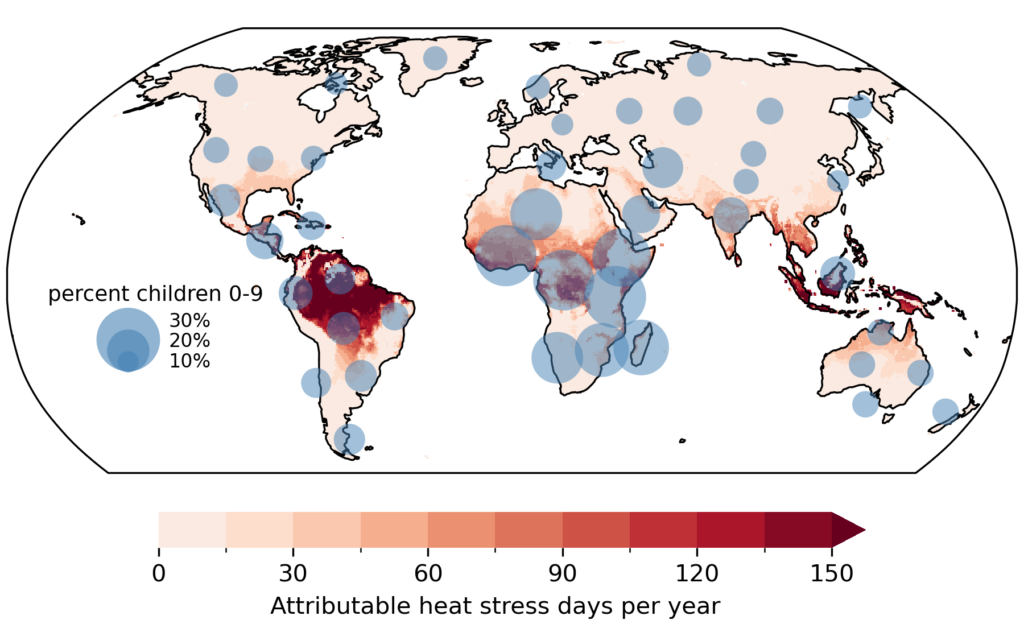
The spatial distribution of attributable heat-stress days reveals a stark geographic divide. Low-latitude, tropical nations absorb the vast majority of the additional thermal burden, while higher-latitude, wealthier nations experience far fewer humid heat days.
Regional Disparities in Exposure
Côte d’Ivoire: Residents currently face an average of 112 heat-stress days every year, with approximately half of those days directly attributable to human-induced climate change.
Germany: By contrast, Germany registers an average of just 0.1 heat-stress days per year under present-day conditions—a figure entirely driven by anthropogenic warming, yet quantitatively minuscule compared to the realities faced by the Global South.
Rosa Pietroiusti, a PhD student at Vrije Universiteit Brussel and lead author of the study, explains that while European figures may appear surprisingly low, they reflect the strict focus on sustained humid heat levels that remain rare across temperate Europe. Furthermore, she notes that standard climate models do not fully capture the urban heat island effect due to data resolution limits, meaning local realities in dense cities are often even more severe than macro-models suggest.
Demographic Vulnerability: Why Children?
The study’s demographic mapping uncovered two primary drivers behind why children under 10 bear the heaviest burden:
Global Age Structure: There are significantly more young people alive today than older individuals. Globally, there are approximately 1.3 billion children under the age of 10, compared to roughly 0.6 billion adults aged 60 to 69.
Population Growth Centers: Populations in sub-Saharan Africa and parts of Asia are growing rapidly and maintain a high proportion of young children. Conversely, many cooler northern-hemisphere nations have aging populations.
Consequently, the numbers are staggering: 583 million children under 10—representing 44% of that global age cohort—already live through at least 20 attributable heat-stress days every year. For comparison, 190 million people aged 60 to 69 (or 30% of their cohort) face the same frequency of extra heat days.
Official Statements & Expert Perspectives
The methodology and implications of the study have drawn widespread attention and nuanced commentary from international climate and health researchers.
Praise for Methodological Rigor
Dr. Qinqin Kong, a postdoctoral researcher in medicine and health policy at Stanford University who was not involved in the study, praised its robust approach.
"The research provides timely quantitative evidence for discussions of climate justice, children’s rights, and intergenerational equity," Dr. Kong noted.
However, Dr. Kong also offered a critical counterpoint regarding elderly vulnerability, suggesting the paper may occasionally understate risks for older demographics.
"The elderly may also be more vulnerable due to their social circumstances. Children often benefit from parental supervision and caregiving, whereas many older adults live alone, have limited mobility, and face barriers to accessing cooling or emergency assistance during heat events."
Furthermore, Dr. Kong highlighted that mid-latitude societies in North America and Europe possess lower physiological heat acclimatization, minimal air conditioning penetration in older housing stock, and urban designs that inhibit heat dissipation, elevating their relative mortality risks during sudden heatwaves.
Behavioral Adaptation and Data Gaps
Dr. Daniel Vecellio, a geographer at the University of Nebraska, pointed out that children represent a traditionally understudied cohort in physiological literature. However, he expressed cautious optimism regarding behavioral adaptability:
"Children are typically pretty good behavioral adapters to extreme heat," Vecellio observed, adding that populations chronically exposed to high temperatures develop superior long-term physiological acclimatization.
Lead author Rosa Pietroiusti emphasized that global disaster reporting databases (such as EM-DAT) historically skew toward wealthy nations, systematically underreporting heat-related crises in regions like Africa due to systemic data gaps and lower media visibility.
"Studies like this, which start from the climate data, can start to fill some of these gaps," Pietroiusti stated, reiterating that the core takeaway must center on climate justice: "Children in developing countries, who are most severely affected by the increase in heat-stress days, have contributed the least to historical greenhouse gas emissions."
Future Outlook: Projections for 1.5°C and 2.0°C Worlds
Looking ahead, the research team modeled future exposure trajectories using the Shared Socioeconomic Pathway (SSP2) demographic projections, which estimate global population peaking above nine billion in the latter half of the 21st century, concentrated largely in sub-Saharan Africa.
The projections present a sobering trajectory:
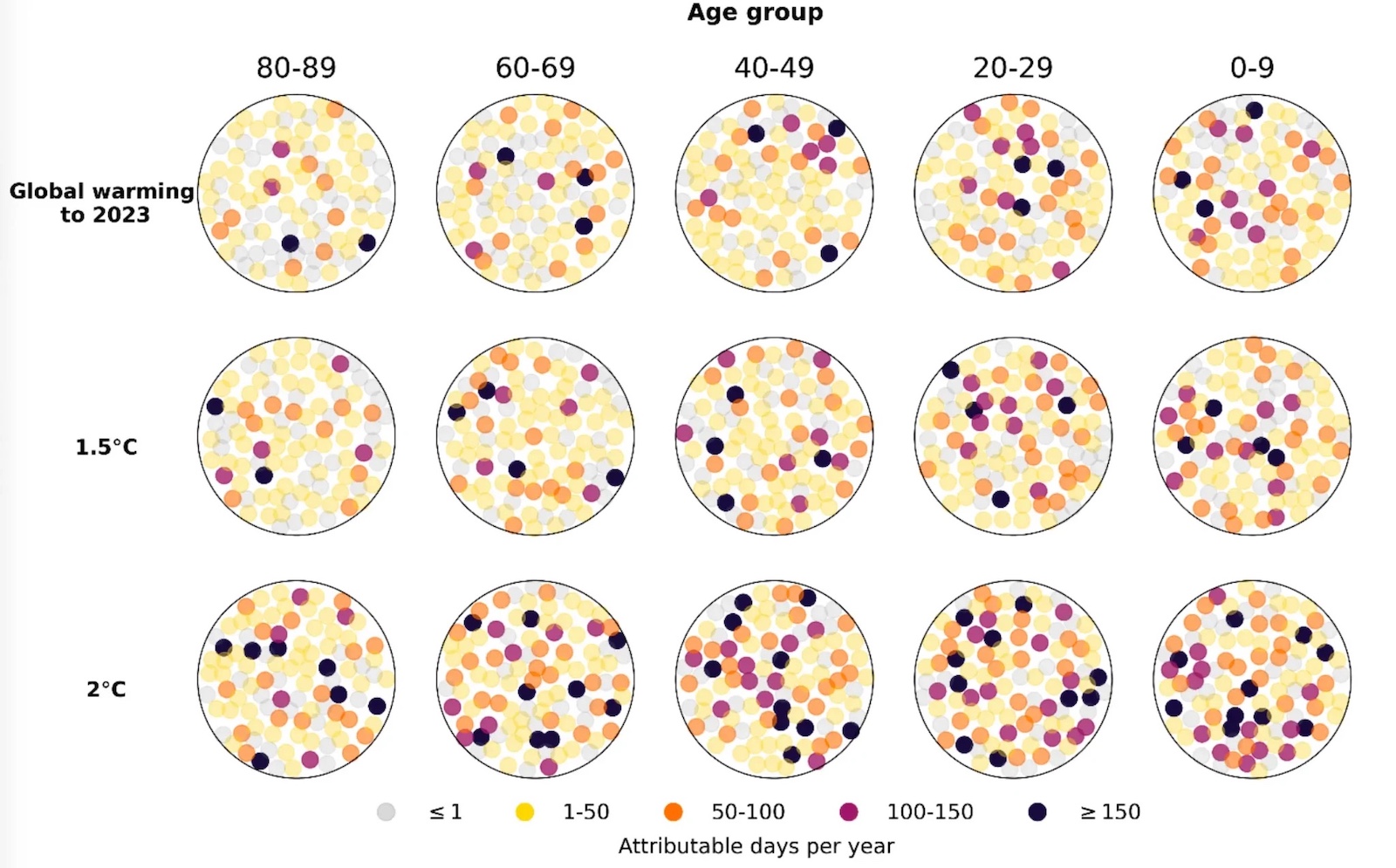
Extreme Exposure Rates: In today’s climate, 11% of children under 10 experience 100 or more extra heat-stress days annually due to climate change.
At 1.5°C of Warming: That figure climbs to 13% of all young children.
At 2.0°C of Warming: The percentage more than doubles compared to today, surging to 23% of all children under 10 enduring over 100 extra heat-stress days every year.
Elderly Projections: For adults aged 60–69, the proportion experiencing 100+ extra heat days rises from 6% today to 9% in a 1.5°C world and 17% in a 2.0°C world.
The Path Forward: Bridging Climate and Health Sciences
As the scientific community digests these findings, researchers emphasize that future work must bridge the gap between atmospheric modeling and public health epidemiology. Standard wet-bulb thresholds, while effective for meteorologists, were not originally calibrated to measure the specific developmental, cognitive, and educational impacts that children suffer during prolonged thermal stress.
Protecting the generations of tomorrow will require more than aggressive emissions reductions to keep global warming within safe boundaries. It demands targeted infrastructural investments in schools, urban greening, healthcare accessibility, and community cooling centers across the developing world—ensuring that those who contributed least to the planetary crisis are not left defenseless as the world continues to warm.