Executive Overview
The global automotive landscape is undergoing a profound structural shift. For over a decade, legacy automakers and pure-play electric vehicle (EV) manufacturers alike have wrestled with the friction points of the energy transition: consumer range anxiety, public charging infrastructure deficits, volatile battery material supply chains, and shifting regulatory incentives. While battery-electric vehicles (BEVs) represent the ultimate long-term destination for zero-emission mobility, the journey toward mass adoption has encountered formidable speed bumps.
Enter the Extended-Range Electric Vehicle (EREV)—a technology bridging the gap between internal combustion engine (ICE) vehicles and fully electric platforms. Long dismissed in Western markets as a transitional compromise, EREVs have exploded in popularity in China, driven by evolving regulatory mandates and consumer demand for uncompromised travel flexibility. Now, this once-niche powertrain architecture is staging a massive global comeback.
Major international automakers are rushing to incorporate EREVs into their multi-energy product portfolios. Most notably, Hyundai Motor Group has announced plans to introduce advanced EREV powertrains to the United States market, starting with the popular three-row Santa Fe SUV and expanding into its luxury Genesis brand. Hyundai is far from alone: legacy giants including Stellantis, Ford, and Volkswagen’s newly revived Scout brand are all placing heavy bets on extended-range hybrids.
This comprehensive report explores the genesis of the EREV category, the regulatory shifts in China that catalyzed its modern renaissance, Hyundai’s strategic pivot into the North American market, the broader competitive landscape, and the psychological and environmental hurdles that continue to shape the future of personal transportation.
Detailed Chronology: From the Chevy Volt to the Chinese Regulatory Boom
To understand the modern EREV, one must look back at the evolutionary history of electrified powertrains. For many years, automotive engineers experimented with conventional combustion engines supplemented by small electric motors and tiny batteries, creating the earliest iterations of "plug-in hybrids" (PHEVs).
The Early Compromise: Early PHEVs
A decade ago, early plug-in hybrid offerings—such as an early-generation offering from Audi—offered a paltry 8 miles of battery-only range. These vehicles were largely exercises in marketing compliance. They allowed legacy manufacturers to compete with the ubiquitous conventional hybrids popularized by Toyota, while offering a stepping-stone for buyers hesitant to leap straight into a pure EV. By skimping on battery capacity, automakers kept manufacturing costs and retail prices low, but the resulting vehicles offered the worst of both worlds: complex dual-powertrain maintenance with negligible zero-emission utility.
The true pioneer of the modern extended-range architecture was the Chevrolet Volt, introduced in the early 2010s. The Volt established the mechanical blueprint of the EREV: a vehicle driven exclusively by electric motors, with an onboard internal combustion engine serving solely as an electrical generator to recharge the battery pack when depleted, rather than driving the wheels directly. Despite its technical elegance, the market was not yet fully primed, and infrastructure lagged behind ambition.
The Chinese Regulatory Catalyst
While Western markets experienced fits and starts with electrification, China emerged as the crucible for modern EREV development. Facing massive urban air pollution and a desire to dominate the global automotive supply chain, Chinese regulators established stringent "New Energy Vehicle" (NEV) mandates.
Recently, Beijing recalibrated its incentive structures. Regulators decided to categorically exclude plug-in hybrids that could not travel at least 100 kilometers (62 miles) on battery power alone from lucrative NEV subsidies and perks. Notably, this range benchmark was established using China’s generous testing cycle. Translated to the stricter standards of the U.S. Environmental Protection Agency (EPA)—which typically yields range figures roughly 20 percent lower—the requirement equates to approximately 50 miles of pure electric range, mirroring the exact capabilities of the original Chevy Volt.
This regulatory nudge triggered an engineering revolution. Domestic Chinese automakers, led by giants like BYD, responded by engineering sophisticated new platforms. BYD recently introduced EREV models capable of traveling up to 1,300 kilometers (approx. 800 miles) on a combined diet of electrons and liquid fuel.

The defining characteristic of these modern Chinese EREVs—and the key differentiator from traditional PHEVs—is the decoupling of the engine from the drivetrain. In a traditional PHEV, the gas engine physically couples to the wheels via a complex transmission when power demands are high, and charges the battery during downtime. In an EREV, the wheels are always driven by electric motors. The internal combustion engine acts exclusively as a high-efficiency mobile power plant, spinning a generator to feed the battery pack. This delivers the smooth, instant torque and driving dynamics of a pure EV, entirely eliminating transmission shift shock while retaining infinite refueling flexibility.
Supporting Context & Metrics: Hyundai’s U.S. EREV Offensive
Capitalizing on the lessons learned in Asian markets, Hyundai Motor Group has officially decided to join the EREV bandwagon, targeting North American consumers who remain hesitant to commit to pure battery-electric ownership.
The Hyundai Santa Fe EREV
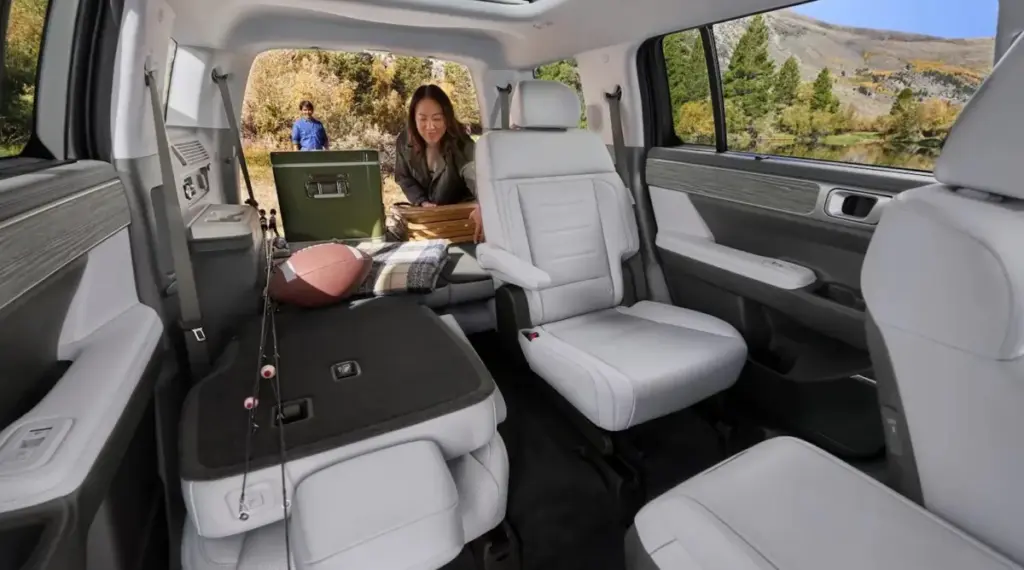
According to industry reports from Car and Driver, Hyundai’s maiden U.S.-bound EREV powertrain will make its debut in the redesigned, three-row Santa Fe SUV.
- Powertrain Layout: A dual-motor configuration featuring an electric motor on both the front and rear axles, delivering standard all-wheel-drive (AWD) capability.
- Performance & Range: Hyundai claims the Santa Fe EREV will deliver acceleration characteristics indistinguishable from a fully electric vehicle, paired with a staggering combined driving range of over 600 miles on a full tank of gas and a charged battery.
- Production Footprint: Unlike imported models, the Santa Fe EREV is slated for domestic production in the United States, likely rolling off the same assembly line in Alabama that currently builds the gas-powered and traditional hybrid variants of the SUV.
The Genesis Luxury Expansion
Hyundai’s luxury subsidiary, Genesis, will also integrate the EREV architecture into its vehicle lineup. While Genesis announced a traditional GV80 Hybrid recently, the brand’s first true EREV application is expected to be the compact GV70 luxury SUV.
While it remains to be seen whether the Santa Fe and GV70 EREVs will share identical powertrain components or feature distinct engineering calibrations, the Genesis iteration is projected to boast an even more impressive combined range of 640 miles. Unlike its mass-market stablemate, the Genesis GV70 EREV is currently scheduled for production in Ulsan, South Korea.
Strategic Roadmap to 2030
Hyundai’s pivot toward extended-range technology is part of a broader, highly calculated electrification roadmap. The company has publicly committed to introducing 10 new conventional hybrid models to the U.S. market by 2030. By that milestone, Hyundai projects that hybrid and electrified variants will account for 50 percent of its total global sales volume.
To support this massive product diversification, Hyundai is scaling its industrial footprint, announcing plans to expand production capacity across its North American manufacturing facilities by an additional 500,000 units annually by 2030.
Furthermore, Hyundai is actively developing utility vehicles tailored to rugged lifestyle segments. Following the positive reception of the Boulder concept truck revealed at the New York Auto Show, the automaker is aggressively eyeing the lucrative body-on-frame SUV and pickup truck markets—segments currently dominated by internal combustion legends like the Ford Bronco and Jeep Wrangler.
Official Statements & Industry-Wide Adoption
Hyundai’s aggressive bet on EREVs is emblematic of a broader industry consensus. Automakers that once promised an unyielding, accelerated march toward 100% BEV lineups are now exercising pragmatic flexibility, acknowledging that consumer adoption curves vary wildly across global regions.
Stellantis, Ford, and Scout Enter the Fray
Other automotive titans are actively developing their own proprietary EREV architectures to capture market share among utility and truck buyers:

- Stellantis has confirmed an advanced EREV powertrain currently in the pipeline. It is expected to make its commercial debut in the opulent Jeep Grand Wagoneer, followed shortly by the heavy-duty Ram 1500 REV pickup truck, offering unprecedented towing range without sacrificing electric drive performance.
- Ford Motor Company is reportedly engineering an extended-range hybrid truck platform. This strategic pivot comes as Ford recalibrates its electric truck strategy in the wake of shifting market demand for the F-150 Lightning.
- Scout Motors, the newly minted, independent electric vehicle division under Volkswagen Group, is exploring EREV powertrains as a core range-extending option for its highly anticipated Traveler SUV and Terra pickup truck. Early data from Scout indicates that pre-orders are skewing heavily in favor of the plug-in option, underscoring consumer demand for physical liquid fuel backups.
Industry analysts note that these legacy players are utilizing EREVs as a financial and operational bridge. By deploying smaller battery packs than those required for 300+ mile BEVs, automakers can insulate themselves from the cost volatility of critical minerals like lithium, cobalt, and nickel while still meeting stringent corporate average fuel economy (CAFE) standards and emissions regulations.
Future Outlook: Overcoming Range Anxiety and the Psychological Roadblock
Despite the engineering brilliance and commercial promise of extended-range electric vehicles, a profound psychological barrier remains embedded within the motoring public: range anxiety.
The Psychology of Refueling
Will EREVs finally allow consumers to overcome their lingering anxieties regarding electric mobility? Industry pundits offer a guarded "maybe."
While EREVs provide a seamless psychological safety net—guaranteeing that a motorist can simply pull into a conventional gas station if public chargers are broken, occupied, or nonexistent—the act of plugging in a vehicle on a nightly basis still presents a cultural hurdle for many traditional drivers.
Consider the everyday experiences of average suburban motorists. Many vehicle owners express immense satisfaction with traditional, non-plug-in hybrids that achieve 40 miles per gallon. While such efficiency gains are commendable, their enthusiasm frequently wanes when confronted with the economics of pure electric drive. A comparable battery-electric vehicle often yields efficiency metrics equivalent to 120 miles per gallon (MPG-e), translating to dramatically lower annual fueling expenditures.
Yet, translating these financial savings to the average consumer is notoriously difficult. Many buyers experience cognitive dissonance when contemplating a vehicle that never visits a gas pump. For generations, stopping at a service station has been an intrinsic ritual of car ownership; altering that deeply ingrained habit proves remarkably stubborn, even when the financial and operational incentives to change are overwhelmingly clear.
The Macro Crisis: Climate Realism vs. Consumer Apathy
Stepping back from dealership metrics reveals a sobering macroeconomic reality. Automotive executives tasked with forecasting multi-billion-dollar product pipelines walk a tightrope, attempting to decode fickle consumer preferences while complying with a fragmented, frequently contradictory web of international regulations.
However, a more profound crisis looms in the background of corporate boardrooms. Empirical observations suggest that virtually no retail car buyer factors the fate of the Earth’s climate into their purchasing calculus. Despite escalating climate anomalies—ranging from catastrophic urban wildfires and unprecedented marine heat waves to collapsing polar ice sheets—the visceral realization that the global ecosystem is in acute peril has failed to alter mainstream consumer behavior.
For the average buyer, purchasing decisions remain tethered to traditional metrics: upfront purchase price, monthly financing rates, fuel economy, cargo capacity, and brand prestige. As global temperatures continue to shatter historical records, automakers are forced to meet consumers where they are, using technologies like the EREV as a pragmatic compromise.
Whether extended-range electric vehicles will act as the ultimate catalyst for global fleet decarbonization—or merely serve as a comfortable half-measure delaying the inevitable transition to sustainable energy—remains to be seen. What is certain, however, is that the automotive industry’s roadmap for the next decade will be paved with electrons, molecules, and an unwavering quest to conquer range anxiety once and for all.