KATHMANDU, Nepal — In the high-altitude Himalayan valleys of Nepal, the air is thick with the smell of wet earth, pulverized stone, and the quiet despair of families waiting by riverbanks. Weeks after a catastrophic glacial collapse unleashed an unprecedented wall of water and debris across Nepal and Tibet, rescue operations have entered a grueling, high-stakes phase.
Among the frontline responders is Manish Maharjan, a professional filmmaker turned volunteer drone pilot. Working alongside the Nepal Army, Maharjan has spent days navigating the jagged canyons and devastated river basins, using thermal-imaging drones and unconventional tactics—such as playing music and broadcasting voice messages over mounted speakers—to coax survivors from remote hillsides.
Yet, as the immediate search transitions into a subterranean nightmare, Maharjan’s ingenuity faces its sternest test. Hundreds of workers are believed to be sealed inside deep-mountain power plant tunnels, entombed by millions of tons of thick, compacted silt. The disaster, which has claimed more than 1,000 lives and left thousands more missing, has exposed the raw vulnerability of Himalayan infrastructure in an era of rapid climate change.
Executive Overview
The flash floods of late August 2026 stand as one of the deadliest natural disasters in the recent history of the Himalayan region. Triggered by a sudden glacial lake outburst flood (GLOF) high in the mountains of Tibet and northern Nepal, the torrent roared down narrow gorges with terrifying velocity. It pulverized vital transportation networks, sweeping away bridges, highways, and entire settlements before slamming into critical energy infrastructure.
At the epicenter of the post-disaster crisis are 12 major hydropower projects scattered across Nepal’s rugged terrain. At least 900 workers remain unaccounted for across these sites, with approximately 500 believed to be trapped deep inside subterranean power plant tunnels and penstocks.
As rescue teams grapple with unprecedented logistical nightmares, advanced technology has become both a lifeline and a limitation. Thermal drones, acoustic locators, and heavy excavation machinery are being pushed to their absolute limits. But as golden hours fade into weeks, authorities and families alike confront the agonizing reality that time—and oxygen—has nearly run out.
Detailed Chronology: The Anatomy of a Catastrophe
The Pre-Dawn Rupture (August 26)
The disaster began silently, miles above human habitation, when an unstable glacial lake breached its moraine wall. Millions of cubic meters of frigid water cascaded down steep rock faces, scouring the valley floors and picking up massive loads of boulders, trees, and loose soil. The resulting debris flow transformed rivers into moving walls of concrete-like slurry.
Initial Impacts and Desperate Calls
As the wall of water struck the low-lying river valleys, it overwhelmed early warning systems. Hydropower stations, strategically built in deep gorges to maximize water pressure and drop, lay directly in the path of destruction.
According to Mohan Kumar Dangi, president of the Independent Power Producers’ Association, a handful of workers managed to make frantic, final phone calls to supervisors just as the floodwaters breached the facility gates. These workers sought refuge inside intake tunnels and maintenance shafts, believing the concrete structures would protect them from the deluge. However, the sheer volume of silt and mud that followed quickly sealed off escape routes, turning safe havens into subterranean tombs.
Mobilization of the Nepal Army and Civil Defense
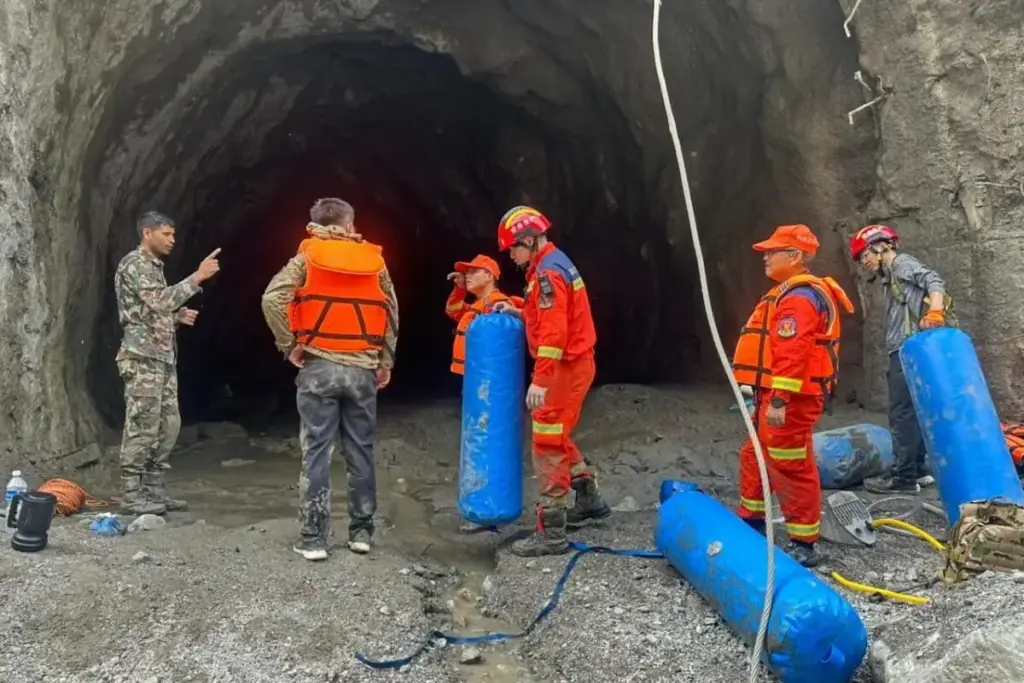
Within 24 hours of the disaster, the Nepal Army mobilized specialized search-and-rescue units, deploying heavy earthmoving equipment, sniffer dogs, and specialized engineering squads to the worst-hit districts, including Upper Trishuli and Rasuwa.
It was during this initial mobilization that civilian specialists like Manish Maharjan integrated into the military-led command structure, bringing commercial and thermal drone capabilities to regions deemed too unstable for ground crews.
The Subterranean Search (Late August – Present)
By August 31, rescue efforts had shifted focus from surface sweeps to deep-tunnel exploration. Using specialized long-range drones equipped with thermal sensors and high-powered LED arrays, pilots like Maharjan began probing the dark, narrow confines of the hydropower tunnels. Despite navigating several hundred meters deep into structures like the Rasuwagadhi hydropower project, missions have repeatedly returned empty-handed, hindered by complete structural blockages.
Supporting Context & Metrics: The Scale of the Devastation
To understand the immense scale of the rescue challenge, one must examine the metrics and environmental factors driving the crisis:
Death Toll: Confirmed fatalities have surpassed 1,000, making this one of the deadliest climate-related disasters in South Asian history.
Missing Persons: Estimates suggest that upwards of 900 workers remain missing, with nearly 500 believed trapped inside subterranean tunnels across 12 different hydropower sites.
Infrastructure Damage: Major damage has been sustained by roads, suspension bridges, transmission lines, and 12 major run-of-the-river hydropower installations.
The "Toothpaste" Phenomenon: Unlike normal flooding, glacial outburst floods carrying heavy glacial flour (finely ground rock) create a slurry that fills confined spaces with dense, high-pressure mud. When it enters a tunnel and settles, it packs as solidly as industrial cement, leaving virtually zero air pockets or void spaces for human survival.
The Drone Pilot’s Perspective: Engineering Meets Despair
Operating a drone in an open sky is vastly different from piloting one inside a concrete conduit buried deep inside a mountain. Maharjan describes the process as a psychological and technical tightrope walk.
"We found tunnels were filled with mud like toothpaste in a tube," Maharjan said during a brief respite from operations. "There was no hollow or empty space inside."
Before shifting to subterranean searches, Maharjan utilized creative psychological tactics on hillsides where survivors were suspected of clinging to trees or rocky outcrops.
"We used microphone speakers to call out to them. In some places, we even played songs and then waited for a response," he explained. "That worked in a few cases and helped us locate people who were stranded without food or water for days."
However, inside the tunnels, these tactics are useless against solid walls of silt. Maharjan notes that his thermal drones can only operate in straight, unobstructed corridors. The moment a tunnel bends, turns, or zigzags—a standard design feature in complex hydro-engineering to control water flow—radio signals drop, and manual line-of-sight flying becomes impossible.
At the Rasuwagadhi project, Maharjan flew a drone to the absolute physical limit of the tunnel. The camera revealed nothing but a wall of gray sludge stretching as far as the lens could see. "We checked repeatedly, but it was filled with mud and debris," he said. "Looking at it, I could only imagine the force of the flood."
Official Statements and Industry Response
The catastrophe has sent shockwaves through Nepal’s energy sector, which has heavily promoted hydropower as the cornerstone of the nation’s economic independence and green energy export ambitions.
Mohan Kumar Dangi of the Independent Power Producers’ Association voiced deep grief over the missing workforce, highlighting the difficult balance between national development and ecological hazard.
"Our priority right now is finding our people," Dangi stated in an address to local media. "Families are demanding answers, and the psychological toll on the workforce and management is unimaginable. These workers are the backbone of our renewable energy infrastructure."
Military spokespersons for the Nepal Army have reiterated their commitment to leaving no stone unturned, though commanders openly acknowledge the severe physical limitations of manual and mechanical excavation. Heavy bulldozers and excavators are currently battling unstable mountain slopes just to clear the entrances of the tunnels, while engineering teams work around the clock to shore up unstable overhangs that threaten to trigger secondary landslides.
International geological and climate experts have also weighed in, pointing out that the disaster underscores a terrifying new reality for the Himalayas. As global temperatures rise, retreating glaciers leave behind unstable moraine dams containing massive volumes of water. When these natural dams fail, the resulting floods defy traditional disaster preparedness models, catching engineers and downstream communities completely off guard.
Future Outlook: A Reckoning for Himalayan Infrastructure
As the rescue phase gradually transitions into recovery, government officials, engineers, and environmental scientists are facing difficult questions about the future of development in the world’s highest mountain range.
1. The Human and Economic Toll
The loss of hundreds of skilled laborers and technical personnel is a devastating blow to Nepal’s expanding energy sector. Rebuilding the damaged plants will take years and cost hundreds of millions of dollars, throwing national energy self-sufficiency targets into disarray. Furthermore, the psychological scars left on local communities living downstream from major river systems will take generations to heal.
2. Policy and Engineering Shifts
Experts argue that future infrastructure projects in the Himalayas must undergo a radical overhaul in design and siting:
Relocation of Control Infrastructure: Powerhouses and residential quarters, often built dangerously close to riverbeds to optimize hydraulic efficiency, may need to be moved to higher, safer elevations.
Advanced Early Warning Systems: Integrating real-time satellite monitoring of glacial lakes with automated sirens and smart-shutoff valves for hydro-dams could provide critical minutes of warning.
Tunnel Safety Protocols: Subterranean installations will require redesigned emergency escape shafts and reinforced blast doors capable of withstanding massive hydrostatic pressures and mudflows.
3. The Climate Change Imperative
Ultimately, the August 26 floods serve as a grim reminder that climate change is no longer a distant threat measured in degrees Celsius, but an immediate crisis measured in lives lost and communities displaced. As long as glacial lakes remain unstable under a warming climate, the communities and infrastructure clinging to Nepal’s riverbanks will remain on the front lines of a planetary emergency.
For now, however, the immediate focus remains locked on the dark, mud-choked tunnels of the Himalayas. Under the hum of rotor blades and the glare of military floodlights, rescuers continue their vigil—hopeful for miracles, yet bracing for the sorrow that comes with the passage of time.